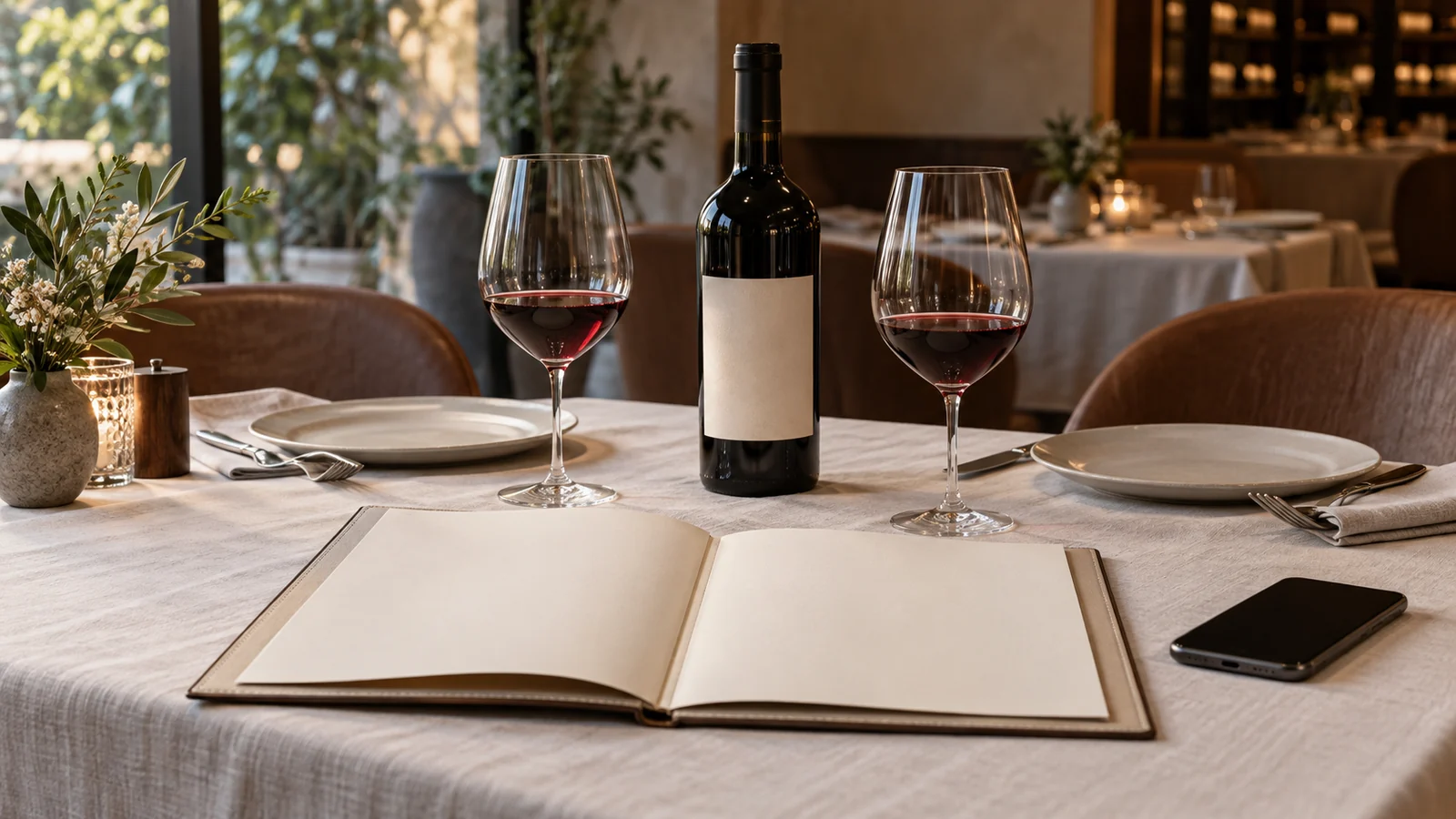
The wine list is open between two people.
One says, “I usually like reds.” The other remembers a bottle from last winter: lovely fruit, but a finish that felt too drying. Neither wants a lecture. They want something that works with dinner.
A phone can put a recommendation on the table in seconds. It can also put an impressively specific explanation beside the wrong wine.
The difference is not how confidently the sentence ends.
It is what happened before the sentence began.
In the previous Cellar Journal article, we asked what evidence sits behind a production claim. Now we turn that question toward the assistant making the recommendation—including our own.
A conversational AI cannot taste the glass in front of you. It can help interpret evidence, context and your preferences, provided it does not hide the gaps between them.
That is not an argument against using the technology. It is the starting point for using it well.
Can AI taste wine?
A conversation about a wine is not a sensory sample of it. An assistant receiving a photograph, a menu and your words has information about the bottle and your experience. It has not received the liquid, its aroma or the drying sensation you notice after swallowing.
That distinction does not mean machine-assisted sensory analysis is imaginary. Researchers have built electronic tongues that combine physical sensors with machine learning to classify liquid samples. The sensor has to interact with the sample; this is not a capability conferred on a phone by photographing a label. Liu and colleagues, 2024
A Bordeaux study classified estate origins using gas chromatograms from 80 wines across seven properties. That is sample-based chemistry, not recognition from menu images or a prediction of pleasure. The finding belongs to its tested wines and task. Schartner and colleagues, 2023; correction, 2024
A measurement, a classification and a personal recommendation answer different questions.
An assistant does not need to confuse them to be useful.
The useful work happens between the question and the choice
A wine assistant can help organize a problem that has become too large for the moment: unfamiliar names, several plausible options, a dish arriving soon, and preferences that are easier to express in ordinary language than in a tasting grid.
A sensible design separates three jobs. Find the relevant evidence. Compare the available choices. Explain the proposed fit. Those jobs may use different software components; not every recommendation engine is a language model, and not every fluent chatbot has a dependable recommendation system behind it.
Wine research illustrates what learning from evidence can mean. WineSensed combined labels and reviews with a tasting experiment involving 256 participants. The sensory relationships came from people comparing wines. A model could learn from those observations without having experienced the wines itself. Bender and colleagues, 2023
A 2026 e-commerce study combined wine attributes, reviews and user relationships for 1,685 wines and 12,361 users. It reported improved recommendation-ranking metrics against its selected baseline. Those results support that particular approach; they do not establish how much a diner enjoyed a subsequently opened bottle. Liou, Hong and Cheng, 2026
The opportunity is substantial. The task still needs a name: identifying, retrieving, ranking and pleasing a person are not one interchangeable success measure.
First, make sure it is the right wine
Before interpreting a tasting note, establish what it belongs to.
Producer, cuvée, vintage, region, bottle size and wine category can all matter. A familiar producer name is not permission to substitute a different cuvée. A missing year is missing information, not an invitation to borrow the most convenient vintage.
Here is a deliberately simple example: a menu lists a producer and village but omits the cuvée. A database contains three possible matches. Choosing the first one and attaching its detailed tasting note makes the answer look richer while making its foundation weaker.
A better response preserves the ambiguity: “I found several possible bottlings. The broad style is a useful starting point, but the exact cuvée needs confirmation.”
Identification also stops short of condition. AWRI describes circumstances in which Brett-related character can vary among bottles through differences in cells, closure or storage. A catalog entry does not inspect the particular bottle a server is about to open. AWRI
Likewise, appearing on a menu does not confirm tonight’s stock. A retailer’s listing does not establish nearby availability. These are separate checks, not details that more elegant prose can supply.
The record describes a wine; it does not inspect this bottle.

A source is useful only when it supports the sentence
A producer sheet for the right vintage can support a blend or maturation detail. An independent tasting note records someone’s sensory observation. Your journal records yours. A regional description provides broader context. None should silently impersonate another.
Research with wine and coffee experts found a modest, domain-specific advantage in aroma communication among wine experts, not universal naming accuracy. Professional language is valuable evidence—not an infallible chemical readout. Croijmans and Majid, 2016
This is where retrieval can help. The original retrieval-augmented generation research combined a language model with externally retrieved passages and improved factual language generation against its tested baseline. It did not establish that every retrieved page is correct or that every later system using retrieval is reliable. Lewis and colleagues, 2020
Nor is connecting a wine catalog the same operation as training a model on that catalog. A system may consult records when answering without those records having been used to change the model during training. Product language should say which arrangement is actually in use. IBM’s explanation
NIST’s generative-AI risk profile identifies confidently presented false content, including misleading supporting material, as a risk to manage. NIST, 2024
At the table, the safeguard is practical: a citation should lead to the relevant claim, for the relevant wine, with its limitations intact. Three copied merchant descriptions are not automatically three independent observations.
A source is not decoration at the end of a persuasive paragraph.
Your palate is a working hypothesis, not a permanent label
“I like reds” is an invitation to ask a better question.
Perhaps the person means fresh fruit, moderate weight and gentle tannin. Perhaps they mean richness, dark fruit and a firm finish. Those are different starting points, even before dinner enters the conversation.
Our preferred approach is to use a few concrete contrasts: fresh or very ripe fruit; gentle or firm grip; discreet or obvious oak; familiar or exploratory. These are editorial suggestions for a useful conversation, not a validated diagnostic quiz.
A profile built from a few answers should remain provisional. The next useful observation may correct it. “Too dry” may refer to little sweetness, a drying texture, or simply a word the guest has borrowed. Ask which sensation they mean before turning it into a permanent preference.
The occasion belongs beside the profile. Tonight’s dish, sauce, companions and desire to explore may justify a different suggestion from last time. In a restaurant, show the prices actually listed and respect any spending limit the guest gives. Do not silently import an old retail budget, or require a budget answer when the menu and request already permit a useful recommendation.
Someone ordering no alcohol deserves that request to be treated as a constraint, not outweighed by a high compatibility score. The reason for the request need not become part of the conversation.
Personalization should make room for the person who is here tonight.
A match score is not automatically a probability
Imagine a screen displaying 92/100 match. This is an illustrative number, not a measured result from our app.
It might summarize similarity between a wine profile and stated preferences. It might help order several candidates. Neither meaning automatically establishes a 92% chance that this person will enjoy this bottle.
Calibration asks whether estimated probabilities match observed correctness. Image and document classification experiments found that predictive strength did not ensure calibrated confidence. They did not test wine enjoyment. Guo and colleagues, 2017
For a wine service, ask what the score measures, which outcomes were checked and how missing information affects it. If a score is intended as an enjoyment probability, it needs validation against that outcome—not merely a percentage sign.
Keep three judgments apart: confidence in the bottle identification, strength of the supporting evidence, and estimated preference fit. A well-identified wine can be a poor match. An appealing style can be attached to an uncertain identification.
A match score can organize choices; it cannot tell you what you must enjoy.

An explanation should make disagreement easier
“This is perfect for you” closes the conversation too early.
“You said you prefer fruit without a strongly drying finish, and this looks closer to that preference” gives the person something to confirm or correct—provided the wine description is actually supported.
A readable explanation is still not proof that a system used the right evidence. A 2023 study found that the tested language models could produce plausible explanations while failing to disclose influences that changed their answers. The finding concerns those models and experiments, not a verdict on every current assistant. Turpin and colleagues, 2023
NIST’s explainability principles similarly separate providing an explanation from making it understandable, accurate and appropriately limited. NIST, 2021
The practical standard is not a long account of invisible computation. It is a short, checkable rationale: what information supports the choice, which preference matters, what trade-off remains and what could change the answer.
Consider this fictional service example. The verified descriptions of two wines on a menu characterize A as fruit-led with gentler tannin and B as firmer with more evident oak. The guest prefers less drying texture. Both prices are visible and neither conflicts with a stated limit.
A useful recommendation might say:
I would start with A because its documented style is closer to the gentler finish you asked for. B is the alternative if you prefer more structure tonight. I have not assessed the condition of either bottle; the server can confirm the available vintage.
This is not a transcript of a live app response or an actual tasting. It demonstrates a proposed standard: a clear choice without an invented certainty.
The guest can now say, “Actually, tonight I want the firmer one.”
That is not the recommendation failing. It is the conversation becoming more accurate.
Trust should follow evidence, not presentation
Wine is particularly good at showing how information can enter an experience. In a controlled experiment, presenting wines with different price information changed reported pleasantness. That does not mean pleasure was fake or that price always dominates; it means the surrounding message can matter. Plassmann and colleagues, 2008
An AI recommendation adds another message: a confident voice, a precise score, perhaps a polished virtual presenter. Those are reasons to inspect the evidence, not substitutes for it.
A 2026 paper on algorithmic expertise in wine proposes a conceptual framework connecting transparency, source framing and trust. It is a theory-building contribution, not a consumer trial proving that a particular interface causes better choices. Heussner and Hanf, 2026
For Ask Sommelier AI, the aim should be justified reliance, not the largest possible amount of trust. A useful system can say, “This is my strongest candidate,” and, in the same breath, “This detail remains unconfirmed.”
It should also distinguish a sensory recommendation from a sponsored position or commercial incentive wherever such arrangements exist. Transparency about the reason for placement belongs beside transparency about the wine.
Learning should not become a smaller world
“I bought it” is not the same feedback as “I enjoyed it.” “I enjoyed it” is not the same as “Please recommend nothing else.”
A simulation study showed how training recommenders on behavior already shaped by recommendations could make behavior more homogeneous without increasing utility. It was not a wine-drinking trial. Its relevance here is a design warning about learning from your own influence. Chaney, Stewart and Engelhardt, 2018
Our editorial response is to leave room for correction and exploration. Ask what worked: the fruit, texture, restraint, freshness, pairing or occasion. Ask what did not. Distinguish declining a recommendation from disliking the wine after trying it.
Do not train the guest to agree with the profile.
A useful recommendation learns from disagreement rather than explaining it away.

Memory needs permission and boundaries
Personalization is not a reason to collect everything a person might reveal.
Our standard is to explain what is remembered, why it helps, who can access it and how the person can correct or remove it. Saving a tasting preference, retaining a conversation, using an external provider and training a general-purpose model are different activities; one permission should not be treated as a silent substitute for all the others.
NIST’s Privacy Framework treats privacy as a risk-management concern in product and service design. It is voluntary guidance, not a certification that any wine app complies. NIST Privacy Framework
For Ask Sommelier AI, consult the current Privacy notice for the published policy. This article does not independently audit implementation or create new data-handling promises.
A person should not need to provide medical or religious details to have “no alcohol tonight” respected. Nor should someone else’s tastes, learned during a shared dinner, automatically become information to disclose to the next guest.
Remembering well includes knowing what not to assume.
The person at the table still matters
A server can check which vintage is actually in the cellar. A sommelier with the bottle present can inspect the closure, smell a fresh pour and discuss the dish. A diner can explain that an otherwise sound wine simply feels too firm.
An assistant operating remotely can support those conversations. It cannot replace the missing physical observation by writing more confidently.
This is not a contest in which either humans or software must win every task. A person may overlook a record; software may organize it usefully. Software may miss the situation; a person can clarify it. The useful arrangement makes those handoffs easier.
And hospitality includes an answer that contains no bottle at all. Declining alcohol, declining the recommendation or choosing something familiar does not make the guest a failed user.
The Six-Layer Trustworthy Recommendation
The following is Ask Sommelier AI’s editorial framework, not a certified test or evidence that every feature described is deployed. Its purpose is to make a recommendation inspectable without turning dinner into a software review.
1. Bottle evidence
Which wine and vintage are we discussing? Separate confirmed identity, attributed tasting notes, producer information and broader inference. Keep missing details visible.
2. Drinking context
What is being served, what is available and what does the person want tonight? Use the actual menu prices when provided. Respect explicit constraints without creating unnecessary questions.
3. Palate model
Which stated preferences or previous reactions matter? Treat them as revisable information. Ask for clarification when an everyday word could describe different sensations.
4. Uncertainty
Where could the recommendation change? Distinguish unknown identity, incomplete evidence, preference uncertainty and unobserved bottle condition. Do not bury them inside one impressive number.
5. Explanation
Give a clear pick, a supported reason and the relevant trade-off. Explain why a nearby alternative might suit a different preference. The explanation should let the person disagree intelligently.
6. Feedback
Record what the person actually reports, without rewriting it to fit the prediction. Preserve the option to explore, update preferences, withhold information or stop using the recommendation.
The chain is bottle evidence → drinking context → palate model → uncertainty → explanation → feedback.
No single layer can quietly do the work of all six.
The standard we set for Ask Sommelier AI
Our Manifesto puts personal palate and returning to the table ahead of performance for its own sake. This article translates that editorial intention into standards against which a recommendation can be questioned.
Those standards are not a claim that we have laboratory access to your bottle, a perfect matching algorithm or an independently validated success rate. Current capabilities must be supported by the released product and its documentation; planned improvements should remain identified as plans.
A service should test more than whether an answer sounds persuasive. Can it identify a difficult menu entry? Keep vintages separate? Connect a claim to the correct source? Respect an explicit restriction? Acknowledge an uncertain match? Revise the suggestion when the user corrects it? Those are proposed evaluation questions, not results we are reporting here.
The answer to “Why use an AI sommelier?” should therefore be practical: because it helps you make a choice with less confusion and more relevant information—not because it asks you to surrender judgment.
The last word belongs at the table
Return to the two people and the open wine list.
The useful answer is not necessarily the one with the most tasting adjectives. It is the one that connects a credible bottle description with the fruit one person enjoyed, the grip the other would rather avoid, and the dinner they are about to share.
Across this season, we have separated names from guarantees, methods from compulsory flavors, protection from certainty, and serving advice from ritual. AI deserves the same discipline. Its value lies in keeping those distinctions useful when a decision needs to be made.
The system can carry the evidence to the table. The final authority still belongs to the person holding the glass.
Choose, taste when appropriate, notice and revise. The technology has done its job when the conversation can return to dinner.
Frequently asked questions
Can an AI sommelier really taste my wine?
A conversational assistant working from text or images has not sampled your wine. Laboratory systems can analyze physical samples with sensors or chromatography, but those are different inputs and tasks—not an ability supplied by a label photograph. Liu · Schartner
How can AI recommend a wine it has not tasted?
It can compare descriptions, documented attributes and preference information. WineSensed demonstrates learning from human sensory comparisons; other research learns from reviews and user relationships. These routes support predictions or rankings, not direct sensory experience. Bender · Liou
Does a high match score guarantee that I will like a bottle?
No. Its meaning depends on how it was defined and evaluated. A compatibility score is not automatically a calibrated enjoyment probability, and neither measures the condition of a specific unopened bottle. Guo
Can a bottle photo tell the app whether the wine is corked or safe?
It cannot establish aroma or chemical safety from an ordinary label image. A visible problem may justify a question, but sensory descriptions, appropriate physical checks or analysis are different evidence. Do not use a match score as a safety assessment. AWRI
Will a wine app remember everything I say?
Do not assume that it does—or that it does not. Check the service’s current privacy notice and controls. Retention, personalization, sharing and model training are distinct questions. For this service, read the Ask Sommelier AI Privacy notice.
Should I follow the recommendation when I prefer another wine?
A recommendation should clarify a choice, not overrule a preference. Explain what appeals to you about the alternative, or simply choose it. That response can be useful feedback; it does not require an apology.
References
- Bender, T., et al. (2023). Learning to Taste: A Multimodal Wine Dataset. NeurIPS 36, Datasets and Benchmarks. Source / Fuente
- Liu, J., et al. (2024). Bioinspired integrated triboelectric electronic tongue. Microsystems & Nanoengineering, 10, 57. Source / Fuente
- Schartner, M., et al. (2023). Predicting Bordeaux red wine origins and vintages from raw gas chromatograms. Communications Chemistry, 6, 247. Source / Fuente · Author correction / Corrección (2024)
- Croijmans, I., & Majid, A. (2016). Not All Flavor Expertise Is Equal: The Language of Wine and Coffee Experts. PLOS ONE, 11(6), e0155845. Source / Fuente
- Liou, J.-H., Hong, Z.-Y., & Cheng, L.-C. (2026). Personalized wine recommendations in e-commerce: Integrating knowledge graphs and graph neural networks. Journal of Information Science, OnlineFirst. Source / Fuente
- Lewis, P., et al. (2020). Retrieval-Augmented Generation for Knowledge-Intensive NLP Tasks. NeurIPS 33. Source / Fuente
- Autio, C., et al. (2024). Artificial Intelligence Risk Management Framework: Generative Artificial Intelligence Profile. NIST AI 600-1. Source / Fuente
- Guo, C., Pleiss, G., Sun, Y., & Weinberger, K. Q. (2017). On Calibration of Modern Neural Networks. PMLR, 70, 1321–1330. Source / Fuente
- Turpin, M., Michael, J., Perez, E., & Bowman, S. (2023). Language Models Don’t Always Say What They Think: Unfaithful Explanations in Chain-of-Thought Prompting. NeurIPS 36. Source / Fuente
- Phillips, P. J., et al. (2021). Four Principles of Explainable Artificial Intelligence. NISTIR 8312. Source / Fuente · Official PDF / PDF oficial
- Plassmann, H., O’Doherty, J., Shiv, B., & Rangel, A. (2008). Marketing actions can modulate neural representations of experienced pleasantness. PNAS, 105(3), 1050–1054. Source / Fuente
- Heussner, J., & Hanf, J. H. (2026). AI and Consumer Perception of Expertise: A Conceptual Framework for Studying Algorithmic Trust in Wine Recommendations. Economia agro-alimentare/Food Economy, 28(1). Source / Fuente
- Chaney, A. J. B., Stewart, B. M., & Engelhardt, B. E. (2018). How Algorithmic Confounding in Recommendation Systems Increases Homogeneity and Decreases Utility. RecSys 2018. Source / Fuente · Author preprint / Prepublicación de los autores
- Australian Wine Research Institute. Brettanomyces — frequently asked questions, including in-bottle variation. Source / Fuente
- National Institute of Standards and Technology. Privacy Framework — overview. Source / Fuente
- Ask Sommelier AI. Manifesto. Source / Fuente
- Ask Sommelier AI. Privacy. Source / Fuente
- IBM. What is retrieval augmented generation (RAG)? Updated July 24, 2026. Source / Fuente