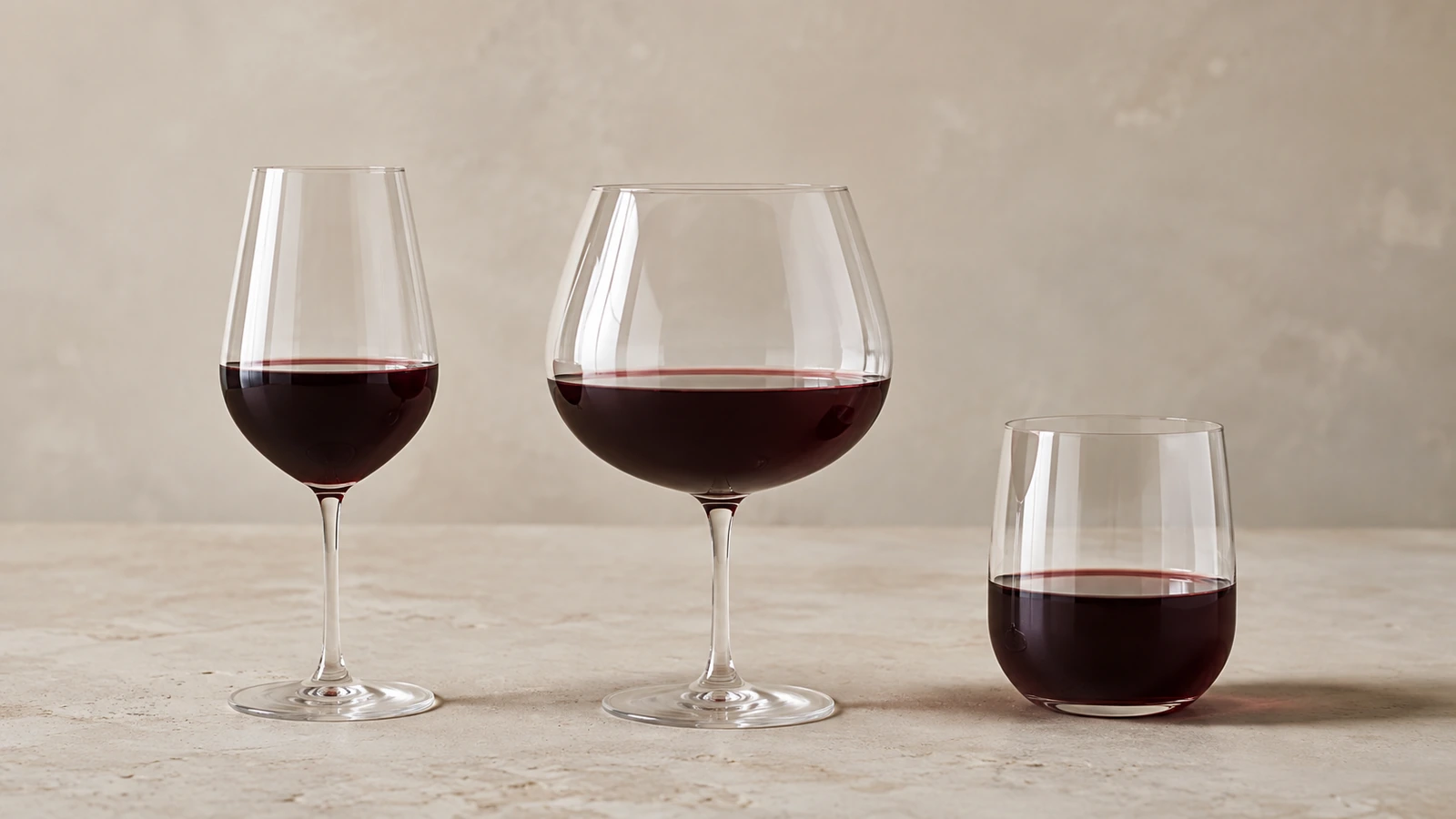
Three glasses stand in a row.
One is a restrained tulip: modest bowl, narrow opening, thin stem. The second is broad and generous, the kind of glass usually placed beside Pinot Noir. The third is an ordinary straight-sided tumbler.
The same bottle fills all three. The pours are equal. The wine entered each glass within seconds.
Yet the first nose feels precise. The second seems wider and more open. The third appears quieter at first, then warmer with alcohol as your face moves closer.
For a moment, it is tempting to believe that the glass has created three different wines.
It has not.
But it has created three different meetings with the same wine.
In our previous Cellar Journal article, we controlled the glass, light, background, and pour before interpreting red-wine color. This time, the glass itself becomes the variable.
The central idea: the glass does not rewrite the wine. It edits the encounter.
A wine glass is not an ingredient. It cannot place blackberry in Cabernet Sauvignon, remove acidity from Riesling, or manufacture elegance in a tired bottle. But it can change the physical space in which aromas gather and escape, the rate at which the wine warms, the way liquid reaches the mouth, the visual and tactile expectations surrounding the sip, and—over time—the wine’s exposure to air.
That is enough to matter.
It is not enough to justify every promise printed on a glassware box.
A wine glass is an interface
We often speak about glassware as decoration: crystal versus ordinary glass, Burgundy versus Bordeaux, stemmed versus stemless.
A more useful way to think about it is as an interface between wine and taster.
That interface controls or influences several conditions at once:
- the surface area of wine exposed to air;
- the volume and contour of the airspace above the pour;
- the diameter of the opening through which volatile compounds leave;
- the distance between the wine surface and the nose;
- the room available for swirling;
- the rate at which the wine warms in the hand and room;
- the angle and width of the sip;
- the glass’s weight, rim, clarity, and visual message.
The chemistry in the bottle has not been replaced. The route by which you encounter it has changed.
That distinction protects us from two equal mistakes.
The first is to declare that glass shape is pure theater.
The second is to treat each grape variety as if it possesses one geometrically ordained vessel without which the wine cannot speak.
The evidence supports a more interesting middle ground.
The liquid may be the same. The air above it is not
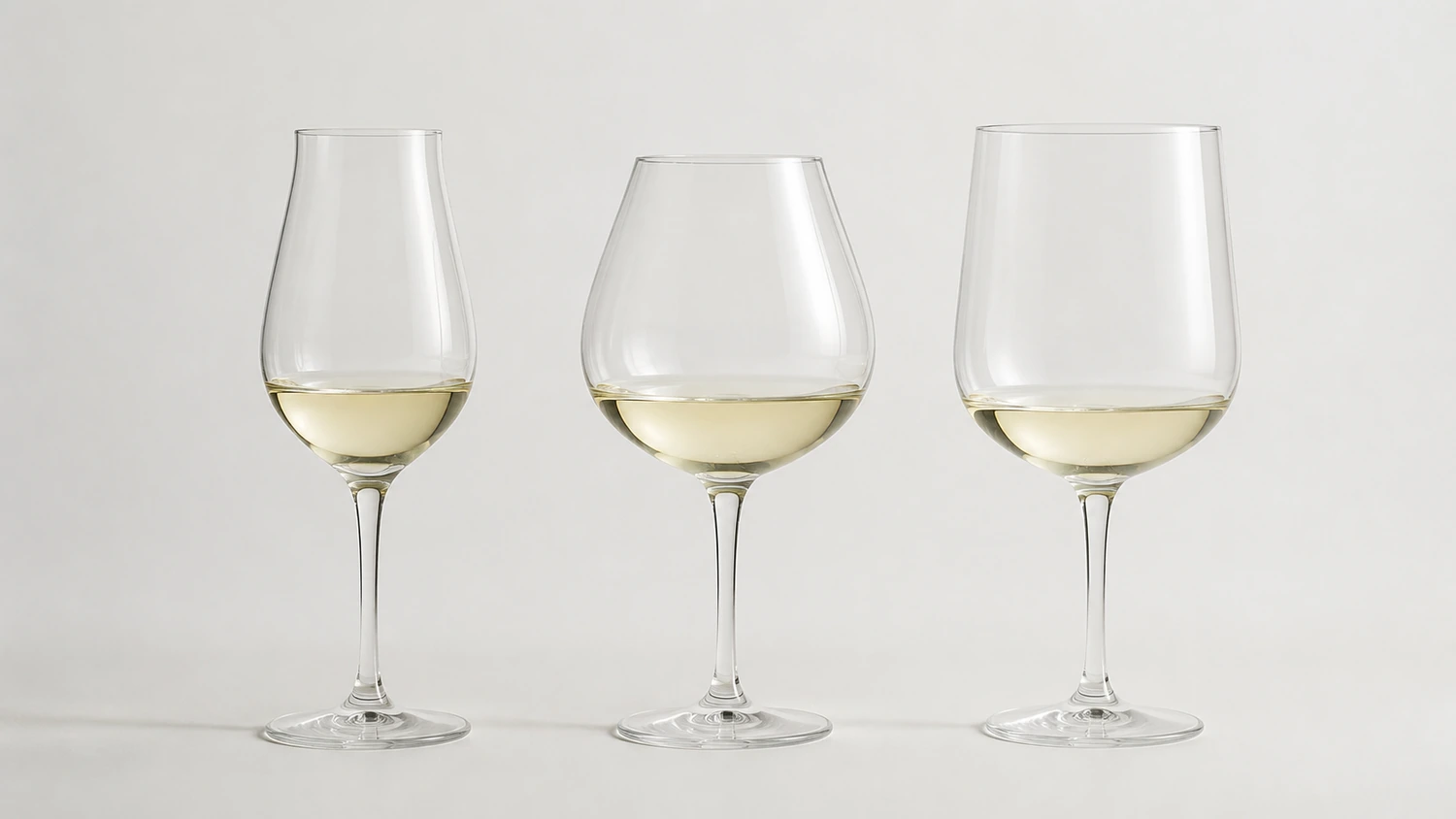
Wine aroma begins in the liquid, but orthonasal smelling happens largely in the headspace: the air between the wine’s surface and the rim of the glass.
Volatile compounds must leave the wine matrix, enter that space, travel toward the opening, and reach the nose in detectable patterns. They do not all escape at the same rate. Their behavior depends not only on volatility, but also on ethanol, sugar, glycerol, phenolic material, temperature, and interactions among components in the wine matrix (Robinson et al., 2009).
The headspace is therefore not a storage chamber holding a fixed copy of the bouquet.
It is a moving atmosphere.
Glass shape can change that atmosphere by altering the relationship among liquid surface, bowl volume, wall contour, opening diameter, and time. A controlled study of Gewürztraminer in five vessels found that headspace composition and sensory ratings changed with both glass shape and equilibration time. Shape had relatively little influence immediately after pouring, but more influence after five and ten minutes; different glasses emphasized fruitiness, total aroma, or a hotter ethanol character under different conditions (Hirson, Heymann & Ebeler, 2012).
The important phrase is under different conditions.
There was no single glass that simply made every desirable aroma larger at every moment.
Bowl, opening, and pour: the geometry is a relationship
A broad bowl can expose more wine surface and create room for a larger rotating film when the glass is swirled. A narrower opening may slow the escape of some vapors or guide a more concentrated portion of the headspace toward the nose. A small pour in a large bowl creates a different air-to-wine relationship than the same pour in a compact glass.
These are plausible physical effects.
They are not a universal formula.
In a blindfolded study of eighteen participants, Margaret Cliff compared an ISO tasting glass with Chardonnay- and Burgundy-style glasses. Perceived total aroma intensity differed by glass and was highest in the Burgundy glass in that experiment; intensity also correlated with the relationship between maximum bowl diameter and opening diameter (Cliff, 2001).
A different blindfolded study, using a California Cabernet Sauvignon and four glasses, found a subtler result: the Bordeaux glass was rated lower in total aroma intensity than the other vessels, while several sensory attributes correlated with glass dimensions (Delwiche & Pelchat, 2002).
More recently, a twelve-member panel evaluating Cabernet Sauvignon reported stronger and more elegant aroma in glasses with a shorter cup height and a larger ratio between maximum diameter and opening diameter (Bai et al., 2023).
Those findings make glass geometry worthy of attention.
They do not produce a law that says “larger bowl equals better wine” or “narrower rim always concentrates fruit.” The studies used different wines, glasses, volumes, panels, timing, descriptors, and statistical designs. Each volatile compound also behaves inside a complex wine matrix rather than as an isolated perfume molecule.
The useful question is not whether a glass is large.
It is how bowl, opening, pour, wine, temperature, motion, and time work together.
Time belongs inside the glass
A newly poured glass is not sensorially identical to the same glass ten minutes later.
During that interval:
- volatile compounds redistribute between liquid and air;
- some compounds leave the opening;
- the headspace develops spatial gradients;
- the wine approaches room temperature;
- oxygen enters and is consumed through reactions in the wine;
- swirling may renew the liquid film along the bowl.
Hirson and colleagues observed both chemical and sensory changes over a ten-minute period, with glass effects becoming more evident after equilibration rather than at the instant of service (Hirson, Heymann & Ebeler, 2012).
Imaging studies make the moving nature of headspace unusually visible. A 2015 “sniffer-camera” mapped ethanol vapor over three vessel shapes and found a distinctive ring of higher ethanol concentration near the rim of a wine glass at one tested temperature, with lower concentration toward the center (Arakawa et al., 2015). A 2025 laser-sensor study mapped gaseous ethanol in a Champagne glass and documented a footprint that evolved in both space and time and depended on temperature (Lecasse et al., 2025).
These experiments are physically revealing, but their limit matters.
They mapped ethanol, not the complete bouquet. They do not prove that one visible vapor pattern is universally more aromatic, more balanced, or more pleasurable.
They show something more fundamental:
Your nose is sampling an atmosphere that is changing while you taste.
What swirling actually changes
Swirling is often performed as if it were a ceremonial password.
Its physical purpose is simpler. Rotation spreads wine into a thin moving film along the bowl, renews the liquid-air interface, mixes the wine, and changes the exchange of gases and volatile compounds. It can make some aromas easier to notice, while also making ethanol or a fault more prominent.
But “more air” is not automatically “better wine.”
A preliminary study measured dissolved oxygen while white, rosé, and red wines were swirled in six glasses. Oxygen behavior depended on both wine and vessel, and the researchers did not find a simple correlation between basic glass dimensions and oxygen uptake. The ISO glass showed relatively low and stable dissolved-oxygen behavior within that experimental design (Parpinello et al., 2018).
This study does not demonstrate that a few seconds of swirling mature tannins, fixes reduction, or improves every wine. It demonstrates that swirling is a variable—and that glass comparisons become unreliable when one vessel receives a broad, forceful swirl while another receives almost none.
A useful tasting habit is therefore modest:
Swirl to compare, not to perform.
Use the same movement and timing in each glass. Smell once before swirling and once after. The difference between those two moments may teach you as much as the difference between the vessels.
Temperature can impersonate a glass effect
A broad stemless bowl held in the palm and a stemmed tulip held by the base do not necessarily keep wine on the same thermal path.
That matters because temperature changes both physical volatility and sensory perception. In controlled sensory work, serving temperature altered perceived aroma in red and white model wines (Ross & Weller, 2008). In a separate study of six Lemberger wines, samples served at cooler temperatures received fewer aroma descriptors and were described more often as astringent, sour, or bitter than the same wines at the warmest tested condition (Ross, Weller & Alldredge, 2012).
These findings should not be converted into one perfect serving temperature for every wine. They show why temperature must be controlled before giving all credit—or blame—to the bowl.
If Glass A is tasted immediately by the stem and Glass B is held for ten minutes around the body, the experiment is no longer only about shape.
It is also about heat and time.
The stem does not make wine more sophisticated.
It makes hand temperature easier to control.
The rim changes motion—not exclusive zones on the tongue
Glassware marketing sometimes claims that a particular rim directs wine toward the “sweet” part of the tongue while steering acidity or bitterness elsewhere.
That explanation depends on the old tongue map.
The strict map is wrong.
Taste sensitivity can vary modestly across regions of the mouth, but sweet, sour, salty, bitter, and umami are not confined to isolated territories. In a regional stimulation study, all tested taste qualities were perceived across the tongue; bitter and umami showed some anterior-posterior differences, while sweet, salty, and sour did not reproduce the mythical compartmental map (Feeney & Hayes, 2014).
A rim can still matter.
Its diameter, thickness, and angle can change how far you tilt your head, how wide the stream feels, how quickly the sip enters, how much liquid contacts the lips, and how aroma reaches the retronasal pathway after swallowing or exhaling. A thin rim may feel less intrusive than a heavy rolled edge. A broad opening can make the nose and mouth approach the glass differently from a narrow one.
Those are real interface effects.
They do not require imaginary sweetness zones.
What the sensory studies agree on—and where they do not
The glassware literature does not deliver one theatrical verdict. It delivers a pattern of conditional results.
| Study | What it found | What it does not establish |
|---|---|---|
| Cliff, 2001 | Blindfolded participants reported differences in total aroma intensity among three glass types; the Burgundy glass was highest in that experiment. | That Burgundy geometry is best for every wine or taster. |
| Delwiche & Pelchat, 2002 | Glass shape had a limited but measurable effect; the varietal-labeled Bordeaux glass was lower in total intensity for the Cabernet tested. | That a manufacturer’s intended pairing guarantees the strongest or preferred aroma. |
| Hummel et al., 2003 | Among 181 untrained participants, odor ratings differed by vessel, with bulbous forms often rated more intense; aesthetics did not explain the result. | Independence from commercial context: the study acknowledged support from Riedel Glas Austria. |
| Russell et al., 2005 | A twelve-member panel did not perceive differences among Merlot served in flute, Bordeaux, and Martini glasses over the tested intervals. | That glass never matters; this was one wine, three vessels, and a specific protocol. |
| Vilanova, Vidal & Cortés, 2008 | Nine trained tasters rated six Ribeiro “toasted wines” differently across nine glasses. | That the preferred glass for that unusual sweet-wine category generalizes to dry wines. |
| Hirson, Heymann & Ebeler, 2012 | Chemical headspace and sensory expression changed with glass and equilibration time. | A simple geometry rule or a timeless winner. |
| Bai et al., 2023 | A twelve-member panel detected shape- and volume-related differences in Cabernet aroma. | A universal one-glass-per-grape taxonomy. |
The studies differ because the experiments differ.
Wine identity, wine volume, bowl dimensions, opening, equilibration time, swirling, serving temperature, participant expertise, blinding, chosen descriptors, and statistical power can all change the outcome.
A responsible conclusion is therefore neither “the glass is magic” nor “the glass is irrelevant.”
It is this:
Glass shape can alter aroma delivery and sensory experience. The magnitude, direction, and preferred result depend on the wine, the vessel, the conditions, and the person tasting.
That sentence is less convenient than a shelf of glasses labeled by grape.
It is also closer to the evidence.
The ISO glass: a control, not a crown
Professional sensory work needs a repeatable vessel.
The international wine-tasting glass is defined by ISO 3591:1977, a standard last confirmed in 2022. Its cup is an elongated egg shape supported by a stem, with an opening narrower than the convex portion of the bowl. The design helps create consistent conditions and concentrate the bouquet for analysis.
Its greatest strength is not that it makes every wine beautiful.
It is that it makes comparisons fairer.
When every sample enters the same glass at the same volume and temperature, the vessel stops moving from one wine to the next. That is invaluable when judging faults, comparing treatments, or evaluating many samples.
But standardization is not the same as universal pleasure.
A glass chosen to reduce experimental variation may not be the vessel that makes a mature Burgundy feel most expressive at dinner. The fairest glass is not always the most flattering one.
That is not a contradiction.
It is a difference in purpose.
Sparkling wine poses a different problem
In still wine, the headspace is shaped mainly by evaporation, diffusion, convection, and movement. Sparkling wine adds a powerful transporter: carbon dioxide.
Bubbles carry gas and volatile compounds upward. Vessel geometry changes how much CO₂ accumulates near the nose and how quickly it disperses.
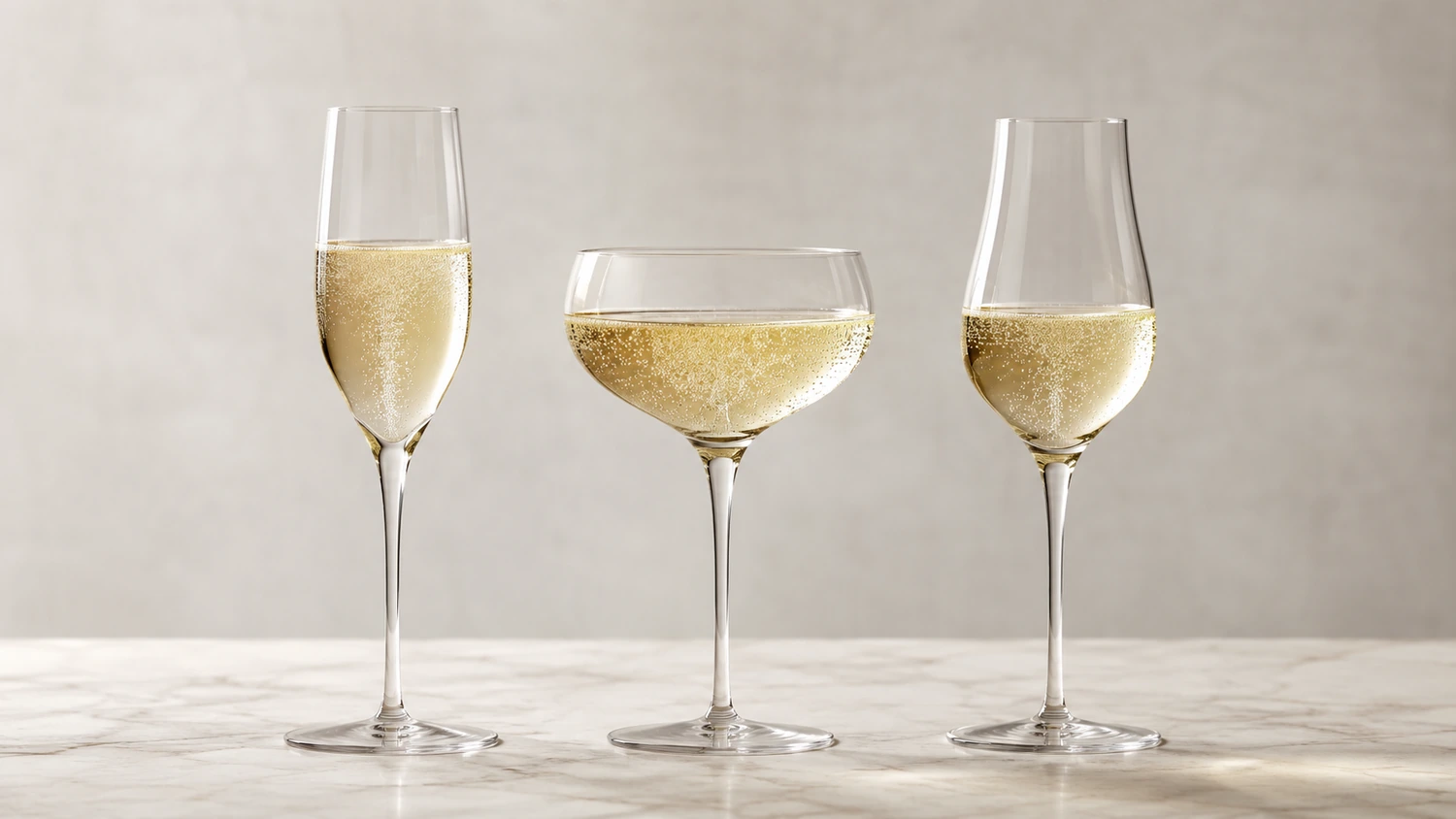
In a comparison of a flute and a coupe filled with Champagne, gaseous CO₂ remained substantially higher above the flute during the fifteen minutes after pouring. Lower wine temperature reduced ethanol vapor in the headspace, while the measured CO₂ pattern did not respond in the same way (Liger-Belair et al., 2012). A later laser-mapping study comparing two tulip-like tasting glasses also found glass-specific CO₂ footprints that changed with geometry, headspace volume, pour volume, and time (Alfonso et al., 2024).
These are gas measurements, not a decree that one glass tastes better.
A flute may maintain a visually concentrated column of bubbles and a higher gaseous-CO₂ environment near the rim, while also placing more irritating CO₂ near the nose. A coupe allows gas to disperse more rapidly and offers a broad opening, so its effervescence may feel less persistent. A tulip-shaped sparkling glass can offer bowl space with a narrower opening, creating a practical middle ground.
The right choice depends on the experience you value.
The science explains the trade-off.
It does not choose pleasure on your behalf.
Clear, clean, and quiet may matter more than expensive
Before buying a cabinet of varietal shapes, solve the unglamorous variables.
Clear
If you want to observe color, the glass should be colorless and optically clean. Tinted glass changes the visual evidence before tasting begins.
Clean
A trace of detergent, stale cabinet odor, polishing cloth, cardboard, or rinse water can overwhelm the subtle difference between two premium bowl geometries.
Quiet
A comfortable, stable glass with a rim that does not distract allows attention to remain on the wine. Thinness, balance, and weight can shape pleasure through touch, even when they do not alter the liquid’s chemistry.
Crystal is not an aroma generator.
A well-made crystal glass may achieve excellent clarity, thin walls, and elegant balance. An ordinary glass with sound geometry and no odor can still present wine beautifully. Material, workmanship, durability, and tactile refinement affect the experience; the word crystal does not prove sensory superiority by itself.
The most useful glass is often the one that disappears from attention without disappearing from function.
Perception is not the opposite of reality
A beautiful glass reaches the mind before the wine reaches the nose.
Its thinness, weight, sound, price, and reputation may suggest that the experience about to follow is careful, expensive, or important. Those expectations do not necessarily replace physical glass effects. They accompany them.
Hummel and colleagues attempted to separate shape from simple aesthetic appeal and found that the glass-related odor differences in their experiment were not explained by how attractive participants found the vessels (Hummel et al., 2003). That is useful evidence against dismissing every difference as imagination.
But context still matters.
In a wine study comparing clear glasses under white or red light with blue tasting glasses, the masking condition altered some judgments of spice, astringency, and liking among trained and consumer panels (Ross, Bohlscheid & Weller, 2008). Even a technique designed to remove visual bias can introduce a different sensory context.
Price can do something similar. In an fMRI experiment, participants tasted wines while being shown prices that did not always correspond to the liquid. Higher stated prices increased reported pleasantness and activity in a brain region associated with experienced pleasantness, even when the wine itself was identical (Plassmann et al., 2008). That was not a glassware study, but it demonstrates why prestige cues around a vessel cannot simply be treated as irrelevant.
This does not mean the experience is fake.
Perception is where chemistry, context, memory, and attention become wine.
The disciplined taster does not try to become free of perception. That would be impossible.
The goal is to know which parts of the encounter were controlled, which were suggested, and which remain personal.
What a glass can—and cannot—do
| A glass can plausibly… | A glass cannot establish or guarantee… |
|---|---|
| Change the size, shape, and dynamics of the headspace | That one proprietary form is universally correct for a grape |
| Change the distribution and escape of ethanol and some volatile compounds | That higher aroma intensity always means better balance or quality |
| Change dissolved-oxygen behavior during pouring and swirling | That a few swirls will mature tannins or repair a closed wine |
| Change the wine’s temperature trajectory | One exact ideal temperature for every bottle and taster |
| Change sip angle, rim feel, flow, and retronasal experience | Exclusive sweet, sour, or bitter zones on the tongue |
| Change visual and tactile expectations | That an expensive glass makes an inexpensive wine objectively superior |
| Make certain attributes easier or harder to notice | The wine’s origin, authenticity, age, or quality from vessel response alone |
The glass changes access.
It does not change pedigree.
The Six-Variable Glass Audit
Ask Sommelier AI uses the following editorial framework to separate a plausible glass effect from a casual comparison. It is a practical method, not a validated laboratory protocol.
| Variable | What to control | Why it matters |
|---|---|---|
| 1. Pour | Use equal, modest volumes from the same bottle. | Pour depth changes exposed surface and headspace volume. |
| 2. Geometry | Note bowl width, opening diameter, height, and distance from wine to rim. | Shape influences how the headspace forms and how the nose approaches it. |
| 3. Time | Pour within seconds and compare at the same intervals. | Aroma distribution, oxygen, and temperature evolve after service. |
| 4. Motion | Smell before swirling; then use the same gentle swirl in every glass. | Different motion renews the surface and can overwhelm the shape comparison. |
| 5. Temperature | Start equally; handle each glass the same way, preferably by stem or base. | Heat can imitate or obscure a glass effect. |
| 6. Observer | Blind or randomize the vessels when possible; record aroma and palate separately. | Brand, price, beauty, and expectation can influence judgment. |
The framework does not ask which glass is “correct.”
It asks whether the comparison was fair enough to teach you something.
Try the Same-Wine Glass Test
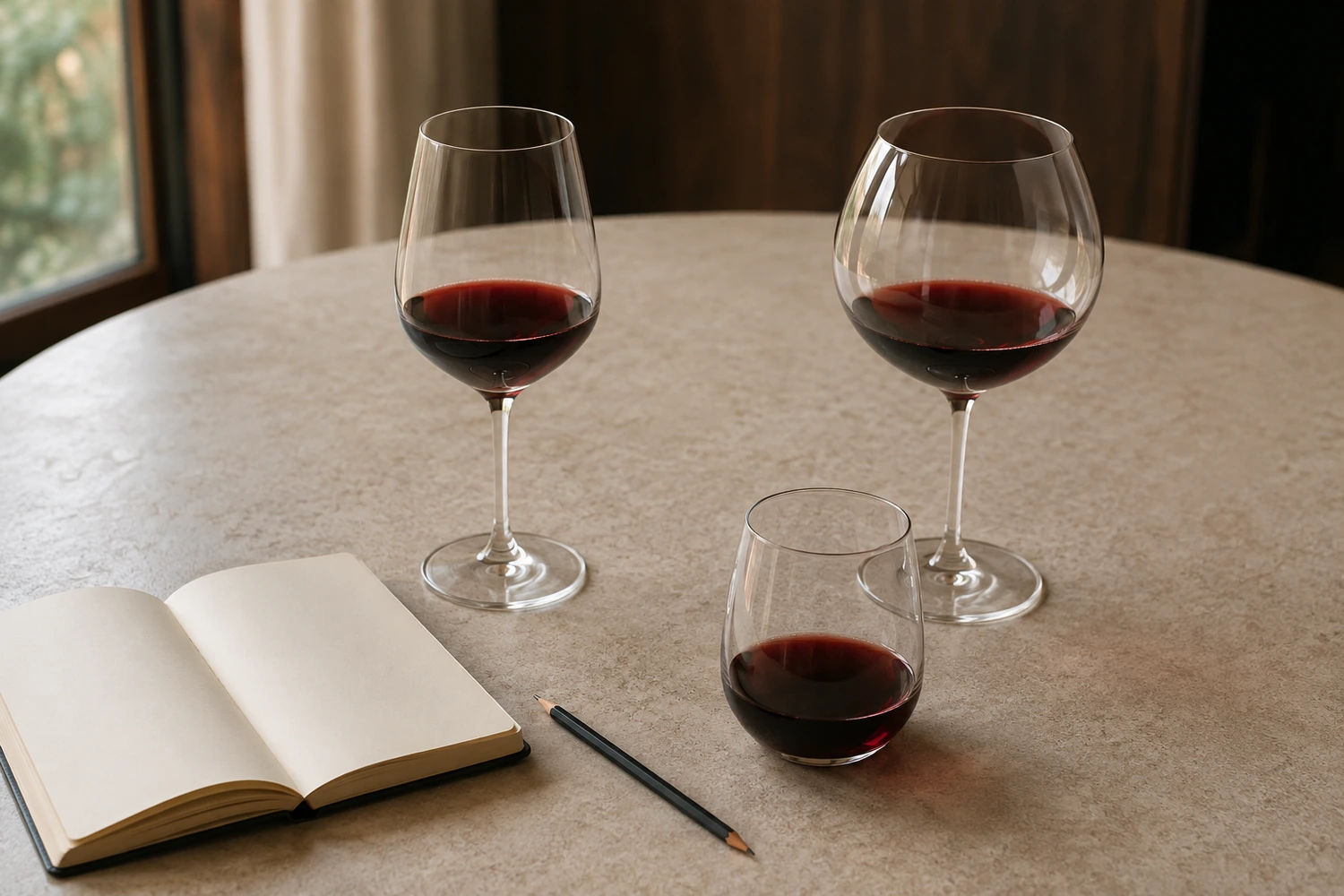
Choose three clean, clear vessels:
- one moderate tulip-shaped wine glass;
- one broader bowl with a generous opening;
- one straight-sided tumbler or simple restaurant glass.
Then:
- Pour the same modest amount into each—about 60 mL or 2 oz is convenient, but equality matters more than the exact number.
- Randomize their positions. Better still, ask someone else to place them while you look away.
- Smell each immediately without swirling. Record aroma intensity, fruit clarity, floral or herbal detail, oak, alcohol warmth, and overall integration.
- Give every glass the same three gentle rotations. Smell again.
- Wait five minutes without holding the bowls. Repeat the comparison.
- Take similarly sized sips. Record texture, acidity, bitterness, alcohol, retronasal aroma, and ease of drinking separately from the nose.
- Rotate positions and repeat once before deciding.
Do not ask only:
Which glass smells strongest?
Ask:
- Which one makes individual aromas easiest to distinguish?
- Which one keeps alcohol from dominating?
- Which one makes the wine feel most integrated?
- Did your preference change after five minutes?
- Did the glass that won on the nose also win on the palate?
- Could you recognize your preferred glass without seeing it?
The result may surprise you.
The expensive vessel may win. The universal tulip may be enough. The tumbler may flatten detail—or make a casual wine feel perfectly at home.
The experiment is not designed to embarrass the glassware.
It is designed to return authority to the tasting.
Do you need one glass for every grape?
No strong body of independent sensory evidence currently establishes a complete universal map in which each major grape variety requires its own unique proprietary glass.
That does not mean specialized shapes are useless. A large aromatic red, a delicate white, a mature wine with fragile detail, and a sparkling wine may benefit from different compromises in bowl volume, opening, temperature control, and effervescence.
But the evidence supports families of physical effects more clearly than it supports a precise commercial taxonomy.
For most homes, one well-proportioned universal tulip and perhaps one broader red-wine glass can cover an extraordinary range of bottles. Add a suitable sparkling option if effervescence is frequent at your table.
Choose more shapes because comparison delights you—not because the wine becomes invalid without them.
What this means for Ask Sommelier AI
A responsible wine recommendation should understand that glassware is context, not destiny.
If a restaurant pours Pinot Noir into a competent universal glass, the wine has not failed. If a powerful red feels hot and diffuse in a broad bowl, the useful response may be to reduce the pour, cool the wine slightly, or try a narrower opening—not to declare the bottle flawed.
Ask Sommelier AI can use glassware information to improve service guidance:
- suggest a moderate tulip as a practical default;
- recommend equal pours for comparison;
- flag temperature and time as possible confounders;
- explain why sparkling vessels create different CO₂ experiences;
- avoid pretending that a label on the glass proves a sensory outcome.
The app helps with the choice.
The Journal protects the reasoning behind it.
Frequently asked questions
Does wine-glass shape really change the taste of wine?
It can change the overall sensory experience by altering aroma headspace, temperature, flow, rim feel, and expectation. Controlled studies have detected differences, but the effects are not always large or consistent, and the preferred glass depends on the wine, conditions, and taster.
What is the best universal wine-glass shape?
A clear, odor-free, stemmed tulip with enough bowl room for a modest swirl and an opening narrower than its widest point is a strong practical default. It is not a scientifically proven winner for every wine; it is a versatile compromise.
Is a Burgundy glass always better for Pinot Noir?
No. A broad Burgundy-style bowl may change headspace and help some wines feel expansive, but no controlled evidence guarantees that every Pinot Noir will be superior in that shape.
Is a Bordeaux glass always better for Cabernet Sauvignon?
No. In one blindfolded Cabernet study, the Bordeaux-designated glass produced lower total aroma intensity than the other tested vessels. That does not make Bordeaux glasses bad; it shows why the printed pairing should be tested rather than assumed.
Does a wine glass direct wine to different taste zones on the tongue?
Not in the way the traditional tongue map claims. Taste qualities are not confined to exclusive sweet, sour, salty, or bitter zones. Rim and flow can still affect tactile experience and retronasal aroma.
Is crystal better than regular glass?
Crystal can offer clarity, thinness, balance, and tactile refinement. Those qualities may improve pleasure. The material label alone does not prove that aroma or flavor will be superior.
Can I drink wine from a tumbler?
Yes. A tumbler may provide less headspace control and a different rim or temperature trajectory, but it does not invalidate the wine. Context matters more than etiquette.
Why should I avoid filling a wine glass to the top?
A very full glass leaves little headspace, restricts safe swirling, and creates a different aroma environment. A modest pour gives the wine and your nose more room to interact.
Flute, coupe, or tulip for sparkling wine?
Each creates a different trade-off. A flute can maintain a higher gaseous-CO₂ environment near the rim; a coupe allows gas to disperse more rapidly; a tulip offers bowl room with a narrower opening. Choose according to whether you prioritize effervescence, aroma space, or a balance of both.
The same wine, heard three ways
Return to the three glasses.
The tulip has not become scientifically correct. The broad bowl has not proven itself luxurious. The tumbler has not committed an offense.
Each has framed the wine differently.
One may separate the fruit from the oak. Another may widen the bouquet but bring ethanol forward. A third may compress detail and make the wine feel simpler. Ten minutes later, the order may change.
The bottle supplied the wine.
The glass shaped the meeting.
The glass does not rewrite the wine. It edits the encounter—and sometimes a better edit is enough to hear what the bottle had been saying all along.
References
- International Organization for Standardization. ISO 3591:1977 — Sensory analysis — Apparatus — Wine-tasting glass.
- Robinson, A. L., Ebeler, S. E., Heymann, H., Boss, P. K., Solomon, P. S., & Trengove, R. D. (2009). Interactions between Wine Volatile Compounds and Grape and Wine Matrix Components Influence Aroma Compound Headspace Partitioning. Journal of Agricultural and Food Chemistry, 57(21), 10313–10322.
- Cliff, M. A. (2001). Influence of Wine Glass Shape on Perceived Aroma and Colour Intensity in Wines. Journal of Wine Research, 12(1), 39–46.
- Delwiche, J. F., & Pelchat, M. L. (2002). Influence of Glass Shape on Wine Aroma. Journal of Sensory Studies, 17(1), 19–28.
- Hummel, T., Delwiche, J. F., Schmidt, C., & Hüttenbrink, K.-B. (2003). Effects of the Form of Glasses on the Perception of Wine Flavors: A Study in Untrained Subjects. Appetite, 41(2), 197–202.
- Russell, K., Zivanovic, S., Morris, W. C., Penfield, M., & Weiss, J. (2005). The Effect of Glass Shape on the Concentration of Polyphenolic Compounds and Perception of Merlot Wine. Journal of Food Quality, 28, 377–385.
- Vilanova, M., Vidal, P., & Cortés, S. (2008). Effect of the Glass Shape on Flavor Perception of “Toasted Wine” from Ribeiro (NW Spain). Journal of Sensory Studies, 23(1), 114–124.
- Hirson, G. D., Heymann, H., & Ebeler, S. E. (2012). Equilibration Time and Glass Shape Effects on Chemical and Sensory Properties of Wine. American Journal of Enology and Viticulture, 63(4), 515–521.
- Arakawa, T., Iitani, K., Wang, X., Kajiro, T., Toma, K., Yano, K., & Mitsubayashi, K. (2015). A Sniffer-Camera for Imaging of Ethanol Vaporization from Wine: The Effect of Wine Glass Shape. Analyst, 140, 2881–2886.
- Parpinello, G. P., Meglioli, M., Ricci, A., & Versari, A. (2018). Effect of Different Glass Shapes and Size on the Time Course of Dissolved Oxygen in Wines during Simulated Tasting. Beverages, 4(1), 3.
- Bai, Y., Zhang, W., Li, Y., Tan, J., & Han, F. (2023). Glass Volume or Shape Influence the Aroma Attributes of Cabernet Sauvignon Dry Red Wine. Journal of Sensory Studies, 38(4), e12828.
- Lecasse, F. et al. (2025). Mapping Gaseous Ethanol in the Headspace of Wine Glasses with an Interband Cascade Laser Sensor. Sensors and Actuators B: Chemical, 443, 138216.
- Ross, C. F., & Weller, K. (2008). Effect of Serving Temperature on the Sensory Attributes of Red and White Wines. Journal of Sensory Studies, 23(3), 398–416.
- Ross, C. F., Weller, K. M., & Alldredge, J. R. (2012). Impact of Serving Temperature on Sensory Properties of Red Wine as Evaluated Using Projective Mapping by a Trained Panel. Journal of Sensory Studies, 27, 463–470.
- Feeney, E. L., & Hayes, J. E. (2014). Regional Differences in Suprathreshold Intensity for Bitter and Umami Stimuli. Chemosensory Perception, 7, 147–157.
- Liger-Belair, G., Bourget, M., Pron, H., Polidori, G., & Cilindre, C. (2012). Monitoring Gaseous CO₂ and Ethanol above Champagne Glasses: Flute versus Coupe, and the Role of Temperature. PLOS ONE, 7(2), e30628.
- Alfonso, V., Lecasse, F., Vallon, R., Cilindre, C., Parvitte, B., Zéninari, V., & Liger-Belair, G. (2024). Mapping Gas-Phase CO₂ in the Headspace of Two Champagne Glasses through Infrared Laser Absorption Spectroscopy: ŒnoXpert Glass versus INAO Glass. OENO One, 58(2).
- Ross, C. F., Bohlscheid, J., & Weller, K. (2008). Influence of Visual Masking Technique on the Assessment of 2 Red Wines by Trained and Consumer Assessors. Journal of Food Science, 73(6), S279–S285.
- Plassmann, H., O’Doherty, J., Shiv, B., & Rangel, A. (2008). Marketing Actions Can Modulate Neural Representations of Experienced Pleasantness. Proceedings of the National Academy of Sciences, 105(3), 1050–1054.