
The first person at the table calls it complex.
The second quietly puts the glass down.
Neither has changed the wine. One has found an interesting savory note; the other keeps noticing something damp that seems to sit in front of the fruit. Then someone offers the sentence that can end a conversation before it has properly begun:
“That’s just the style.”
Perhaps it is. Perhaps it is not.
A good answer begins by asking what each person noticed—not by deciding who is sophisticated enough to enjoy it.
In the previous Cellar Journal article, we explored how sulfites help protect wine and why protection is not a guarantee. Now the bottle is open. The question is no longer simply what the producer intended to preserve, but what has actually reached the glass.
An unfamiliar aroma is an observation, not a verdict. A fault is not simply something you dislike: mechanism, intensity, context and the wine’s expression all matter.
That distinction leaves room for unfamiliar styles without giving every compromised bottle an elegant excuse.
Dislike, difference and damage are different judgments
“I don’t enjoy this” is a complete statement about preference. It does not need a laboratory result to become legitimate.
“This is unusual for the style” is a comparison. It depends on the examples you know and the information available about this wine.
“This bottle has a fault” is a stronger claim. It proposes that contamination, an unwanted chemical change or another problem has compromised its expression. That deserves supporting observations rather than a reaction to unfamiliarity alone.
These judgments can overlap. They are not interchangeable.
Sensory research distinguishes detecting a difference from rejecting a wine because of it. A study of cork taint in white wine deliberately examined a consumer rejection threshold, rather than treating detection as identical to dislike. Prescott and colleagues, 2005
Nor do all noses operate at the same sensitivity. A 2026 study asked 68 casual wine consumers to evaluate seven aroma stimuli and documented different response patterns. Crucially, the stimuli were prepared in water, not finished wines. Those results cannot supply a universal cutoff for the bottle on your table. Dectis and Tepper, 2026
You do not need everyone’s agreement to ask for a bottle to be checked. Equally, disagreement does not establish that one person is imagining the problem.
Cork taint: the problem is not a piece of cork
A little cork fragment floating in a glass is not what corked wine means.
The familiar suspicion is a persistent musty or damp-cardboard impression, sometimes accompanied by muted fruit. The compound most closely associated with cork taint is 2,4,6-trichloroanisole, usually shortened to TCA. The Australian Wine Research Institute includes it among the causes of moldy and musty wine taints. AWRI’s fault guide
The effect need not announce itself as a dramatic smell. Experimental work with isolated olfactory receptor cells showed that TCA can suppress signal transduction. That offers a mechanism relevant to aroma suppression; it does not mean that every quiet wine contains TCA, or that a drinker’s nose has been switched off. Takeuchi, Kato and Kurahashi, 2013
It is also a mistake to make the stopper the only possible suspect. Researchers have identified tribromoanisole, or TBA, in musty wines and implicated materials in the winery environment as contamination reservoirs. A musty impression therefore does not identify TCA, a particular cork, or the stage at which contamination occurred. Chatonnet and colleagues, 2004
At the table, describe the wine, not just the closure: persistent mustiness; fruit seems unusually subdued. Check a fresh pour in a clean glass before drawing a conclusion. Smelling a stopper or seeing its fragments cannot replace that observation.
TCA contamination is not a regional tradition to defend. But identifying its precise cause is a different task from recognizing that a bottle deserves attention.
Reduction: one word covers several sulfur stories
The term reduction can describe a cellar approach that limits oxygen exposure. In tasting conversation, it is also used loosely for a range of sulfur-related odors. Those uses should not be collapsed into one diagnosis.
Hydrogen sulfide may evoke rotten egg. Other volatile sulfur compounds can suggest onion, cabbage or rubber. Yet sulfur chemistry also contributes to desirable wine aromas; the presence of sulfur in a molecule is not itself a fault. These compounds are not interchangeable with the sulfites discussed in the previous article. AWRI: volatile sulfur compounds
What matters is the particular character and what happens to the rest of the wine around it. Does a fleeting note recede and allow fruit to emerge? Or does a persistent odor continue to dominate?
Does air solve it?
Sometimes an impression changes after gentle aeration. That is useful information, not a universal repair.
Research on bottled wines has examined precursors capable of generating reductive compounds later. The system can contain more than a single odorant waiting to evaporate; its behavior depends on the compounds and wine conditions involved. Bekker, Wilkes and Smith, 2018
A 2024 experimental study found strong oxidation effective at reducing hydrogen sulfide and methanethiol under its tested conditions. However, the oxidation treatment involved two selected wines and substantial laboratory handling—not a quick swirl. The authors also cautioned about possible damage to wine quality and the need for further work. Sánchez-Gimeno and colleagues, 2024
That evidence should neither be hidden nor turned into “give every bottle more oxygen.”
For an ordinary sensory comparison, test a small separate pour before exposing the entire bottle. Stop when the comparison has answered your question. Do not improvise treatments with coins, metal objects or household chemicals. A professional remediation study is not a dining-room recipe.
A change with air is evidence about change. It does not identify the whole problem—or promise a lasting cure.
Brett: an organism, its products and your impression
Brett is shorthand for Brettanomyces, a yeast. It is not the formal name of every earthy, leathery or rustic smell.
Among its associated products are 4-ethylphenol, often described in medicinal or adhesive-dressing terms, and 4-ethylguaiacol, associated with smoky or spicy character. Their sensory expression depends on the wine around them, and some impressions overlap with other sources. AWRI’s Brettanomyces FAQ
Three questions therefore need to remain separate: what you smell, which compounds are present, and whether viable organisms are still active. Smelling a possible Brett-associated character does not count living yeast cells or establish when the compounds formed.
The familiar debate—*complexity or spoilage?*—also needs more precision than either side usually gives it.
In a study of Australian Cabernet Sauvignon and Shiraz, consumer liking and professional quality judgments did not line up perfectly. Nevertheless, both favored lower Brett-related flavor in the wines tested. That is evidence against assuming that a character becomes universally desirable simply because it has a traditional reputation. It is not proof that every consumer rejects every trace in every style. Lattey, Bramley and Francis, 2010
A useful question is whether the savory impression adds detail while leaving the wine legible—or whether the same dominant character seems to cover fruit, freshness and distinctions between bottles.
“Rustic” should describe an impression. It should not end the investigation.
Volatile acidity: vinegar is not the same as solvent
A wine can taste sharply acidic without smelling vinegary. Acidity is part of wine’s structure; volatile acidity is a specific analytical and sensory discussion, not a synonym for every tart sensation.
Acetic acid is the main reference for the vinegar-like side of that discussion. The OIV’s analytical method measures acids of the acetic series, with specified removals and corrections. It is not a measurement of everything volatile in the glass. OIV-MA-AS313-02
A solvent-like or nail-polish-remover association may instead point toward ethyl acetate, an ester. It is not the acetic-acid quantity reported by the volatile-acidity test, and the two measurements do not necessarily rise together. The laboratory Vintessential explains why confusing them can send an investigation toward the wrong analysis. Vintessential Laboratories
The distinction is small in wording and large in consequence:
“Vinegar-like” and “solvent-like” are useful separate observations. “This must have a particular volatile-acidity value” goes further than your nose can establish.
A trace that one person finds lifting may distract another, while a dominant acetic or solvent-like character can eclipse the wine. There is no reason to pretend that intensity and context do not matter. There is also no reason to manufacture an exact concentration from an adjective.
Sensory reference words are analogies. Do not use household solvents as tasting props or training materials.
Oxidation: the reference style matters
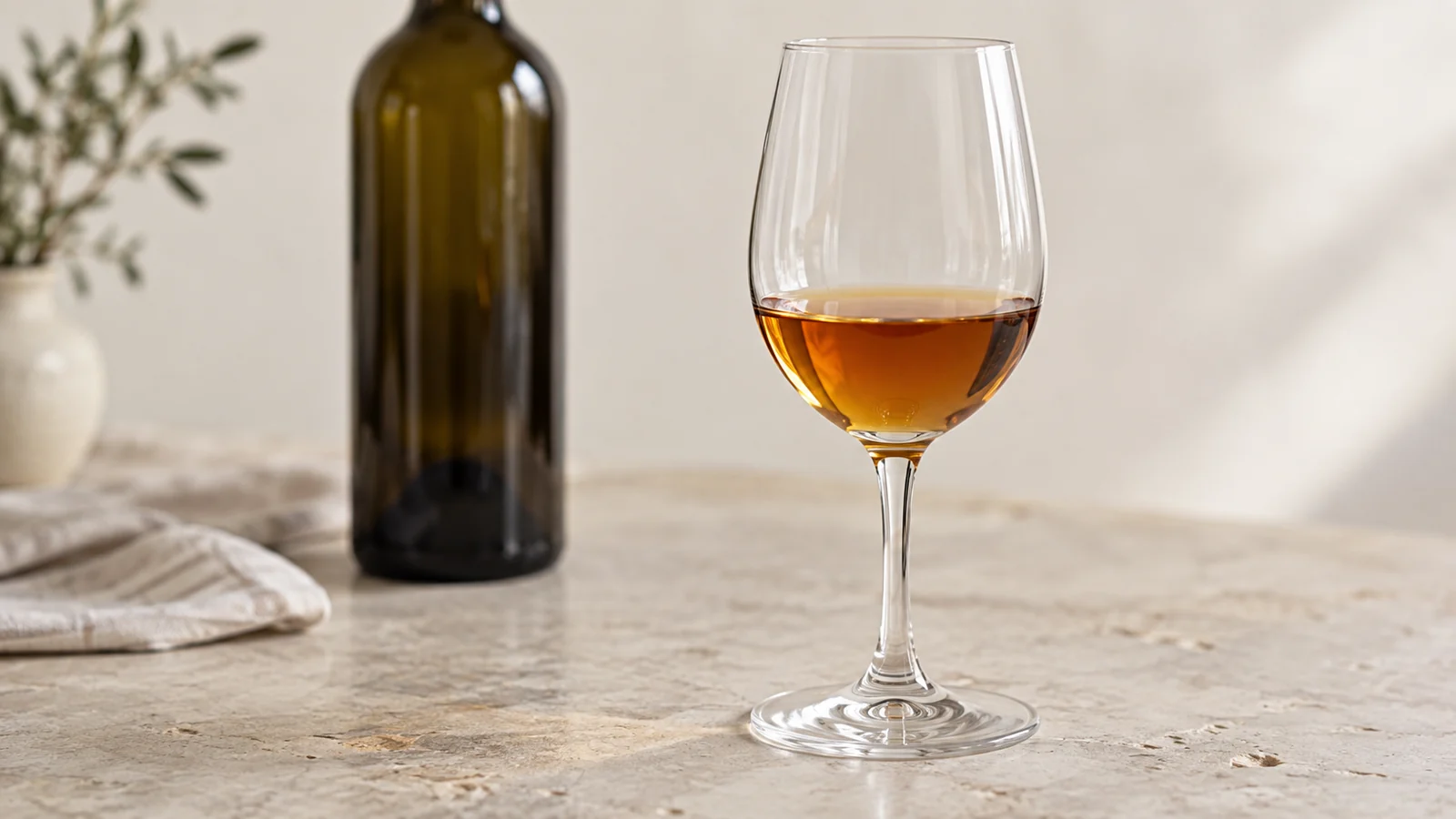
An aroma of bruised apple, a loss of freshness or an unexpectedly stale impression can raise a question about oxidation. But amber color or a nutty aroma alone cannot settle it. AWRI’s oxidation descriptions
Consider Oloroso. Its official appellation description places oxidative aging at the center of the style, alongside amber color and nutty character. Those features cannot be judged against the expectations for a freshly bottled, fruit-led white wine. Consejo Regulador de Jerez
That does not mean every Oloroso is flawless, every Sherry follows the same process, or any tired bottle can be defended by calling it oxidative.
The distinction is between development that belongs coherently to a documented style and deterioration that has displaced the wine’s balance. Producer information helps establish the comparison; the condition of this bottle still needs attention.
Intent provides context. It does not make all outcomes successful.
Heat, age and deposits: do not diagnose from appearance
Current serving temperature and past heat exposure are different questions. In a controlled shipping study, hotter treatments altered the sensory properties and volatile composition of the tested wines. That supports the importance of storage history—not a universal deadline after which every bottle is ruined. Robinson and colleagues, 2010
Cooling an overly warm glass changes how it is served. It does not undo chemical changes that may have occurred earlier. A cooked-fruit impression, leakage or a displaced closure can justify questions, but a photograph does not reconstruct the bottle’s temperature history.
Deposits require the same restraint. Identified potassium bitartrate crystals do not necessarily harm wine quality; AWRI distinguishes them from other deposits through identification. That is not permission to call every unknown particle harmless or to identify possible glass fragments by resemblance. AWRI: crystalline deposits
Sediment is an observation. It is not, by itself, cork taint, prestige, proof of age or proof of safety.
An unexpected finish can arrive after the first smell
Some off-flavors do not reveal themselves clearly when you first smell the glass.
Mousiness is a useful example: its pH-dependent expression can become more noticeable retronasally after wine meets the conditions of the mouth. Research has investigated different microorganisms capable of contributing to it, rather than treating it as another name for Brett’s familiar volatile-phenol character. Moulis and colleagues, 2023
That study examined wines already selected for a mousy defect. It does not tell us how common mousiness is across all natural wine.
The practical lesson is to record when an impression appears: at the first smell, after air, in the mouth, or in the finish. It is not an instruction to keep tasting a bottle that concerns you.
Four clues, without a premature verdict
These are directions for investigation, not chemical identifications from aroma alone.
| What you notice | A plausible direction | What it does not prove |
|---|---|---|
| Persistent mustiness with subdued fruit | TCA or another musty taint | The exact molecule, closure or source of contamination |
| Egg, onion or rubber-like character | Particular volatile sulfur compounds | That all sulfites are responsible or that air will fix it |
| Medicinal, smoky or animal-like character | Brett-associated compounds, among other possibilities | Viable Brett cells, a universal stylistic virtue or a producer-wide problem |
| Vinegar-like versus solvent-like character | Acetic acid versus ethyl acetate deserves separation | A numerical VA result, a legal breach or a medical risk |
The distinctions above are supported by the fault, sulfur, Brett and analytical sources already discussed. The table is an editorial summary—not an identification chart validated against every wine.
The Six-Pass Bottle Check

_(_A simple comparison begins with the glass and the surroundings, not with a chemical diagnosis. )
This is Ask Sommelier AI’s practical observation framework, not a laboratory diagnosis or a test of whether a beverage is safe.
It applies to an ordinary, intact commercial bottle whose sensory condition is being questioned. Suspected foreign chemicals, broken glass, unexplained pressure, tampering or a physical reaction are reasons to stop—not to proceed through a tasting exercise. Do not transfer this framework to assessing the microbiological safety of homemade or dealcoholized drinks.
1. Observe
Write what is present before naming a cause: damp, vinegary, sulfurous, bitter, muted, persistent. Separate smell, taste, texture and finish. “I notice a medicinal aroma that covers the fruit” is more useful than “bad wine.”
A photograph may document appearance, packaging or leakage. It cannot record aroma or establish the responsible chemistry.
2. Isolate
Check a small fresh pour in a clean, odor-free glass, away from strongly scented surroundings. Compare the empty glass as well as the wine. This helps distinguish a bottle concern from glassware or environmental context.
Keep the remaining wine and packaging available. There is no need to empty or transform the bottle before asking someone else to assess it.
3. Change temperature
If the sample is exceptionally cold or warm, let a small portion approach a more useful serving condition gradually, without direct heat. Research shows that serving temperature can change sensory ratings; that makes it a variable to control, not a diagnostic treatment. Ross and Weller, 2008
Record a change rather than declaring a cure. This step may be unnecessary when the wine was already served appropriately.
4. Add controlled air
Only when useful, give one small pour a gentle swirl and leave a second comparable pour less disturbed. Do not begin by vigorously decanting a fragile mature bottle.
Keep the comparison modest. The sulfur research discussed earlier explains why neither improvement nor persistence supplies a complete molecular diagnosis.
5. Compare over time
Return briefly and compare your notes. Has the suspect impression faded, persisted or become more dominant? Has fruit emerged, or merely disappeared underneath another change?
There is no universal countdown. You do not owe a disappointing bottle repeated tasting, and you can stop once the observation is clear enough to discuss.
6. State confidence and limits
Separate observation, working hypothesis and next action.
For example: “Persistent damp-cardboard impression in a second clean glass; suspected musty taint; please check another sample.”
That is an illustrative note, not a finding about a named producer. It communicates more responsibly than asserting an exact molecule or condemning an entire region.
What to say at a restaurant
You can be specific without becoming confrontational:
“I keep noticing a damp smell, and the fruit seems muted. Would you check this bottle with me?”
Or, when the issue is preference:
“This may be sound, but I’m finding the oxidative style stronger than I enjoy.”
Those requests invite different responses. Neither requires an apology for your palate. A sommelier can compare a fresh pour, clarify the intended style and consider the bottle’s condition. At home, retain the bottle information and contact the seller rather than trying to repair the wine yourself. Replacement and return policies vary; this is a communication approach, not a promised refund.
What Ask Sommelier AI should—and should not—do
A useful assistant should ask about the exact wine, age, storage, glassware, sensory description and what changed during a modest comparison. It should preserve the difference between an observed smell and a suspected mechanism.
It should not diagnose TCA from a bottle photo, infer a laboratory concentration from “vinegar,” certify microbiological safety, or turn one report into a claim about every wine from that producer. These are standards for responsible assistance, not a declaration that an app can perform laboratory analysis.
Return to the two people at the table.
The wine does not need a defense lawyer, and the drinker does not need an examination. Both need a more precise conversation.
An unfamiliar style deserves curiosity. A compromised bottle deserves attention. Personal preference deserves respect without being disguised as a scientific verdict.
Describe before diagnosing. Compare before concluding. And never mistake hospitality for asking someone to ignore what they notice.
Next comes a question that follows naturally: if air can change what a wine presents, when should we decant—and when should we leave the bottle alone?
Frequently asked questions
Does a piece of cork mean the wine is corked?
No. A cork fragment is a physical observation; cork taint concerns an unwanted sensory influence commonly associated with TCA. Evaluate the wine rather than using the fragment as a diagnosis. AWRI
Can a wine be musty without a cork stopper?
A stopper is not the only possible route. Research on TBA identified winery-environment contamination associated with musty wines. This does not make every musty wine a TBA case; it shows why closure alone cannot settle the cause. Chatonnet and colleagues
Will decanting remove reduction?
It may change some sulfur-related impressions. It is not a guaranteed or permanent remedy, and excessive exposure can harm the wine. Compare a small portion first rather than treating the whole bottle automatically. AWRI
Is volatile acidity the same as a solvent smell?
No. Acetic acid and ethyl acetate are different substances, and ethyl acetate is not the acid value measured by the corrected VA method. Describe vinegar-like and solvent-like impressions separately. OIV; Vintessential
Does sediment mean the wine has gone bad?
Not necessarily. Identified tartrate deposits can be unrelated to a quality problem. Unknown particles still require care; appearance alone does not establish their identity or safety. AWRI
Must I identify the exact fault before asking for help?
No. State what you notice, whether it persists in a clean glass, and what concerns you. “Would you check this bottle?” is enough to begin. Sensory observation is not a requirement to make a laboratory or medical diagnosis.
References
- Australian Wine Research Institute (undated; accessed 13 September 2026). Wine flavours, faults and taints. Institutional source.
- Prescott, J., Norris, L., Kunst, M., & Kim, S. (2005). Estimating a ‘consumer rejection threshold’ for cork taint in white wine. Food Quality and Preference, 16(4), 345–349. DOI. Record and abstract.
- Dectis, K. C., & Tepper, B. J. (2026). Sensitivity Threshold for Selected Aromas and Defects in Casual Wine Consumers. Journal of Sensory Studies, 41(2), e70126. DOI.
- Takeuchi, H., Kato, H., & Kurahashi, T. (2013). 2,4,6-Trichloroanisole is a potent suppressor of olfactory signal transduction. Proceedings of the National Academy of Sciences, 110(40), 16235–16240. DOI. Record and abstract.
- Chatonnet, P., Bonnet, S., Boutou, S., & Labadie, M.-D. (2004). Identification and responsibility of 2,4,6-tribromoanisole in musty, corked odors in wine. Journal of Agricultural and Food Chemistry, 52(5), 1255–1262. DOI. Record and abstract.
- Australian Wine Research Institute (undated; accessed 13 September 2026). Removal of volatile sulfur compounds. Institutional source.
- Bekker, M. Z., Wilkes, E. N., & Smith, P. A. (2018). Evaluation of putative precursors of key ‘reductive’ compounds in wines post-bottling. Food Chemistry, 245, 676–686. DOI.
- Sánchez-Gimeno, D., Vela, E., Ferreira, V., & Ontañón, I. (2024). Alternative strategies for eliminating hydrogen sulfide and methanethiol from wine: results and learnings. OENO One, 58(4). DOI. Institutional repository.
- Australian Wine Research Institute (undated; accessed 13 September 2026). Brettanomyces FAQ. Institutional source.
- Lattey, K. A., Bramley, B. R., & Francis, I. L. (2010). Consumer acceptability, sensory properties and expert quality judgements of Australian Cabernet Sauvignon and Shiraz wines. Australian Journal of Grape and Wine Research, 16, 189–202. DOI.
- International Organisation of Vine and Wine (undated; accessed 13 September 2026). OIV-MA-AS313-02 — Volatile acidity (Type I). Institutional source.
- Vintessential Laboratories (undated; accessed 13 September 2026). Ethyl acetate — a misunderstood fermentation problem. Laboratory technical page.
- Consejo Regulador de los Vinos de Jerez y la Manzanilla (undated; accessed 13 September 2026). Oloroso. Institutional source.
- Robinson, A. L., et al. (2010). Effect of simulated shipping conditions on sensory attributes and volatile composition of commercial white and red wines. American Journal of Enology and Viticulture, 61(3), 337–347. DOI. Record and abstract.
- Australian Wine Research Institute (undated; accessed 13 September 2026). Crystalline deposits. Institutional source.
- Moulis, P., et al. (2023). Which microorganisms contribute to mousy off-flavour in our wines?. OENO One, 57(2). DOI.
- Ross, C. F., & Weller, K. (2008). Effect of Serving Temperature on the Sensory Attributes of Red and White Wines. Journal of Sensory Studies, 23(3), 398–416. DOI.