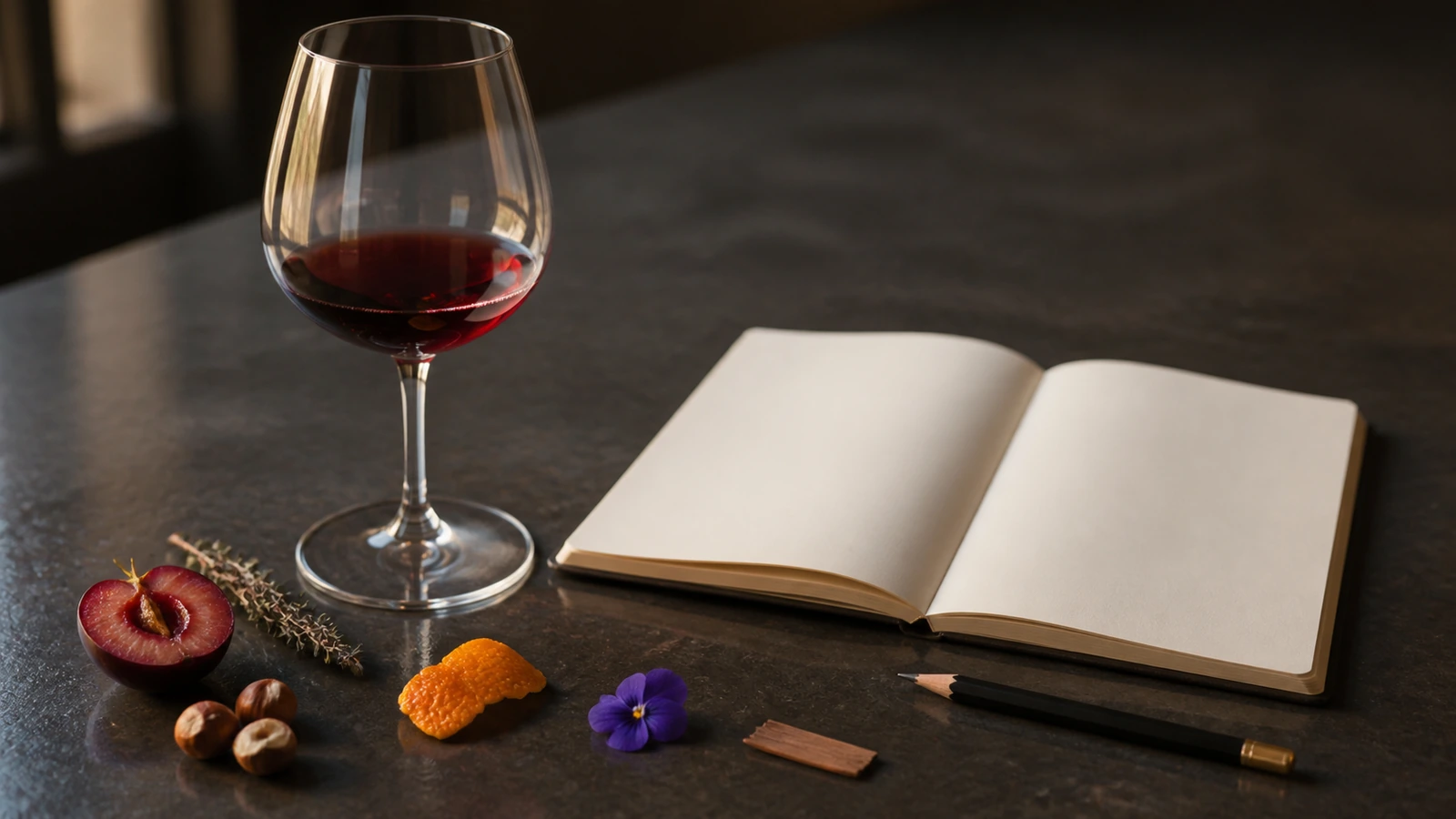
A tasting note should help you recognize a wine again, compare it with another bottle, or explain what you enjoyed. It should not feel like an answer key hidden inside the glass.
Yet many people approach aroma as a test: either you identify the “correct” fruit, flower, spice, or wood note, or you assume your nose failed.
That is the wrong standard.
Smelling a wine, recognizing something familiar, and retrieving a precise word are related tasks—but they are not the same task. Research on olfaction shows that the path from sensation to language contains several stages, and difficulty at the naming stage does not automatically mean the aroma went unnoticed.
This article explains what current research can—and cannot—tell us, then turns those findings into a practical method for writing clearer, more honest tasting notes.
The central idea: A useful aroma description does not prove that you found a secret answer. It records a repeatable sensory impression in language that you and other people can understand.
One sniff contains several different tasks
When you smell a wine, your brain is doing more than one thing.
At a simplified level, you may need to:
- Notice that an odor is present and distinguish it from other odors.
- Connect that sensation with stored knowledge or familiarity.
- Retrieve language that communicates the experience.
A major review of olfactory language describes odor naming as a process involving object perception, lexical-semantic integration, and verbalization. A breakdown or delay can occur along that route even when basic odor perception and ordinary visual naming are intact (Olofsson & Gottfried, 2015).
This distinction matters in wine tasting. You may reliably notice that one glass is more floral, darker, fresher, or more herbal than another before you can identify a specific reference. That comparison is already meaningful sensory information.
Researchers have also studied the strong “feeling of knowing” that can accompany odor-naming failure: the sense that the answer is available somewhere in memory even though it cannot yet be retrieved (Jönsson et al., 2005).
So when a wine seems familiar but the name remains uncertain, avoid jumping to one of two conclusions:
- “I have a bad nose.”
- “The tasting note must be wrong.”
The more accurate conclusion may be: I perceived something, but I have not yet found stable language for it.
Labels can help—and they can also steer perception
Words do not merely report an odor after the fact. They can influence how we interpret it.
In experiments with common odors, verbal information about an odor’s identity and source affected how participants evaluated the experience (Herz, 2003). That study was not conducted with wine, so it should not be treated as direct proof of how every tasting note changes every wine. It does, however, demonstrate a relevant principle: context and labels can participate in odor perception rather than acting as neutral captions.
That is why reading the producer’s tasting note before smelling can be useful for learning but poor for testing your independent impression. Once “ripe pear,” “violet,” or “toasted almond” is in your mind, it may become easier to organize the wine around that suggestion.
A better sequence is:
- Smell and write privately.
- Decide what you are confident about.
- Read the professional or producer note.
- Compare without treating disagreement as failure.
The goal is not to eliminate influence—no taster operates without context—but to know when the context arrived.
Aroma descriptors are references, not ingredients
Many English speakers describe odors by naming likely sources: a flower, fruit, herb, spice, food, material, or place associated with a similar smell. Research on odor language frequently distinguishes these source-based descriptions from abstract odor terms (Majid & Burenhult, 2014).
In wine, this creates familiar phrases such as:
- red plum
- orange blossom
- dried thyme
- toasted hazelnut
- beeswax
- smoke
- pencil shavings
These terms do not usually claim that the named object was added to the wine. They function as sensory comparisons.
A descriptor is therefore best understood as a communication tool:
“The aroma in this glass reminds me, with some degree of confidence, of the odor I associate with this reference.”
That wording is less dramatic than declaring that a wine “has” seven perfectly identifiable objects in it, but it is more faithful to how aroma language often works.
It also explains why two thoughtful people can choose different references for a similar impression. One may write red plum and another dark cherry. Their notes may still overlap in broader information: both perceived ripe, dark-red fruit rather than citrus, green herbs, or toasted oak.
Difficulty naming odors is not universal
It is common to hear that humans are simply bad at describing smell. The evidence is more nuanced.
A 2014 experiment found that Jahai speakers from the Malay Peninsula could name odors as readily as colors, while matched English speakers had much greater difficulty. The authors argued that poor odor naming should not be treated as a universal human limitation (Majid & Burenhult, 2014).
A later experiment compared 30 Jahai participants with 30 Dutch participants using the same odorants. Dutch speakers relied mainly on concrete source references, while Jahai speakers used more abstract odor vocabulary. Despite those linguistic differences, the groups showed similar initial emotional reactions to the odors (Majid et al., 2018).
The careful conclusion is not that one culture has a “better nose,” or that biology does not matter. The studies show that languages and communities can provide different tools for categorizing and communicating odor.
For wine drinkers, that has two practical implications:
- A descriptor is easier to use when it connects to a sensory reference you actually know.
- A shared professional vocabulary is valuable, but it should not erase personal or culturally familiar references.
A useful tasting note can include both layers:
Shared category: ripe tropical fruit
Personal reference: reminiscent of the mango variety I grew up eating
The first phrase helps another reader orient themselves. The second preserves the specificity of your memory.
Expertise creates a shared code—not perfect identification
Wine professionals often sound more fluent because they practice both perception and language. But expertise should not be mistaken for universal olfactory certainty.
In a study comparing wine experts, coffee experts, and novices, wine experts were more consistent when describing wine smells and flavors. The advantage was modest and domain-specific. Neither expert group was more accurate than novices at identifying everyday smells and basic tastes, and the researchers concluded that effective flavor communication depends on linguistic practice as well as sensory experience (Croijmans & Majid, 2016).
This finding helps explain what structured wine education can genuinely improve:
- a more organized vocabulary
- greater consistency across repeated tastings
- faster movement from broad families to specific candidates
- better communication with other trained tasters
It does not turn aroma identification into an infallible measurement.
Confidence, expertise, and accuracy are related only imperfectly. A polished note can still be overly specific, while a cautious note can be highly useful.
An evidence-informed seven-pass method
The following method is an Ask Sommelier editorial framework derived from the research above. It is not a clinical diagnostic protocol or an official universal tasting standard. Its purpose is to separate observation from interpretation and make your notes easier to repeat.
Pass 1: Record intensity before identity
Ask how present the aroma is:
- light
- moderate
- pronounced
This gives you useful information without forcing a source name too early.
Pass 2: Choose a broad family
Start with one or two families:
- fruit
- floral
- herbal or vegetal
- spice
- earth or savory
- fermentation-related
- oak or toast
- other
Broad classification reduces the pressure to produce an impressive noun immediately.
Pass 3: Describe condition and character
For fruit, ask whether the impression is:
- underripe or ripe
- fresh or dried
- tart or sweet-smelling
- delicate or concentrated
- bright or jam-like
For herbal notes, consider fresh, dried, leafy, resinous, or medicinal. For oak-related impressions, consider fresh wood, toast, sweet spice, smoke, or nuttiness.
These modifiers often communicate more than a long list of objects.
Pass 4: Add one or two source candidates
Only now propose specific references.
Write ripe red fruit—possibly plum rather than listing plum, cherry, raspberry, strawberry, and pomegranate in the hope that one will be right.
A short note with clear confidence is more useful than a crowded note designed to sound authoritative.
Pass 5: Mark uncertainty honestly
Try language such as:
- “reminds me of”
- “suggests”
- “between X and Y”
- “possibly”
- “uncertain floral note”
Uncertainty is information. It allows you to revisit the wine later and see whether the impression becomes clearer.
Pass 6: Check the wine after air and temperature change
Return after several minutes. A wine can become more expressive, less reductive, warmer, or more integrated as it sits in the glass.
Do not erase your first note. Add a second observation. The change itself may be one of the most useful things you record.
Pass 7: Compare with an external note
After documenting your own impression, read another source. Ask:
- Where do the notes agree at the family level?
- Did the other note give you a useful name for something you noticed but could not label?
- Did the label cause you to perceive something new, or merely persuade you that it must be present?
- Can you find the impression again without reading the word?
This turns tasting notes into learning tools rather than answer keys.
What a clear note can look like
Here is an example that preserves both specificity and uncertainty:
Aroma: Moderate-plus intensity. Ripe red and dark fruit, led by red plum with a dried-fig edge. A dried-herb note becomes clearer with air, followed by light toast and a faint floral impression I cannot yet identify. After ten minutes, the fruit feels fresher and the herbal note becomes more defined.
Why this works:
- It begins with intensity.
- It gives a broad family before narrowing.
- It distinguishes fresh, ripe, and dried character.
- It limits specific candidates.
- It records uncertainty instead of hiding it.
- It documents change over time.
Build a sensory library, not a memorized script
Vocabulary becomes useful when it connects to real sensory memory.
You do not need an expensive aroma kit to begin. Use safe, ordinary materials already present in daily life:
- compare fresh fruit with the dried version
- smell herbs before and after crushing them
- compare raw nuts with toasted nuts
- notice citrus peel separately from the juice
- smell whole spices and then freshly ground spices
- compare fresh flowers, dried flowers, tea, cocoa, wood, and mushrooms when naturally available
Write two things each time:
- What broad family does this belong to?
- What makes this example different from a nearby example?
For instance, do not only memorize “plum.” Compare a firm fresh plum, a very ripe plum, plum preserves, and dried plum. Wine descriptors often depend as much on condition as on identity.
This practice is not about forcing every real-world smell into every wine. It is about giving memory more organized reference points.
Four mistakes that make tasting less useful
Reading the note before forming any impression
This is fine when your goal is guided learning, but not when you want to know what you perceived independently.
Treating the longest note as the best note
Length can conceal low confidence. Four precise observations are often more useful than fifteen loosely connected nouns.
Believing disagreement proves incompetence
Two descriptors can differ while still locating the aroma in a similar sensory neighborhood.
Borrowing vocabulary with no sensory reference behind it
Using a term because it frequently appears with a grape variety may help you sound familiar with wine language, but it does not automatically create recognition memory.
Use language to preserve your own palate
The best tasting vocabulary is neither completely private nor mechanically standardized.
It should be:
- personal enough to connect with memory
- structured enough to compare over time
- shared enough that another person can understand it
- modest enough to show uncertainty where uncertainty exists
That balance is especially useful in a digital wine journal. In Ask Sommelier AI, record your own wording before comparing it with external descriptions. Over time, patterns in your language can reveal which aroma families, styles, and levels of ripeness you consistently enjoy.
The point is not to make every user sound like the same sommelier. It is to make your own sensory history easier to recognize.
Related perspective
Wine educator and oenologist Patrick Richaud has also discussed the relationship among smell, language, and cultural reference points in wine tasting. His short video helped prompt the editorial question explored here.
- Watch Patrick Richaud’s short video
- Patrick Richaud — official website
- Mèmora Vino — official website
The analysis, organization, examples, tasting framework, and conclusions in this article were developed independently from the research cited below.
References
- Olofsson, J. K., & Gottfried, J. A. (2015). The muted sense: Neurocognitive limitations of olfactory language. Trends in Cognitive Sciences, 19(6), 314–321. https://doi.org/10.1016/j.tics.2015.04.007 · Open-access full text at PMC
- Jönsson, F. U., Tchekhova, A., Lönner, P., & Olsson, M. J. (2005). A metamemory perspective on odor naming and identification. Chemical Senses, 30(4), 353–365. https://doi.org/10.1093/chemse/bji030
- Herz, R. S. (2003). The effect of verbal context on olfactory perception. Journal of Experimental Psychology: General, 132(4), 595–606. https://doi.org/10.1037/0096-3445.132.4.595 · PubMed record
- Majid, A., & Burenhult, N. (2014). Odors are expressible in language, as long as you speak the right language. Cognition, 130(2), 266–270. https://doi.org/10.1016/j.cognition.2013.11.004
- Majid, A., Burenhult, N., Stensmyr, M., de Valk, J., & Hansson, B. S. (2018). Olfactory language and abstraction across cultures. Philosophical Transactions of the Royal Society B, 373(1752), 20170139. https://doi.org/10.1098/rstb.2017.0139 · Open-access full text at PMC
- Croijmans, I., & Majid, A. (2016). Not all flavor expertise is equal: The language of wine and coffee experts. PLOS ONE, 11(6), e0155845. https://doi.org/10.1371/journal.pone.0155845
- Majid, A. (2021). Human olfaction at the intersection of language, culture, and biology. Trends in Cognitive Sciences, 25(2), 111–123. https://doi.org/10.1016/j.tics.2020.11.005