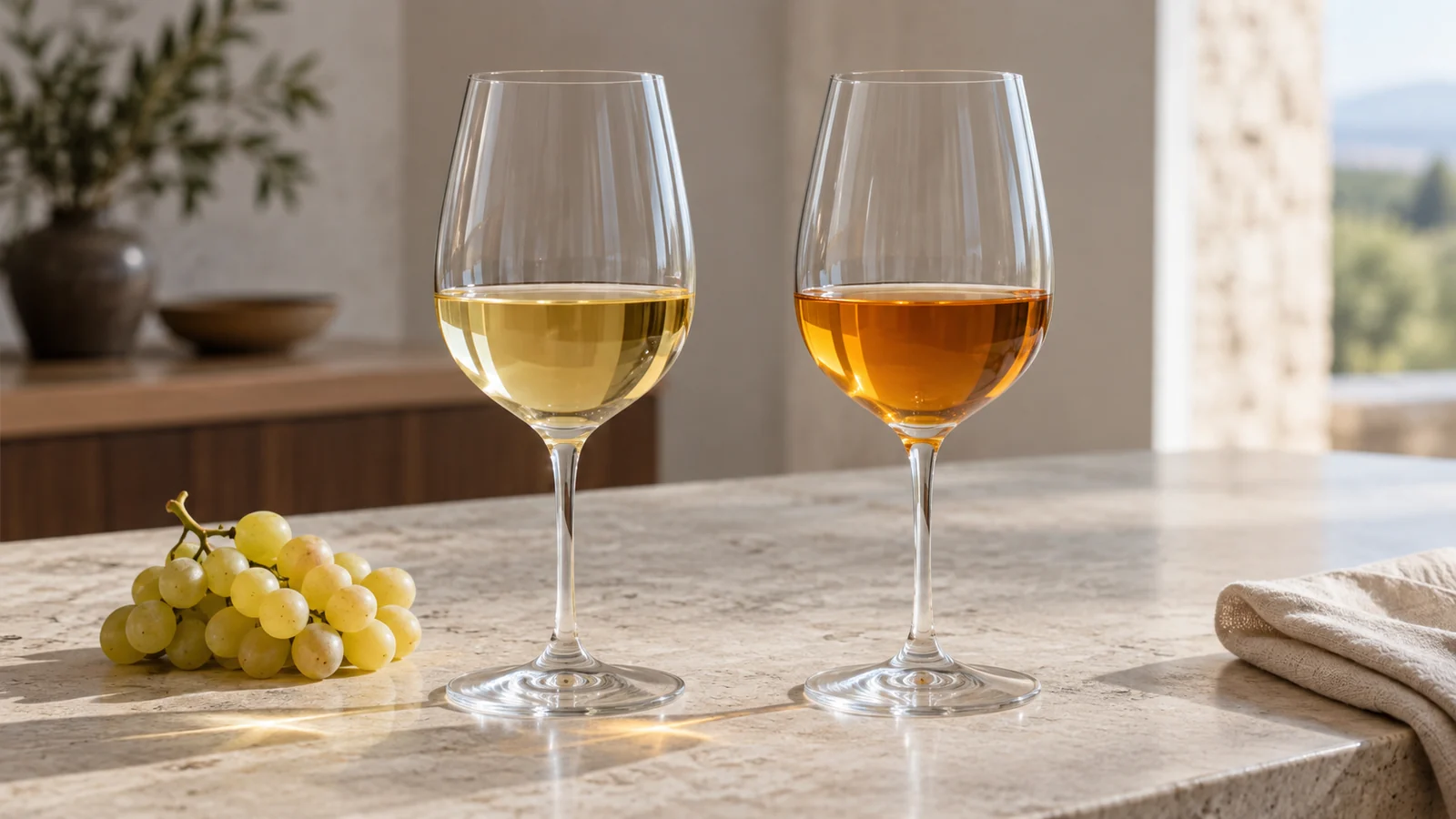
Imagine a glass arriving at the table with the color of late-afternoon light.
You expect something sweet. Perhaps something heavy. Then the first sip is bright, dry and gently gripping, with a texture that seems closer to tea than to the white wine you had imagined.
Someone says, “It’s an orange wine.”
That gives the surprise a name. It does not yet explain it.
In the previous Cellar Journal article, we separated a production philosophy—natural wine—from a predetermined flavor. Now we turn to a more concrete decision: what happens when white-grape juice spends more of its life in contact with the skins?
The answer changes more than the color. But it does not give every bottle the same personality.
Orange wine describes a way of making wine, not one flavor you are required to find.
What is orange wine?
In the contemporary skin-contact sense, orange or amber wine is made from white grape varieties whose juice ferments with the skins, often the seeds and sometimes stems. Contact may continue after fermentation. The distinguishing choice is to retain grape solids during a stage when many familiar white wines would already have been separated from them. AWRI’s technical explanation makes that distinction explicitly.
Here, orange does not mean wine made from oranges, orange flavoring or an obligation to smell citrusy.
There is an important naming exception, especially for Spanish-speaking readers: Vino Naranja del Condado de Huelva is a distinct protected aromatized-wine name involving an actual orange-peel preparation. It is not the white-grape skin-contact category discussed here. Neither tradition becomes incorrect because the words overlap. Junta de Andalucía.
Does skin contact have to last a month?
For the specifically defined OIV category “White wine with maceration,” the answer is yes: its standard requires white varieties and at least one month of contact with grape pomace. That is the scope of Resolution OIV-ECO 647-2020.
Everyday use of orange wine is broader. WSET’s field account describes varied practices, including shorter macerations. The OIV standard should therefore not be silently converted into a universal rule governing every use of the nickname or every country’s labels. WSET.
For understanding a bottle, “How long, and during which stage?” is more useful than policing its shade of amber.
The decisive moment is separation
Making white wine does not require pretending that grapes have no skins. The question is when the juice leaves them behind.
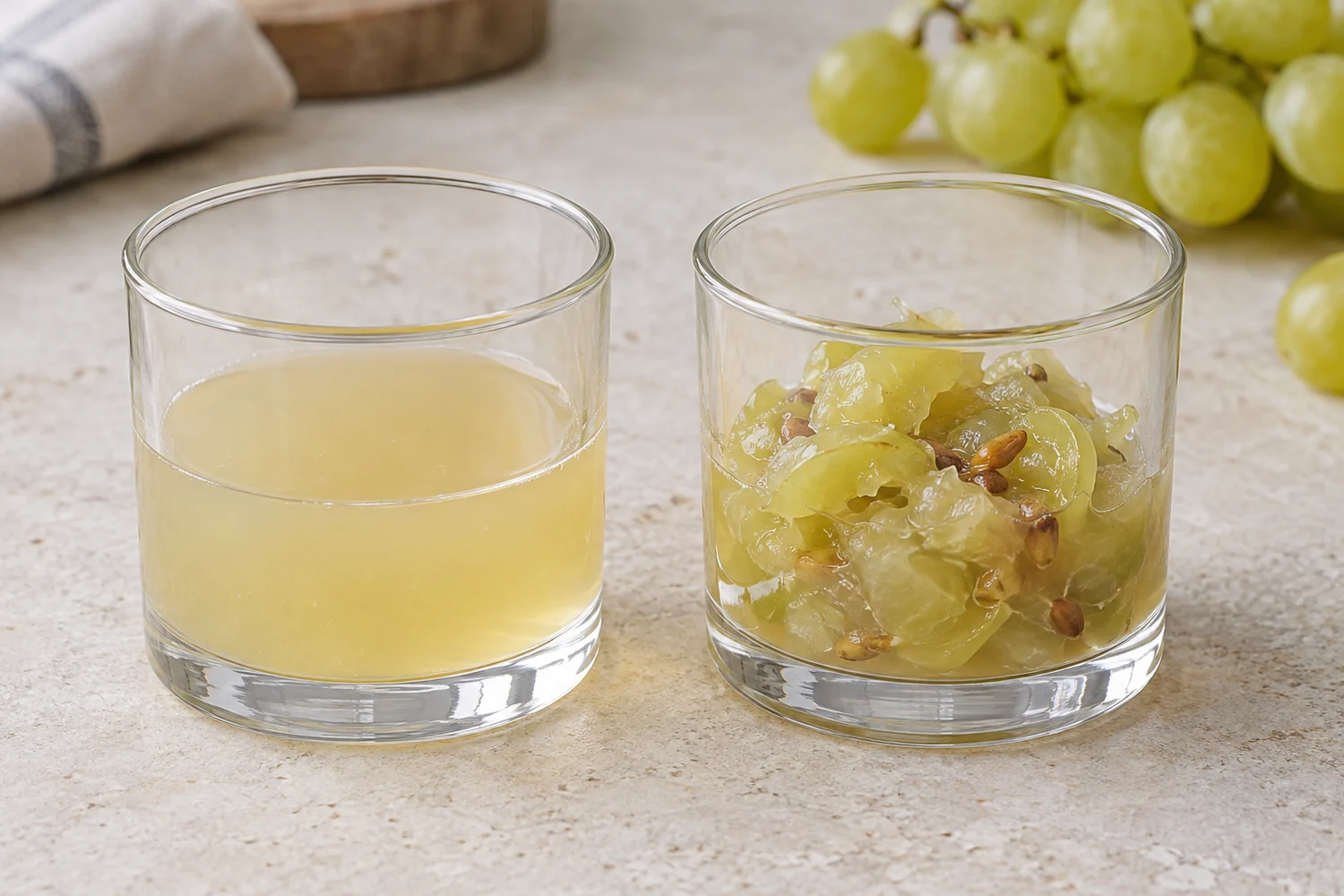
One producer presses early and ferments the separated juice. Another allows a period of contact before pressing. A third ferments with the solids and may keep the wine with them afterward. These are different decisions, not interchangeable names for one treatment. AWRI on pre-fermentation skin contact.
A brief cold soak before fermentation does not automatically make an otherwise conventional white wine orange. Nor does contact on either side of fermentation occur in an identical environment: temperature, alcohol development, solid material and handling all belong to the extraction question.
This also explains why orange wine is not simply another name for rosé. In the Provence methods described by its regional wine body, dark-skinned grapes undergo direct pressing or a relatively short maceration. Orange wine starts from white varieties and retains skin contact through fermentation. The contrast concerns grape material and processing, not just two colors on a chart. Vins de Provence.
The useful question is not “How orange is it?”
It is “What stayed with the juice, and for how long?”
What the skins change in the mouth
The surprise may arrive after the aroma.
A wine can smell delicate and still leave a firm impression along the gums. Another may be deeply colored but feel broad and relatively gentle. To describe that difference, keep three observations separate:
Sweetness is not the same as a sweet-smelling aroma. Bitterness is a taste. Astringency is the drying, gripping or rough tactile impression that tasters often associate with tannin. “Dry” can be confusing because people use it both for little perceived sweetness and for a drying mouthfeel.
Skin contact changes the material available for extraction, including phenolic compounds. Yet total phenolics are not a simple dial marked more tannin, more bitterness. In a white-wine processing study, large differences in total phenolics produced much smaller differences in bitterness, while acidity-related conditions also mattered to texture. That experiment concerns the wines tested, not every orange wine. Gawel and colleagues.
So rather than writing “very dry,” try separating the observations:
Little apparent sweetness. Fresh acidity. A gentle drying finish. A small bitter edge.
That is an illustrative note, not a template every orange wine must satisfy. Its value is that it tells another person where the sensation occurred.
White wine did not acquire its first phenolic compound when someone invented a fashionable category. Skin contact changes the opportunity for extraction; it does not create a clean division between wines with chemistry and wines without it.
Color records change; it does not measure the clock
Amber can be beautiful. It is not a laboratory result.
Extraction, reactions among wine components and subsequent maturation can all contribute to the finished appearance. Research on wines made with prolonged maceration and wooden-barrel maturation documents changes in color, phenolics and aroma, but the combined processes do not let us assign every difference to skin contact alone. Lukić and colleagues.
That distinction matters whenever we see a photograph of several glasses progressing from pale gold to copper.
Unless their production histories are controlled and documented, they are examples of color—not a timeline. The darkest glass does not reveal an exact number of days, prove the highest tannin level or identify a particular vessel.
The distinction is worth keeping precise: color is a visible consequence of extraction and evolution, not a promise of “funk.” It cannot tell us whether an unfamiliar aroma is present, attractive or problematic before we have smelled the wine.
Longer does not always mean more
A maceration is not a tea bag that keeps adding the same sensation at the same rate forever.
An experiment with the Apulian varieties Minutolo and Verdeca followed prolonged contact for up to six months. Reported total phenolics rose to a peak at four months and then declined; the two varieties did not respond identically. That is evidence against a simple, indefinitely rising curve—not a recommendation to macerate every white wine for four months. Prezioso and colleagues.
A preliminary conference study of 36 commercial Italian wines likewise did not find that the longest-contact group was simply the most astringent. Because those were different commercial wines and the available publication is a poster abstract, the result is a useful caution, not a controlled demonstration of what time alone does. Kasianova and colleagues, Macrowine 2025.
The practical lesson is modest: a duration tells you something important about the producer’s decisions. It does not supply the entire tasting note.
Ask about the grape, the solids, fermentation and what happened after pressing. Time is one part of the explanation, not its substitute.
Skin contact can change aroma in more than one direction
It is tempting to say that leaving the skins in simply gives a wine “more aroma.”
The evidence is less uniform—and more useful.
In a South African Chenin Blanc experiment, contact before or during fermentation changed volatile composition and shifted sensory expression away from fresh or tropical impressions toward riper character. Aleixandre-Tudo and colleagues.
A 2026 laboratory study of Chardonnay and what the paper calls Italian Riesling, using fruit from Yantai, found stronger fruity or floral expression under certain skin-contact treatments. Its sensory panel contained seven trained assessors, and the varieties responded differently. It supports an outcome under that design, not a universal quality upgrade. Xu and colleagues.
These studies do not cancel each other. They ask us to stop treating different grapes, treatments and fermentation conditions as one experiment.
The right question is not whether orange wine is fruity or savory. It is how this particular wine balances its aromatic material after extraction, fermentation and maturation.
Names such as apricot, tea, dried flowers or citrus peel remain sensory references, not a compulsory ingredient list. A restrained wine has not failed because it refuses the most dramatic descriptors in the category.
Qvevri is a living tradition, not a mandatory container
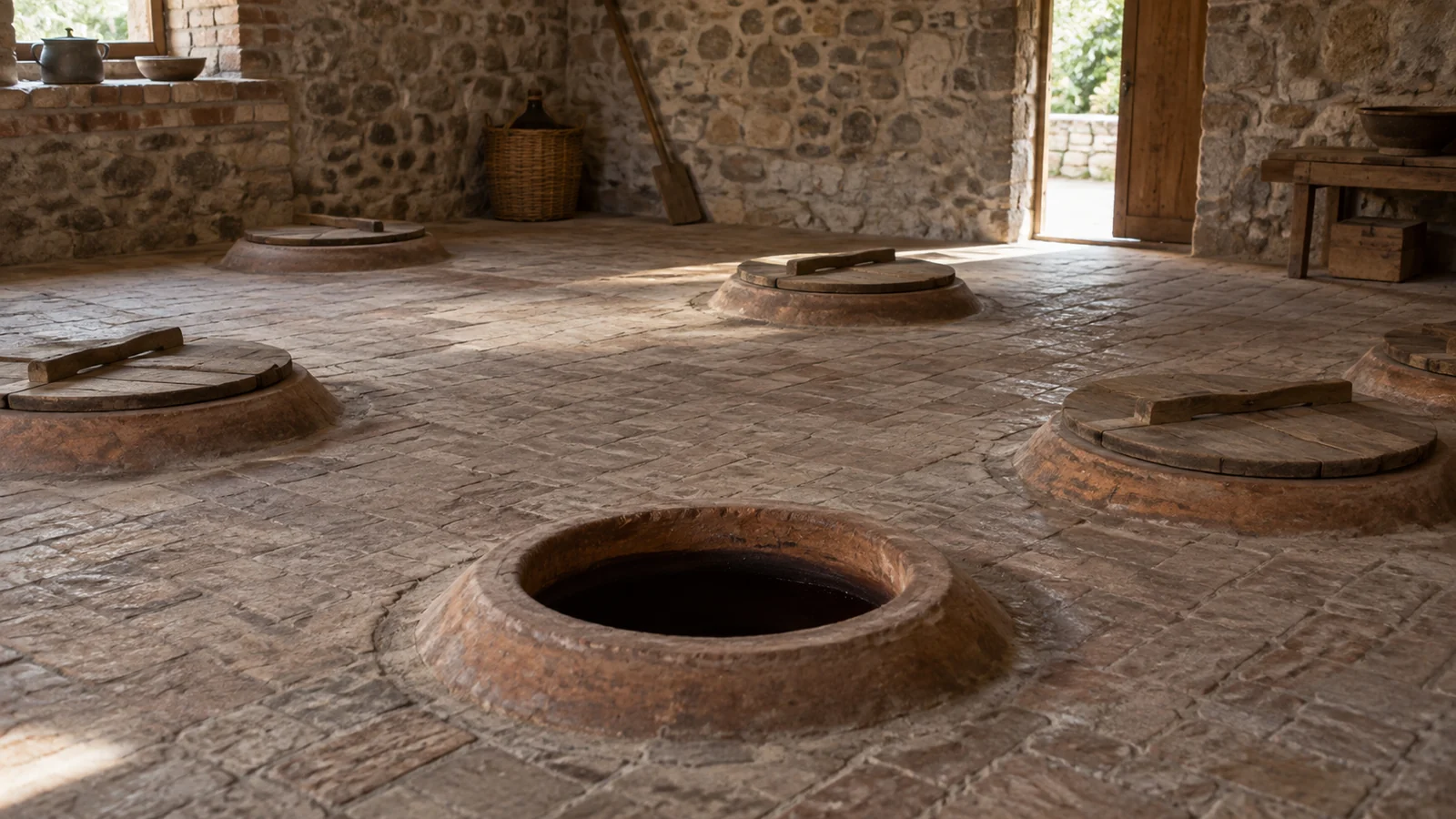
Georgia belongs in this story as more than a picturesque origin paragraph.
UNESCO inscribed the Ancient Georgian traditional Qvevri wine-making method in 2013, recognizing knowledge passed through families and communities around wine made in buried, egg-shaped earthenware vessels. The recognition concerns living cultural practice, not a tasting score. UNESCO.
Georgia’s National Wine Agency describes regional differences in the use of grape solids and also discusses red wine made in qvevri. The vessel therefore does not mean “orange” in every case, and Georgian practice is not one unchanging recipe. National Wine Agency.
Nor must every contemporary skin-contact white be made in clay. Tank, wood and clay are production choices; qvevri, amphora and orange wine should not be entered as synonyms.
Even “clay” does not describe one standardized oxygen environment. Materials research on wine vessels examines how clay composition and manufacturing conditions influence properties such as permeability. It does not establish a compulsory earthy flavor or prove that a ceramic vessel improves every wine. Open Ceramics research.
The vessel is part of the method. It is not the finished wine’s personality.
Orange, natural, cloudy and oxidative are different claims
These words often travel together. They should still be checked separately.
Orange concerns the white-grape skin-contact approach. Natural concerns a production philosophy or a claim under a particular scheme. AWRI explicitly describes amber wine made with or without sulfur dioxide additions. Skin contact alone does not certify farming, spontaneous fermentation or a no-added-sulfites policy. AWRI.
Cloudy describes appearance. Filtration, clarification and microbial removal are separate process questions; a cloudy glass is not its own production certificate, and a clear one does not disprove skin contact. AWRI on filtration.
Oxidative describes an aspect of development or style, not a synonym for maceration. An amber appearance is not enough to diagnose damage. Conversely, the word orange should not excuse every distracting vinegar, solvent, musty or otherwise troubling impression. Different wine faults require different explanations. AWRI’s sensory guide.
You do not have to enjoy an unfamiliar style. You also do not have to call it faulty to explain that it is not for you.
The Six-Layer Skin-Contact Read
This is our editorial framework for reading a bottle, not a laboratory protocol or certification test. Its six layers turn a broad category into useful questions.
1. Grape
Which variety or blend is involved? Begin with the actual raw material, not a presumed universal orange-wine aroma. Preserve uncertainty when the composition is unknown.
2. Skin-contact time
How long were juice or wine in contact with the solids—and was that before, during or after fermentation? “Several weeks” is more informative when we know which weeks.
3. Fermentation
How did it start, under what conditions, and what material remained with the liquid? Do not infer spontaneous fermentation from the color or confuse maceration with later yeast-lees aging.
4. Vessel
Was it tank, wood, qvevri or another vessel? Ask what is documented. Do not assign an imagined mineral flavor to a material or presume that every clay vessel behaves alike.
5. Oxygen and protection
How was the wine handled, protected and finished? A philosophy about additions is not a complete record of oxygen exposure or cellar attention.
6. Service and food
How does this bottle behave at the table? Consider aroma, acidity, sweetness, bitterness, tactile grip and the dish—not just its color or fashionable name.
You need not ask all six questions aloud. Often one will open the conversation:
“Is this a lighter, fresher example, or something more structured—and what gives it that character?”
That invites useful hospitality rather than a vocabulary contest.
Bring the explanation back to dinner
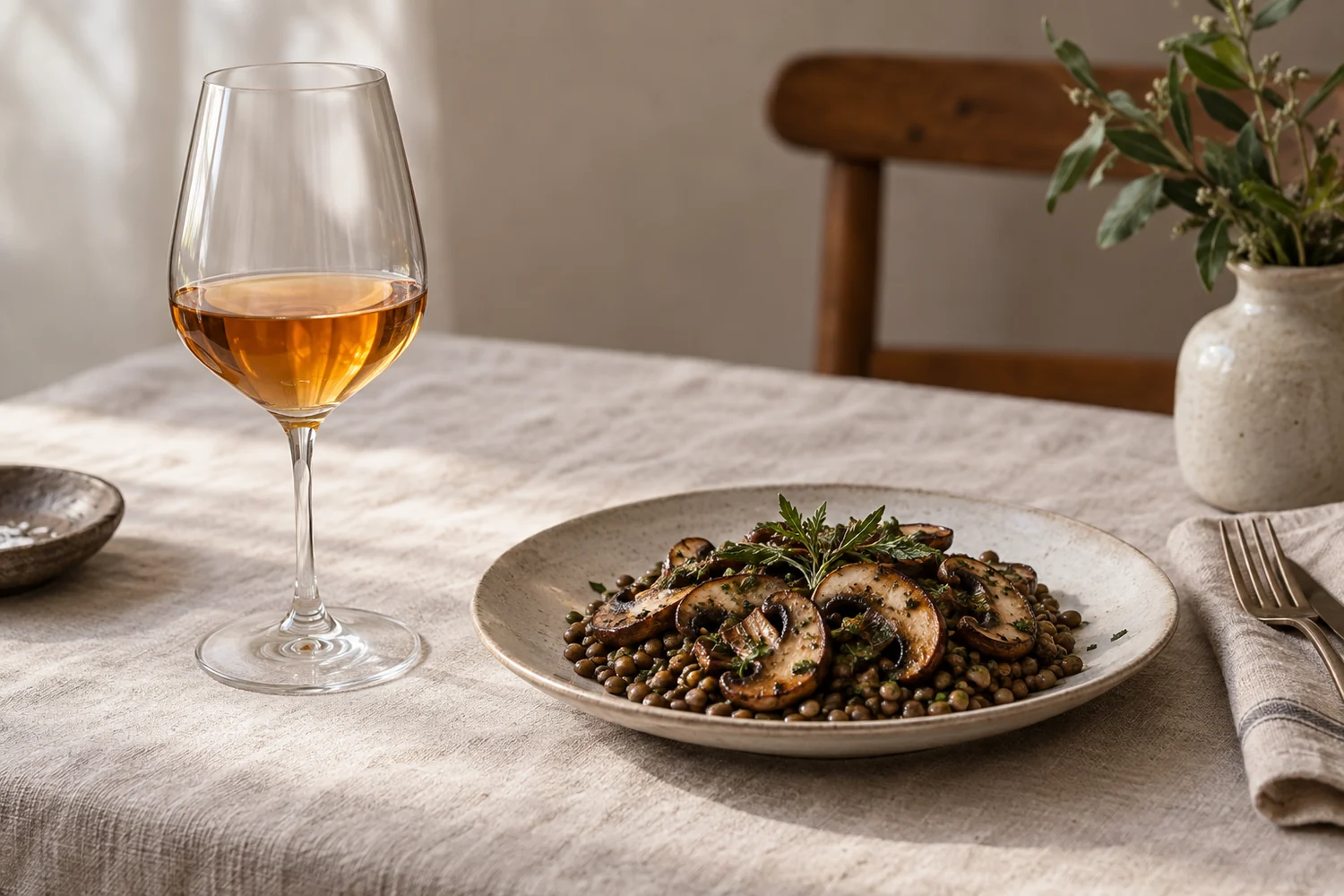
For service, start with the producer’s guidance when available. Then observe the bottle rather than obeying a universal temperature assigned to its color.
Our practical suggestion is to serve a small amount, allow it to change in the glass and notice whether aroma, bitterness and texture become more or less comfortable. Do not assume that colder, warmer or more air must always improve it. This is an editorial tasting approach, not a validated temperature experiment.
For food, the following are starting hypotheses from Ask Sommelier AI, not guaranteed pairings established by the studies above:
| The wine in your glass | A starting dish | What to pay attention to |
|---|---|---|
| Lighter, floral, fresh, with modest grip | Roast squash with herbs, or a simple roast chicken | Whether the food leaves room for the wine’s finer aromas |
| Herbal or savory, with moderate texture | Grilled mushrooms with lentils | Whether the savory elements feel connected rather than heavy |
| Firmer and more gripping | Aged cheese with bread, or a richer mushroom dish | Whether the pairing makes the texture comfortable or exaggerates it |
This is more useful than deciding that every orange wine belongs with every spicy dish.
For a comparison at home, choose a conventionally vinified white and a skin-contact version of the same grape, ideally with good production information. Record aroma, acidity, bitterness and grip separately; then record which you prefer. Unless the other variables are controlled, their differences cannot all be assigned to skins. The comparison is for learning your palate, not proving a treatment effect.
What Ask Sommelier AI should remember
A recommendation system should keep production method separate from sensory experience.
Verified skin contact may provide context. It should not automatically set high tannin, zero sweetness, spontaneous fermentation, unfiltered status, oxidative character or a natural-wine certification. A documented vessel and maceration duration are useful fields; missing information must remain missing.
For your next recommendation, “I enjoy floral wines with fresh acidity and a gentle tea-like grip” tells us more than “I like orange.” So does “I’m curious about skin contact, but I don’t enjoy a pronounced bitter finish.”
The category opens a door. Your palate decides whether you want to stay.
What stayed with the juice
Return to that first amber glass.
The color caught your attention. The texture made you reconsider. Now the phrase skin contact offers a way to ask what happened, without deciding in advance what you must find.
That is the pleasure of understanding a method: not removing the surprise, but giving it somewhere to land.
A philosophy can guide a producer. A technique changes the material. Neither relieves us of tasting the actual bottle.
And once more of the grape has entered the conversation, another decision follows: how will the producer protect the wine that emerges?
That question leads to the next Cellar Journal article: sulfites—what they do, what their labels mean, and what they cannot explain on their own.
Frequently asked questions
Is orange wine made from oranges?
Not in the skin-contact meaning used here: it is made from white grape varieties. The Spanish protected name Vino Naranja del Condado de Huelva describes a different aromatized product involving orange peel. Check the exact name and context rather than treating both as the same category. Official Huelva explanation.
Is orange wine the same as rosé?
No. The comparison is about grape material and technique, not only color. Provence rosé provides a useful example of dark-skinned grapes with direct pressing or short maceration; the skin-contact whites discussed here retain their solids during fermentation. This is not an exhaustive rule for every rosé in the world. Vins de Provence.
Is every orange wine natural or unfiltered?
No. Ask about farming, fermentation, additions and filtration separately. The use of skins alone does not establish those choices. Amber wines can also be made with sulfur dioxide additions. AWRI.
Does darker color mean more tannin or longer maceration?
Not reliably. Different grapes and production histories can yield different color and texture. Duration matters, but it cannot be reverse-engineered from a photograph, and greater total phenolics do not automatically predict a proportionately more bitter wine. Gawel and colleagues; Prezioso and colleagues.
Must orange wine be made in qvevri?
No. Qvevri belongs to a specific living Georgian tradition; other vessels also appear in contemporary skin-contact production. Qvevri is used for red wines as well, so the vessel and the category are not interchangeable. National Wine Agency; WSET.
What should I ask when ordering my first bottle?
Ask for a description of the style: lighter or structured, fresh-fruited or savory, gently textured or firmly gripping. Mention whether you enjoy bitterness and what you are eating. Our recommendation is to choose by those details rather than seeking the darkest or most unconventional-looking bottle.
References
Sources are linked at the claims they support. The conference abstract is identified as preliminary evidence. The internal dossier records which sources were available in full and which were consulted through abstracts or indexed text.
- Australian Wine Research Institute. (undated; consulted 2026-09-11). Winemaking treatment – Amber wine.
- International Organisation of Vine and Wine. (2020). Resolution OIV-ECO 647-2020 — White wine with maceration.
- Way, D. / Wine & Spirit Education Trust. (2026). What is orange wine? Understanding skin-contact white wines.
- Junta de Andalucía. (2020). La Unión Europea incluye el ‘Vino Naranja del Condado de Huelva’ en el nuevo registro de productos vitivinícolas aromatizados.
- Australian Wine Research Institute. (undated; consulted 2026-09-11). Winemaking treatment – Skin contact.
- Conseil Interprofessionnel des Vins de Provence. (undated; consulted 2026-09-11). L’élaboration du rosé.
- Gawel, R., Day, M., Van Sluyter, S. C., Holt, H., Waters, E. J., & Smith, P. A.. (2014). White Wine Taste and Mouthfeel As Affected by Juice Extraction and Processing. Journal of Agricultural and Food Chemistry 62(41), 10008–10014.
- Lukić, I., Jedrejčić, N., Kovačević Ganić, K., Staver, M., & Peršurić, Đ.. (2015). Phenolic and Aroma Composition of White Wines Produced by Prolonged Maceration and Maturation in Wooden Barrels. Food Technology and Biotechnology 53(4), 407–418.
- Prezioso, I., et al.. (2024). Influence of prolonged maceration on phenolic compounds, volatile profile and sensory properties of wines from Minutolo and Verdeca, two Apulian white grape varieties. LWT 192, 115698.
- Kasianova, A., et al.. (2025). Colour, phenolic, and sensory characteristics of commercial monovarietal white wines produced with maceration. Macrowine conference poster abstract, IVES Open Science. Conference poster abstract, not a full research article.
- Aleixandre-Tudo, J. L., Weightman, C., Panzeri, V., Nieuwoudt, H. H., & du Toit, W. J.. (2015 issue; journal web publication record 2016). Effect of Skin Contact before and during Alcoholic Fermentation on the Chemical and Sensory Profile of South African Chenin Blanc White Wines. South African Journal of Enology and Viticulture 36(3), 366–377.
- Xu, W., et al.. (2026). Maceration in White Winemaking: Enhancing Phenolics, Volatile Aromas and Sensory Characteristics of Chardonnay and Italian Riesling Wines. Molecules 31(13), 2223. Open full text.
- UNESCO. (2013). Ancient Georgian traditional Qvevri wine-making method — inscription and Decision 8.COM 8.13.
- National Wine Agency of Georgia. (undated; consulted 2026-09-11). Qvevri Wine.
- (2022). Red firing clays for the manufacture of vessels for wine fermentation and maturation by means of technological processes. Open Ceramics 9, 100232.
- Australian Wine Research Institute. (undated; consulted 2026-09-11). Filtration — physical removal of microorganisms.
- Australian Wine Research Institute. (undated; consulted 2026-09-11). Wine flavours, faults and taints.