
The bottle has a leaf on the label.
The next one mentions biodynamics. A third promises regeneration. Across the shelf, a small card simply says sustainable.
You came looking for something to drink with dinner. Now the shelf appears to be asking you to choose an agricultural philosophy before you have chosen a grape.
There is a temptation to arrange the words into a ladder: organic, then biodynamic, then regenerative, with each step promising a better wine and a cleaner conscience.
But the words are not rungs on the same ladder.
In our previous Cellar Journal article, removing alcohol taught us to ask what happened to the whole drink, not only to one number. Environmental and ethical claims deserve the same attention. We need to know what a claim covers, what was checked and what remains outside it.
These words describe different scopes of practice. None is a universal flavor or quality score.
That does not make certification unimportant. It makes precision the way we respect it.
Four words, four different starting questions
Before comparing bottles, separate the questions their language is trying to answer.
| Word | A useful starting question | Where to look next |
|---|---|---|
| Organic | Which farming and processing rules apply? | The jurisdiction, product wording and certification; for example, USDA organic standards. |
| Biodynamic | Which whole-farm practices and preparation requirements are followed? | The named scheme, such as the Demeter standard, rather than the adjective alone. |
| Regenerative | What is being restored or improved, and how is that demonstrated? | The producer’s practices, measurements and any specific certification, such as Regenerative Organic Certified. |
| Sustainable | Which environmental, social and economic responsibilities are addressed? | The particular program and scope; the OIV principles provide a broad framework, not a bottle certificate. |
These approaches can overlap. The table is not a ranking, and it is not permission to substitute one certificate for another.
A bottle can meet several standards. It can also make one carefully bounded claim without answering every question about its production.
Organic does not mean farming without decisions
Organic farming is a regulated production system in markets such as the United States and the European Union. It concerns practices and permitted inputs, not merely the appearance of a green vineyard. USDA describes soil management, pest prevention and verification by certifying agents. USDA’s standards overview
One common shortcut deserves removing immediately: organic does not mean no pesticides, no treatments or no chemistry.
Under the U.S. National List, synthetic substances are generally prohibited in organic crop production unless specifically allowed, while nonsynthetic substances can also be prohibited. Conditions and restrictions matter. The certifier must approve substances before use. USDA National List
The meaningful question is therefore not whether a grower has intervened. It is whether the practices and materials comply with the applicable rules.
That is a more useful understanding than imagining an untouched landscape. It also avoids promising that a production certificate is a laboratory report showing the absence of every possible residue in a particular bottle.
An organic vineyard and an organic wine are not identical claims
The word after organic matters.
A statement about grapes identifies an agricultural starting point. A statement about the finished wine also brings processing and labeling requirements into the conversation.
In the United States, added sulfites exclude wine from the USDA organic labeling category. Wine eligible for made with organic grapes can contain added sulfites under the applicable conditions, but cannot carry the USDA organic seal. USDA: Organic Alcohol
European organic winemaking uses a different framework, including restrictions on practices and additives and lower sulfite limits than the corresponding conventional wines. It is not a worldwide no-added-sulfites rule. European Commission: organic production and wine
USDA’s international guidance explains why a wine certified organic abroad may need different wording for the U.S. market. That is a difference in applicable rules, not an invitation to declare one country’s producers dishonest. USDA: labeling for the U.S. organic market
Our practical reading is simple: identify the market and preserve the exact phrase on the bottle. Do not silently shorten made with organic grapes to organic wine, or expand a vineyard claim into a description of everything done in the cellar.
The vineyard is the beginning of the claim, not necessarily its full boundary.
Biodynamic: the whole farm, not a single treatment
Biodynamics treats the farm as an interconnected living system. Demeter’s international standard translates that approach into requirements involving the farm, fertility, biodiversity and biodynamic preparations. Those preparations include horn-manure and horn-silica treatments, alongside other specified practices. The standard describes a production philosophy and certification conditions; it does not make every proposed explanation of their effects a demonstrated scientific mechanism. Demeter’s 2026 standard, sections 1 and 6.2
Demeter states that farms receive annual inspections in addition to organic inspection, and that national organizations can impose additional requirements. Its name identifies a particular system—not every informal use of biodynamic. Demeter’s certification standard
The scientific question must remain separate from the compliance question.
In Swiss Chasselas during 2016–2020, a comparison of preparations 500 and 501 against organic management found no significant differences across most measured vine, berry and soil outcomes; photosynthesis differed at one measurement. It did not establish a universal effect on wine quality. Rienth and colleagues, 2023
A Bordeaux study published in September 2026 reported changes in grape-skin structure and lower susceptibility to Botrytis in its berry test. However, its alternating strips were not fully randomized, some phenolic differences were not significant, and funding came from Fonds d’initiatives Lafite. It was not a blind preference test of finished wines. Brando de Lachapelle and colleagues, 2026
Different results do not require us to choose a belief system at the table. They require us to ask what each experiment actually tested.
A certificate can document compliance with a method. It cannot, by itself, isolate which component caused a particular result or tell you which glass you will prefer.
Regenerative describes a direction; a named standard defines a commitment
The Regenerative Viticulture Foundation emphasizes soil health and ecosystem function. It explicitly welcomes regenerative practices in conventional, organic and biodynamic vineyards. In that usage, regenerative is not synonymous with certified organic. The foundation’s definition and scope
Regenerative Organic Certified, or ROC, is more specific. Its baseline requirements include USDA organic certification or a recognized international equivalent. Its framework adds requirements across soil health, animal welfare and farmer/worker fairness, with applicability and exceptions determined by the operation. ROC baseline requirements · ROC framework
Those two uses of the word should not be collapsed.
Nor should a discussion document be mistaken for a rule already in force. As checked on September 17, 2026, ROA’s revision page still identified its 2026 consultation document as a draft. Check the currently applicable framework and the certificate, not merely the newest date found by a search engine. ROA’s revision page
The useful question is: regenerating what, under which commitments, and with what evidence of change?
A practice is not the same as a measured outcome
Cover crops, reduced disturbance and other soil-management choices are worth understanding individually. Wine Australia’s guidance describes benefits of cover crops alongside the need to manage competition for water. A practice that is useful in one site or season still needs to fit the next. Wine Australia: cover crops
A three-year no-till study in a cover-cropped biodynamic vineyard found changes in active-carbon distribution but no increase in total soil carbon stocks during the trial; yield and the measured warming potential were similar between treatments. Its later erratum corrected a missing citation, not those results. Lazcano and colleagues, 2022 · Erratum
That is not a verdict against soil care. It is a reason to distinguish doing something from documenting what it achieved.
If a producer reports better soil carbon, useful follow-up questions include where samples came from, which depths were compared, what the baseline was and over what interval change was measured. A vineyard result also should not be silently converted into a carbon-neutral claim for the packaged wine’s entire journey.
These are questions about the evidence, not requests for the grower to perform certainty.
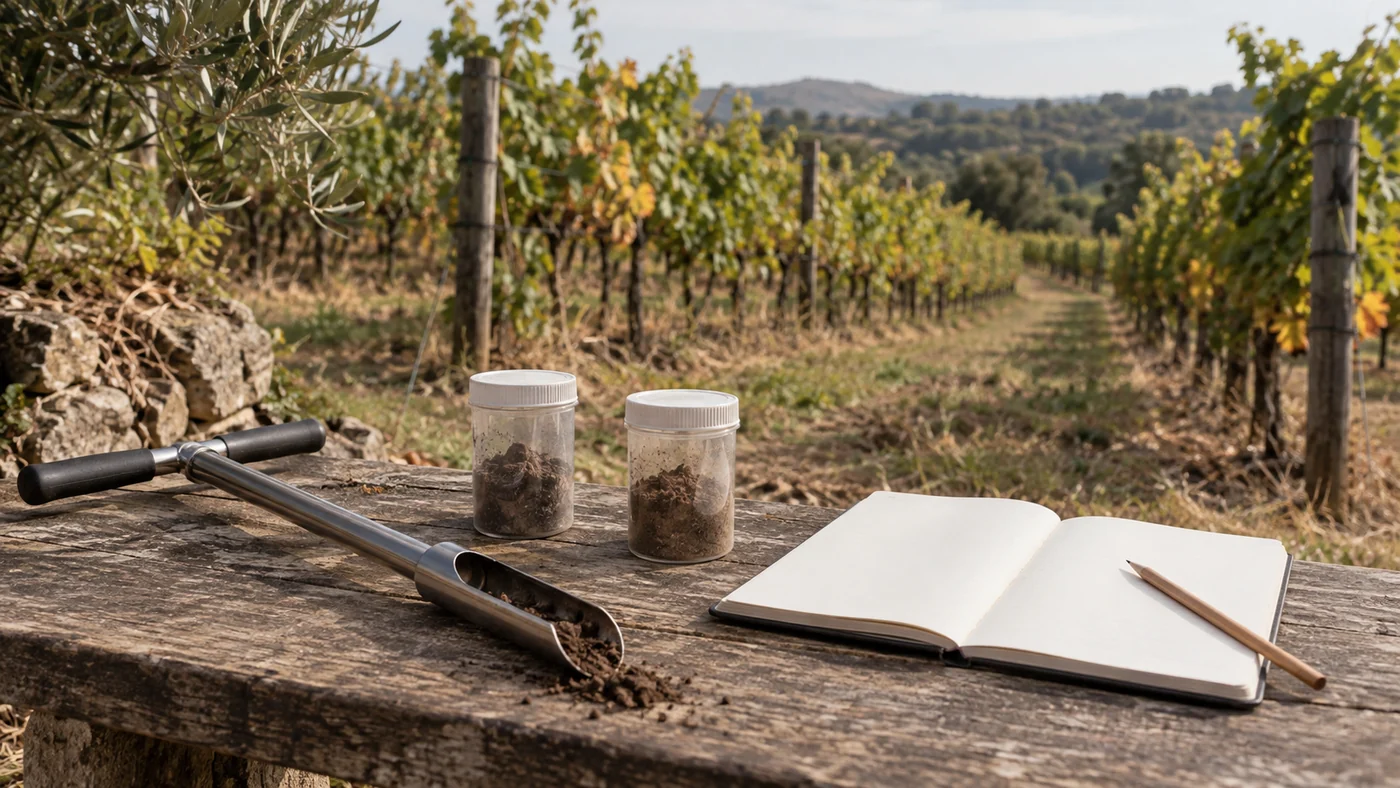
A green photograph is not a before-and-after measurement.
Sustainable should include the people, not just the rows
A vineyard can be photographed without the people who prune, harvest, clean, pack and transport its wine. Sustainability cannot be understood quite so selectively.
The OIV’s principles combine environmental, social and economic dimensions and address cultural context, working conditions, resource use and long-term viability. They are guidance for sustainable vitiviniculture, not a certification issued by the OIV to every bottle using the word. OIV-CST 518-2016
Specific programs translate such concerns into different requirements. Ask whether a claim concerns a vineyard, a winery, a business or a finished product.
For example, the Certified California Sustainable Winegrowing bottle logo requires wine from a certified winery, at least 85% of its grapes from certified vineyards and 100% California grapes. Wine Institute describes annual third-party audits and performance measures for participating operations. That 85% requirement should not be retold as 100% certified fruit. Wine Institute’s program explanation
A winery’s certification is meaningful within its scope. It is not automatically a certificate for every supplier, every environmental metric or every product the company might sell.
The right response is neither automatic trust nor automatic suspicion. It is to find the boundary of the verified claim.
Natural and vegan belong on different lines
The natural-wine discussion from our earlier article concerned production philosophy, particular schemes and cellar choices. It should not become a shortcut for organic, biodynamic, regenerative or sustainable certification.
Vegan answers another question again. Wine processing can involve animal-derived fining agents, including egg albumen, milk-derived casein and gelatin; other materials, such as bentonite, have different origins. The grape’s identity alone cannot establish the processing history. AWRI: fining agents
Vegan Action’s certification criteria explicitly address animal-derived ingredients and processing, including clarification of wine. Those are the conditions of a named scheme, not evidence of organic farming or a measured carbon footprint. Vegan Action’s criteria
Demeter’s wine section, meanwhile, allows certain egg- and milk-derived fining materials and sulfur dioxide within its conditions. Biodynamic therefore does not automatically mean vegan or no-added-sulfites. Demeter 2026, section 7.12
Keep each question separate. A dietary preference, an agricultural commitment and a cellar practice may all matter to one person without becoming interchangeable claims. None of these words should be used as an assurance that someone will not experience a reaction.
The bottle’s journey continues after the vineyard
A photograph of healthy soil does not show glass production, cellar energy or transport.
The Australian wine-industry life-cycle assessment, undertaken by AWRI and funded by Wine Australia, identified packaging, electricity, vineyard diesel and transport among important emissions contributors. It evaluated a defined production and distribution system; it did not assign an identical footprint to every bottle in every country. Wine Australia’s project and final report
For a consumer, this widens the conversation without turning shopping into a calculation exercise. A producer may have strong farming commitments and still have unanswered packaging questions. Another may document improvements in transport or energy without claiming an organic certificate.
An honest comparison needs the same boundary: vineyard only, winery operations, or a life cycle extending further. Otherwise, two attractive numbers may describe different things.
The purpose is not to punish a producer for failing to fit everything on a label. It is to avoid giving one verified achievement responsibility for an entire system.
The wine leaves the vineyard. Its environmental story does not stop there.
Does any of this tell you how the wine will taste?
Production matters. But how it was made, how well a claim is supported and how much you enjoy it remain separate questions.
None of the standards described here gives you a compulsory aroma, acidity, sweetness, tannin level or preferred drinking temperature. Do not turn an agricultural term into a tasting note before opening the bottle.
An original, deliberately simple exercise is to keep two columns in your journal. In the first, record the verified production claims and their sources. In the second, describe the wine as you experience it: perhaps bright fruit, moderate body, a firm finish—or something entirely different.
Do not require either column to impersonate the other.
You are entitled to choose a bottle partly because its verified practices match your values. You are equally entitled to discover that its style is not your favorite. Neither judgment needs to invalidate the other.
The Six-Layer Green Claim Read
This is an Ask Sommelier AI editorial tool, not a certification audit or environmental scoring model. Use it to make a statement more precise.
1. Exact wording
Record what is actually said. Organic wine, made with organic grapes, certified winery and practicing regenerative agriculture are not abbreviated versions of one promise.
2. Scope
Ask what the statement covers: land, grapes, processing, a facility, a cuvée, an entire business or a particular outcome. Scope is the difference between relevant evidence and evidence borrowed from somewhere else.
3. Standard
Identify the named regulation, private scheme or producer protocol. A recognizable word is not the standard itself. Keep the applicable version rather than assuming that every updated webpage changes an existing certificate.
4. Certifier or evidence
Find the certifier, certificate or supporting report. Is the statement independently checked, declared by the producer, based on measured outcomes or still a stated goal? Those are different kinds of support—not automatic synonyms for good and bad faith.
5. Geography and date
Preserve jurisdiction, production location, market and relevant dates. Check whether the document covers this wine, vintage or period. A current company website does not automatically establish the status of an older bottle.
6. What the claim does not prove
Finish the sentence: This supports… but it does not establish… It might support compliance with farming rules without establishing zero residues, a particular flavor, medical suitability or the lowest full-life-cycle impact.
The framework ends with a boundary because that is where an accurate claim becomes trustworthy.
One question can be enough at the table
You do not need to recite six layers to a server.
Try: “When you say sustainable, what is actually certified or documented for this bottle?”
Then ask the usual wine question: “And is it more fresh and light, or richer and more structured?”
Imagine one wine accompanied by a current certificate covering its grapes and another accompanied by a producer’s account of cover-crop trials. These are invented examples, not judgments about real bottles. The first offers a defined verification; the second may offer useful practice information. You still need the scope of the first and the evidence behind the second.
Missing information is not a certificate. It is also not proof that a producer does not care.
For Ask Sommelier AI, the standard should be equally careful: preserve wording, scope, scheme, source, jurisdiction and date separately. Treat unverified claims as unverified. Do not assign an automatic taste, health benefit or universal environmental ranking from a label. These are requirements for responsible assistance, not a claim that the app independently audits wineries.
Return to the shelf with its leaf, its farming philosophies and its promises.
The words can help. They become more useful when they lead to something specific rather than ending the conversation.
Let the claim explain the practice. Let the evidence establish its reach. Let the glass remain a separate conversation.
Our next article asks how a recommendation system can carry those distinctions to the table without disguising uncertainty as expertise: can an AI really taste wine, and what should a trustworthy recommendation mean?
Frequently asked questions
What is the difference between organic and biodynamic wine?
Organic identifies compliance with applicable organic rules. Biodynamic adds a particular farming approach and, where certified, a named scheme’s additional requirements. Demeter is one such system; its certification is not the same as every informal biodynamic claim. USDA · Demeter
Does organic wine contain sulfites?
U.S. organic-wine labeling excludes added sulfites, while made with organic grapes can allow them. European organic wine follows different limits. Read the exact market-specific wording, not an assumed global meaning. USDA · European Commission
Is regenerative wine always organic?
Not every use of regenerative requires organic certification. ROC specifically does require an organic baseline. An informal description and that named certification are different claims. Regenerative Viticulture Foundation · ROC baseline requirements
Does certified sustainable mean every grape is certified?
Check the scheme. The California bottle-logo example discussed here requires at least 85% certified-vineyard grapes, not 100%; its other origin and winery conditions also matter. Do not apply that percentage to another program. Wine Institute
Is biodynamic wine automatically vegan?
No. Demeter’s wine standard permits some animal-derived fining materials. A vegan claim needs its own processing evidence or certification. Demeter, section 7.12 · Vegan Action
Which of these wines should I choose?
Choose the verified commitments that matter to you, then ask about the actual wine’s style, price and occasion. These terms are not a universal order of quality or pleasure. A useful explanation should help you choose without asking one adjective to answer every question.
References
Official and program sources were checked on September 17, 2026. Their scopes and effective dates differ. A link to a standard is not a claim that its organization reviewed this article.
- USDA Agricultural Marketing Service. Organic Standards. Source / Fuente.
- Biodynamic Federation Demeter International. The Demeter Standard. Source / Fuente.
- Regenerative Organic Alliance. Certification Resource Library. Source / Fuente.
- International Organisation of Vine and Wine. Resolution OIV-CST 518-2016 — General Principles of Sustainable Vitiviniculture: Environmental, Social, Economic and Cultural Aspects. Source / Fuente.
- USDA Agricultural Marketing Service. The National List. Source / Fuente.
- USDA Agricultural Marketing Service. Organic Alcohol. Source / Fuente.
- European Commission, Agriculture and Rural Development. Organic Production and Products. Source / Fuente.
- USDA Agricultural Marketing Service. Labeling Requirements for the U.S. Organic Market. Source / Fuente.
- Biodynamic Federation Demeter International. International Demeter Biodynamic Standard — 2026 Edition. Source / Fuente.
- Rienth, M., Lamy, F., Chessex, C., & Heger, T. J.. Effects of Biodynamic Preparations 500 and 501 on Vine and Berry Physiology, Pedology and the Soil Microbiome. Source / Fuente.
- Brando de Lachapelle, M., Ishizaki, Y., Lacampagne, S., & Geny-Denis, L.. Effects of Biodynamic Preparations on Grape Skin Structure and Composition. Source / Fuente.
- Regenerative Viticulture Foundation. About the Regenerative Viticulture Foundation. Source / Fuente.
- Regenerative Organic Alliance. Required Baseline Certifications & Equivalency Assessment. Source / Fuente.
- Regenerative Organic Alliance. Regenerative Organic Certified Framework. Source / Fuente.
- Regenerative Organic Alliance. ROC Framework Revision. Source / Fuente.
- Wine Australia. Cover Crops. Source / Fuente.
- Lazcano, C., and colleagues. Assessing the Short-Term Effects of No-Till on Crop Yield, Greenhouse Gas Emissions, and Soil C and N Pools in a Cover-Cropped, Biodynamic Mediterranean Vineyard. Source / Fuente.
- Australian Journal of Grape and Wine Research. Erratum to the Lazcano and colleagues No-Till Study. Source / Fuente.
- Wine Institute. Certified Sustainable. Source / Fuente.
- Australian Wine Research Institute. Fining Agents. Source / Fuente.
- Vegan Action. Certification. Source / Fuente.
- Wine Australia / Australian Wine Research Institute. Life Cycle Assessment of Australian Wine Industry — Project AWR 2201. Source / Fuente.