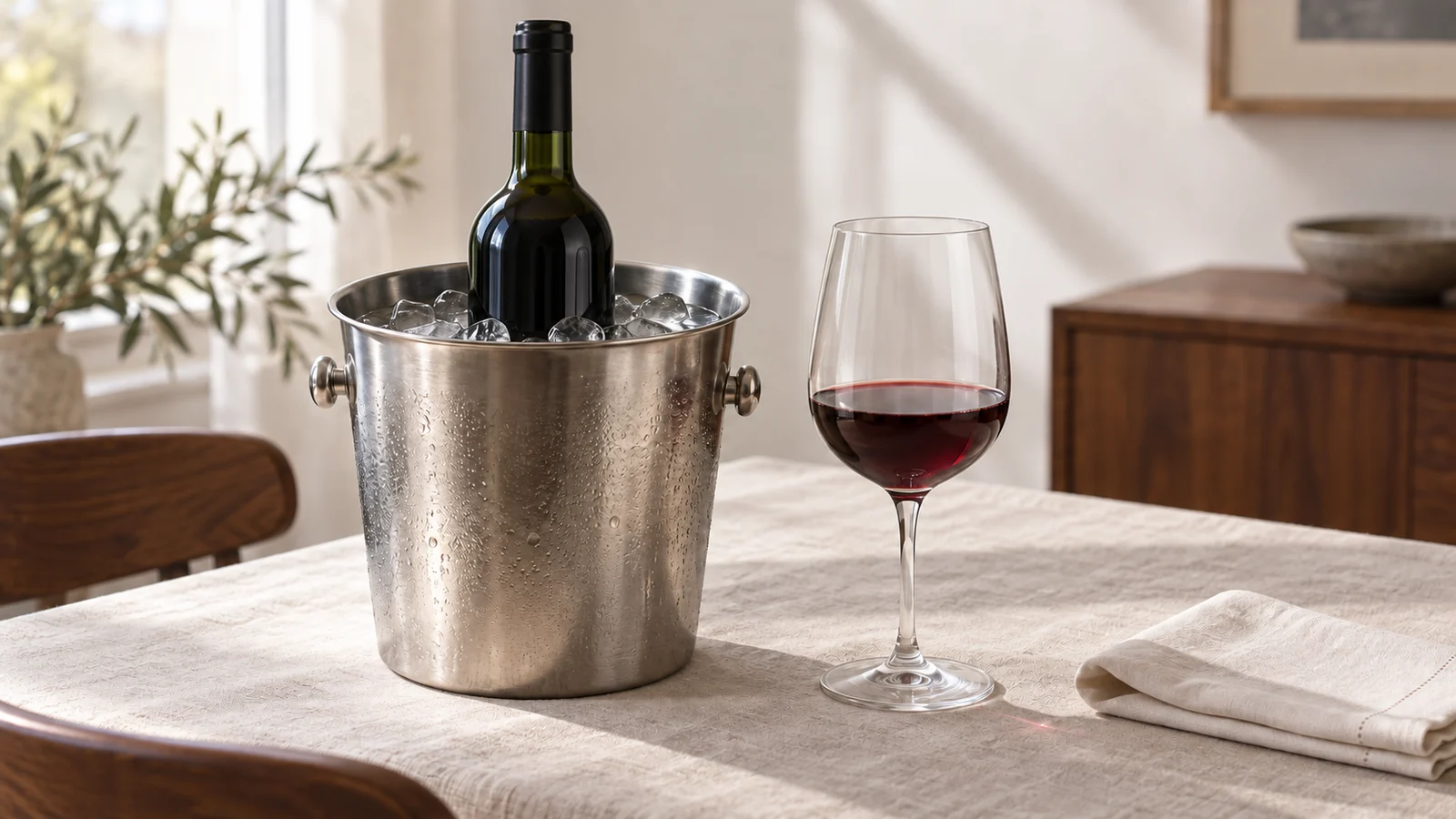
The server brings an ice bucket for the red wine.
Someone at the table looks up. Not alarmed, exactly. More as though a familiar rule has quietly changed while they were reading the menu.
“Isn’t that supposed to stay at room temperature?”
It is a reasonable question. It is also missing a detail: which room?
Imagine a bottle waiting in a warm dining room, and another that has spent hours in a refrigerator. Both are red. One might need cooling; the other might need a little time to warm. The label has not changed. The starting point has.
In the previous Cellar Journal article, we gave the decanter a purpose before assigning it a duration. Temperature deserves the same courtesy. Before deciding how cold a wine should be, ask what you want to notice more clearly—and what you do not want to lose.
Chilling does not turn a red wine into a white. It changes the balance of what we perceive, not the wine’s identity.
The useful question is not whether a red is allowed to be chilled. It is how much cooling helps this bottle, at this table, for this person.
Should red wine be chilled?
Yes, many reds are enjoyable below the temperature of a warm room. But chilled need not mean refrigerator-cold. WSET places the traditional service meaning of room temperature around 15–18°C / 59–64°F, and its guidance recognizes that excessive cooling can leave a full-bodied red seeming thin or harsh. WSET’s service-temperature guide
For a practical first trial, we suggest 12–14°C / 54–57°F for a supple, fruit-led red, with a more modest adjustment for a firm or fuller wine. Those are starting windows, not a universal scoring system. Later, we will separate lighter, intermediate and more structured examples without pretending every grape name comes with a thermostat.
A wine at 24°C and the same wine at 16°C are both possible candidates for the phrase room temperature. They are not the same serving condition. These numbers illustrate the ambiguity; they are not a report of a tasting we conducted.
The improvement may be an adjustment, not a transformation.
What is new about the chilled-red trend?
On June 23, 2026, Google’s Summergeist report, based on U.S. search data, said that “chilled red” had recently reached peak search interest. That is a dated observation about attention—not bottle sales, a worldwide preference, or proof that a new category tastes better. Google’s report
The attention is contemporary. Cool service for red wine is not an invention of the search bar. The Beaujolais wine body recommends 12–14°C for its red Beaujolais category. Official Beaujolais guidance
What the trend usefully challenges is a rigid color rule: white belongs in the cooler; red does not. The risk is replacing that rule with another: every red should now emerge covered in condensation.
A fashionable instruction still needs a reason.
Three temperatures, three different jobs
Storage temperature concerns the bottle before the occasion. Serving temperature is its condition when poured. Drinking temperature is what reaches you during the next few minutes.
Those are not interchangeable targets. The long-term storage question discussed in our refrigerator article should not be answered by a serving chart. Nor does putting an opened red in the refrigerator mean it must be drunk at that same temperature.
There is a second distinction: coldness is a temperature sensation; freshness is a tasting description. Calling a wine fresher does not establish that chilling has created more acid, removed alcohol or repaired damage. Record the observation first: perhaps the finish feels less hot, the fruit seems easier to distinguish, or the drying sensation has become more noticeable.
That is already a more useful note than “cold is better.”
The nose does not receive the whole bottle at once
Aroma depends on what reaches the space above the liquid and then the nose. In experiments on aroma partitioning, changes in ethanol, glucose and other matrix components altered how volatile compounds entered that space. The liquid is not a neutral carrier. Robinson and colleagues, 2009
Temperature adds another variable. Ross and Weller’s trained-panel study evaluated adjusted red wines at 14, 18 and 23°C, alongside a separate white-wine series. Serving temperature significantly affected red-wine aroma intensity. That result supports a perceptual effect; it does not identify one ideal temperature for all red wines. Ross & Weller, 2008
This helps explain a common experience without overexplaining it: a very cold glass may seem less expressive, then become easier to describe as it warms. That does not mean warming has manufactured the fruit you notice. Nor does more total aromatic intensity necessarily mean more pleasure.
For the reader, the practical test is straightforward. When the wine becomes warmer, do you discover useful detail—or merely a louder impression?
Does chilling make tannins harsher?
First separate the terms. Bitterness is a taste. Astringency is the drying, rough or gripping tactile impression. Tannin contributes to the latter, but the sensation is not a direct readout of tannin concentration. Research comparing Cabernet Sauvignon and Carménère with similar tannin contents found different astringency sub-qualities and examined their interactions with saliva. Brossard and colleagues, 2021
Cooling may make a red feel firmer. In a study of six Washington State Lemberger wines, a trained panel of 12 used astringent, sour and bitter descriptions more frequently at 10 and 16°C than at 22°C; cooler samples received fewer aroma descriptors. This was a descriptive experiment, not a finding that 22°C produced the best wine. Ross, Weller & Alldredge, 2012
Notice what that evidence does—and does not—say. It concerns particular wines, tasters and temperatures. It does not demonstrate a fixed increase in astringency for every degree of cooling, or prove that tannin has physically increased.
Our service conclusion is deliberately modest: a wine whose appeal depends on generous fruit around a firm structure deserves a small comparison before deep chilling. If the fruit becomes harder to find and the finish feels less comfortable, allow the sample to warm. There is no prize for following a temperature recommendation after it has stopped helping.
Sourer, sweeter, lighter: name the sensation carefully
Do not turn temperature into a set of imaginary ingredient adjustments.
A wine that tastes sharper has not necessarily acquired more acid. A fruit aroma that suggests sweetness is not a residual-sugar measurement. A wine that feels lighter has not become a lower-alcohol product.
The underlying sensory responses are not equally simple. An experiment using separate sweet, sour, bitter and astringent stimuli at 5 and 35°C found temperature effects on peak perceived intensity for several sensations, but not the sweet stimulus. Those were test solutions, not finished red wines; neither temperature is a proposed service target here. Bajec, Pickering & DeCourville, 2012
The lesson is not to memorize a contrary rule. It is to avoid slogans such as “cold always increases acidity and decreases sweetness” as though they were universal measurements.
Try a more useful description: less aromatic at first; drying finish more apparent; fruit becomes clearer as the glass warms. That is an illustrative note, not a prediction of what your bottle must do.
Alcohol warmth is not alcohol content
Temperature can change the impression of warmth and the balance around it. Cooling a sealed bottle for service, however, is not a dealcoholization process. Do not treat a less hot-tasting glass as permission to assume less alcohol has been consumed.
This distinction also prevents a recommendation error. A relatively high-alcohol red is not automatically unsuitable for modest cooling; neither will ice-cold service automatically make it balanced. The question is whether aromatic expression, texture and warmth work together at the temperature you choose.
Personal responses matter. In a four-wine study, groups differing in thermal-taste status differed in reported sensory intensity, but that status did not predict liking. Feeling more intensely and enjoying more are separate outcomes. This was not a trial to assign each person a preferred serving temperature. Pickering and colleagues, 2010
You are not trying to win a contest for the coldest red. You are looking for a balance you enjoy.
Choose a style, then check the bottle
A supple, fragrant red with gentle tannin is a sensible place to begin exploring cooler service. Gamay and some lighter Pinot Noir styles are useful questions to ask a merchant about—not promises that every example will be delicate or equally chillable.
A named producer’s instructions can make the conversation more concrete. Famille Chermette recommends 12–14°C for its Beaujolais Les Griottes. That is guidance for that wine, not a temperature law covering every cru, vintage or bottle from the region. Producer’s technical page
Do not substitute color for structure. A translucent red can still have a firm finish. Nor should natural, organic, an illustrated label or a low-looking alcohol figure decide the service temperature. Ask about the actual wine: its extraction, maturity, texture, aromatic delicacy and the producer’s intended expression.
A fuller red that has become warm may benefit from cooling without becoming a wine you want to serve deeply chilled. These are two different decisions, and both fit comfortably within good service.
A starting-temperature table—not a verdict
The following is Ask Sommelier AI’s practical service proposal. It draws on WSET’s broad guidance and the cooler Beaujolais examples above; the intermediate band is our working bridge, not an experimentally validated category boundary. Fahrenheit values are rounded.
| What you are trying | Initial comparison window | What to watch |
|---|---|---|
| Supple, fruit-led red with relatively gentle grip | 12–14°C / 54–57°F | Can you still follow the fruit? Does the finish remain comfortable? |
| A red between light and full, or a firmer wine you are cautiously exploring | 14–16°C / 57–61°F | Is freshness increasing without losing aromatic detail? |
| Fuller or firmly structured red that started too warm | 16–18°C / 61–64°F | Does the wine become clearer while keeping its texture and expression? |
These are not certified ideal temperatures or rankings of wine quality. Wine Australia’s consumer guide uses broader, partly warmer ranges, including 17–21°C for full-bodied reds. That difference is a reason to disclose the judgment in a chart, not to invent a universal consensus. Wine Australia’s service guide
A producer’s bottle-specific advice and your observation can justify another starting point. Uncertainty belongs in the table, not in tiny print beneath a promise of perfection.
How long should red wine go in the refrigerator?
A timer measures elapsed time, not the temperature inside the bottle.
A half-full bottle already cool, a full heavy bottle from a warm kitchen and a bottle taken from a cellar do not begin with the same problem. The refrigerator setting and its contents add more variation.
Our practical approach is to check a warm bottle after about ten minutes in the refrigerator, or after three to five minutes in an ice-and-water bath, then continue only as needed. These are early observation checkpoints, not promises that the wine will be ready. A full warm bottle may need substantially longer.
An ice-and-water bath surrounds the bottle more effectively than loose ice alone; WSET explains the role of water in heat transfer. Keep the closure above the water and dry the bottle before opening. A clean food-safe probe in a separate small sample can guide the decision more directly than guessing from the wet glass exterior. WSET
When the wine is too cold, let a small pour warm gently. Avoid microwaves, radiators, hot-water shocks and forgotten freezer sessions. Nothing about this method requires frozen wine, special chemicals or salt in the glass.
Does fast cooling damage the wine?
The cooling-rate question has been tested. Researchers compared refrigerator cooling with a faster ice–water–salt bath for six wines, including two reds. Their sensory tests did not detect differences between the cooling treatments. That does not establish that freezing, repeated extreme cycling or prolonged storage is harmless. Tarasov and colleagues, 2020
So distinguish a wine being temporarily less expressive because it is cold from a bottle having been permanently damaged. Neither diagnose damage from quiet aroma alone nor promise that warming will reverse every possible problem.
Crystals require the same restraint. The AWRI identifies potassium hydrogen tartrate as a possible wine deposit that need not impair quality. An unfamiliar particle is not automatically that compound; suspected broken glass is not something to taste around. AWRI’s crystalline-deposit guidance
The glass keeps moving after service
Serving at a number does not keep the wine at that number.
A 2024 study validated a heat-transfer model against experiments and examined 150 mL in one medium-sized red-wine glass. It found that conduction, convection and radiation all mattered. Its warming curves apply to the studied configuration, not every pour, glass or outdoor table. Kannapinn, Köhler & Schäfer, 2024
That physical limitation becomes a useful service habit: observe what happens after pouring. A bottle initially pleasant can become too warm during a long meal; an overcooled sample can become more expressive while you talk.
Prefer modest pours that can be followed attentively, keep the bottle away from sun and heat, and return it to a cooler briefly when necessary. These are practical suggestions, not a claim that every small pour warms at the same rate. Hold the stem when trying to keep handling comparable. Do not change the glass, swirl, temperature and food simultaneously and then assign the whole result to cooling.
The target is a useful drinking window, not one ceremonially correct instant.
The Five-Factor Chill Read
This is our original editorial framework, not a laboratory assay. It keeps five questions in view.
1. Body. Does the wine feel light, medium or full? Describe its presence rather than estimating it from darkness.
2. Tannin. How firm, fine, drying or rough is the finish? Notice whether cooler service leaves that texture pleasantly defined or more exposed than you enjoy.
3. Alcohol. What does the label report, and how warming does the wine feel? Keep those answers separate.
4. Aroma. Can you still find what makes the wine interesting? More refreshing is not automatically more expressive.
5. Warming curve. What happens between the first observation and the next? Record the actual change rather than assuming the wine improved because it reached a recommended number.
The sequence is body → tannin → alcohol → aroma → warming curve.
Its answer may be to cool more, allow gentle warming, maintain the current condition or leave a delicate bottle alone. It should not require every wine to arrive at the same destination.
A small comparison that teaches more than a rigid rule
Choose one sound red you already know. Ask someone to prepare two equal small pours—about 30 mL each—in identical, clean glasses, aiming for roughly 12°C and 16°C at the start. Record the actual sample temperatures when possible; do not pretend a fridge setting measures the liquid. Serve both close together in time and keep swirling comparable.
These quantities and temperatures are editorial exercise choices, not an optimal dose or a validated sensory protocol. Smelling is useful by itself; tasting need not involve swallowing.
Write separately about aroma, drying sensation, warmth and preference. Then revisit after a few minutes. Did the more aromatic sample also feel more pleasant? Did your preference change as the cooler sample warmed? Which difference could you describe confidently?
Do not claim a blind test: temperature itself is an obvious cue. Order, expectation, time and handling remain involved. The purpose is to learn about one bottle and your response—not to prove that a whole region should be served colder.
Ask for a change without making service a confrontation
A useful restaurant request is simple:
“Could we cool the bottle a little and try a small pour again?”
Or:
“This is a little too cold for me. Could we leave it out of the bucket for now?”
Neither sentence needs a lecture about what all reds ought to be. Good service can adjust without making the guest defend a preference.
Ask Sommelier AI should work the same way: start with the exact wine and available producer guidance, ask what you notice, and keep estimated temperature separate from a measured value. A bottle photo cannot reveal liquid temperature. A recommendation should not invent a fixed refrigerator countdown or confuse refreshing service with lower alcohol.
Return to the ice bucket.
It was not necessarily an exception to the rules. It may simply have been the right tool for that bottle’s starting point.
Cool the wine enough to make it easier to enjoy—not so far that the temperature becomes the whole experience.
Next, we will separate changing how alcohol is perceived from changing how much is present: what happens when alcohol is actually removed from wine?
Frequently asked questions
What temperature should red wine be served at?
Our starting windows are 12–14°C for supple reds, 14–16°C for intermediate exploration and 16–18°C for fuller or firmly structured wines. They are service proposals, not universal optima. WSET and individual producers offer useful reference points; adjust to the bottle and the person. WSET · Chermette
Should Pinot Noir and Beaujolais be chilled?
They are reasonable styles to ask about, but the producer, vintage and structure still matter. The official red Beaujolais recommendation is 12–14°C; it does not assign a temperature to every Pinot Noir or every bottle carrying a related regional name. Beaujolais
Can Cabernet Sauvignon be cooled too?
Yes. Cooling a warm, structured red toward a moderate service range is different from serving it refrigerator-cold. Taste and aroma should guide the adjustment; its grape name does not exempt it from temperature management. WSET
Is twenty minutes in the fridge enough?
Sometimes, but no fixed duration guarantees a target temperature. Start checking rather than treating a timer as a thermometer. The article’s ten-minute refrigerator checkpoint is an editorial suggestion, not a tested cooling curve.
Can I put ice directly in red wine?
You can choose that style of drinking; it is not a test of sophistication. Melting ice also adds water, so cooling and dilution occur together. To explore temperature alone, cool the closed bottle instead. This distinction follows from the method, not a sensory trial of every ice-and-wine combination.
Does colder red wine contain less alcohol or fewer faults?
Ordinary service cooling is not alcohol removal or fault treatment. A change in what you notice should not be mistaken for a change in composition or a safety clearance. Keep any unfamiliar or concerning bottle separate from a preference exercise.
References
Web and bibliographic records checked on September 14, 2026. A link does not imply that all publisher content is unrestricted or that the source endorses this article.
- Wine & Spirit Education Trust. (2022, April 26). Ideal serving temperatures and top tips for wine storage. Source / Fuente
- Lee, J. / Google. (2026, June 23). What’s trending on Google this summer. Summergeist; U.S. Google Trends context. Source / Fuente
- Inter Beaujolais. Beaujolais — official appellation profile and serving guidance. Red-wine section. Source / Fuente
- Robinson, A. L., Ebeler, S. E., Heymann, H., Boss, P. K., Solomon, P. S., & Trengove, R. D. (2009). Interactions between Wine Volatile Compounds and Grape and Wine Matrix Components Influence Aroma Compound Headspace Partitioning. Journal of Agricultural and Food Chemistry, 57(21), 10313–10322. Source / Fuente
- Ross, C. F., & Weller, K. (2008). Effect of Serving Temperature on the Sensory Attributes of Red and White Wines. Journal of Sensory Studies, 23(3), 398–416. Source / Fuente
- Brossard, N., et al. (2021). Astringency sub-qualities of red wines and the influence of wine–saliva aggregates. International Journal of Food Science & Technology, 56(10), 5382–5394. Source / Fuente
- Ross, C. F., Weller, K. M., & Alldredge, J. R. (2012). Impact of Serving Temperature on Sensory Properties of Red Wine as Evaluated Using Projective Mapping by a Trained Panel. Journal of Sensory Studies, 27(6), 463–470. Source / Fuente
- Bajec, M. R., Pickering, G. J., & DeCourville, N. (2012). Influence of Stimulus Temperature on Orosensory Perception and Variation with Taste Phenotype. Chemosensory Perception, 5, 243–265. Source / Fuente
- Pickering, G. J., Moyes, A., Bajec, M. R., & DeCourville, N. (2010). Thermal taster status associates with oral sensations elicited by wine. Australian Journal of Grape and Wine Research, 16(2), 361–367. Source / Fuente
- Famille Chermette. Beaujolais Les Griottes — producer’s wine and service information. Source / Fuente
- Wine Australia / Australian Wine. How to serve wine like an expert. Consumer service guide. Source / Fuente
- Tarasov, A., Wagenitz, J., Pfeifer, W., Schuessler, C., & Jung, R. (2020). Cooling Shock for Bottled Wine. How Dramatic Is This before Tasting? Beverages, 6(4), 62. Source / Fuente
- Australian Wine Research Institute. Crystalline deposits. Technical guidance; use only the identified-deposit information, not the laboratory procedures as home instructions. Source / Fuente
- Kannapinn, M., Köhler, F., & Schäfer, M. (2024). A Validated Thermal Computational Fluid Dynamics Model of Wine Warming in a Glass. Applied Sciences, 14(19), 8997. Source / Fuente