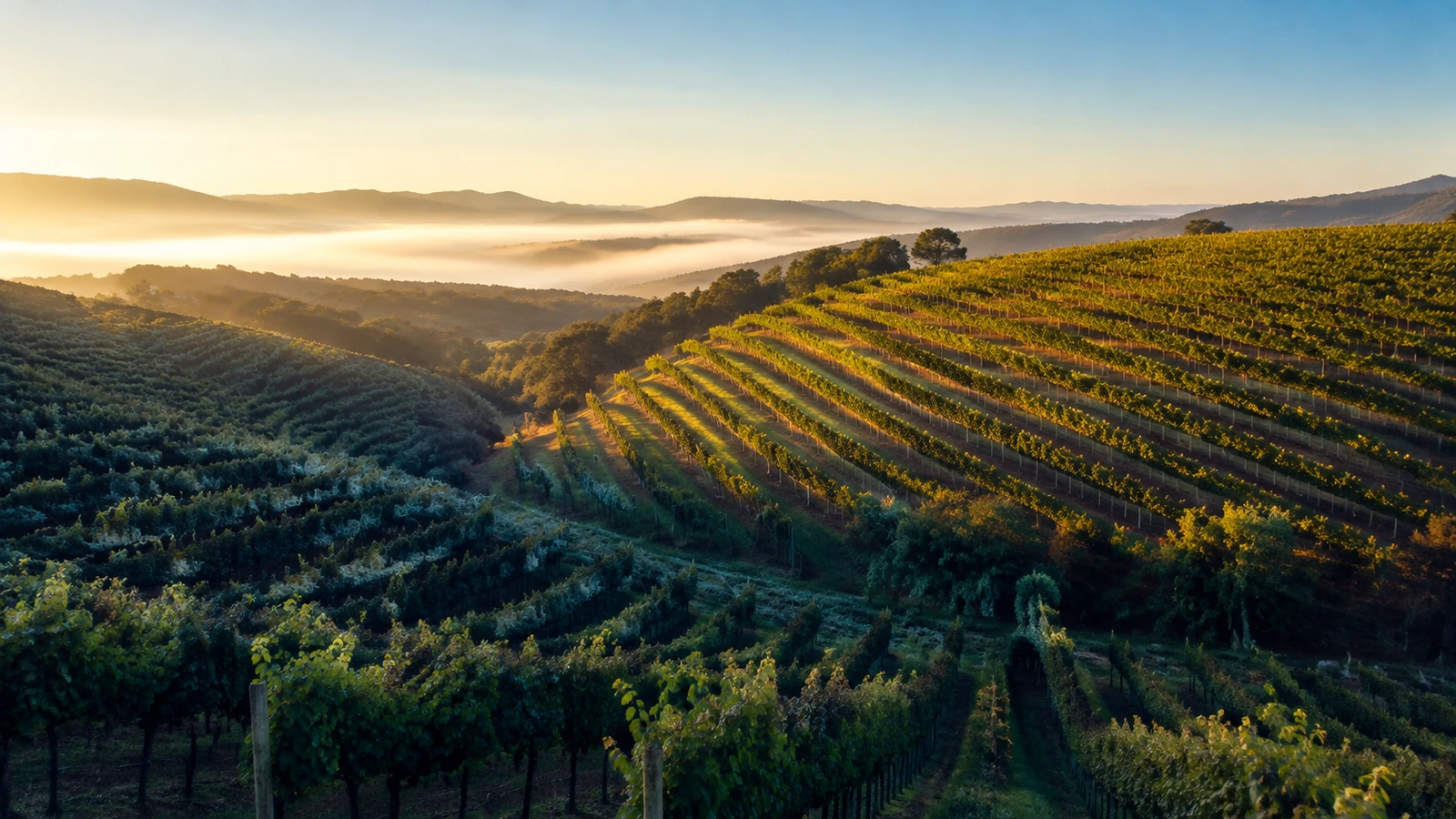
At first light, a hillside divides itself.
The eastern shoulder turns gold. Dew brightens on the leaves. Clusters hidden in the next fold remain in cool blue shade.
Hours later, the difference is no longer simply light versus darkness. One face of the hill has warmed early and begun releasing heat. Another will carry the full weight of the afternoon. A breeze moves across the crest but settles differently in the hollow. Cold air left from the night continues to collect below.
The compass has not changed.
The vineyard has.
In our previous Cellar Journal article, the wine glass became a small environment around a finished wine: bowl, airspace, temperature, movement, and time edited the encounter. A vineyard does something more consequential. It creates a changing environment around the vine before the fruit—and therefore the wine—exists.
That is why growers care about aspect, slope, elevation, row direction, and canopy exposure.
It is also why the familiar sentence “south-facing vineyards are better” is not a rule. In one region, a sun-facing slope may help a late-ripening variety reach maturity. In another, the same exposure may intensify afternoon heat, accelerate sugar, reduce acidity, or raise the risk of sunburn. Reverse the hemisphere and even the basic compass shorthand changes.
The central idea: aspect is not a quality ranking. It is a timetable for energy.
A slope does not taste like a compass point. Orientation matters because it changes when and how solar radiation, warmth, wind, moisture, and cold air reach a site—and because the vine responds to all of them together.
The useful question is not:
Which direction is best?
It is:
What does this exposure ask the vine to live through, in this place, during this season?
The compass is a beginning, not a verdict
Aspect is the compass direction a slope faces. A hillside may face north, south, east, west, or somewhere between.
Slope is its steepness.
Elevation can mean the vineyard’s height above sea level, while relative elevation describes whether a parcel sits high, low, or midway within its immediate landscape.
Row orientation is the direction the vine rows run.
Canopy side is the side of that row—and of the fruit zone—that faces a particular direction.
These terms are related. They are not interchangeable.
A south-facing hillside can carry rows running east–west, north–south, or diagonally. Those rows can be trained tall or low, densely leafed or open. Fruit on one side of the same row may receive direct sun in the morning while fruit on the other side receives it later—or remains protected by leaves.
So when a winery says a vineyard is south-facing, we know one meaningful fact.
We do not yet know the fruit’s complete microclimate.
University of California viticulture guidance defines aspect, slope, and elevation as separate site variables and connects them with solar exposure, water and air drainage, frost, and regional climate. The same guidance recommends warmer exposures in cool Northern Hemisphere conditions while warning that southern and western aspects may overheat fruit in warmer settings (UC Agriculture and Natural Resources).
That is not contradiction.
It is context.
Aspect is a timetable for energy
The sun does not strike every surface at the same angle or at the same hour.
A slope tilted toward the sun can receive more direct radiation than a slope tilted away from it. Steepness changes that angle. Latitude changes the sun’s path. Season changes its height. Clouds, haze, nearby ridges, trees, ground reflectance, and canopy architecture modify what finally reaches the leaves and clusters.
Aspect therefore acts less like a flavor switch and more like a schedule.
It influences:
- when a slope first receives direct light;
- how long it remains illuminated;
- whether the strongest radiation coincides with cool morning air or hot afternoon air;
- how quickly leaves, berries, and soil warm;
- how rapidly dew or rain may dry;
- when photosynthesis is light-limited or heat-limited;
- how much thermal energy accumulates across a day and season.
This schedule can alter vine development and berry composition without producing one inevitable style.
The same amount of sunlight delivered at 9:00 a.m. and 4:00 p.m. is not necessarily the same experience for a grape. The surrounding air, wind, vine water status, and berry temperature may be very different.
Morning light and afternoon heat are not synonyms.
North and south change meaning with hemisphere
In much of the Northern Hemisphere, south-facing slopes generally receive more direct solar energy across the growing season than north-facing slopes. In the Southern Hemisphere, north-facing slopes tend to occupy the warmer solar orientation.
That is the first correction to any global rule about vineyard direction.
The second is that latitude and climate determine whether extra energy is an advantage.
In a cool, high-latitude region, a warmer aspect can help:
- advance development;
- improve the probability of ripening a demanding variety;
- dry moisture earlier;
- reduce some frost or disease pressures under the right local conditions.
In a hot or semi-arid region, protection from the most intense exposure can help:
- reduce berry overheating;
- slow rapid sugar accumulation;
- preserve organic acids;
- limit sunburn;
- protect color or aroma-related compounds that respond poorly to excessive heat.
Official Wine Australia material for the cool Upper Goulburn region, for example, identifies north and north-east slopes as offering the best chance of full ripening—an appropriate Southern Hemisphere inversion of the familiar northern European shorthand (Wine Australia).
The compass only becomes meaningful after we locate the vineyard on the planet.
East and west are different hours of the same day
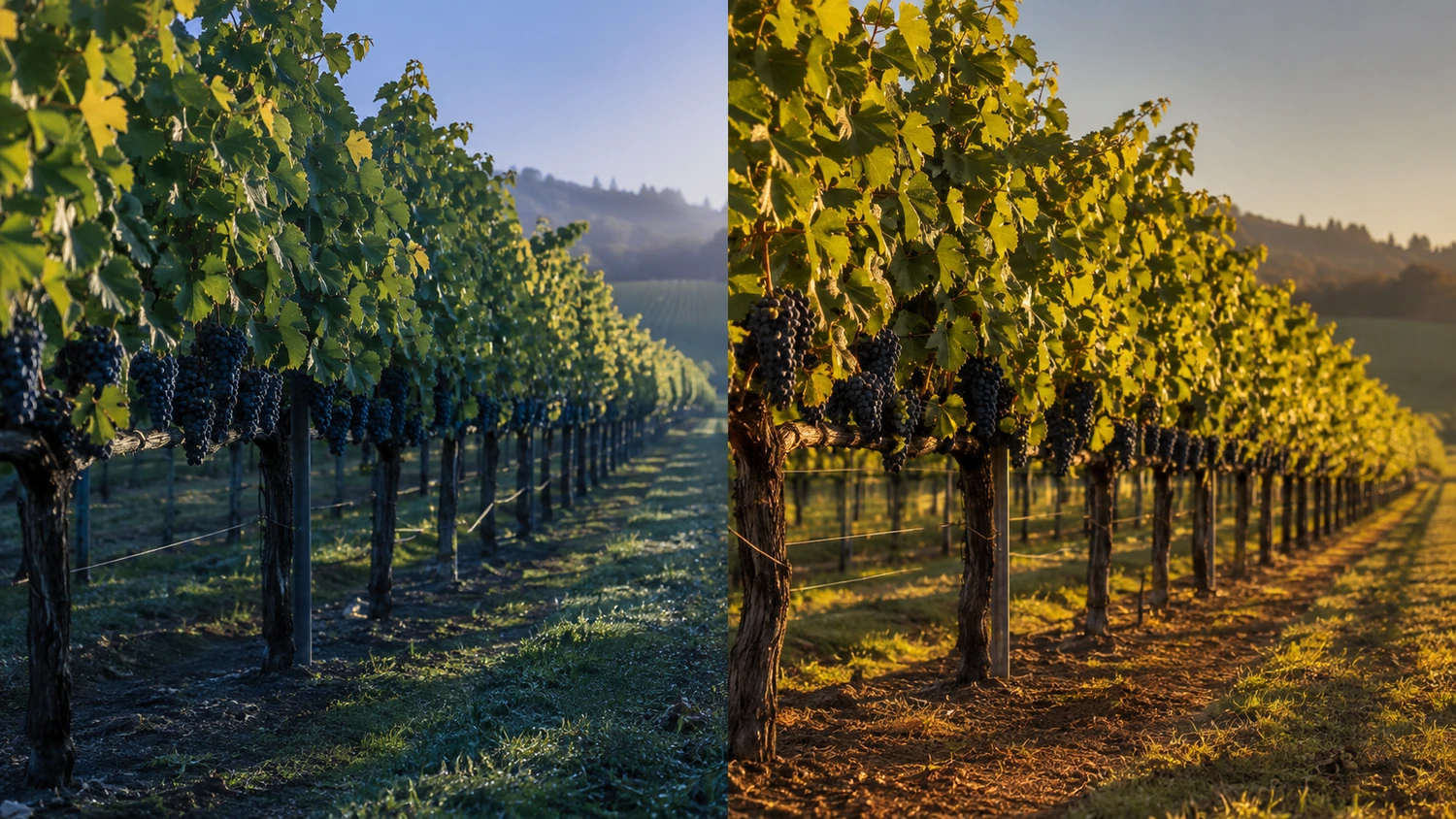
An east-facing slope or canopy side receives direct light earlier. A west-facing one receives it later.
That often leads to an appealing simplification:
- east equals gentle morning sun;
- west equals dangerous afternoon heat.
Sometimes that is directionally useful.
It is not universally true.
UC guidance notes that eastern slopes can warm and dry earlier, while western exposure may increase overheating risk in warm, dry regions. Yet actual berry temperature depends on more than clock time. Wind can remove heat. Leaves can intercept radiation. Humidity changes evaporative conditions. A ridge may block part of the morning or afternoon sky. A wet coastal summer does not behave like a dry continental one.
A 2025 study in Hokkaido illustrates why local measurement matters. During an exceptionally hot summer, east-facing clusters exposed by leaf removal became as much as 10°C warmer than ambient air in the morning. Comparable heating on west-facing clusters was less pronounced in the afternoon, apparently because wind speed was higher then. The usual assumption that east-side leaf removal is always the cooler choice did not hold at that site during those conditions (Murakami, Nemoto & Yamazaki, 2025).
The result does not prove that east exposure is generally hotter than west exposure.
It proves something more useful:
The hour of sunlight cannot be separated from the weather arriving with it.
Slope changes more than the angle of light
A hillside does not merely turn the vineyard toward the sun.
It moves air and water.
Cold air drainage
At night, land surfaces cool. Dense cold air can flow downslope and collect in low areas when the terrain and vegetation permit. Valley bottoms and enclosed depressions may therefore carry greater frost risk than nearby slopes.
A modest incline can be enough to improve cold-air drainage. Steeper ground may accelerate the movement, but barriers—trees, berms, buildings, or topographic pockets—can interrupt it. UC guidance treats local elevation and slope as important frost variables because cold air settles in lower positions and because unobstructed slopes allow drainage (UC Agriculture and Natural Resources).
This is why the lowest point of a vineyard can be colder than land only a short distance uphill.
It is also why “higher” and “warmer” are not always interchangeable.
Water movement
Slope also affects runoff, infiltration, erosion, and soil depth.
On steep land, water may leave the surface more quickly instead of entering the root zone. Soil can be thinner or more variable. Erosion risk increases. In a wet year, drainage may be valuable. In a dry year, the same parcel may experience water deficit sooner.
That does not allow us to conclude that steep slopes create concentrated or superior wine.
Vine water status can influence growth, berry size, photosynthesis, acid and phenolic metabolism, and the timing of ripening. But the effect depends on soil water-holding capacity, rainfall, irrigation, root depth, evaporative demand, variety, rootstock, and when the stress occurs.
A three-year Chardonnay study along a Burgundy hillslope found the most severe water deficit in gravelly soils on steep slopes and related vine water status to must sugars and acids. That result describes a particular toposequence; it does not turn steep, gravelly ground into a universal quality formula (Brillante et al., 2018).
A slope can solve one problem while creating another.
Absolute altitude and relative elevation answer different questions
A vineyard at 700 meters above sea level may be cooler than one at 100 meters within the same broad region.
But a vineyard’s position within its own landscape can matter just as much for frost and air movement.
Consider three parcels at the same absolute elevation:
- one sits on an exposed crest;
- one occupies a mid-slope position;
- one lies in a shallow basin.
They share an altitude.
They do not share a microclimate.
The crest may receive more wind and lose heat rapidly at night. The basin may collect cold air. The mid-slope parcel may sit inside a relatively protected thermal band, depending on terrain and weather.
This distinction is easy to miss when a label proudly prints only the number of meters above sea level.
Altitude is evidence.
It is not the whole site.
Row orientation is not slope aspect
Imagine a flat vineyard.
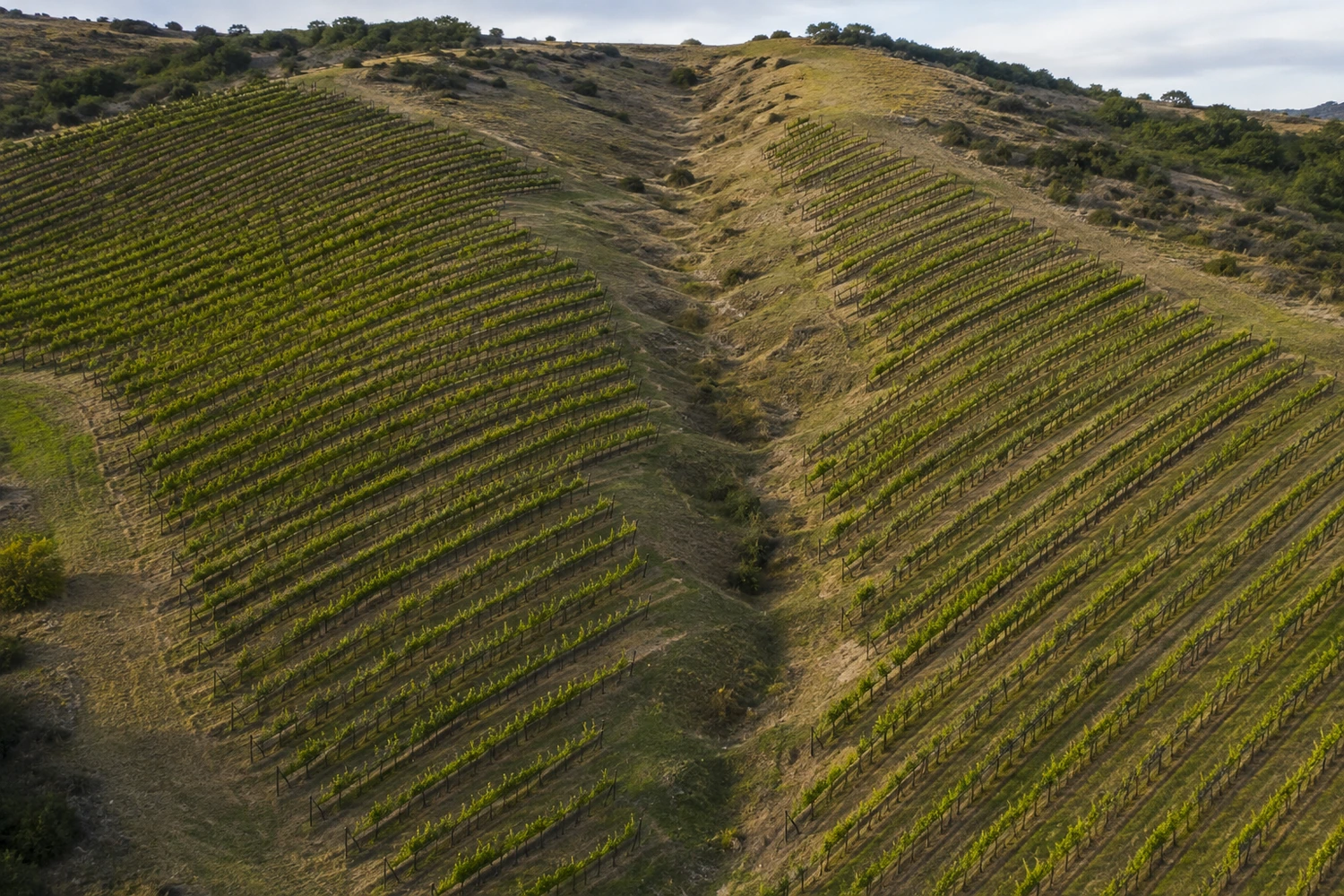
It has no meaningful hillside aspect, yet its rows still face the sun in different ways across the day.
A north–south row tends to expose one canopy side more directly in the morning and the other in the afternoon. An east–west row can create a more persistent contrast between its sun-facing and shade-facing sides, depending on hemisphere, canopy height, season, and solar angle. Diagonal orientations distribute light differently again.
Researchers working with Shiraz planted in north–south, east–west, northeast–southwest, and northwest–southeast rows found distinct spatial and temporal radiation patterns, leaf responses, berry temperatures, and compositional outcomes. Their central lesson was not that one row direction wins everywhere. It was that orientation creates a multi-level canopy environment whose effect depends on the larger climate and management system (Hunter et al., 2020; Hunter et al., 2021).
A later four-season analysis of Syrah phenolics found that row orientations receiving more moderate radiation across the day appeared favorable for several phenolic measures in that experiment, while the authors explicitly warned that a desirable direction may not apply to every environment (Minnaar et al., 2022).
The practical distinction is essential:
Slope aspect describes the land. Row orientation describes the planted geometry. Canopy management decides how much of that geometry reaches the fruit.
Sunlight and heat pull different levers
Sun-exposed berries are often warmer than the surrounding air, but sunlight and temperature are not identical variables.
That distinction matters because grape compounds do not all respond to light and heat in the same way.
A field experiment with Merlot separated solar exposure from berry temperature by controlling cluster temperature under both sun and shade. Sunlight increased certain flavonols, compounds involved in UV response, while high berry temperatures altered anthocyanin concentration and composition. The results showed complex interactions rather than a simple equation in which more sun created more color (Spayd et al., 2002).
A later Merlot study reached a similarly careful conclusion. Moderate combinations of radiation and temperature could support anthocyanin development, while high temperature extremes changed pigment composition and could work against total anthocyanin accumulation under some conditions (Tarara et al., 2008).
This connects directly with what we learned in our article on red-wine color.
A dark berry skin is not simply a solar meter.
Light can stimulate protective pathways. Heat can accelerate, suppress, or redirect them. The outcome depends on intensity, duration, berry temperature, developmental stage, cultivar, water status, and the rest of the canopy.
Exposure is an optimum, not a maximum
Grapevines need light.
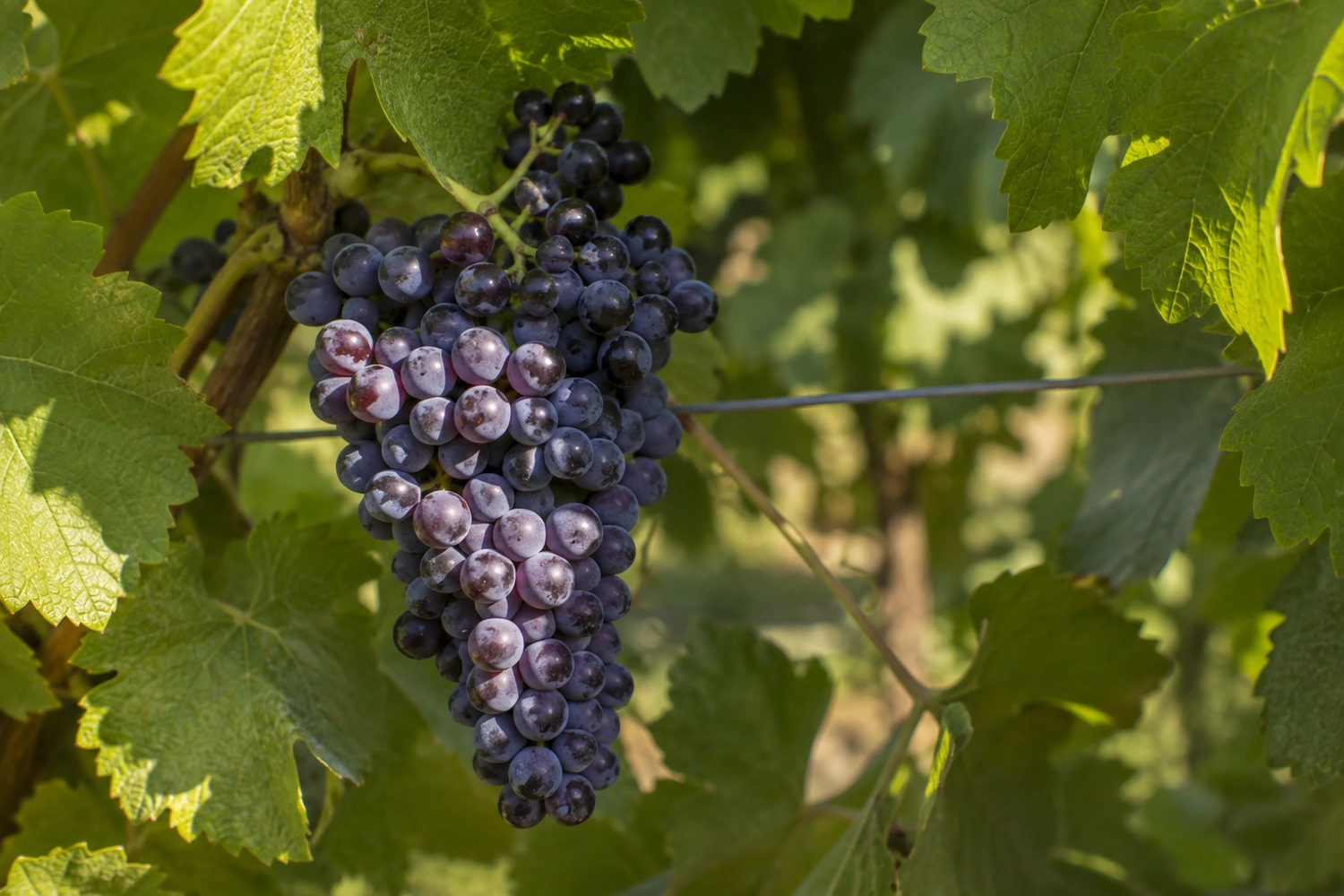
Dense, permanently shaded canopies can reduce photosynthetic efficiency, delay ripening, retain moisture, and alter berry composition. Strategic exposure can improve airflow, spray penetration, color development, and some aroma or phenolic pathways.
But the goal is not to expose every cluster to the greatest possible radiation.
Exposure is an optimum, not a maximum.
Too much direct energy can raise berry-surface temperature far above ambient air. Under warm conditions, that can contribute to:
- sunburn and tissue damage;
- accelerated dehydration;
- faster sugar concentration without equivalent aromatic or phenolic development;
- loss or redistribution of anthocyanins;
- altered organic-acid balance;
- changes in aroma precursors and volatile composition;
- greater physiological stress when heat and limited water arrive together.
In a three-year semi-arid experiment, afternoon shading reduced berry-surface temperature by as much as 4°C, delayed early ripening, preserved more acidity, and changed flavonoid composition. This does not mean vineyards should be permanently shaded. It shows why protection during the hottest part of the day can be a rational tool where heat—not insufficient light—is the limiting problem (Tian et al., 2025).
A 2026 Shiraz field experiment adds another layer. High radiation intensified damage to photosynthetic performance when heat and water deficit occurred together. Irrigation reduced some of that vulnerability, demonstrating that the same exposure can produce a different physiological result depending on water status (Shtai et al., 2026).
The vineyard does not experience sun, heat, and drought as separate chapters.
It experiences them in the same afternoon.
Ripeness is plural
We often talk about ripeness as if it were one number moving toward completion.
It is not.
A grape can accumulate sugar while retaining or losing acids at a different rate. Skin color and tannin development can follow another trajectory. Aroma precursors may respond differently again. Seeds, pulp, skins, and stems do not all mature on one synchronized clock.
Useful distinctions include:
- sugar ripeness — accumulation of soluble sugars and the potential alcohol they may support;
- acid development — the evolution of tartaric and malic acid, pH, and perceived freshness;
- phenolic development — changes in anthocyanins, tannins, flavonols, and related skin or seed compounds;
- aromatic development — formation, loss, or transformation of aroma compounds and precursors;
- physiological condition — berry integrity, hydration, vine function, and stress.
Heat can accelerate some parts of this system faster than others. Elevated temperature has been shown to decouple sugar accumulation from anthocyanin accumulation in red grapes, which helps explain why a berry can taste sweet before its color-related chemistry has followed the same pace (Sadras & Moran, 2012).
This is one reason “more sun means riper grapes” is incomplete.
The grapes may be riper by one measure and less desirable by another.
Aroma lives inside the microclimate
The vineyard’s exposure can also influence the aromatic material that fermentation will later reveal or transform.
That does not mean a compass direction creates one guaranteed aroma.
It means light, shade, heat, and vine physiology can alter the available precursors and metabolites.
Pepper under the leaves
Rotundone is a compound strongly associated with the black-pepper character of Shiraz and several other varieties. In a within-vineyard study, the highest rotundone concentrations occurred in cooler, shaded berry sectors and higher-vigor areas. Berry temperatures above 25°C were negatively associated with rotundone concentration in that experiment (Zhang et al., 2015).
That is not a universal command to shade all Shiraz.
It is an example of why a warmer, more exposed parcel may not simply produce “more aroma.” It may favor a different aromatic direction.
Herbaceous, fruity, and heat-derived differences
A 2024 Cabernet Sauvignon study compared the two canopy sides of vineyards with four row orientations. On average, the shaded sides received less radiation and experienced fewer high-temperature days. Herbaceous, grassy, and woody odors were more abundant in grapes and wines from shaded sides, while exposed and heat-stressed sides showed different patterns in terpenoids and norisoprenoids. Primary metabolites such as sugars changed less than several aroma-related compounds (Lu et al., 2024).
The finding is useful because it shows that two sections of one vineyard can converge in basic maturity while diverging aromatically.
The vine is connected.
Its microclimates are not identical.
The same compass point can produce different outcomes
Suppose two vineyards are both west-facing.
One lies at high latitude near a cooling body of water, on deep soil with dependable moisture and regular afternoon wind.
The other lies inland in a semi-arid region, on shallow soil, during a heatwave with limited water.
The compass direction is the same.
The vine’s experience is not.
The first site may use late light to support ripening without severe thermal stress. The second may combine direct afternoon radiation, hot air, warm soil, and water deficit at the most vulnerable moment of the day.
Now change the canopy.
One grower retains leaves around the western fruit zone. Another removes them. A third leans the canopy, changes row height, applies shade cloth, adjusts irrigation, or harvests the two sides separately.
Aspect sets conditions.
Viticulture interprets them.
This is why site descriptions should never be read as destiny. A vineyard is an interaction among fixed features and human decisions:
- latitude and hemisphere;
- aspect and slope;
- absolute and relative elevation;
- soil depth and water capacity;
- seasonal weather;
- row orientation and spacing;
- trellis and canopy architecture;
- variety, clone, rootstock, and vigor;
- crop level and harvest objective;
- the grower’s response to the vintage.
No single factor disappears.
No single factor earns the right to explain everything.
Does a steeper, sunnier slope make better wine?
It can make a different site.
“Better” requires a separate argument.
A three-year study of Touriga Nacional across eighteen Douro plots found that aspect and elevation influenced yield and aspects of berry composition, including phenolic measures. The patterns, however, varied with year and did not collapse into a universal topographic hierarchy (Oliveira & Correia, 2008).
Research in other regions reaches the same broad lesson through different routes: topography can matter, but its signal depends on scale, season, variety, and what the study measures.
A 2020 analysis of Chablis compared digital topography with 6,850 crowdsourced wine scores. It found no strong evidence that topography explained quality differences within the region, although slope gradient remained a possible but insufficiently demonstrated influence. The study did not test whether topography changed wine character; it tested whether topographic variables could explain consumer scores under a design with important confounders, including appellation and producer (Biss, 2020).
This distinction is vital.
A site can influence style without guaranteeing a higher score.
A prestigious slope can also contain better-funded viticulture, stricter rules, older reputations, different yields, or more skilled producers. Those factors are not erased when we calculate aspect.
The careful conclusion is not that topography is irrelevant.
It is that topography should not be converted directly into a quality grade.
Climate change is moving the optimum
The “best” historical exposure was often the one that solved a historical limitation.
In a cool region, the limitation may have been insufficient warmth. A sun-facing slope, open canopy, and late-afternoon energy could improve the probability of reaching maturity before autumn rain or frost.
As growing seasons warm, the limitation may shift.
The same parcel may now reach sugar targets earlier, experience hotter berry temperatures, lose acid faster, or require more protection around the fruit. A cooler aspect that once struggled may become more valuable. Row orientation, leaf removal, shading, irrigation, and harvest timing may need to change even though the hillside itself does not move.
This is not a prediction that every cool slope will become superior.
It is a reminder that site value is relational.
A vineyard does not face south in isolation. It faces a latitude, a season, a sky, and a climate.
The next Cellar Journal article will stay with this problem: what happens when the place keeps its name, but the vintage conditions used to interpret that place are no longer stable?
The Seven-Layer Exposure Read
Vineyard language becomes useful when we read it in layers rather than as prestige shorthand.
The Seven-Layer Exposure Read is an original Ask Sommelier AI framework for evaluating a site description. It is not a laboratory protocol and cannot predict a wine from a map alone. Its purpose is to slow down causal overreach.
1. Hemisphere and latitude
Which side of the equator is the vineyard on, and how high or low is the sun during the growing season?
A “sun-facing” direction changes with hemisphere. Latitude changes the intensity, day length, and seasonal path behind the shorthand.
2. Aspect and slope angle
Which way does the land face, and how steeply?
Aspect influences timing and angle of solar energy. Slope also affects cold-air and water movement. Neither tells us the final berry temperature by itself.
3. Daily timing
Does direct exposure arrive mainly in the morning, at midday, or in the afternoon?
Ask what the air temperature, wind, and vine water status are likely to be during that period.
4. Altitude and landscape position
What is the elevation above sea level, and where does the parcel sit relative to nearby land?
A high valley bottom can collect cold air. A lower coastal slope can remain cool through wind and maritime influence. The printed altitude is only one coordinate.
5. Soil and water
How deep is the soil? How quickly does water drain? How much can the root zone store? Is the vineyard irrigated?
Exposure under adequate water is not physiologically equivalent to exposure during drought.
6. Rows and canopy
Which direction do the rows run? Which canopy side receives direct sun? How much leaf cover surrounds the clusters? What trellis, height, spacing, and leaf-removal strategy are used?
The planted architecture can amplify or soften the land’s exposure.
7. Vintage, variety, and goal
Was the season cool, wet, dry, windy, or marked by heatwaves? Is the variety early- or late-ripening? Is the producer seeking freshness, color, pepper, concentration, sparkling-wine acidity, or another style?
There is no useful definition of “ideal exposure” without naming the goal.
A precision table for vineyard claims
| Site clue | Plausible contribution | What it does not prove |
|---|---|---|
| Sun-facing slope in a cool region | Greater seasonal energy and improved ripening probability | Superior quality, exact alcohol, or full phenolic maturity |
| Cooler-facing slope in a warm region | Reduced heat load and potentially slower ripening | High acidity, elegance, or freedom from heat stress |
| East-facing exposure | Earlier direct light and potentially earlier drying | Always cooler fruit or lower disease pressure |
| West-facing exposure | Later direct light, sometimes coinciding with warmer air | Overripe grapes or damaged wine |
| Steep slope | Different solar angle, faster air or water movement, possible thinner soils | Concentration, minerality, prestige, or better drainage under every condition |
| High altitude | Different temperature, radiation, wind, and diurnal conditions | A fixed degree of freshness or a universal temperature reduction |
| Mid-slope position | Potential cold-air drainage and reduced basin frost exposure | Guaranteed frost protection |
| Open fruit zone | More light and airflow around clusters | Better aroma, color, or health in all climates |
| Shaded fruit zone | Lower direct radiation and possibly cooler berries | Delayed maturity or herbaceous wine in every variety |
| North–south rows | Alternating morning/afternoon exposure of canopy sides in many settings | Uniform exposure or an automatic quality advantage |
The table is intentionally asymmetric.
Every clue can support a plausible interpretation.
None can complete the story alone.
How to read a vineyard claim on a label
When a producer mentions steep south-facing slopes, cool eastern exposure, or high-altitude terraces, do not dismiss the language.
Ask it to become more specific.
A useful reading sequence is:
- Locate the site. Hemisphere, latitude, regional climate, and nearby geographic influences.
- Identify the problem the exposure may solve. Insufficient warmth, excessive heat, frost, moisture, waterlogging, slow drying, or rapid ripening.
- Separate land from rows. Which way does the slope face, and which way do the vines run?
- Look for management. Canopy, irrigation, yields, harvest timing, and protection from heat or frost.
- Check the vintage. A valuable exposure in a cool year may become demanding in a hot one.
- Translate to style cautiously. Use words such as may, plausibly, and in this context until tasting and production evidence support more.
The label gives you an invitation to investigate.
It does not give you a causal certificate.
What this means for Ask Sommelier AI
A responsible recommendation system should never convert south-facing, high-altitude, or steep slope directly into better.
Those descriptors belong inside a contextual model.
If a producer identifies a west-facing parcel, Ask Sommelier AI should ask, explicitly or internally:
- Northern or Southern Hemisphere?
- Cool, moderate, or hot region?
- What happened in this vintage?
- What variety is planted?
- Is there afternoon wind?
- What is the altitude and water context?
- How is the fruit zone managed?
- Does the producer provide measured or historical evidence for the style claim?
Only then can the site information help explain why a wine may lean toward slower or faster ripening, higher or lower freshness, darker or lighter phenolic expression, or a particular aromatic profile.
The app helps with the choice.
The Journal protects the chain of reasoning.
Frequently asked questions
Are south-facing vineyards always better?
No. In much of the Northern Hemisphere, south-facing slopes receive more solar energy and can help ripening in cool climates. In warm regions or hot vintages, the same exposure may raise heat stress or accelerate ripening. In the Southern Hemisphere, north-facing slopes occupy the more sun-facing orientation. Quality depends on the complete site, season, variety, and management.
Is an east-facing vineyard always cooler than a west-facing vineyard?
Not always. East-facing land receives morning light; west-facing land receives later light that often coincides with warmer air. Wind, cloud, humidity, canopy shade, terrain, and water status can reverse or reduce the expected thermal difference.
Do steep slopes produce better wine?
Steepness can affect radiation, cold-air drainage, runoff, erosion, soil depth, and vineyard work. It can influence vine performance and wine style, but it does not guarantee quality. Some research finds topographic effects on grape composition; other work cannot explain wine scores from topography alone.
Is vineyard aspect the same as row orientation?
No. Aspect is the direction the land faces. Row orientation is the direction the planted rows run. A single hillside aspect can contain multiple row directions, and each row creates different sun and shade patterns on its two canopy sides.
Does more sun always mean riper grapes?
More energy can increase sugar accumulation or advance development when light and warmth are limiting. Excessive exposure can also overheat berries, contribute to sunburn, alter acids, pigments, and aromas, and decouple sugar from other forms of maturity. Ripeness has several dimensions.
Why are mid-slope vineyards often valued?
Mid-slope positions may avoid some cold-air accumulation found at valley bottoms while receiving less wind exposure than a crest. But the result depends on the shape of the terrain, barriers to airflow, elevation, soil, and local weather.
Does high altitude automatically make wine fresher?
No. Altitude can change temperature, radiation, wind, and daily temperature range, but latitude, aspect, cloud, maritime influence, and vineyard management also matter. A printed altitude cannot predict acidity or style by itself.
Can canopy management compensate for a difficult aspect?
It can modify the fruit-zone microclimate through leaf retention or removal, trellis choice, shading, row height, and irrigation. It cannot change the slope’s compass direction, but it can amplify or soften how that exposure reaches leaves and berries.
The hillside has not moved. The meaning has.
Return to first light.
One side of the hill enters the sun. Another waits. By afternoon, a different face carries more heat, and the breeze has changed the consequence of every exposed leaf.
The compass remains fixed.
The vine experiences a sequence.
That sequence is written through budbreak, flowering, berry growth, color change, acid loss, sugar accumulation, aromatic development, and harvest. It is edited by water, wind, soil, canopy, and the decisions of the grower.
A vineyard is not great because it points in a prestigious direction.
It becomes meaningful because its exposure suits—or challenges—the life of the vine in a particular place and year.
Aspect is not a verdict. It is the schedule. The wine begins in how the vine lived through it.
References
- UC Agriculture and Natural Resources. Vineyard Location: Elevation, Slope, and Aspect.
- Wine Australia. Upper Goulburn — Regional Climate and Site Selection.
- Hunter, J. J. K., Tarricone, L., Volschenk, C., Giacalone, C., Melo, M. S., & Zorer, R. (2020). Grapevine Physiological Response to Row Orientation-Induced Spatial Radiation and Microclimate Changes. OENO One, 54(2).
- Hunter, J. J. K. et al. (2021). Grapevine Row Orientation Mediated Temporal and Cumulative Microclimatic Effects on Grape Berry Temperature and Composition. Agricultural and Forest Meteorology, 310, 108660.
- Minnaar, P. P. et al. (2022). Grapevine Row Orientation, Vintage and Grape Ripeness Effect on Anthocyanins, Flavan-3-ols, Flavonols and Phenolic Acids: I. Vitis vinifera L. cv. Syrah Grapes. OENO One, 56(1).
- Spayd, S. E., Tarara, J. M., Mee, D. L., & Ferguson, J. C. (2002). Separation of Sunlight and Temperature Effects on the Composition of Vitis vinifera cv. Merlot Berries. American Journal of Enology and Viticulture, 53(3), 171–182.
- Tarara, J. M., Lee, J., Spayd, S. E., & Scagel, C. F. (2008). Berry Temperature and Solar Radiation Alter Acylation, Proportion, and Concentration of Anthocyanin in Merlot Grapes. American Journal of Enology and Viticulture, 59(3), 235–247.
- Sadras, V. O., & Moran, M. A. (2012). Elevated Temperature Decouples Anthocyanins and Sugars in Berries of Shiraz and Cabernet Franc. Australian Journal of Grape and Wine Research, 18(2), 115–122.
- Zhang, P. et al. (2015). Within-Vineyard, Within-Vine, and Within-Bunch Variability of the Rotundone Concentration in Berries of Vitis vinifera L. cv. Shiraz. Journal of Agricultural and Food Chemistry, 63(17), 4276–4283.
- Lu, H.-C. et al. (2024). Volatilomics of Cabernet Sauvignon Grapes and Sensory Perception of Wines Are Affected by Canopy Side in Vineyards with Different Row Orientations. Food Chemistry, 460, 140508.
- Murakami, K., Nemoto, M., & Yamazaki, T. (2025). Should Leaves Be Removed on the East or the West? Diurnal Patterns of Cluster-Zone Microclimate and Leaf Photosynthesis in Hedgerow Grapevines during an Extraordinarily Hot Summer in Hokkaido in 2023. Journal of Agricultural Meteorology, 81(1), 2–11.
- Tian, M.-B. et al. (2025). Afternoon Shading Delays Ripening and Modifies Grape Flavonoids and Wine Composition under Natural Heat Stress in Semi-Arid Regions. Food Chemistry: X, 29, 102831.
- Shtai, W., Bonada, M., Edwards, E., Wohlfahrt, G., Tagliavini, M., & Petrie, P. (2026). Physiological Response of Grapevine (cv. Shiraz) to Drought, Light Exposure and Heat Stress. OENO One, 60(2).
- Oliveira, M., & Correia, M. J. (2008). The Effects of Aspect and Altitude on the Development and Composition of Touriga Nacional Grapevines. OENO One, 42(2).
- Biss, A. J. (2020). Impact of Vineyard Topography on the Quality of Chablis Wine. Australian Journal of Grape and Wine Research, 26(3), 247–258.
- Brillante, L., Mathieu, O., Lévêque, J., van Leeuwen, C., & Bois, B. (2018). Water Status and Must Composition in Grapevine cv. Chardonnay with Different Soils and Topography and a Mini Meta-Analysis of the δ13C/Water Potentials Correlation. Journal of the Science of Food and Agriculture, 98(2), 691–697.