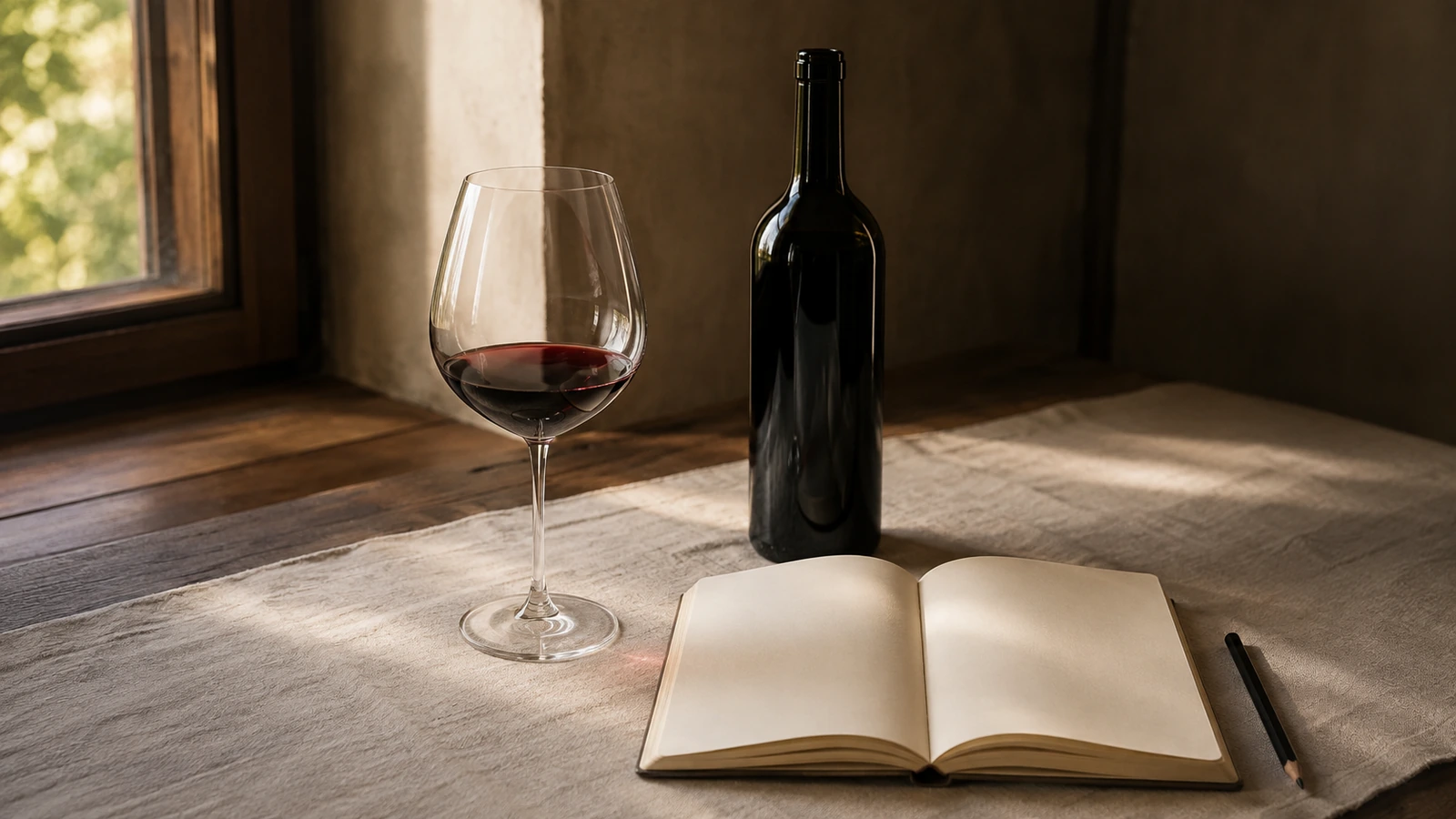
There is a small pause at almost every wine table.
The cork is out. The label has been turned toward the light. Someone pours, everyone looks into the glass, and then a question appears—sometimes aloud, sometimes not:
What am I supposed to notice?
It sounds like a question about aroma or flavor. Often, it is also a question about permission.
Am I allowed to trust my own reaction before someone more knowledgeable tells me what the wine is supposed to be?
The Cellar Journal begins there.
Wine becomes more interesting when knowledge removes anxiety instead of adding performance.
This is a journal about bottles, certainly. But it is also about the person opening them: what memory brings to the glass, how language shapes perception, why evidence sometimes corrects a beautiful story, and how understanding more can make wine feel less intimidating—not more.
Wine without the performance
Wine has accumulated an enormous vocabulary.
Vintage. Terroir. Tannin. Typicity. Minerality. Reduction. Structure. Prestige. Scores.
These words can be useful. They can also make a simple human pleasure feel like an examination for which everyone else received the study guide.
We are not interested in pretending expertise does not matter. It does. Farming matters. Chemistry matters. Cellar decisions matter. History, law, geography, memory, and technique all leave traces in the experience of a wine.
But expertise should make the table larger.
It should help a curious drinker understand why a Sauvignon Blanc can feel vivid, why one Cabernet seems firm while another feels plush, why a bottle changed overnight, or why a familiar aroma refuses to produce a name.
It should never be used to make someone feel small for saying, honestly, I like this one more.
The purpose of the Cellar Journal is not to give you a more impressive vocabulary than the person sitting beside you.
It is to give you better questions.
Evidence does not diminish the pleasure
Wine is full of explanations that sound beautiful because they compress a complicated experience into one sentence.
Sometimes that sentence is useful.
Sometimes it asks the glass to prove more than the glass can support.
An aroma can be real without revealing a single, certain cause. A mineral impression can be meaningful without proving that a named rock traveled intact from the vineyard into the wine. A brick-colored rim can suggest evolution without revealing an exact age. A cold bottle can seem muted without having been damaged.
The useful distinction is always the same:
What did we observe, and what does that observation truly allow us to conclude?
That question will guide this journal.
When research is clear, we will show it. When credible sources disagree, we will explain the disagreement. When a conclusion is plausible but not proven, we will say so. And when a traditional wine word remains useful even though its mechanism is uncertain, we will not discard it merely to sound modern.
Evidence does not remove the romance from wine.
It protects the romance from becoming misinformation.
Your palate is not an error message
Two people can share a bottle and experience it differently.
One notices blackcurrant. Another thinks of guava paste. One enjoys the wine’s grip. Another finds it tiring. One remembers a special dinner. Another remembers the price.
Not every interpretation is equally supported as a factual claim. But preference is not a factual error waiting to be corrected.
Your palate has a history.
It has learned from the foods you grew up with, the aromas you can name, the textures you seek, the bitterness you tolerate, the acidity you enjoy, the occasions you remember, and the bottles that surprised or disappointed you.
Ask Sommelier AI was built around that simple respect: a useful recommendation should not begin with what an abstract drinker ought to prefer. It should begin with the person who will actually taste the wine.
The goal is not to replace your palate with an algorithm.
The goal is to help you understand it—and to make better use of it when the wine list is long, the cellar is full, the guests disagree, or the label tells you almost nothing you can use.
What you will find here
Some articles will begin with a sensory mystery.
Why can an aroma feel completely familiar and still remain impossible to name? Where do notes of grapefruit, pepper, vanilla, butter, leather, or dried fruit come from if none of those things were added to the wine?
Others will begin with a practical argument at home.
Does the refrigerator ruin red wine? What does the color of an older bottle actually reveal? When should a wine be decanted? How long can an opened bottle remain expressive? Which changes indicate evolution, and which suggest decline?
We will move between the vineyard, the cellar, the bottle, and the mind.
We will explore grapes and fermentation, glassware and serving, climate and vintage, classification and history, restaurants and home cellars. We will also show parts of the work behind Ask Sommelier AI: how we think about evidence, uncertainty, explanation, and the difference between a confident recommendation and a confident-sounding guess.
Not every article will tell you what to drink.
Some will help you recognize what a bottle cannot tell you on its own.
How we will earn your trust
The Cellar Journal will not ask a score to do the work of a conversation.
Scientific and historical claims will be linked to sources readers can inspect. Sensory observations will not be disguised as laboratory proof. Producer information will be used for that producer’s wine—not stretched into a universal rule. Uncertainty will remain visible rather than being edited away for a cleaner headline.
English and Spanish will receive the same care. One language will not be treated as the original and the other as an afterthought.
And we will preserve one discipline throughout every subject:
Ask Sommelier AI separates what the glass supports from what the story invites us to believe.
That does not mean wine must become cold or clinical.
It means curiosity deserves honesty.
The app helps you choose. The Journal stays for the why.
A recommendation often has to arrive in a real moment.
You are seated at a restaurant. Dinner is coming. The list contains eighty bottles. Your budget matters. Your companion dislikes heavy tannin. You remember enjoying a wine from Rioja, but not which one.
That is where the app belongs: close to the decision, aware of the context, and accountable to your palate.
The Journal has a different pace.
It stays with the question after the bottle has been chosen. It explains why the recommendation made sense, which assumptions were involved, what the evidence can support, and what remains a matter of taste.
The app helps at the moment of choice.
The Journal helps turn that choice into understanding.
Come to the table as you are
You do not need a certification to read this journal.
You do not need an expensive cellar, a perfect memory for vintages, or the confidence to identify five aromas before the glass reaches the table.
Bring curiosity.
Bring the questions you were embarrassed to ask. Bring the opinions you are willing to reconsider and the preferences you have no obligation to apologize for.
We will bring the research, the context, and the occasional strong opinion about decanting—never stronger than the evidence beneath it.
The bottle is the point.
Your palate is the reason we are here.