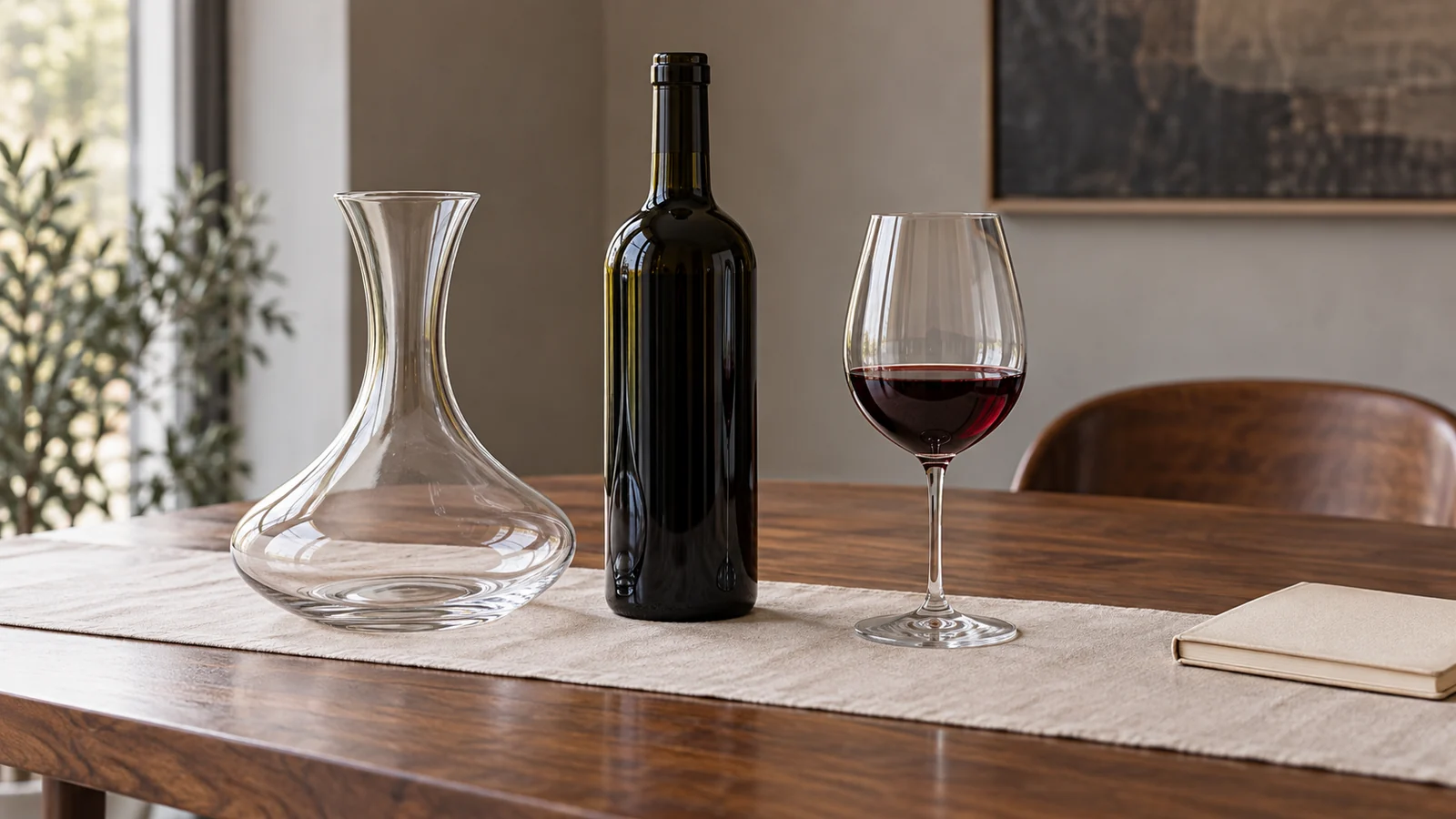
The decanter arrives before the bottle is opened.
It catches the light beautifully. A wide bowl, a narrow neck, an empty space that already seems to promise improvement. Someone asks how long the wine should breathe.
There is another question worth asking first:
What are we trying to change?
Perhaps a deposit needs to stay out of the glasses. Perhaps the wine seems reluctant to show its fruit. Perhaps it is already lovely and the most useful thing we can do is stop preparing it and start serving it.
In the previous Cellar Journal article, we learned to describe a possible fault before naming its cause. The same discipline belongs here: an intervention needs a purpose before it needs a duration.
Decanting is not one operation. It is two: separating sediment and changing exposure to air.
They can happen during the same pour. They do not always call for the same treatment.
How long should you decant wine?
There is no single waiting time that follows reliably from the grape name or the price. WSET distinguishes deposit removal from the more disputed benefits of aeration and does not prescribe a standard schedule for young wines. WSET’s serving guidance
Our practical starting point is simple: inspect the bottle, smell a small pour and decide which problem—if any—you are addressing. A wine that is expressive and pleasant now does not owe the decanter an hour. A wine needing deposit removal may need a careful transfer, not a long rest afterward.
Later in this article, we suggest observation checkpoints, not guaranteed completion times. The distinction is important: checking a wine after ten minutes does not mean ten minutes is its scientifically determined optimum.
One pour, two different jobs
Separation means leaving settled material behind while transferring the clearer wine. Success is judged by what remains in the bottle and what reaches the glass.
Aeration means changing contact between wine and air. Success must be judged by the resulting experience—not by the size of the vessel or the drama of the pour.
A slow transfer into a relatively narrow vessel can emphasize the first purpose. A broader exposed surface and more movement emphasize the second. Neither choice is intrinsically more professional. The relevant difference is what you want to preserve or change.
That is why “decant all old wines” and “never decant old wines” are both incomplete instructions. A mature bottle can need separation and still deserve minimal additional exposure.
The two jobs belong on separate lines of the decision.
What sediment can—and cannot—tell you
Some deposits involve pigments and other phenolic material that have become less soluble. The AWRI describes several possible constituents of amorphous deposits and warns that appearance alone cannot positively identify their composition. AWRI: amorphous deposits
Visible particles are therefore not a certificate of age, quality or authenticity. Nor does leaving a deposit behind remove all the wine’s dissolved tannin. Physical separation is not the same operation as chemically rebuilding its structure.
Crystals need a separate distinction. Identified potassium hydrogen tartrate deposits need not harm wine quality, but that does not make every unidentified shard a tartrate. AWRI: crystalline deposits
The service advice here concerns ordinary, intact bottles with expected wine deposits. Suspected broken glass, foreign chemicals, tampering or unexplained contamination are reasons to stop—not to filter the liquid and declare it safe. A decanter is a serving tool, not a safety test.
For an ordinary deposit, the useful question is modest: can we leave the material behind without needlessly disturbing the wine?
What “opening up” actually asks us to observe
“Opening up” is useful tasting shorthand. It is not the name of one chemical reaction.
Moving wine changes the exchange between liquid and surrounding air. Volatile compounds can escape; the aromatic space above the liquid changes; oxygen can enter and participate in reactions. Dissolved carbon dioxide can also influence sensory expression. These processes should not all be renamed oxidation. AWRI: gas adjustment
A 2012 experiment with Gewürztraminer found that glass shape and time affected headspace chemistry and sensory expression, with differences becoming more apparent after several minutes. It was a glass study, not proof that every wine needs ten minutes in a carafe. Hirson, Heymann and Ebeler
A particularly helpful 2026 study examined hydrogen sulfide in model wine and Chenin blanc. Swirling reduced free H₂S chiefly through volatilisation, not oxidation. Yet the real-wine results also showed that continued exposure could diminish some fruity attributes. The effect depended on the wine and conditions. Lesković and colleagues
That is a more interesting story than “oxygen makes wine better.” Something obscuring fruit may recede; something desirable may also escape.
When a wine seems more expressive, ask what changed: less intrusive odor, clearer fruit, a different aromatic balance—or simply a warmer glass?
The decanter is not a time machine
It is tempting to describe aeration as making a young wine older. The phrase promises to turn patience into a piece of equipment.
But a more approachable glass after a pour is not evidence that years of bottle evolution have occurred.
A 2026 study examined tannin changes in one red blend stored under different closures for 17 years. It found structural differences associated with closure conditions. The work was funded by closure manufacturer DIAM Bouchage; it is not a test of minutes in a decanter. Razafindrabenja and colleagues
Likewise, an experiment following opened Cabernet Sauvignon for a week linked greater oxidation with changed aroma and taste. That timescale cannot supply a universal dinner-table countdown. Lee, Kang and Park
The responsible conclusion is not that chemistry stops during service. It is that different exposures and timescales are not interchangeable.
Write “the wine feels less severe” when that is what you perceive. Do not automatically translate it into “the tannins have disappeared” or “the wine has aged five years.” Sensory balance can change without demonstrating either claim.
Geometry matters; temperature does too
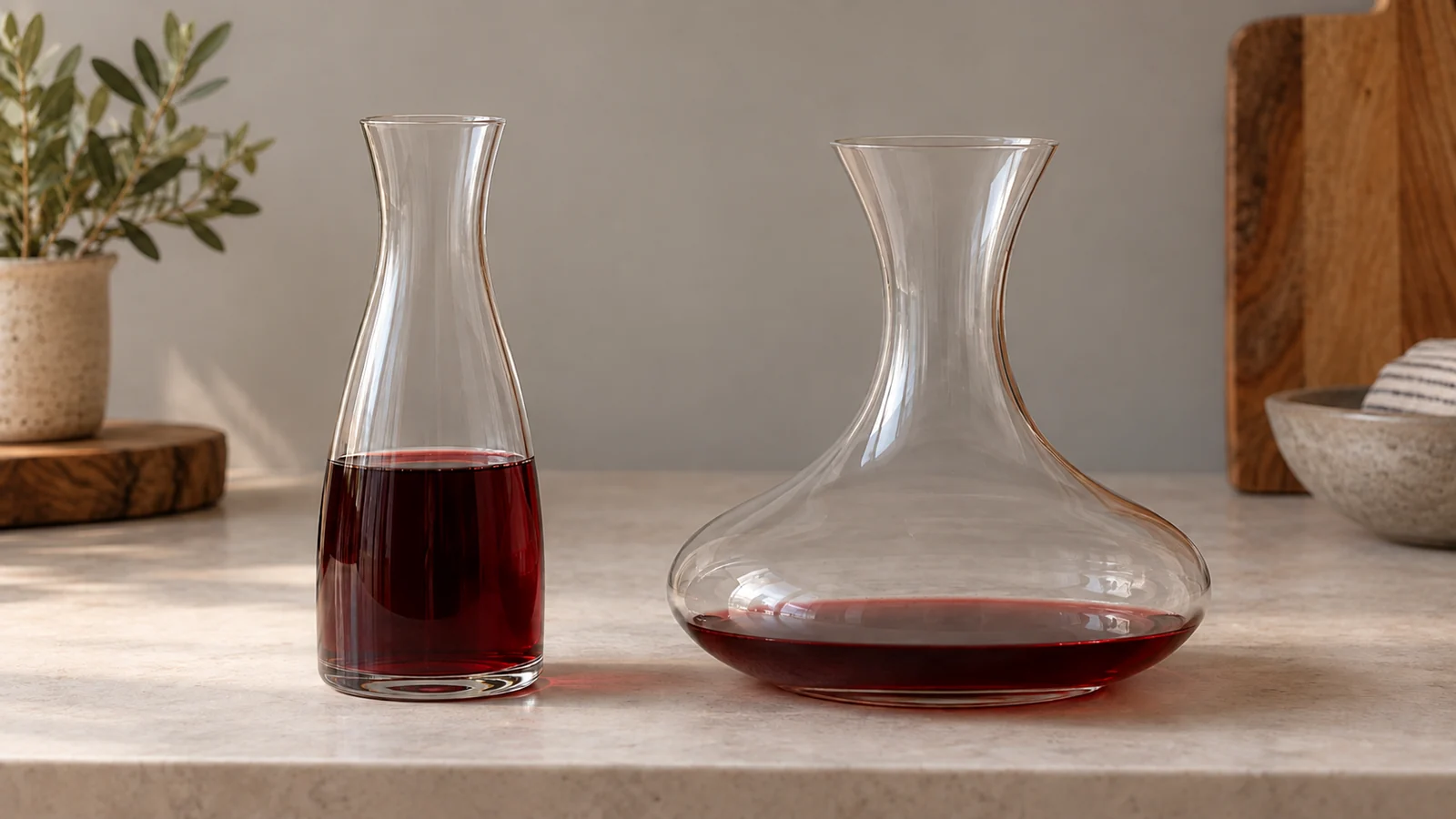
A wide vessel holding a shallow layer is not the same environment as a narrow one containing the same volume. The pour, exposed surface, movement and surrounding air all belong to the comparison.
Nevertheless, a preliminary study of swirling wine in different glasses found no simple relationship between basic glass dimensions and dissolved oxygen. Geometry is relevant, but “wider always works faster and better” is too easy a conclusion. Parpinello and colleagues
There is another variable on the table. A trained-panel experiment found that serving temperature affected aroma intensity in red and white wines. Ross and Weller
If one sample has been standing in a warm room while another remains cool, the comparison no longer isolates the vessel. Keep portions at similar temperatures when judging them. Avoid placing a carafe in direct sun or using warmth as an improvised accelerator.
The comparison should help you understand the wine, not combine so many changes that every result gets credited to air.
The Six-Variable Decant Decision
This is Ask Sommelier AI’s editorial framework, not a validated laboratory protocol or a prescription for every bottle.
1. Purpose
Are you separating a deposit, exploring a restrained aroma, or simply choosing an attractive way to serve? Presentation is a legitimate pleasure. It does not need to masquerade as chemistry.
2. Bottle age
Consider the vintage, bottling history and storage information available. An old year on a label does not tell you how much time the wine spent in wood versus bottle, or how it was subsequently kept.
3. Structure
Describe fruit, acidity, tannin, alcohol and balance. “Powerful” is not an instruction to apply maximum air. Ask what feels obstructive and what still supports it.
4. Aromatic state
Is the wine quiet, expressive, delicately mature, or dominated by a troubling odor? Those are different starting points. Check a clean glass before treating the whole bottle.
5. Fragility
Look for the direction of change in a small pour. Does fruit hold its shape? Do delicate details persist? Or is expression already thinning? Fragility is something to assess, not a rule that all mature wines share.
6. Available time
How soon is dinner? How much wine will be served? Can you revisit a small sample? Choosing a bottle that is enjoyable now is often better hospitality than making guests wait for a promised transformation.
The sequence is purpose → bottle age → structure → aromatic state → fragility → available time. The answer can legitimately be: leave the bottle alone.
A clock for checking, not for obeying
The following checkpoints are our practical service suggestions. They are not timings measured or validated by the studies above, and they are not a grape-by-grape aging formula.
| What the bottle presents | A reasonable starting action | When to check again |
|---|---|---|
| Clear, expressive and enjoyable | Serve directly | No obligatory waiting period |
| Sound but restrained, without troublesome deposit | Observe a small pour before committing the bottle | After about 5–10 minutes; earlier if desired |
| Young and firm, with a small comparison becoming more appealing | Consider a partial transfer rather than automatic whole-bottle treatment | Revisit about every 15–20 minutes; stop extending exposure when the benefit stalls |
| Mature, delicate and carrying ordinary settled deposit | Separate carefully close to service | Immediately after transfer; no required resting interval |
| Persistent mustiness or another worrying character | Check the glass and ask for the bottle to be assessed | No promised waiting time will certify a repair |
| Sparkling wine whose bubbles you want to preserve | Prefer serving from the bottle | Do not introduce a decanting countdown by habit |
“Check again” does not mean “keep drinking until it improves.” Small observations are enough, and you can stop at any stage.
If a producer offers guidance for the exact wine and vintage, include it as another piece of information. Still observe the bottle you actually have.
Separating a deposit without adding a performance
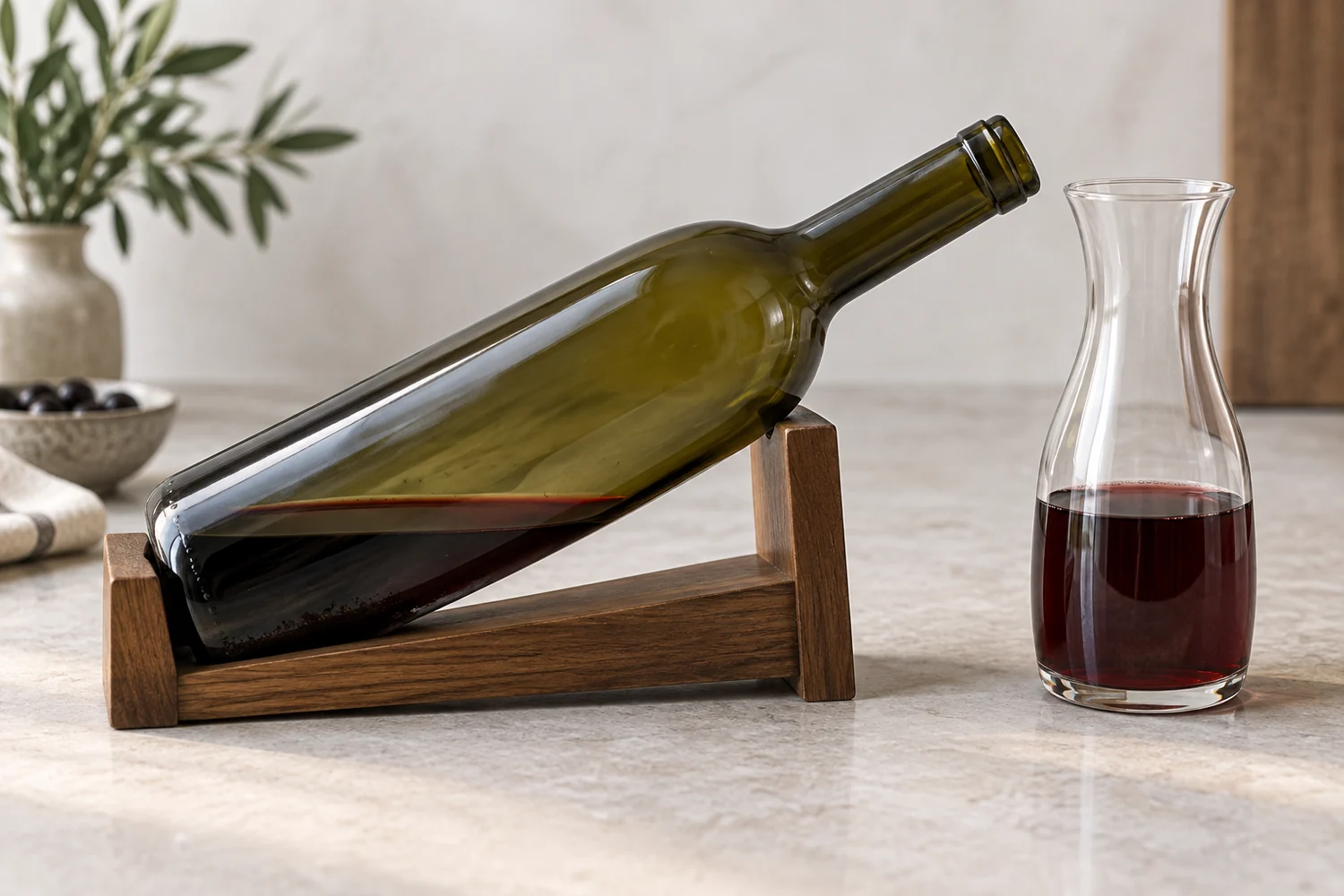
The following sequence is practical service guidance, not a reconstruction of a laboratory experiment.
Prepare before opening. Choose a clean, intact, odor-free vessel, good light and somewhere stable to work. Avoid perfumes or cleaning odors around the tasting area.
Let an ordinary deposit settle when possible. If the bottle has been moved, set it somewhere undisturbed in advance; overnight is a convenient planning option, not a universal settling time. A bottle whose deposit already lies along one side may instead be handled in a cradle without first turning it repeatedly. The goal is to preserve the separation that gravity has created.
Open with minimal disturbance. Keep the bottle stable, clear loose capsule or cork debris from the opening, and inspect the neck. Stop if glass damage is suspected.
Make one slow, continuous transfer. Use a cool light behind the shoulder or neck to watch the deposit approaching. Stop before cloudy material enters the receiving vessel. Do not chase the last clear-looking sip by repeatedly tipping the bottle. WSET’s service instructions likewise emphasize gentle handling and stopping before the deposit passes the neck. WSET
Serve according to the purpose. For a fragile wine transferred mainly to remove sediment, the next step can be the glass, not an hour on the sideboard.
Leaving a small amount behind is not poor service. It is how the separation is completed.
Young structure and mature delicacy ask different questions
Consider two imagined bottles, not actual tasting records.
The first is a young red with firm tannin and substantial fruit. A small pour becomes more inviting while holding its fruit. That observation supports trying a little more exposure, while keeping the rest available for comparison.
The second is a mature red with a deposit and a delicate, already expressive aroma. Its need for separation is clear; its need for more air is not. A gentle transfer near service may solve the first problem without deliberately creating the second.
The young wine has not proved it needs two hours. The mature wine has not proved that every decanter is dangerous.
Both have given us a reason to choose a particular action.
White wine, sparkling wine and Port
A white or skin-contact wine should not be excluded merely because the ritual is associated with reds. Apply the same questions about deposit, expression and fragility. A clean tasting glass may be all the space required; cool service should not be sacrificed to the ceremony.
For sparkling wine, there is a specific trade-off. Research on Champagne found that pouring method and temperature affected the loss of dissolved CO₂. It did not test every decanter. Our conservative service recommendation, when retaining bubbles is the goal, is to avoid unnecessary transfers. Liger-Belair and colleagues
Port offers an instructive contrast within one producer’s range. Taylor Fladgate recommends decanting Vintage Port, including for its bottle deposit. Taylor’s says its 1975 Single Harvest, matured in cask, does not require decanting. These are producer instructions for different products, not a universal ranking by age. Vintage Port guidance · 1975 Single Harvest guidance
The year alone did not answer the question. The wine’s history did more of the work.
Aerator, decanter, bottle—or simply the glass?
A pour-through aerator changes flow and contact during the pour. A decanter allows a chosen portion to remain in a different vessel. A tasting glass lets you explore a small amount while retaining the rest.
These are different operations, not three guaranteed speeds of the same transformation. This article has not tested particular devices and does not assign them an equivalent number of hours. A device that agitates wine is not automatically designed to keep settled material out of the pour.
Simply uncorking also differs from transferring: the exposed liquid surface inside a nearly full bottle is small. That physical difference does not mean nothing can happen in an open bottle, nor does it establish how long a particular wine needs.
Double decanting means transferring out of the bottle and then returning the separated wine to a clean, odor-free bottle. It can be useful when retaining the original presentation matters. It also involves another transfer; it is not double the benefit.
AWRI distinguishes oxygen dissolved in wine from oxygen in the package headspace. Returning wine to its bottle does not withdraw oxygen already taken up or reverse changes that have occurred. AWRI: package oxygen
Do not return wine to a bottle that still contains the deposit or cleaning residue. And do not treat a serving carafe as an overnight preservation plan.
Air is not a universal repair
The previous article’s boundary still applies. A change after aeration is an observation, not proof that a defect has been permanently removed.
AWRI’s technical guidance distinguishes sulfur compounds and notes that aeration can transform some into other forms. Professional remediation is not a recipe for treating a dinner bottle with coins, copper, peroxide or household materials. AWRI: volatile sulfur compounds
If a wine remains musty, increasingly tired or unpleasant, there is no obligation to keep rescuing it. Ask for it to be checked. If the style is sound but not enjoyable to you, say that instead.
More intervention is not always more care.
Keep one small comparison
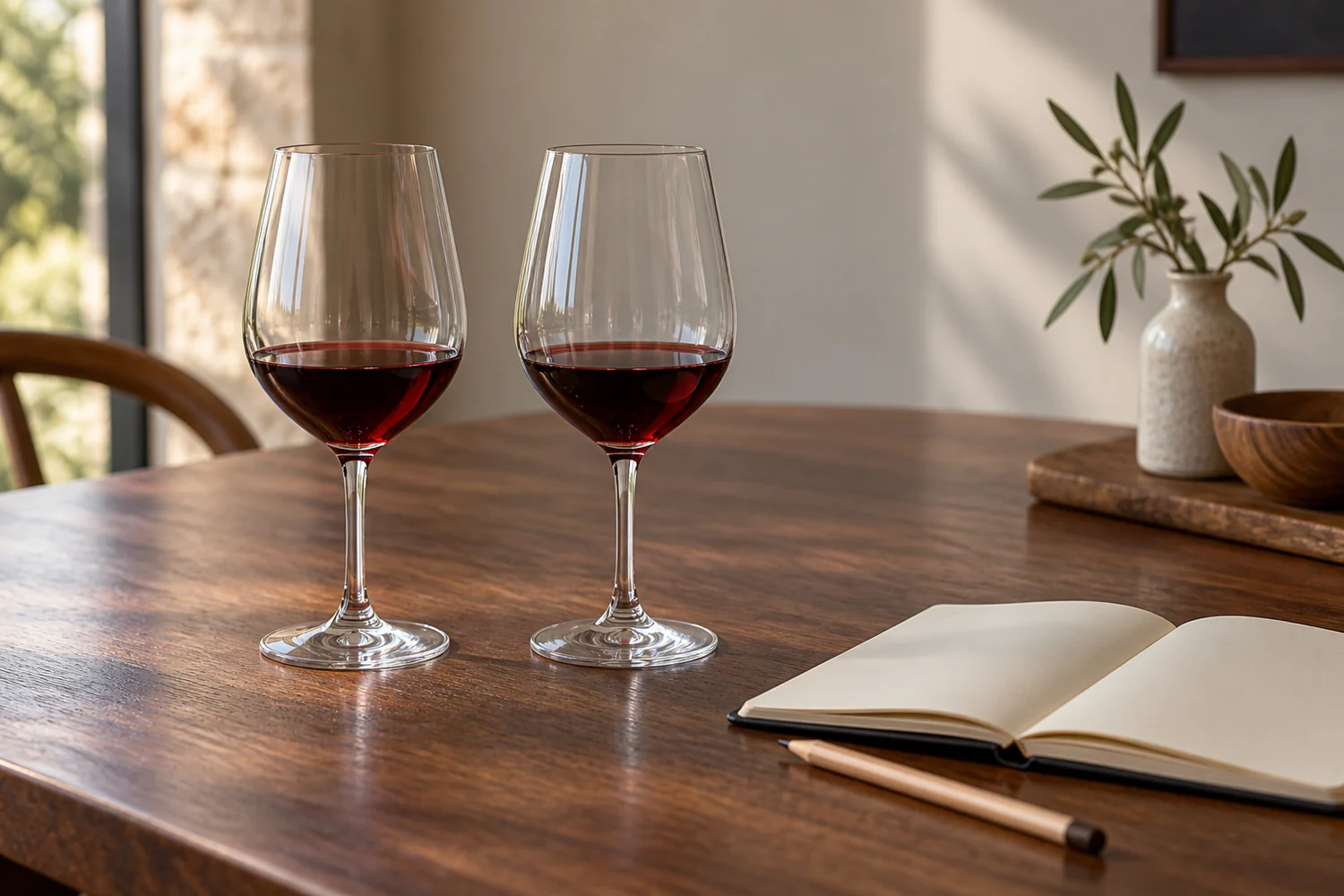
For an ordinary sound bottle, our simplest exercise needs two identical glasses and modest, equal pours at similar temperatures. Give one a gentle swirl and leave the other relatively still. Compare them without a predetermined winner, then return after a short interval.
Both samples have met air. Neither is an untouched control. This is a personal comparison of handling, not an experiment isolating oxidation.
Record what actually changes: fruit becomes clearer, an odor recedes, a detail fades, or no useful difference appears. An illustrative note might read:
The moved sample is more expressive, but no longer more enjoyable after another few minutes. Serve now rather than extend the wait.
Preference is the outcome that matters at your table. The note helps you make the next decision without pretending to measure a molecule.
A better question at the restaurant
Instead of asking only, “Should this be decanted?”, try:
“Are we separating sediment, or do you think a little air will help? Could we taste a small pour first?”
That opens a conversation rather than challenging someone’s competence. A server may have useful experience with the exact wine. You bring your preferences and the pace of your meal.
Ask Sommelier AI should preserve those distinctions too: exact bottle and vintage, storage where known, purpose, current expression, service conditions and uncertainty. It should not turn a grape name into an automatic timer or infer fragility from label prestige. These are standards for responsible recommendations, not a claim that software can inspect the liquid remotely.
Return to the empty decanter.
It can be beautiful and useful. It can also remain empty without making the evening less serious.
Give the decanter a job, not the wine a deadline.
The next article follows another variable that has been quietly present throughout: what changes when we serve red wine cooler?
Frequently asked questions
How long should I decant Cabernet Sauvignon or another young red?
Start with the bottle, not a fixed varietal timer. A small pour and a short checkpoint can show whether expression is becoming more appealing. The intervals above are service suggestions, not validated optima. WSET
Should old wine be decanted?
A settled deposit may justify careful separation. Age alone does not establish a need for prolonged aeration. Look at the wine’s history, expression and apparent fragility, and transfer near service when the main goal is separation.
Does decanting soften tannins?
A wine may feel more approachable after handling, but that does not demonstrate rapid removal of dissolved tannins or equivalence to years of aging. The long-term tannin study cited here did not test a dinner-time pour. Razafindrabenja and colleagues
Is an aerator the same as a decanter?
No. One alters a pour through a device; the other changes the vessel and allows ongoing exposure. Their effect depends on implementation and wine. An aerator does not necessarily separate sediment; a decanter leaves it behind only if you pour selectively. No universal time conversion is established here.
Can decanting fix a faulty wine?
Some impressions may change; others persist or transform. That is not a general cure or a safety certification. Do not use repeated aeration or household additives to override a concern about the bottle. AWRI
Can I enjoy wine without decanting it?
Absolutely. When a cleanly served wine already offers what you enjoy, no further intervention needs to be justified. The decanter serves the wine and the table—not the other way around.
References
Sources checked on 13 September 2026. Research titles are retained in their original form.
- Wine & Spirit Education Trust (WSET) (2024). Frequently asked questions about serving and decanting wine. Direct source.
- Australian Wine Research Institute (AWRI) (n.d.). Amorphous deposits. Direct source.
- Australian Wine Research Institute (AWRI) (n.d.). Crystalline deposits. Direct source.
- Hirson, G. D., Heymann, H., & Ebeler, S. E. (2012). Equilibration Time and Glass Shape Effects on Chemical and Sensory Properties of Wine. American Journal of Enology and Viticulture, 63(4), 515–521. Direct source · Record or alternative access.
- Lesković, M., Bekker, M. Z., Shoba, S., Brand, J., & Du Toit, W. (2026). Effect of glass swirling on the removal of ‘reductive’ off-odours caused by H₂S in wine. OENO One, 60(1). Direct source · Record or alternative access.
- Australian Wine Research Institute (AWRI) (n.d.). Removal of volatile sulfur compounds. Direct source.
- Parpinello, G. P., Meglioli, M., Ricci, A., & Versari, A. (2018). Effect of Different Glass Shapes and Size on the Time Course of Dissolved Oxygen in Wines during Simulated Tasting. Beverages, 4(1), article 3. Direct source · Record or alternative access.
- Ross, C. F., & Weller, K. (2008). Effect of Serving Temperature on the Sensory Attributes of Red and White Wines. Journal of Sensory Studies, 23(3), 398–416. Direct source.
- Razafindrabenja, L. E., et al. (2026). Impact of bottle closures on tannin evolution in red wine after 17 years of aging using UHPLC−UHRMS metabolomic approach. Journal of Food Composition and Analysis, 154, 109196. Direct source.
- Lee, D.-H., Kang, B.-S., & Park, H.-J. (2011). Effect of oxygen on volatile and sensory characteristics of Cabernet Sauvignon during secondary shelf life. Journal of Agricultural and Food Chemistry, 59(21), 11657–11666. Direct source · Record or alternative access.
- Liger-Belair, G., Bourget, M., Villaume, S., Jeandet, P., Pron, H., & Polidori, G. (2010). On the Losses of Dissolved CO₂ during Champagne Serving. Journal of Agricultural and Food Chemistry, 58(15), 8768–8775. Direct source.
- Taylor Fladgate (n.d.). Port Wine Traditions: Decanting. Direct source.
- Taylor’s Port (n.d.). 1975 Single Harvest — storage and serving advice. Direct source.
- Australian Wine Research Institute (AWRI) (n.d.). Gas adjustment. Direct source.
- Australian Wine Research Institute (AWRI) (n.d.). Oxygen pick-up during packaging: understanding total package oxygen. Direct source.