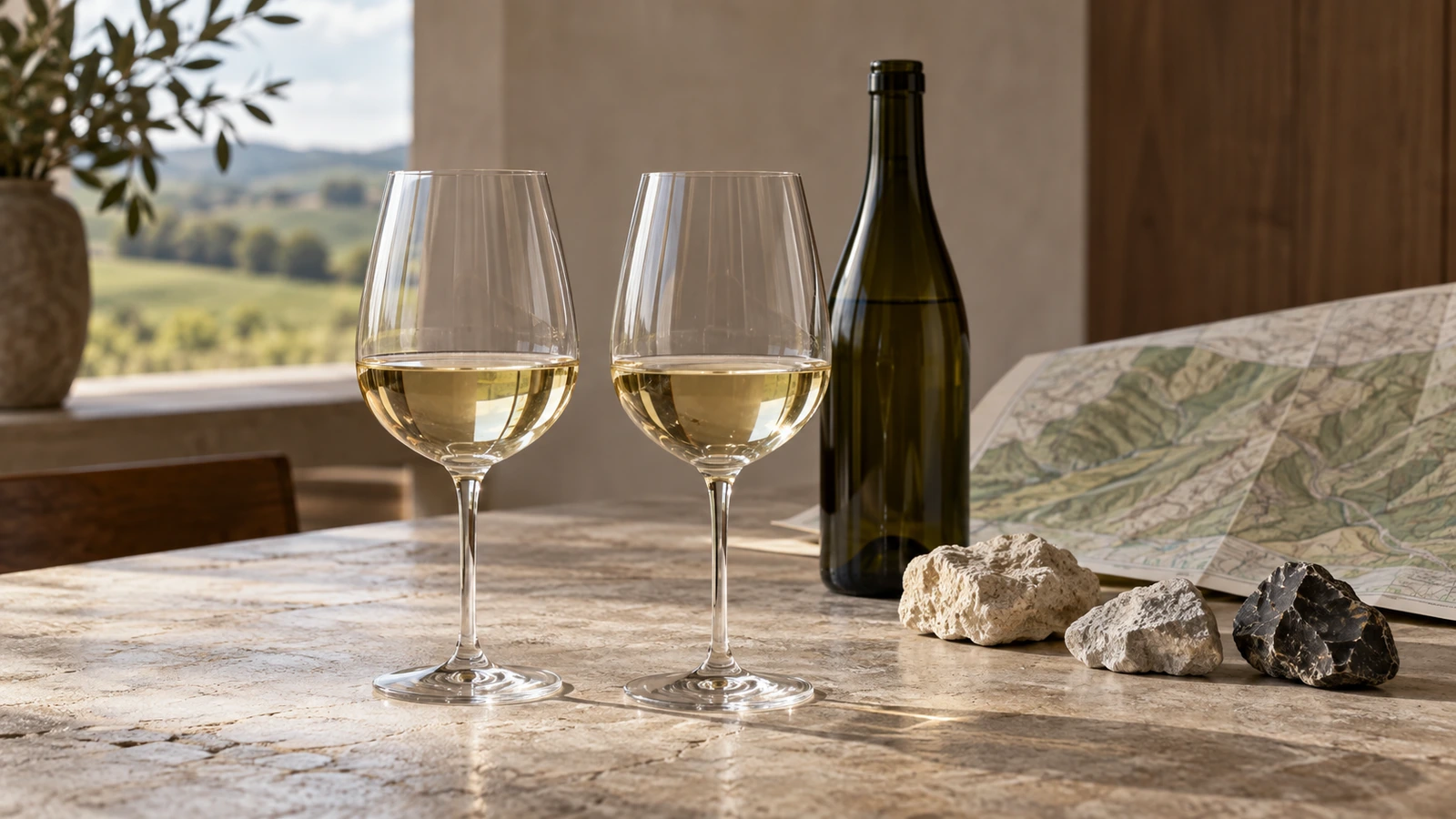
Some wines arrive at the table with a grape.
Sancerre often arrives with a place.
The bottle may contain Sauvignon Blanc, but the name on the front has already brought more than a variety into the room: pale limestone, flint, citrus, restraint, freshness, a river, a hillside, perhaps even a certain kind of sophistication.
Then the cork comes out.
Before anyone speaks, the wine offers what it actually has: a particular intensity, a particular shape of acidity, fruit at a certain degree of ripeness, perhaps something herbal, floral, smoky, saline, creamy, neutral, or none of the words we expected.
Now someone says, “That is so Sancerre.”
The sentence sounds simple. It contains at least three different claims.
The first is about origin: this wine comes from a legally delimited place.
The second is about sensory resemblance: it tastes like other wines we have learned to associate with that place.
The third is about expectation: once the name was visible, we knew what to look for.
All three can matter.
They are not the same thing.
The central idea: typicity is a family resemblance, not a fingerprint.
A fingerprint implies one stable pattern capable of identifying every member and excluding every outsider. Wine regions rarely work that neatly. A family resemblance allows shared features without demanding identical faces. One bottle may carry the eyes, another the voice, another only the posture—and yet the relationship can still be recognizable.
That is closer to what regional character looks like in a glass.
A rule can tell us what belongs
In the previous Cellar Journal article, we separated legal classification from sensory quality.
An appellation can define where grapes must come from, which varieties may be used, how the wine must be produced, and which standards must be met. Those rules protect a collective name. They do not write a complete tasting note for every compliant bottle.
Typicity begins where the legal document stops.
It asks a more difficult question:
When several wines are entitled to the same place-name, what allows us to recognize their belonging in the glass?
To answer it, we need to keep five ideas separate.
| Term | The question it answers | What it does not answer by itself |
|---|---|---|
| Provenance | Where does the wine claim to come from? | Whether it tastes typical, authentic, good, or right for you |
| Terroir | Which physical, biological, human, and practical interactions shape production in that place? | One guaranteed flavor or one direct soil-to-glass pathway |
| Typicity | How strongly does the wine resemble a learned sensory category? | Legal compliance, universal quality, or personal preference |
| Authenticity | Are the material claims about origin, identity, and production truthful? | Whether the wine is typical or enjoyable |
| Quality and preference | How well was the wine made, and how well does it fit a particular drinker or occasion? | Whether it is the most representative member of its category |
These distinctions protect us from a common mistake: asking one word to prove too much.
A wine can be legally authentic and sensorially unusual. It can be deeply typical and not especially pleasurable to you. It can be atypical, excellent, and completely honest. It can also conform to a familiar regional profile while being technically flawed.
Typical is not a synonym for superior.
Atypical is not a synonym for fraudulent.
What is terroir in wine?
Terroir is often reduced to a photograph of soil.
A hand holds pale stones. Roots disappear into fractured rock. The caption implies that the geology has traveled directly into the flavor of the wine.
The internationally adopted definition is broader and more careful.
The International Organisation of Vine and Wine defines vitivinicultural terroir as an area in which collective knowledge develops around the interactions among an identifiable physical and biological environment and the viticultural and winemaking practices applied there. The definition includes soil, topography, climate, landscape, and biodiversity—and explicitly distinguishes this descriptive concept from the legal definition of a geographical indication.
That matters.
Terroir is not just dirt. It is not nature with the humans edited out. It is an interacting system in which a place is observed, cultivated, interpreted, and carried into wine over time.
The soil can matter profoundly without becoming literal rock flavor. A major review of soil-related terroir factors explains that soil influences vine development and grape ripening principally through mechanisms such as root-zone temperature, water supply, and mineral nutrition—especially nitrogen—acting through the vine (van Leeuwen, Roby & de Rességuier, 2018).
The path is therefore not:
limestone → limestone taste
It is more plausibly:
soil properties → root environment → vine physiology → grape composition → fermentation and maturation → sensory result
Even that chain is incomplete unless we add season, grape material, harvesting, cellar practice, bottle age, service, and the person tasting.
Terroir is the system. Typicity is the resemblance we learn to recognize.
A category is built in memory
No one is born knowing what Sancerre, Rioja, Barolo, Napa Cabernet, or Mosel Riesling is supposed to taste like.
The category is learned.
We taste repeated examples. We read labels and tasting notes. We listen to teachers, winemakers, merchants, friends, and critics. We encounter celebrated bottles and ordinary ones, young wines and mature wines, traditional producers and stylistic outliers. From those experiences, the mind gradually builds a prototype.
Not a single bottle.
A center of gravity.
Sensory researchers often study wine typicity by asking knowledgeable tasters how well a sample represents a category: from a poor example to a very good example. A broad review of the field describes typicity as a set of recognizable traits associated with wines sharing biophysical and human dimensions of terroir, while also emphasizing that no single sensory method is sufficient to characterize it completely (Souza Gonzaga et al., 2021).
That qualification is essential.
A typicality score tells us where a wine sits relative to a panel’s learned concept. By itself, it does not explain which aroma, taste, texture, or chemical composition drove the judgment. Researchers therefore combine exemplarity ratings with descriptive analysis, sorting tasks, chemical measurements, or multiple panels.
Typicity is not found by asking one expert for the correct adjective.
It is approached by looking for a pattern that survives several ways of asking.
Expertise changes the map
Experience can make a category more stable—but not necessarily more absolute.
In a study comparing Chardonnay and Melon de Bourgogne wines, experts showed agreement in their typicality judgments and differentiated the two categories with only limited overlap. Novices showed neither the same agreement nor the same separation (Ballester et al., 2008).
The result does not mean experts possess a secret receptor that novices lack.
It suggests that repeated exposure helps organize sensory memory.
An experienced taster may recognize a configuration of acidity, aroma, texture, alcohol, and finish before being able to explain every component. A novice may perceive the same sensations but lack a stable category in which to place them.
This is similar to hearing an accent. Familiarity can make the pattern recognizable even when no single syllable proves the speaker’s origin.
But expertise also carries history, vocabulary, status, and expectation. The expert’s map can become more precise—and more vulnerable to the power of the label.
We will return to that.
A family resemblance is made of several signals
If typicity is real, it does not need to be one aroma.
Research on Chardonnay provides a useful example. In one experiment, researchers tested combinations of aroma compounds rather than searching for a single “Chardonnay molecule.” Wines supplemented with a ten-compound combination were judged more representative of the Chardonnay concept than wines supplemented with a smaller combination (Lorrain et al., 2006).
The study was conducted under specific experimental conditions and does not define all Chardonnay everywhere. Its value here is conceptual: a sensory category may emerge from a configuration of signals whose joint effect matters more than any one component.
Regional studies show the same kind of complexity.
A project involving 145 Australian Shiraz wines from six regions found region-associated sensory characteristics, while also documenting meaningful variation within each region and overlap among regions. For some regions, individual attributes helped differentiate the wines; for others, the distinguishing feature was the overall pattern across several sensory properties (Pearson et al., 2020).
A study of 30 young Tempranillo wines from Rioja found a shared regional core centered on fresh-fruit character, alongside more specific profiles associated with Rioja Alta, Rioja Alavesa, and Rioja Oriental. The authors also documented diversity within the subregions rather than presenting each one as a single flavor (Sáenz-Navajas et al., 2023).
This is what family resemblance allows:
- a common center without identical bottles;
- regional tendencies without compulsory descriptors;
- recognizable patterns without absolute borders;
- variation that belongs inside the category rather than threatening it.
A place can influence a wine without issuing every bottle the same accent.
Sancerre: a name with learned expectations
Sancerre is a useful case because the name is currently doing a remarkable amount of cultural work.
Google reported that U.S. search interest for Sancerre reached a peak during summer 2026 (Google Summergeist 2026). That search signal does not tell us why every person became interested, and it does not establish a new sensory fact. It tells us that the name is unusually present in consumer attention.
Legally and geographically, the name is specific. The official INAO page describes the Sancerre vineyard across 14 communes in the Cher department, on hills with calcareous, clay, and siliceous soils. White Sancerre is produced from Sauvignon Blanc; the white appellation was recognized in 1936 (INAO, Sancerre blanc).
The same official page offers broad sensory language around freshness, pale color, citrus, exotic fruit, and floral notes.
That description is useful as a collective and institutional portrait.
It is not a chemical formula that every bottle must reproduce.
A cross-origin study of 18 Sauvignon Blanc wines—six each from New Zealand, France, and Austria—found that a panel of 19 New Zealand wine professionals separated the origin groups through sensory and chemical analyses. The New Zealand wines were associated more strongly with green characteristics, the Austrian wines with stone-fruit character, and the French group was relatively subdued in most measured attributes apart from perceived minerality (Green et al., 2011).
The result supports the possibility that Sauvignon Blanc from different origins can form distinguishable patterns.
It does not establish one universal fingerprint for Sancerre.
The French set included wines from Sancerre, other Loire origins, and Saint-Bris. There were only six wines per broad source group. The assessors belonged to one professional culture. A different sample, vintage range, panel, or method could produce a different boundary.
That is how strong evidence should be read:
as support for a possibility within its design—not permission to turn a result into folklore.
Reading a Sancerre claim with precision
| Signal | What it can support | What it cannot prove |
|---|---|---|
| The Sancerre appellation name on the label | Verified geographical and production-category context when the label is authentic and compliant | Flint, citrus, quality, or personal enjoyment in every bottle |
| Sauvignon Blanc | A known varietal context and range of plausible aroma precursors | Sancerre origin or one inevitable style |
| High acidity, citrus, herbal, smoky, or stony language | Compatibility with common descriptions used for some regional wines | Unique origin; many regions and processes can produce overlapping sensations |
| Limestone, marl, or flint in the site description | Relevant physical context for water, temperature, rooting, and vine development | Direct transfer of stone flavor into the glass |
| Correct regional grouping in a blind study | Evidence that the tested wines and panel contained differentiating information | Universal recognition by all tasters or perfect classification of every bottle |
| An unusual Sancerre | Vintage, parcel, maturity, producer, technique, or bottle variation | Fraud, poor quality, or failure of the entire appellation |
The name matters.
The glass still gets a vote.
Place reaches wine through translators
Terroir does not speak directly. It is translated.
The grape translates the environment
Different varieties and clones respond differently to heat, water, light, soil temperature, nitrogen, disease pressure, and harvest timing. Planting Sauvignon Blanc rather than Pinot Noir does not merely change the label. It changes the biological instrument through which the site is expressed.
This is why grape and place cannot be interpreted independently.
A region may become known for a variety because the relationship proves useful over time. The resulting typicity belongs neither to the grape alone nor to geography alone. It emerges from their repeated interaction.
The vintage translates the baseline into one season
Climate may define long-term possibilities. Weather writes the particular year.
A warm, dry season, a wet flowering period, a heat event near harvest, or a cool ripening window can shift acidity, aromatic development, phenolics, sugar, disease pressure, and harvest decisions. The same vineyard and producer can therefore make wines with recognizable continuity and meaningful vintage variation.
If every vintage tasted identical, we would not be tasting only place.
We would also be tasting a process that had deliberately reduced seasonal variation.
The vine translates soil through physiology
Water availability, root-zone temperature, nitrogen, drainage, rooting depth, and many other factors can shape vine growth and grape composition. That is a real soil effect.
It is not the same as saying that roots mine the flavor of chalk, slate, or granite and deposit it intact into the berry.
The distinction protects terroir from the very mythology that makes it easy to dismiss.
Microorganisms may translate part of the environment
Microbial communities associated with grapes and fermentation can also show regional patterns.
A longitudinal study of more than 200 commercial fermentations in Napa and Sonoma found that grape and wine microbiota, fermentation behavior, and metabolite profiles could distinguish viticultural areas and individual vineyards, and that microbial composition was associated with finished-wine chemistry (Bokulich et al., 2016).
The study supports a microbial contribution to regional wine characteristics.
It does not prove that each place has an immutable microbial signature, that all native fermentations taste more authentic, or that correlation alone identifies the precise sensory effect of every organism.
A living layer of terroir is plausible.
A microbial passport is not yet warranted.
The producer translates possibility into a wine
Harvest date, sorting, pressing, extraction, fermentation temperature, yeast population, vessel, oxygen, lees, malolactic fermentation, oak, blending, filtration, sulfur dioxide, and maturation all influence what reaches the bottle.
Technique is therefore not simply the enemy of terroir.
The OIV definition includes applied viticultural and winemaking practices because a place does not become wine without decisions.
The winemaker does not choose between place and technique. Technique is how place is carried, edited, protected—or sometimes overwritten.
The useful question is not whether humans touched the wine.
They did.
The useful question is what their decisions amplified, preserved, transformed, standardized, or obscured.
Technique can change how typical a wine seems
A controlled study of Marlborough Sauvignon Blanc illustrates the point.
Researchers made experimental wines from fruit harvested at three stages of ripeness, with and without chaptalization under the conditions studied. A panel of Marlborough wine professionals found that fruit ripeness affected the balance of green and ripe-fruit characteristics and the degree to which the wines represented their concept of Marlborough Sauvignon Blanc. Chaptalization also modified taste and mouthfeel and affected typicality in some treatments (Pineau et al., 2011).
The study does not provide a recipe for all Sauvignon Blanc, nor does it say that one ripeness level is universally best.
It demonstrates something more useful:
a wine can come from the right place and grape while harvest and cellar decisions alter how typical it appears to a knowledgeable panel.
That does not make technique fake terroir.
It makes technique one of the ways terroir becomes legible—or less legible—in a particular style.
Sometimes the sensory signature is weak
If every legally delimited place produced an unmistakable sensory signature, typicity research would be easy.
It is not.
A 2023 study examined whether experts had developed a specific sensory concept for the newer Beaujolais Pierres Dorées PDO. Across mental representations and tasting, the researchers did not find a distinct sensory description separating it clearly from the comparison category. When appellation information was provided, descriptions within the same appellation became more similar and the categories more separated, suggesting assimilation and contrast effects (Otheguy, Honoré-Chedozeau & Valentin, 2023).
This negative result is not an embarrassment for terroir.
It is a reminder that a boundary on a map, a production specification, and a market ambition do not automatically create a sensory category that experts can already recognize.
A category may be:
- physically distinct but sensorially overlapping;
- too new for a stable shared prototype;
- internally diverse;
- differentiated by variables the chosen method did not capture;
- more meaningful legally, historically, or economically than aromatically;
- recognizable at one scale but not another.
Good research must be able to find a regional pattern.
It must also be allowed not to find one.
Consensus is useful—and situated
Professional consensus is often treated as the final court of wine identity.
It is better understood as evidence from a particular community of practice.
Winemakers, sommeliers, merchants, critics, growers, laboratory panels, and consumers do not encounter wine for the same purpose. Their mental categories may emphasize different things.
A winemaker may remember fermentation behavior, structure, and seasonal variation. A sommelier may organize the category around service, food, price, and guest expectations. A critic may retain memorable descriptors and comparative hierarchies. A local expert may recognize subtleties that disappear at a broader market scale.
None of those perspectives is automatically invalid.
None is the place itself.
When a panel agrees, we should ask:
- Who was on the panel?
- How familiar were they with the category?
- What wines were selected?
- Were they tasted blind or informed?
- Which attributes were measured?
- Was the task recognition, description, liking, or quality?
- How much variation existed inside the category?
- Was the result replicated with another panel or vintage?
Consensus can reveal a learned and useful sensory prototype.
It should not be mistaken for a law of nature.
Blind tasting removes the label—not the taster
Blind tasting is valuable because it removes some external information.
It does not empty the person holding the glass.
The taster still brings:
- past bottles;
- learned regional prototypes;
- vocabulary;
- cultural references;
- recent tasting order;
- expectations about the exercise;
- individual sensitivity;
- fatigue;
- preference;
- professional incentives.
Blind tasting removes the label. It does not remove memory.
That is not a criticism of blind tasting. It is what makes the method informative.
By comparing blind and informed conditions, researchers can ask which part of a judgment appears to arise from intrinsic sensory information and which part changes when origin, price, producer, soil, or description becomes available.
But exact-origin identification is a harder task than detecting that two groups differ.
A panel may separate wines statistically without correctly naming every region. A taster may recognize a family resemblance without identifying the address. A bottle may be typical while sharing many attributes with neighboring places.
Blind tasting is therefore most useful when it tests a clear question—not when it is staged as a public trial of expertise.
When the label enters the glass
Origin information can change the experience even when the liquid does not change.
A study of 112 regular wine consumers evaluated Cabernet Sauvignon wines from four regions. Region information increased liking scores, particularly where consumers were familiar with the region, while the study’s sensory characterization was relatively stable between informed and uninformed groups. Some regional sensory features were still apparent in the wines (Souza Gonzaga et al., 2022).
That result is subtle.
The label influenced pleasure more clearly than it rewrote the complete sensory profile.
Other designs have found stronger descriptive effects. In a study of 22 wine traders evaluating eight Pinot Noir wines from four countries, revealing country of origin changed liking and language: wines presented as Argentinean or Brazilian attracted more negative judgments, while French and Swiss origins prompted more positive descriptors (Depetris Chauvin et al., 2024).
A 2024 study of 20 German Rieslings and 20 experts found that providing soil-type information changed ratings and the way wines were grouped, even though the relationship between soil names and wine flavor remains contested (Nguyen et al., 2024).
Descriptions can act similarly. In a study of 126 regular white-wine consumers, elaborate sensory and winery information raised expectations, liking, positive emotions, and willingness to pay compared with blind tasting (Danner et al., 2017).
These studies do not prove that tasting is imaginary.
They show that wine perception is not a laboratory instrument reading chemistry in isolation.
The label can be evidence, context, and suggestion at the same time.
Origin can provide genuine information about grape, climate, rules, and production culture. It can also activate prestige, familiarity, stereotype, and anticipated flavor.
The answer is not to discard the label.
It is to notice what the label is doing.
Expectation does not cancel place
The debate is often framed as a choice:
Either wine tastes of place, or people merely imagine it because they saw the label.
That is a false binary.
A regional pattern can exist in the wine, and the label can still alter how strongly we perceive, describe, or value it.
A person can recognize a familiar accent more easily after learning where the speaker is from. That does not prove the accent was absent before the introduction. It does mean recognition is partly a relationship between signal and memory.
Similarly, a wine may contain region-associated sensory information without carrying a complete address in every aroma molecule.
Place shapes possibilities.
Grape and season translate them.
Technique selects among them.
Producer style gives them emphasis.
Communities learn a prototype.
The label activates that prototype.
The taster decides what survives contact with the glass.
The Seven-Layer Typicity Read
When someone says, “This wine tastes exactly like its place,” do not begin by agreeing or rejecting the claim.
Read it in layers.
1. Place
Ask: What level of place is actually being claimed—country, region, appellation, village, vineyard, or parcel?
It can support: physical context, legal origin, climate, topography, soils, biodiversity, and production culture when those details are verified.
It does not prove: one flavor, one quality level, or one direct geological pathway.
2. Grape
Ask: Which variety, clone, rootstock, and blend carry the site into the wine?
It can support: biological possibilities and known ranges of aroma, structure, phenology, and response to environment.
It does not prove: origin, exact style, or a complete sensory result.
3. Vintage
Ask: What sequence of weather and vine development shaped this harvest?
It can support: why a familiar region may appear riper, leaner, earlier, later, more structured, or more delicate in a particular year.
It does not prove: that every producer or parcel experienced the season identically.
4. Technique
Ask: Which harvest and cellar decisions changed extraction, fermentation, oxygen, texture, aroma, and maturation?
It can support: how the producer carried, protected, transformed, or standardized the raw material.
It does not prove: that intervention erased place—or that low intervention revealed it automatically.
5. Producer
Ask: What pattern does this producer pursue across vintages and cuvées?
It can support: a house style, recurring choices, and a useful explanation for variation within one appellation.
It does not prove: that the producer represents the entire region.
6. Consensus
Ask: Who considers this typical, using which wines, task, vocabulary, and standard?
It can support: a shared prototype within a defined expert or consumer community.
It does not prove: universal agreement or an objective essence independent of experience.
7. Expectation
Ask: What did the label, price, reputation, soil story, or tasting context prepare you to find?
It can support: useful contextual knowledge and more efficient recognition.
It does not prove: that every descriptor activated by the story was present at the same intensity before the story arrived.
The chain is:
Place → grape → vintage → technique → producer → consensus → expectation.
A reading that survives all seven layers is not certain.
It is better calibrated.
This is an original Ask Sommelier AI editorial framework, not a validated sensory-analysis protocol, legal test, or method for certifying origin.
A practical exercise: the Two-Column Place Note
You can test the effect of regional expectation without turning tasting into a guessing contest.
Choose two wines made from the same grape but from different regions—or two producers from the same appellation. Ask another person to cover the identifying parts of the bottles and pour equal amounts at the same temperature.
Create two columns.
Column 1 — What the glass presents
Before seeing the labels, record only what you can observe:
- aroma families;
- ripeness level;
- acidity;
- sweetness;
- alcohol warmth;
- tannin;
- body;
- texture;
- finish;
- confidence in each observation.
Do not guess the origin yet.
Column 2 — What the name predicts
Reveal the wines.
Write what the origin, producer, price, or soil story now makes you expect. Then return to the glass and ask:
- Which expectations were already present in Column 1?
- Which became noticeable only after the reveal?
- Which still cannot be found?
- Did liking change more than description?
- Does one bottle seem more representative, or merely more familiar?
The goal is not to catch yourself being biased.
The goal is to see perception working.
A label that helps you name a real pattern can be informative. A label that supplies a descriptor unsupported by the glass is suggestive. Most tasting experiences contain some of both.
How Ask Sommelier AI should use place
A recommendation system cannot responsibly treat regional typicity as a fixed lookup table.
It should not reason:
Sancerre = flint. Napa = ripe. Rioja = oak. Burgundy = earth.
Those shortcuts erase vintage, producer, cuvée, technique, maturity, bottle condition, and the user’s actual palate.
Ask Sommelier AI should instead treat place as a probabilistic context.
The system may use verified regional patterns to form an initial expectation. It should then update that expectation with stronger bottle-level evidence:
- exact wine and vintage;
- grape composition;
- producer technical information;
- vineyard or subregional source;
- fermentation and maturation;
- professional and consumer observations;
- bottle age and storage;
- serving conditions;
- the individual user’s feedback.
When sources disagree, the disagreement should remain visible. When information exists only at regional scale, the system should not present it as bottle-specific fact. When a wine is atypical, the model should not lower its quality automatically.
The app can use place as context. It must not turn geography into destiny.
The app helps with the choice.
The Journal protects the chain of reasoning.
What makes a wine taste like its place?
Not one thing.
Not the soil alone.
Not the grape alone.
Not the winemaker alone.
Not the label alone.
Regional character becomes plausible when repeated interactions leave a pattern: environment acting through the vine, a grape adapted to its setting, seasons varying around a baseline, people making choices within a local culture, and tasters learning what tends to recur.
That pattern can be strong enough to recognize and loose enough to permit surprise.
Which is exactly what family resemblance means.
Return to the glass of Sancerre.
The name may help you notice. It may also tempt you to complete the picture too quickly.
Let the place provide context.
Let the wine provide evidence.
Then ask not whether it carries a perfect fingerprint, but whether its features belong convincingly to the family—and whether you enjoy the person this bottle became.
A place can teach us what to look for. The glass must still decide what is there.
And if typicity is a recurring pattern rather than a fixed recipe, the next question becomes unavoidable:
What happens when a production philosophy—“natural wine”—begins to function as a sensory category in the consumer’s mind?
English FAQ
What is terroir in wine?
Terroir is the interacting system of a place: its physical and biological environment, the grapevine, and the viticultural and winemaking practices developed around them. It includes soil, climate, topography, biodiversity, and collective human knowledge. It is broader than soil and distinct from the legal definition of a geographical indication.
What does wine typicity mean?
Wine typicity is the degree to which a wine resembles a learned category, such as a grape variety, region, appellation, or established style. It is usually evaluated through patterns of aroma, taste, texture, and structure rather than one compulsory descriptor.
Can experts identify a wine’s region in a blind tasting?
Sometimes experts or trained panels can distinguish groups of wines statistically or recognize familiar category patterns. That does not mean every expert can name every origin correctly, nor that every region has a unique sensory fingerprint. Results depend on the wines, panel, vintages, task, and comparison set.
Does soil give wine its flavor?
Soil can influence vine growth and grape composition through factors such as water availability, root-zone temperature, nitrogen supply, drainage, and rooting. That is different from claiming that the literal taste of a rock is absorbed and transferred unchanged into wine.
Is an atypical wine a bad wine?
No. Atypical means that a wine does not closely match a particular learned prototype. It may still be authentic, technically sound, complex, and highly pleasurable. Typicality, quality, authenticity, and preference are related but separate judgments.
Why can Sancerre taste different from Marlborough Sauvignon Blanc?
The wines may differ because of climate, soils acting through the vine, harvest timing, grape composition, fermentation, maturation, producer style, and vintage. Research has found origin-associated patterns in Sauvignon Blanc, but no single descriptor identifies every wine from either region.
References — English
- International Organisation of Vine and Wine. Resolution OIV/VITI 333/2010 — Definition of vitivinicultural terroir. https://www.oiv.int/node/3362
- Souza Gonzaga, L., Capone, D. L., Bastian, S. E. P., & Jeffery, D. W. Defining wine typicity: sensory characterisation and consumer perspectives. Australian Journal of Grape and Wine Research 27 (2021): 246–256. https://doi.org/10.1111/ajgw.12474
- Cadot, Y., Caillé, S., Samson, A., Barbeau, G., & Cheynier, V. Sensory dimension of wine typicality related to a terroir by Quantitative Descriptive Analysis, Just About Right analysis and typicality assessment. Analytica Chimica Acta 660 (2010): 53–62. https://doi.org/10.1016/j.aca.2009.10.006
- Ballester, J., Patris, B., Symoneaux, R., & Valentin, D. Conceptual vs. perceptual wine spaces: Does expertise matter? Food Quality and Preference 19 (2008): 267–276. https://doi.org/10.1016/j.foodqual.2007.08.001
- Lorrain, B., Ballester, J., Thomas-Danguin, T., Blanquet, J., Meunier, J. M., & Le Fur, Y. Selection of potential impact odorants and sensory validation of their importance in typical Chardonnay wines. Journal of Agricultural and Food Chemistry 54 (2006): 3973–3981. https://doi.org/10.1021/jf052350g
- Pearson, W., et al. Characterising inter- and intra-regional variation in sensory profiles of Australian Shiraz wines from six regions. Australian Journal of Grape and Wine Research 26 (2020). https://doi.org/10.1111/ajgw.12455
- Sáenz-Navajas, M.-P., Iosifidis, A., Gonzalez-Hernandez, M., Fernández-Zurbano, P., & Valentin, D. Identification of sensory and voltammetric markers of regional typicality: Tempranillo Rioja wines as a case study. Beverages 9 (2023): 85. https://doi.org/10.3390/beverages9040085
- Institut national de l’origine et de la qualité. Sancerre blanc — official product and geographical-area information. https://www.inao.gouv.fr/produit/sancerre-blanc-7929
- Green, J. A., Parr, W. V., Breitmeyer, J., Valentin, D., & Sherlock, R. Sensory and chemical characterisation of Sauvignon Blanc wine: Influence of source of origin. Food Research International 44 (2011): 2788–2797. https://doi.org/10.1016/j.foodres.2011.06.005
- van Leeuwen, C., Roby, J.-P., & de Rességuier, L. Soil-related terroir factors: a review. OENO One 52 (2018). https://doi.org/10.20870/oeno-one.2018.52.2.2208
- Bokulich, N. A., et al. Associations among wine grape microbiome, metabolome, and fermentation behavior suggest microbial contribution to regional wine characteristics. mBio 7 (2016): e00631-16. https://doi.org/10.1128/mbio.00631-16
- Pineau, B., et al. Influence of fruit ripeness and juice chaptalisation on the sensory properties and degree of typicality expressed by Sauvignon Blanc wines from Marlborough, New Zealand. Australian Journal of Grape and Wine Research 17 (2011): 358–367. https://doi.org/10.1111/j.1755-0238.2011.00160.x
- Otheguy, M., Honoré-Chedozeau, C., & Valentin, D. Are specific PDO wines sensorially recognisable? A study in the Beaujolais vineyard with different types of experts. OENO One 57 (2023). https://doi.org/10.20870/oeno-one.2023.57.2.5546
- Souza Gonzaga, L., et al. Consumer perspectives of wine typicity and impact of region information on the sensory perception of Cabernet Sauvignon wines. Food Research International 152 (2022): 110719. https://doi.org/10.1016/j.foodres.2021.110719
- Depetris Chauvin, N., Valentin, D., Behrens, J. H., & Rodrigues, H. Country-of-Origin as bias inducer in experts’ wine judgments: A sensory experiment in a world wine fair. International Journal of Gastronomy and Food Science 35 (2024): 100883. https://doi.org/10.1016/j.ijgfs.2024.100883
- Nguyen, T. H., Zimmermann, D., Müller, J., & Durner, D. Soil types as extrinsic cues differentially shape sensory perception of German Riesling wine. OENO One 58, no. 4 (2024). https://doi.org/10.20870/oeno-one.2024.58.3.7918
- Danner, L., Johnson, T. E., Ristic, R., Meiselman, H. L., & Bastian, S. E. P. “I like the sound of that!” Wine descriptions influence consumers’ expectations, liking, emotions and willingness to pay for Australian white wines. Food Research International 99 (2017): 263–274. https://doi.org/10.1016/j.foodres.2017.05.019
- Google. Summergeist 2026 — U.S. Google Trends signal for Sancerre and chilled red. https://blog.google/products-and-platforms/products/search/summergeist-google-trends/