
Who has the right to put a place’s name on a bottle?
The question seems geographical: surely a point on a map would settle it. But others follow immediately. Where were the grapes grown? Where was the wine made? Is working within a boundary enough, or must the work be done in a particular way? And when two communities claim the same name, who decides which is telling the story correctly?
In the previous Cellar Journal chapter, the bottle held a transformation. Now it also holds a claim. Before we remove its closure, we read a word that asks for our trust.
To understand where that trust comes from, we need to step away from the glass for a moment. This story passes through an eighteenth-century decree, granite markers, files recording objections, and a crowd defending its belonging to Champagne. Its participants were not always arguing about how a wine should taste. They were also arguing about who could sell it under a particular name. 1 2 3 6
This is not a story of the inevitable triumph of the best vineyard sites. It asks something more human: how can provenance become a promise that someone is answerable for keeping?
A boundary you could touch
On September 24, 1716, Cosimo III de’ Medici issued a proclamation delimiting the area entitled to use the name Chianti. The Chianti Classico consortium records the episode in its institutional history. It was an early delimitation, not the premature arrival of every requirement in today’s DOCG. 1
The decision did something a recommendation cannot: it distinguished benefiting from a name’s reputation from having the right to use it. A buyer might be far from the vineyards. The name attempted to bridge that distance.
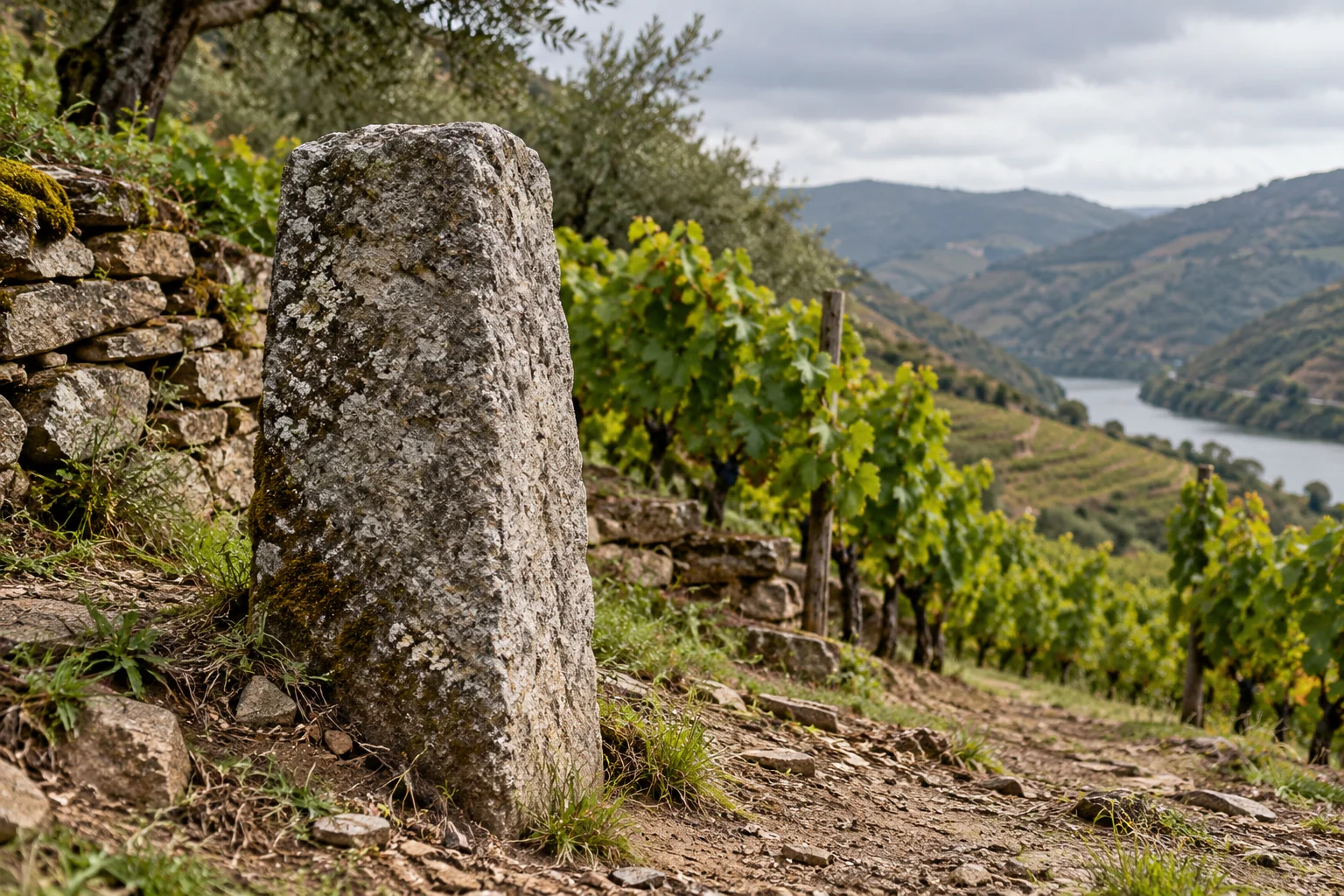
In the Douro, the distinction acquired weight and a surface. Museu do Douro documents granite markers inscribed “Feitoria,” identifying land suitable for producing export wine: 201 were installed in 1758 and another 134 in 1761. They were not all installed at once. 2
A stone does not explain an aroma. It can nevertheless announce where a condition for entering a market begins.
The records prevent us from turning that delimitation into a still photograph. The archive catalogue describes work beginning in 1757, subsequent corrections and fresh delimitation after objections in 1761. The boundary required technical work, decisions and revision. Here we are following the archival description, not a direct reading of every surviving petition. 3
That precision changes the story. The lines did not emerge fully formed from the landscape; criteria had to be formulated, applied and defended when someone challenged the result. This does not make soil or exposure irrelevant. It makes visible the work of translating them, alongside other interests, into a public decision.
Origin also distributed power
The museum archive preserves another delimitation, different from that of the export vineyards: the four-league district connected to the Companhia’s commercial privilege. Its description explains an exclusive right to supply wine to taverns in Porto and the surrounding area, as well as a role in approving tavern keepers. 4
The two maps must remain separate. One cannot automatically be used to establish the other’s limits or functions. Together, however, they allow a question that the word “tradition” can leave in shadow: who controlled access to selling?
Protecting provenance could be a way of combating deception. It does not follow that everyone concerned had equal authority, or that every decision was fair by definition. Evaluating an individual dispute would require its documents, participants and consequences.
The value of this shift in perspective is that it returns people to what might look like a classification of land. Behind a rule are those who request it, those who may benefit and those who must explain why they should not be left outside.
A rigorous history of origin needs room for those questions. Celebrating heritage does not require turning its administration into a tale without disagreement.
The right to remain Champagne
France entered the early twentieth century facing a serious wine crisis. Recovery after phylloxera, imports and fraud form part of the context described by INAO. The 1905 law entrusted delimitation to the administration; the 1919 law gave a central role to courts and collective action by professional associations. 5
But a boundary intended to combat a falsehood could generate another argument: who was included in the official truth?
The conflict between the Marne and the Aube exposed that difficulty. According to Yves Tesson’s research published by the Union des Maisons de Champagne, Aube growers invoked both historical connections and purchases by Marne merchants. They demonstrated in Troyes on April 9, 1911. The Aube’s definitive inclusion came in 1927. 6
We do not need to invent a conversation at that march to understand the stakes. Alongside the buyer’s question—“Is this really Champagne?”—stood the grower’s: “Why should my place and my work not count within that name?”
Tesson’s account comes from an institution associated with Champagne houses and has an identifiable perspective. Its arguments about the different participants should not be mistaken for a neutral verdict on all their motives. We use it to recognize the conflict, not to decide retrospectively who deserved prosperity more.
Comité Champagne identifies the 1927 law as the basis of the production area’s delimitation. That reference should not be confused with the later creation of France’s AOC system. Delimiting an area and establishing a recognition system are related but different steps. 7 8
The name’s history becomes less comfortable and more interesting: it was not only defended against distant imitators; it was also negotiated among neighbors.
From being inside to meeting the conditions
The decree-law of July 30, 1935 created the national committee responsible for the new appellations d’origine contrôlées system. INAO dates the first recognitions to May 15, 1936, including Arbois, Cassis and Châteauneuf-du-Pape. Protection encompassed product characteristics and conditions connected to origin, rather than an address alone. 8
The distinction remains useful: being in a place and being entitled to its appellation are not equivalent claims.
Even the mapping requires attention. INAO distinguishes a geographical area from a finer parcel delimitation, common in wine appellations. The latter allows local variations to be considered; being inside an included municipality does not by itself make every plot eligible for the same protected production. 10
Provenance is joined by verifiable commitments. In its explanation of PDO, the institute describes a product specification and checks by recognized bodies. The name no longer rests only on the seller’s word: there is a framework against which certain claims can be tested. 11
That matters. It lets the conversation begin with something more solid than fame.
But we should not demand a different function from it. Checking appellation requirements is not the same as deciding which bottle will be your favorite. A control can address product characteristics without being designed to represent every diner’s preferences.
Authentic provenance deserves respect. Enjoyment does not have to obey it as an instruction.
The land does not write the rules
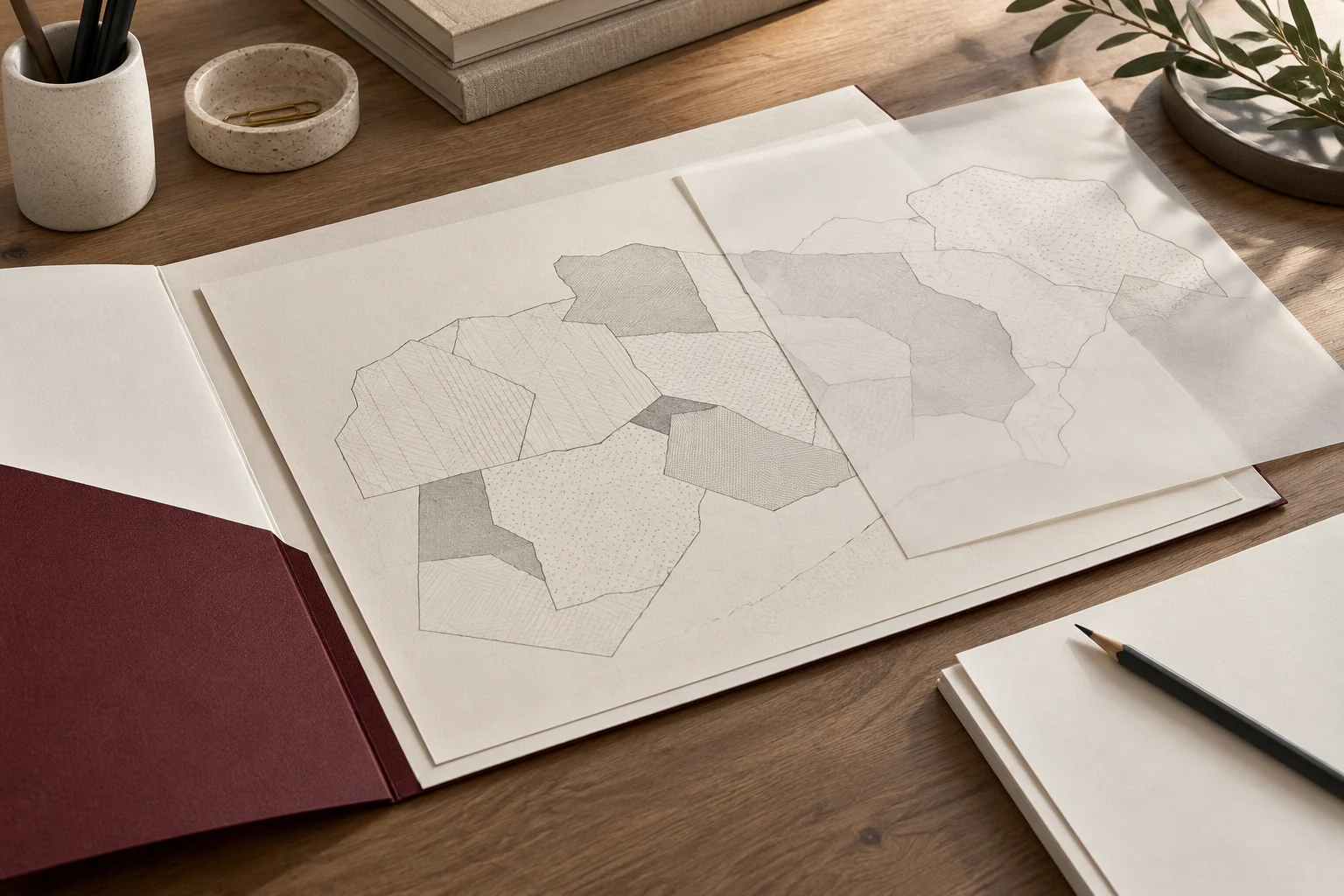
In 2010, the OIV adopted a definition of terroir based on relationships among physical and biological surroundings, vitivinicultural practices and collective knowledge. The same resolution warns that this descriptive definition should not be confused with the legal definition of a geographical indication. 9
That warning helps us hold two ideas together. Place matters; its legal protection is a construction requiring decisions.
We can study relationships among a plant, an environment and practices without asserting that every line on a map is an absolute sensory boundary. We can also defend a name without requiring every wine bearing it to be indistinguishable. Resemblance, diversity and compliance pose different questions.
Consider two possible readings of the same label. The first says: “I already know what I am supposed to experience.” The second: “I have information from which to begin asking questions.” The first risks correcting the glass until it obeys the name. The second lets the glass complete, confirm or complicate our expectations.
That second reading does not dismiss knowledge. It gives knowledge a more demanding task: helping us notice without deciding in advance what we ought to enjoy.
A word changes scope when it crosses a border
The initials do not travel with a universal meaning. In the European explanation, a PDO wine uses grapes exclusively from the corresponding area. For PGI wines, the general rule requires at least 85 percent of the grapes to come from that area. These are differently defined connections, not two percentages of pleasure. 12
In the United States, an American Viticultural Area, or AVA, identifies a delimited grape-growing region distinguished by geographical or climatic conditions. Its informational purpose is not to give the buyer a score. 13
The general federal rule requires at least 85 percent of the wine to derive from grapes grown in the named AVA and sets additional conditions for where the wine is finished. It does not necessarily mean that every grape came from that area, or that meeting the percentage alone satisfies every applicable rule. 14
The figure matches the European minimum just mentioned, but that coincidence does not turn an AVA into a European PGI. To understand what a claim establishes, we need to read its own system rather than translate the initials as though they were interchangeable.
Even the international protection of familiar names has a history. The US authority explains that the 2006 wine agreement with the European Union and subsequent legislation restricted certain uses while retaining an exception for certain labels approved before March 10, 2006. That qualification does not authorize anyone to copy an appellation or let us judge an unknown bottle remotely. 15
The consequence for someone reading a wine list is straightforward: asking about a name is not the same as asking about a grape, a technique or a brand. Sometimes we need all four answers before we understand what is being offered.
Changing in order to keep belonging
An appellation preserves memory, but its producers work with present problems. INAO describes varieties of interest for adaptation, or VIFA, as a route for extended observation, on a small scale and with technical monitoring, addressing needs such as climate adaptation or reduced plant-protection treatments. 16
This does not mean that any producer may change any rule at will. Precisely because the promise is shared, introducing change requires discussion about what is retained, what is tested and how it is evaluated.
One concrete example is the French order of May 26, 2025 amending the Crémant d’Alsace specification. It introduced adaptation varieties under an agreement, limited to 5 percent of the holding’s vineyard varietal composition and 10 percent in blends. The text documents conditional permission; it does not establish that all producers use it or that its results are guaranteed. 17
That first limit concerns the holding’s vineyard composition, not the proportion of wine in a bottle. The difference matters: planting, blending and labeling are separate decisions.
Revision continued. Another order, signed on December 29, 2025 and published on January 9, 2026, amended the same specification in administrative and transitional matters. The May document must therefore be cited as a dated change, not as though it alone were the entire current rulebook. 18
Here is a tension no slogan resolves: what must remain for a wine to express a recognizable continuity, and what must be able to change for that continuity to have a future?
Preserving everything without examination can become immobility. Changing everything without accountability can empty the name. Between those extremes is less spectacular work: observing, comparing, negotiating and revising.
Read the name without giving it the whole conversation
The next time an appellation catches your attention, you need not become an inspector. It may be enough to separate what you know from what you are still assuming.
The name supplies provenance and a regulated context within its own system. Information from the producer can clarify how that bottle was made. Your experience, when you taste it, will address another question: whether that combination interests you, surprises you or does not suit you.
This is the conversation we want to cultivate at Ask Sommelier AI: using knowledge to sharpen questions rather than asking the palate to confirm a hierarchy.
It also changes how we talk about disappointment. “I did not like this wine” need not become “that region has nothing to offer.” Admiring a place does not oblige us to enjoy every bottle carrying its name. Valuing a tradition and retaining our own judgment are compatible gestures.
The history of origin does not end when a word is registered. It continues whenever someone works under its conditions, requests a revision or must answer for a claim. On the other side is the person reading the label, entitled to know what they are buying and free to decide what they enjoy.
We can sit down at the table with both: trust in what has been checked and curiosity about what we do not yet know about that wine.
Questions worth asking
Is the appellation the same as the grape variety?
No. An origin claim and a varietal designation communicate different information. US rules, for example, require an appellation when a varietal designation is used. Identifying the grape does not by itself settle where the wine comes from. 14
Do terroir and appellation mean the same thing?
No. The OIV expressly separates the descriptive concept of terroir from the legal definition of a geographical indication. They can be related without being interchangeable. The distinction lets us study a place and understand its protection without confusing the two tasks. 9
Does every plot in an included municipality have the same right?
That cannot be assumed. Some appellations distinguish a geographical area from a more precise parcel delimitation. Municipal location alone does not replace checking the specification, plot and applicable conditions. 10
Does PDO mean that I have to like the wine more?
No. The system establishes commitments and controls concerning origin and product; it does not know your preferences. The point is not to diminish those checks, but to distinguish what they verify from the personal experience of drinking a bottle. 11
Can an appellation’s rules change?
Yes. INAO’s innovation-evaluation mechanisms show that protection can include procedures for examining change. This is not a general authorization: the individual appellation, procedure and version of its requirements still matter. 16
Is a US AVA automatically equivalent to a European PDO?
No. The AVA defines a wine-growing region within the US system; it is not a legal translation of the European category. The origin percentage is only part of the comparison. Neither designation decides which wine you will enjoy more. 12 13
References and further reading
1. Consorzio Vino Chianti Classico. The proclamation of the boundaries for the production of Chianti Classico. 2024-04-12.
2. Museu do Douro. Marcos da Demarcação. Exposición inaugurada / Exhibition opened 2006-12-14.
3. Arquivo do Museu do Douro; productor documental: Companhia Geral da Agricultura das Vinhas do Alto Douro. Demarcações — SC 4, PT MD EMP/CGAVAD-4. Serie documental / Record series: 1756–1815; ficha sin fecha / undated catalogue.
4. Arquivo do Museu do Douro; productor documental: Companhia Geral da Agricultura das Vinhas do Alto Douro. Demarcação das 4 léguas, do privilégio exclusivo — SSC 2, PT MD EMP/CGAVAD-4-2. Serie documental / Record series: 1761–1815; ficha sin fecha / undated catalogue.
5. Institut national de l’origine et de la qualité (INAO). 1905–1935 : les prémices des appellations d’origine : une réponse aux crises alimentaires et viticoles. Sin fecha / Undated institutional history.
6. Yves Tesson; publicado por / hosted by Union des Maisons de Champagne. 1911 ou la construction identitaire champenoise. 2016; La Revue des Deux Mondes, hors-série Patrimoine champagne.
7. Comité Champagne. The Champagne region. Sin fecha / Undated institutional resource; consultado / accessed 2026-10-19.
8. INAO. 1935–1970 : l’avènement de l’INAO et la création des appellations d’origine contrôlées. Sin fecha / Undated institutional history.
9. International Organisation of Vine and Wine (OIV). Definition of vitivinicultural ‘terroir’ — Resolution OIV/VITI 333/2010. 2010.
10. INAO. Qu’est-ce qu’une aire géographique et une aire parcellaire ?. Sin fecha / Undated; consultado / accessed 2026-10-19.
11. INAO. Appellation d’origine protégée / contrôlée (AOP / AOC). Sin fecha / Undated; consultado / accessed 2026-10-19.
12. European Commission, Directorate-General for Agriculture and Rural Development. Geographical indications and quality schemes explained. Página viva / Living guidance; consultada / accessed 2026-10-19.
13. Alcohol and Tobacco Tax and Trade Bureau (TTB). American Viticultural Area (AVA). Última actualización indicada / Stated update: 2024-05-01; accessed 2026-10-19.
14. TTB. Wine Labeling: Appellation of Origin. Sin fecha / Undated guidance; accessed 2026-10-19.
15. TTB. Wine Appellations of Origin. Última actualización indicada / Stated update: 2026-01-08; accessed 2026-10-19.
16. INAO. Durabilité et attentes sociétales. Página viva / Living resource; accessed 2026-10-19.
17. République française; Journal officiel / Légifrance. Arrêté du 26 mai 2025 modifiant le cahier des charges de l’appellation d’origine contrôlée « Crémant d’Alsace ». Firmado / Signed 2025-05-26; publicado / published 2025-05-31.
18. République française; Journal officiel / Légifrance. Arrêté du 29 décembre 2025 modifiant le cahier des charges de l’appellation d’origine contrôlée « Crémant d’Alsace ». Firmado / Signed 2025-12-29; publicado / published 2026-01-09.