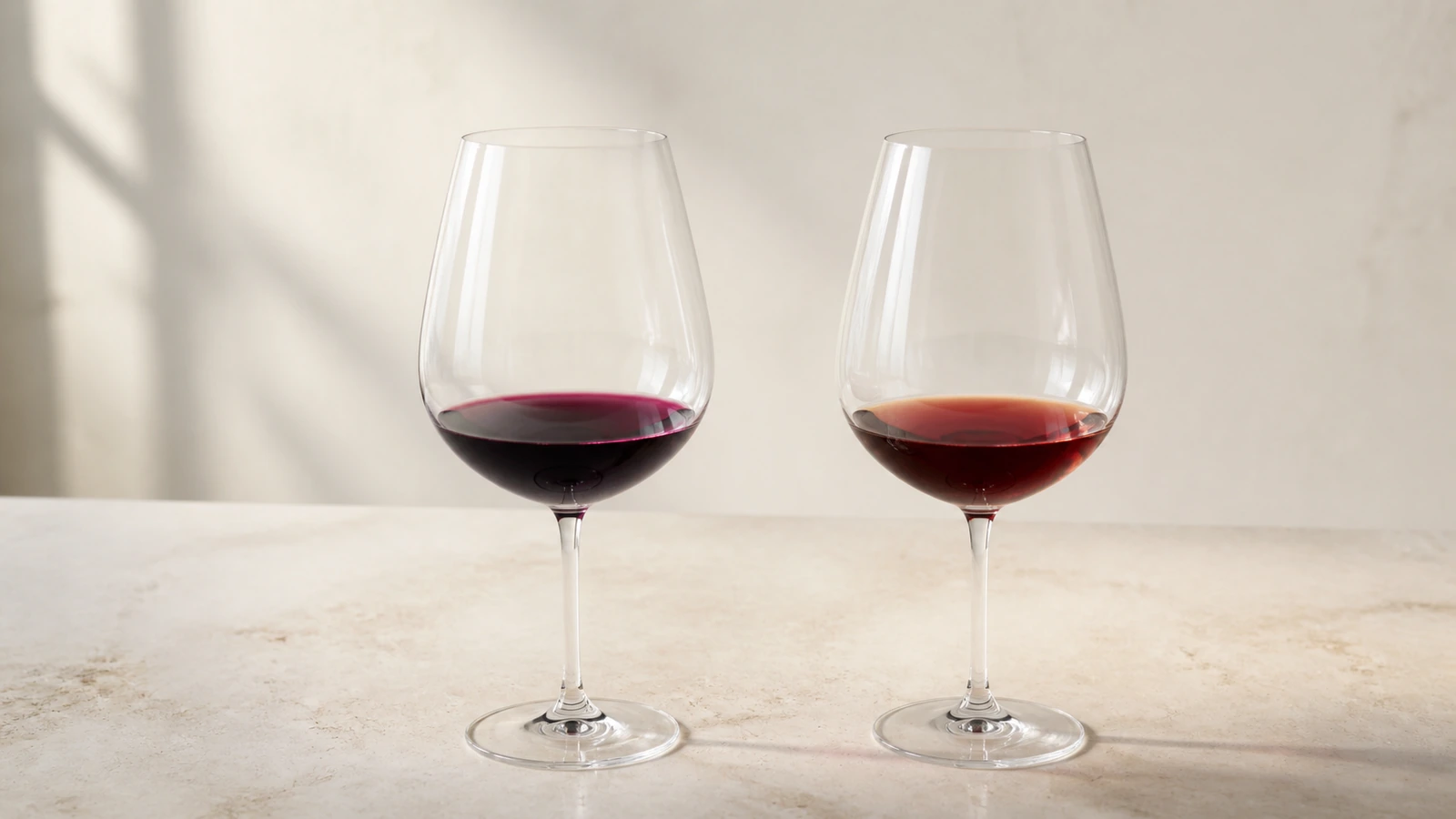
Two glasses rest on the same pale surface.
The first is almost opaque at its center, with a violet line where the wine meets the glass. The second allows more light through. Its core is garnet; its edge is beginning to turn brick.
The eye writes the story before the nose reaches either glass:
Young. Old.
That first impression may be directionally useful. It is not yet a diagnosis.
In our previous Cellar Journal article, temperature changed the speed of wine’s clock. Color shows some of what that clock has done—but never by itself, and never with the precision of a date printed on a calendar.
The central idea: color is a record of change, not a date stamp.
A red wine does not simply become paler as it ages. Its pigments are extracted, arranged, protected, transformed, joined to other compounds, and sometimes removed from solution. The result depends on the grape, the season, the winemaking, the wine’s pH and phenolic composition, the oxygen it encounters, and the conditions under which it is stored.
That is why color can support a hypothesis.
It cannot finish the investigation.
Color is not one observation
When people say a wine is “dark” or “old-looking,” they often compress several different observations into a single word.
A more useful color description separates at least four dimensions:
- Intensity or depth: how difficult it is for light to pass through the wine.
- Hue: whether the visible color leans toward violet, ruby, garnet, orange, brick, or brown.
- Rim development: how the color changes toward the shallow edge of a tilted glass.
- Clarity and deposit: whether the wine is brilliant, hazy, or carrying visible sediment.
Laboratories separate color variables for the same reason. The International Organisation of Vine and Wine defines conventional red- and rosé-wine color intensity from absorbance at 420, 520, and 620 nanometers, while “shade” is expressed as the ratio between absorbance at 420 and 520 nanometers (OIV, OIV-MA-AS2-07B). The OIV also recognizes CIELab measurements that describe lightness and chromatic coordinates across the visible spectrum (OIV, Determination according to CIELab).
A tasting glass is not a spectrophotometer. But the discipline is transferable:
Describe the color before interpreting the color.
Where red color begins
In most red Vitis vinifera grapes, the pulp is lightly colored or nearly colorless while anthocyanins—the main grape-derived red, purple, and blue pigments—are concentrated primarily in the skins. Teinturier varieties are notable exceptions because pigment also occurs in the pulp (He et al., 2012a).
This means red wine begins as a question of contact.
Crushing, fermentation, maceration time, temperature, alcohol development, cap management, enzymes, and other cellar choices influence how much pigment leaves the skins and enters the wine. The grape supplies a potential inventory; winemaking determines how that inventory is extracted and what happens to it next.
Even before aging begins, two wines can therefore start from very different color baselines.
One variety may contain a larger concentration or a different profile of anthocyanins than another. Vineyard conditions can alter that profile. A long or forceful extraction can produce a different visual result from a gentle maceration. And the same technique does not behave identically in every cultivar: in a six-variety experiment, prefermentative cold soak improved perceived color intensity in some wines, reduced it in Pinot Noir, and produced outcomes that the authors concluded were cultivar-dependent (Casassa, Bolcato & Sari, 2015).
So a pale red wine is not automatically old.
A dark one is not automatically young.
Why young red wine can look purple
The vivid violet edge of a young wine is not produced by one pigment acting alone.
Anthocyanins exist in several chemical forms whose proportions and visible expression depend strongly on the surrounding matrix, especially pH. Their molecular structures also differ, and those differences influence hue and stability. In model solutions, changing pH altered the chromatic behavior of individual grape anthocyanins because the pigments shifted among differently colored and colorless forms (Heredia et al., 1998).
But pH is not a simple purple-versus-red switch.
In real wine, anthocyanins interact with themselves and with other molecules. One important young-wine phenomenon is copigmentation: noncovalent associations between anthocyanins and suitable cofactors that can increase color intensity and sometimes shift the visible hue toward a more bluish or purple expression. Boulton’s critical review described copigmentation as a potentially substantial part of young red-wine color, while also emphasizing that its magnitude depends on pigment and cofactor composition (Boulton, 2001).
This is one reason a young wine can appear more saturated than a simple count of free anthocyanins would predict.
The color is already an interaction.
Wine does not merely fade; its pigment system reorganizes
If aging were only pigment loss, an old red wine would simply become a weaker version of its younger self.
That is not what happens.
During maturation and aging, monomeric anthocyanins decline. Some degrade. Some react with flavan-3-ols and tannin-related compounds. Some participate in reactions mediated by aldehydes. Others form new families of pigments, including pyranoanthocyanins and more complex polymeric structures. These products differ in color, stability, sensitivity to sulfur dioxide, and response to pH (He et al., 2012b; Zhang et al., 2022).
The wine therefore changes both how much color it carries and what kind of molecules are carrying it.
Some anthocyanin-derived pigments contribute more orange-red tones than their grape-derived precursors. Polymeric pigments can become increasingly important to the visible color of aged wine. In a study of Chilean Cabernet Sauvignon spanning a sixteen-year vertical, vitisin A remained detectable for many years but accounted for only a small share of perceived color; the isolated polymeric fraction was the dominant contributor in those wines (Schwarz et al., 2003).
The exact percentages from that experiment should not be turned into a rule for every red wine. The deeper lesson is more durable:
There is no single “aging pigment” responsible for the color of mature wine.
Tannins participate, but “more tannin” is not a color guarantee
Tannins are often described as if they were brown scaffolding waiting to capture red pigment.
The reality is more specific.
Flavan-3-ols and proanthocyanidins can participate in direct and aldehyde-mediated reactions with anthocyanins, contributing to polymeric pigments. These reactions can help shift wine from a system dominated by fragile monomeric pigments toward one supported by more complex forms. Yet the outcome depends on which compounds are present, their concentrations, the wine’s pH, oxygen exposure, sulfur dioxide, and time (Somers, 1971; Gambuti et al., 2020).
A tannic wine is therefore not guaranteed to remain deeply colored.
Nor does color intensity reveal tannin quality, texture, or aging potential by itself.
The pigment network and the mouthfeel network overlap.
They are not identical.
Pyranoanthocyanins: new pigments born inside the wine
Some of the most intriguing pigments in mature red wine were not present in the grape in the same form.
Pyranoanthocyanins can form when anthocyanins react with fermentation- or aging-related compounds such as pyruvic acid, acetaldehyde, and hydroxycinnamic-acid derivatives. The additional ring in their structure can make many of these pigments more resistant than monomeric anthocyanins to pH changes and sulfur-dioxide bleaching. Their visible contribution often leans toward red-orange hues (Márquez et al., 2013).
This chemistry gives a better explanation for the movement from purple-red toward garnet and brick than the phrase “the wine is losing color.”
The wine is losing some pigments.
It is also creating others.
A large targeted study of 234 red wines from multiple varieties, vintages, and countries found that pigment families evolved differently over prolonged aging and contributed differently to red-violet and tawny color. Statistical and machine-learning models could classify broad aging stages using detailed chemical and CIELab data (Zhang et al., 2021).
That result is fascinating—but it does not turn visual inspection into a laboratory age test. The model used targeted chemical measurements, controlled color coordinates, and a large dataset.
Your eye sees far less information.
Why the rim looks older than the center
Tilt a glass of red wine over a white surface and the edge will usually look lighter and often more orange than the core.
The rim has not aged faster than the center.
It is the same wine viewed through a shorter optical path. In the deep center, light travels through more liquid and more pigment, which can mask subtle shifts in hue. At the edge, a thinner layer allows those shifts to become easier to see. The OIV’s analytical method explicitly standardizes optical path length because measured absorbance changes with the distance light travels through the sample (OIV, OIV-MA-AS2-07B).
That makes the rim useful.
It does not make it a calendar.
A broad brick-colored rim may be consistent with more pigment evolution than a narrow violet one. But glass shape, pour depth, lighting, background, variety, extraction, and storage history can all alter the comparison.
Purple, ruby, garnet, brick: a tendency, not a timeline
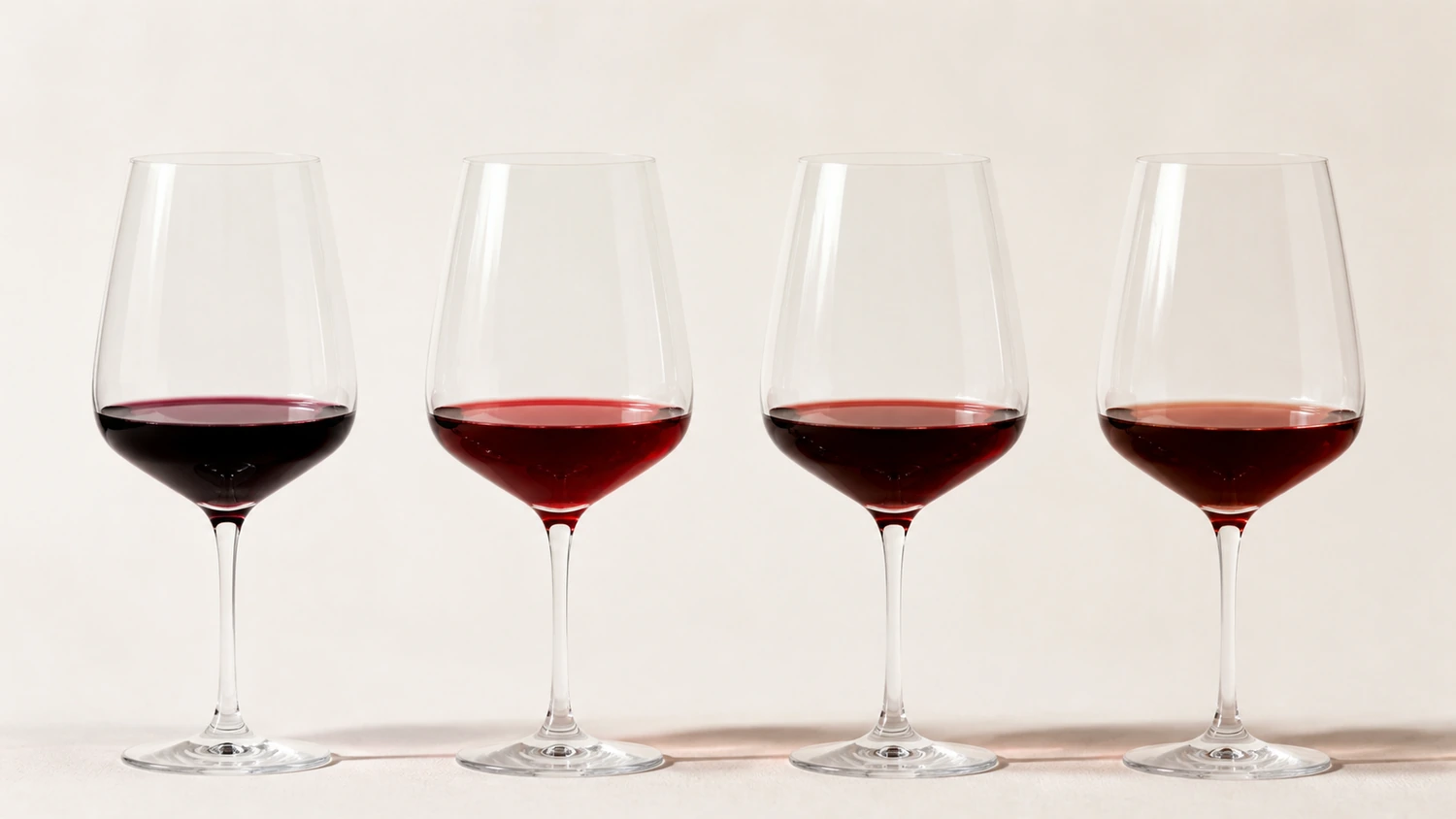
The familiar sequence is real enough to be useful:
violet or purple → ruby → garnet → brick or tawny
As monomeric anthocyanins decline and derived pigments become more prominent, the balance often shifts away from blue-red and toward orange-yellow components. Reviews of red-wine pigment chemistry repeatedly describe this broad evolution from purple-red in youth toward brick-red in maturity (He et al., 2012b; Delić et al., 2024).
What the sequence does not provide is a universal schedule.
There is no defensible rule that says a wine becomes garnet at year five or brick at year ten. Different varieties begin with different pigment profiles. Different vintages alter grape composition. Different winemaking choices affect extraction and pigment formation. Different closures and storage temperatures change the pace of evolution.
A mature-looking color may reflect age.
It may also reflect the wine’s starting point and the road it traveled.
Oxygen is a reagent, not a simple villain
Oxygen is often described in wine as either salvation or destruction.
It is neither in isolation.
Small, controlled oxygen exposure can participate in reactions that help link anthocyanins and flavanols through aldehyde-mediated pathways and can support the formation of some stable pigments. During aging, moderate oxidation is part of the chemistry by which the pigment system evolves (Zhang et al., 2022).
But oxygen exposure is not beneficial without limit. It also consumes sulfur dioxide, changes aroma, and can drive wine toward excessive oxidation, loss of freshness, and greater brown or yellow expression. In a five-year bottle-aging study of three tannin-rich red wines, initial anthocyanin, tannin, and sulfur-dioxide composition influenced polymerization and the way closure-related oxygen exposure affected the wines (Gambuti et al., 2020).
The useful distinction is not oxygen versus no oxygen.
It is dose, timing, wine composition, and control.
Storage changes the pace of the color story
The refrigerator article introduced wine’s aging clock. Color gives us one visible part of that clock’s movement.
Higher storage temperatures generally accelerate chemical change. In Sangiovese aged under different barrel and temperature conditions, warmer storage favored polymerized phenolics and increased color density and hue during the study period (Castellari et al., 2001). Bottle studies have likewise shown that temperature can strongly influence color, phenolic evolution, aroma, and sulfur compounds over time (Giuffrida de Esteban et al., 2019).
Faster change is not automatically better development.
A wine stored warm may acquire mature-looking hues sooner while losing aromatic precision or balance. Color can reveal that change occurred; it cannot certify that the change was graceful.
That distinction matters in a cellar.
A brick rim may be beautiful evidence of maturity.
It may also be one symptom in a larger story of heat or oxygen exposure.
The nose and palate must decide which story is more plausible.
Sediment: when some color leaves the wine
As phenolic compounds react and polymerize, some structures become large enough to lose solubility and precipitate. The Australian Wine Research Institute notes that polyphenolic compounds can condense over time, form larger polymers, and eventually fall out of solution; red pigments and tannin-related material are common components of colored deposits in red wine (AWRI, Amorphous deposits).
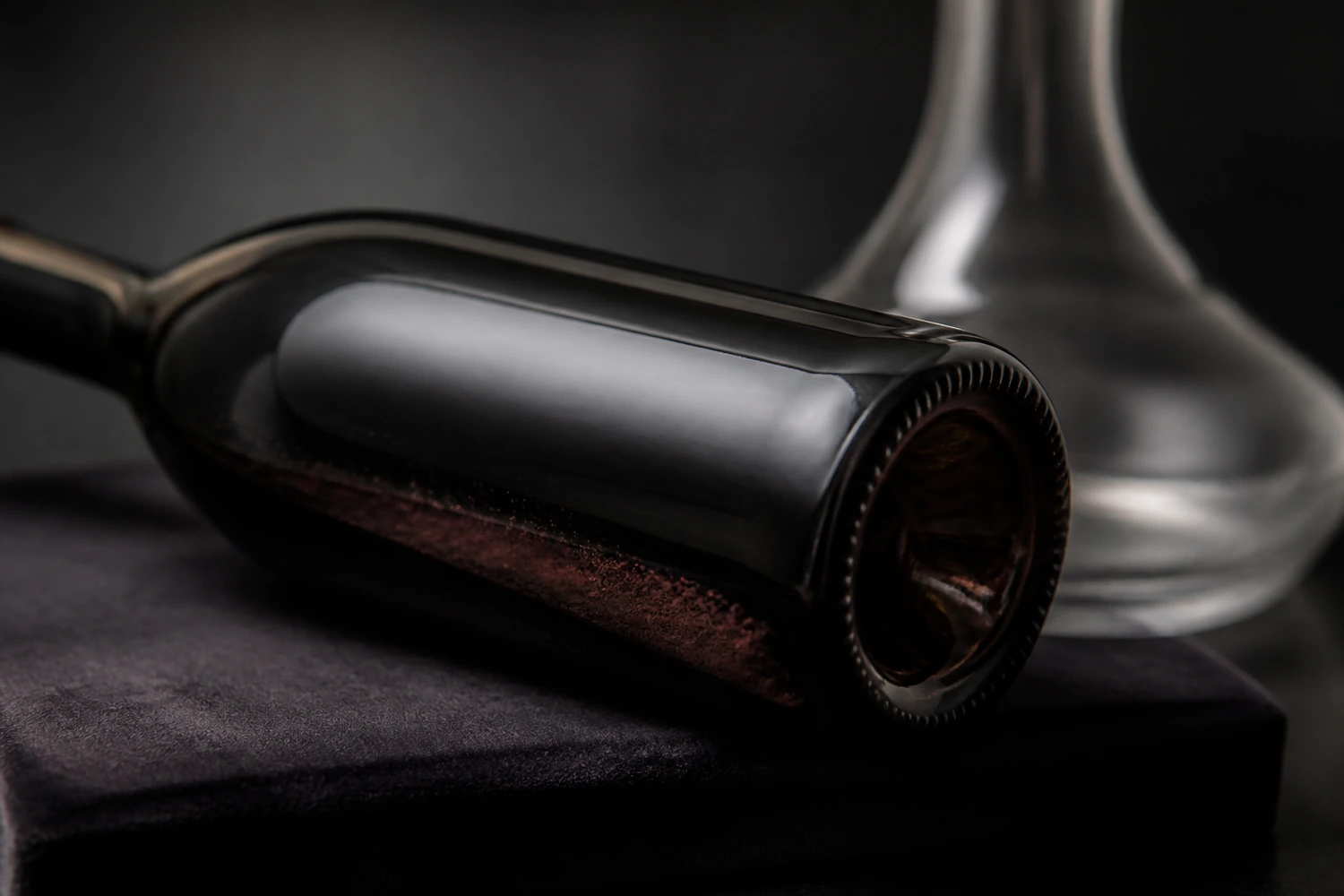
This helps explain why a mature bottle can be both lighter in the glass and richer in sediment.
But sediment is not an age certificate.
Unfiltered young wine may carry deposit. A carefully clarified older wine may carry little visible sediment. Instability, storage, production choices, and bottle handling all matter.
Describe the deposit.
Do not assign prestige to it.
Color is evidence—and expectation
Color does not merely tell us something about the wine. It tells our brain what to expect from the wine.
In a well-known experiment, 54 wine tasters described a white wine that had been colored red with an odorless dye using odor terms more typical of red wine. The study demonstrated that visual information could influence the language tasters used to characterize aroma (Morrot, Brochet & Dubourdieu, 2001).
That does not mean color makes tasting imaginary.
It means perception is integrated.
A deep purple wine may prepare us for density, youth, dark fruit, and tannin. A transparent garnet wine may prepare us for delicacy, dried fruit, earth, or age. Sometimes the wine confirms those expectations. Sometimes the expectation leads the description.
The best defense is not to ignore color.
It is to observe it precisely and hold the inference lightly.
What color can—and cannot—tell you
Color can support useful conclusions when combined with context.
It may suggest:
- relative pigment concentration;
- broad movement from blue-red toward orange-red hues;
- possible evolution in the pigment system;
- differences among varieties, extraction choices, or storage histories;
- the presence of haze or sediment that deserves further inspection.
Color alone cannot prove:
- the exact age of the wine;
- the grape variety;
- the region or soil;
- the quality of the vintage;
- the tannin level or texture;
- that the wine was aged in oak;
- that the wine is oxidized;
- that sediment is either a flaw or a mark of prestige;
- whether you will enjoy the wine.
The visual evidence is real.
Its jurisdiction is limited.
The Five-Pass Color Read
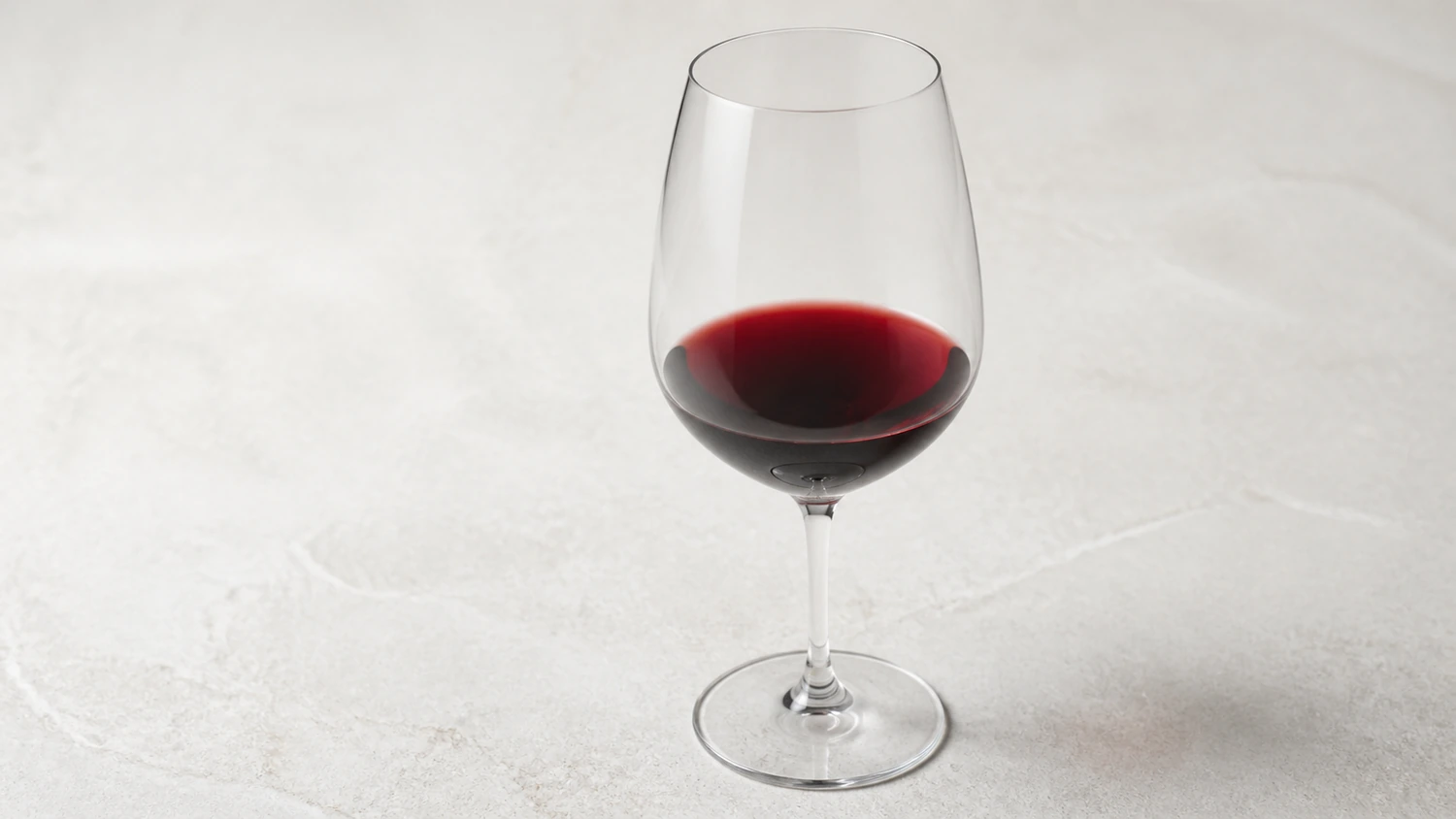
The following method is an original Ask Sommelier AI tasting framework. It is designed for consistent observation, not laboratory measurement and not blind dating.
1. Set the scene
Use neutral daylight or high-quality white light. Hold the glass over a clean white or pale matte surface. Use the same style of clear glass and a similar pour when comparing wines.
Avoid colored tablecloths, amber lighting, tinted glass, and the dramatic blue LEDs of some wine bars.
2. Read depth before age
Look down through the center and then tilt the glass.
Ask:
- Is the core transparent, translucent, deep, or nearly opaque?
- Can I see the stem through the wine?
- How quickly does the wine become pale toward the edge?
Describe depth without immediately calling the wine young, powerful, concentrated, or old.
3. Name the hue in two places
Describe the center and rim separately.
For example:
- deep ruby core, violet rim;
- ruby core, narrow garnet edge;
- translucent garnet core, broad brick rim;
- tawny-brown dominance throughout.
“Red” is a category.
Hue makes the observation useful.
4. Inspect clarity and deposit
Is the wine brilliant, slightly hazy, cloudy, or carrying visible sediment?
If deposit is present, note its color and form without diagnosing it from sight alone. Bottle movement can suspend material that would otherwise settle. Natural-wine production, filtration choices, phenolic precipitation, and instability can create different appearances.
5. Add context—and state confidence
Only now bring in:
- known vintage;
- grape or blend;
- region and climate;
- winemaking information;
- storage history;
- aroma and palate evidence.
Finish with a confidence statement rather than a verdict.
Example: Deep ruby core, narrow garnet rim, clear, no visible sediment. The appearance is consistent with some pigment evolution, but variety, extraction, and storage history remain important alternatives. Confidence: moderate.
The interpretation table
| What you observe | Plausible interpretations | What it does not prove |
|---|---|---|
| Dense ruby-purple core with violet rim | High visible pigment load, young-wine anthocyanins and copigmentation may be prominent | Exact age, high quality, full body, or high tannin |
| Ruby core with a narrow garnet rim | Early or moderate pigment evolution may be visible | A specific vintage or drinking window |
| Translucent garnet with a broad brick edge | Greater orange-red contribution and longer pigment evolution are plausible | That the wine is old, sound, oxidized, or valuable |
| Brown or tawny color dominating the full glass | Advanced evolution or oxidation may be involved | Automatic spoilage; some styles are intentionally oxidative |
| Fine red-brown sediment | Phenolic or pigment precipitation is plausible | Great age, premium quality, or a flaw |
| Unexpected haze or suspended particles | Bottle movement, filtration choices, instability, or microbial activity may deserve consideration | A diagnosis from appearance alone |
The table does not replace the wine.
It slows the leap from seeing to claiming.
Why this matters to Ask Sommelier AI
A useful wine record should remember more than a color word.
When you log a bottle, record:
- the core intensity;
- the center hue;
- the rim hue and width;
- clarity and sediment;
- serving light and glass conditions;
- aroma and palate observations;
- the date opened and storage history, when known.
That context allows future comparisons to become more meaningful. A note reading garnet is evocative. A note reading translucent garnet core, broad brick rim, clear after standing upright, dried cherry and leather emerging after thirty minutes becomes evidence you can use.
Ask Sommelier AI should help organize that evidence—not pretend a photograph can reveal an exact vintage, certify condition, or replace the next smell and sip.
Color begins the conversation.
The rest of the wine answers it.
Frequently asked questions
Why does red wine turn brown as it ages?
Monomeric anthocyanins decline while new anthocyanin-derived and polymeric pigments form. The balance of visible color often shifts from blue-red toward orange-yellow and brown components. Oxygen, pH, temperature, sulfur dioxide, variety, and wine composition influence the pace and result.
Does a garnet color mean a wine is old?
Not necessarily. Garnet can be consistent with evolution, but some varieties and winemaking styles begin lighter or move toward garnet sooner than others. Lighting, pour depth, extraction, oxygen, and storage also matter.
Is a purple rim proof that a red wine is young?
A violet or purple rim is common in many young, pigment-rich reds, particularly when monomeric anthocyanins and copigmentation are prominent. It is supportive evidence, not proof of a specific age.
Why is the rim lighter than the center?
The edge contains a shallower layer of wine, so light travels through less liquid and less pigment. That shorter optical path makes subtle hue changes easier to see.
Does sediment mean the wine is bad?
No. Pigments and phenolic polymers can precipitate naturally, especially as wine evolves. Sediment may also reflect filtration choices or instability. Evaluate aroma, palate, bottle history, and the form of the deposit before drawing a conclusion.
Can color tell me whether a wine is oxidized?
Color can raise suspicion—especially when browning is unexpected for the wine’s style—but it cannot diagnose oxidation alone. Aroma, flavor, freshness, closure condition, and storage history are essential.
Can I estimate a wine’s vintage from color alone?
Not reliably. Trained tasters may make broad hypotheses, but exact blind dating requires more evidence, and even then remains uncertain. Color should be combined with variety, region, aroma, structure, development, and known storage conditions.
The color of time
Return to the two glasses.
The violet wine may be young. The garnet wine may have traveled farther.
But now the eye hesitates before writing the whole story.
It notices depth. It separates core from rim. It asks what the grape contributed, what the cellar extracted, what oxygen helped transform, what temperature accelerated, and what has already settled to the bottom of the bottle.
Then the nose approaches.
That is the right order.
Color is the first page of a wine’s history.
It is not the final chapter.
References & further reading
- International Organisation of Vine and Wine. Chromatic Characteristics (Type IV), OIV-MA-AS2-07B.
- International Organisation of Vine and Wine. Determination of the chromatic characteristics of wine according to CIELab.
- He, F., et al. (2012). Anthocyanins and their variation in red wines I: Monomeric anthocyanins and their color expression. Molecules, 17, 1571–1601.
- He, F., et al. (2012). Anthocyanins and their variation in red wines II: Anthocyanin-derived pigments and their color evolution. Molecules, 17, 1483–1519.
- Boulton, R. (2001). The copigmentation of anthocyanins and its role in the color of red wine: A critical review. American Journal of Enology and Viticulture, 52, 67–87.
- Heredia, F. J., et al. (1998). Chromatic characterization of anthocyanins from red grapes—I. pH effect. Food Chemistry, 63, 491–498.
- Somers, T. C. (1971). The polymeric nature of wine pigments. Phytochemistry, 10, 2175–2186.
- Zhang, X.-K., et al. (2022). Red wine coloration: A review of pigmented molecules, reactions, and applications. Comprehensive Reviews in Food Science and Food Safety, 21, 3834–3866.
- Márquez, A., et al. (2013). Pyranoanthocyanin-derived pigments in wine: Structure and formation during winemaking. Journal of Chemistry, 713028.
- Schwarz, M., et al. (2003). Vitisin A content in Chilean Cabernet Sauvignon wines and contribution to the color of aged red wines. Journal of Agricultural and Food Chemistry, 51, 6261–6267.
- Zhang, X.-K., et al. (2021). Targeted metabolomics of anthocyanin derivatives during prolonged wine aging: Evolution, color contribution and aging prediction. Food Chemistry, 339, 127795.
- Gambuti, A., et al. (2020). Impact of five-year bottle aging under controlled oxygen exposure on sulfur dioxide and phenolic composition of tannin-rich red wines. OENO One, 54, 623–636.
- Casassa, L. F., Bolcato, E. A., & Sari, S. E. (2015). Chemical, chromatic, and sensory attributes of six red wines produced with prefermentative cold soak. Food Chemistry, 174, 110–118.
- Zhang, H.-L., et al. (2024). Effects of phenolic evolution on color characteristics of single-cultivar Marselan and Merlot wines during vinification and aging. Foods, 13, 494.
- Delić, M., et al. (2024). Grape, wine and pomace anthocyanins: Winemaking biochemical transformations, application and potential benefits. OENO One, 58(4).
- Castellari, M., et al. (2001). Influence of aging conditions on the quality of red Sangiovese wine. Journal of Agricultural and Food Chemistry, 49, 3672–3676.
- Giuffrida de Esteban, M. L., et al. (2019). Impact of closure type and storage temperature on chemical and sensory composition of Malbec wines during aging in bottle. Food Research International, 125, 108553.
- Morrot, G., Brochet, F., & Dubourdieu, D. (2001). The color of odors. Brain and Language, 79, 309–320.
- Australian Wine Research Institute. Amorphous deposits in wine.