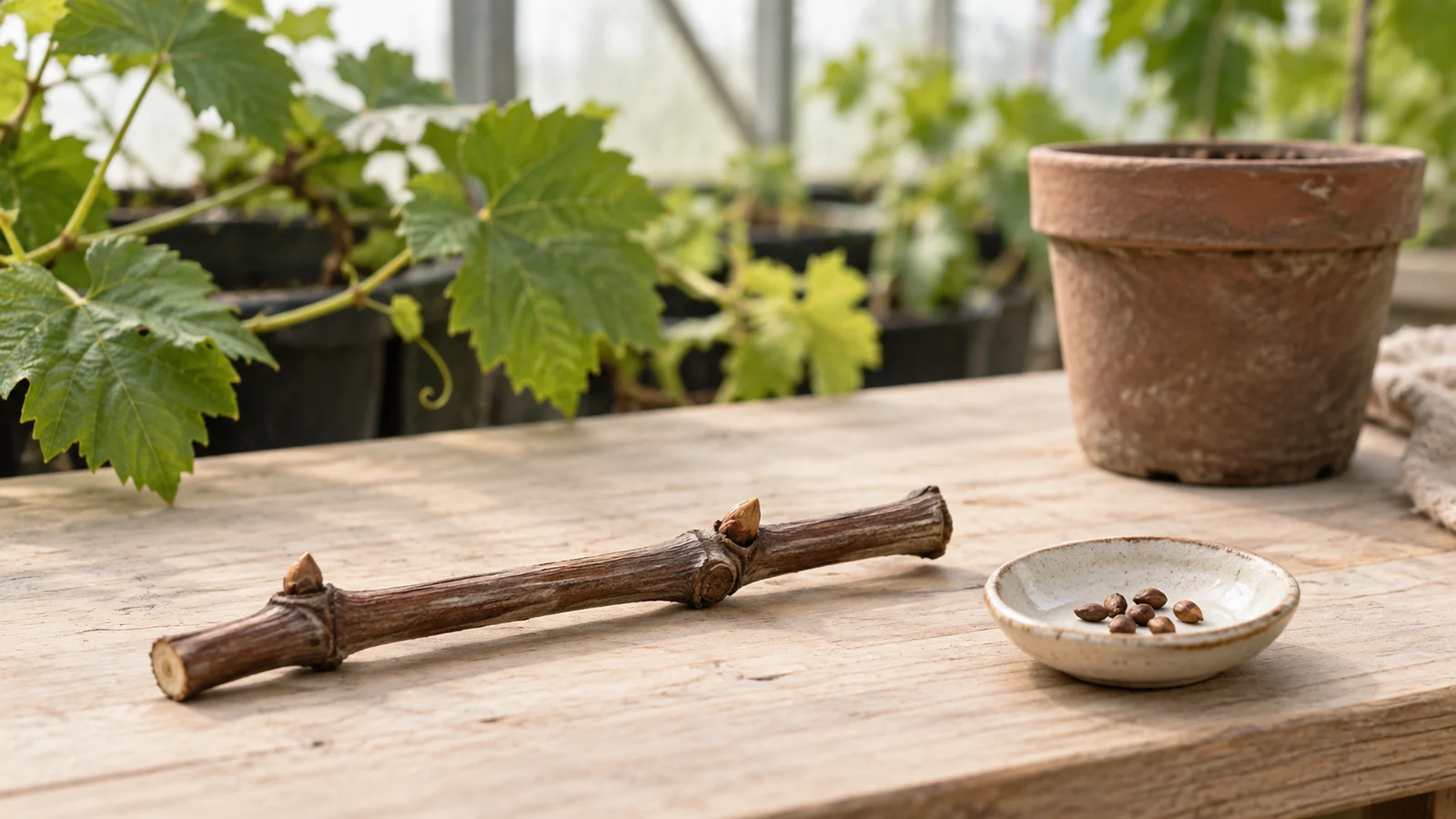
Imagine two objects on a nursery bench: a grape seed and a short piece of dormant vine.
Neither looks much like a bottle of wine. There is no vineyard name to admire, no scent of fruit, no reason yet to reach for a glass. But they place us in front of a choice that helps explain thousands of years of growing grapes.
Do we want to grow another plant—or preserve a particular plant we have learned to value?
Those ambitions can lead in different directions.
In the previous Cellar Journal article, a clay vessel helped us ask when wine first appears in the surviving evidence. Now we step outside the vessel. Making something from grapes and changing the plants that produce them are connected histories, not the same event.
Domesticating the vine meant more than choosing fruit. It changed which plants were multiplied and how their qualities could be carried forward.
This is not a story about one person discovering the perfect grape. It is about selection, reproduction, movement and a relationship that never became completely separate from the wild.
What does it mean to domesticate a grapevine?
Picking grapes from a wild plant is gathering. Protecting, tending or planting a vine is cultivation. Favoring plants with particular inherited characteristics, and repeatedly influencing which ones reproduce, participates in domestication.
These distinctions help us read evidence. They are not compulsory steps that every community followed in the same order.
A plant could be tended while retaining wild-like characteristics. An archaeological study of southern France found wild, intermediate and domestic seed forms in contexts that supported cultivation, complicating a clean division between wild fruit gathered in woodland and fully transformed vineyard plants. Bouby and colleagues, 2013
That is the first adjustment to the familiar picture: domestication is not simply the moment a climber is put into a neat row.
Nor does finding a fermented grape product automatically tell us whether its fruit came from a domesticated population. Evidence about a beverage cannot quietly stand in for evidence about the plant.
The vine before the rows
Our focus is the Eurasian grapevine, Vitis vinifera. Its wild relative is commonly named Vitis vinifera subsp. sylvestris; the cultivated form is generally called subsp. vinifera, while some studies use sativa. These names distinguish related plant populations, not a ladder from inferior fruit to superior wine. Magris and colleagues, 2021
Other grape species exist. This particular history should not be substituted for the ancestry of every grape grown anywhere in the world.
In its habitat, the wild Eurasian vine is a woody climber, using surrounding vegetation rather than a winery’s trellis. Field research in the Danube floodplain describes vines in forest gaps and along woodland edges and channels. That landscape is a useful corrective to the assumption that the vine’s natural shape is a low, evenly spaced vineyard row. Arnold, Bachmann and Schnitzler, 2017
But a vine found outside a vineyard is not automatically an untouched wild ancestor. Escaped cultivated plants, rootstocks and hybrids can also occur there. The same field study needed genetic and botanical observations to distinguish them.
Location begins the question. It does not finish the identification.
A small flower changed a large part of the story
Fruit attracts our attention. Reproduction helps explain the transformation.
Wild Eurasian vines are generally functionally male or female: pollen production and the ability to set fruit are separated between plants. Most cultivated Vitis vinifera varieties instead have flowers with functional male and female organs and can self-pollinate. Research on wild and cultivated genomes investigates the genetic changes associated with that transition. Badouin and colleagues, 2020
The practical significance is considerable. A fruit-bearing plant need not depend on a separate male vine to supply compatible pollen. That does not eliminate weather, disease or other influences on fruit set, and self-pollination does not mean seedlessness.
A second genomic investigation proposed a rare recombination event in the sex-determining region as part of the explanation. Its candidate mechanisms should not be retold as an eyewitness account of someone intentionally changing a flower. Massonnet and colleagues, 2020
The distinction lets us appreciate the grower’s achievement without inventing a prehistoric genetics lesson. People could favor useful plants without knowing why their flowers behaved differently.
Selection was not a single wish for bigger grapes
It is tempting to draw domestication as a tiny wild berry becoming a large cultivated one.
That picture leaves too much out.
Fruit size, seed form, flower function and other traits need not change together. A modern study of grape-seed shape treated domestication as a combination of changes examined across reference populations, rather than a single feature sufficient to identify every plant. Terral and colleagues, 2010
For our purposes, the useful question is what a plant made possible for the people tending it. Reliable fruiting and fruit suited to a purpose are not the same preference as maximum berry size. Nor should we assume that early growers were already choosing between the modern supermarket grape and a familiar named wine variety.
The history becomes more plausible when we leave room for different uses, local conditions and choices whose exact motives were never recorded.
A selection can have consequences even when its original reason is lost.
A seed offers a new combination; a cutting preserves a starting point
Return to the nursery bench.
A seed results from sexual reproduction. Its inherited combination can differ from that of the vine on which its grape grew—even when the flower self-pollinated. Planting seeds from an admired vine therefore does not reliably reproduce that cultivar. A cutting, by contrast, develops from existing plant tissue and maintains the selected genetic background. Grape population research connects this reliance on vegetative propagation with the long persistence of cultivar lineages. Myles and colleagues, 2011
Think of a deliberately simplified example. A grower likes one vine’s fruit. Raising seedlings offers possibilities, including surprises. Multiplying that vine vegetatively offers continuity. Neither is inherently the more enlightened choice; they answer different questions.
The example is an explanation of reproductive choices, not a reconstruction of the first grower’s actions.
Selection and preservation can work together: variation provides something to choose, and propagation provides a way to keep it.
That relationship is more interesting than imagining that domestication ended as soon as someone found a satisfactory grape.
A seed opens a new combination. A cutting carries a chosen starting point forward.
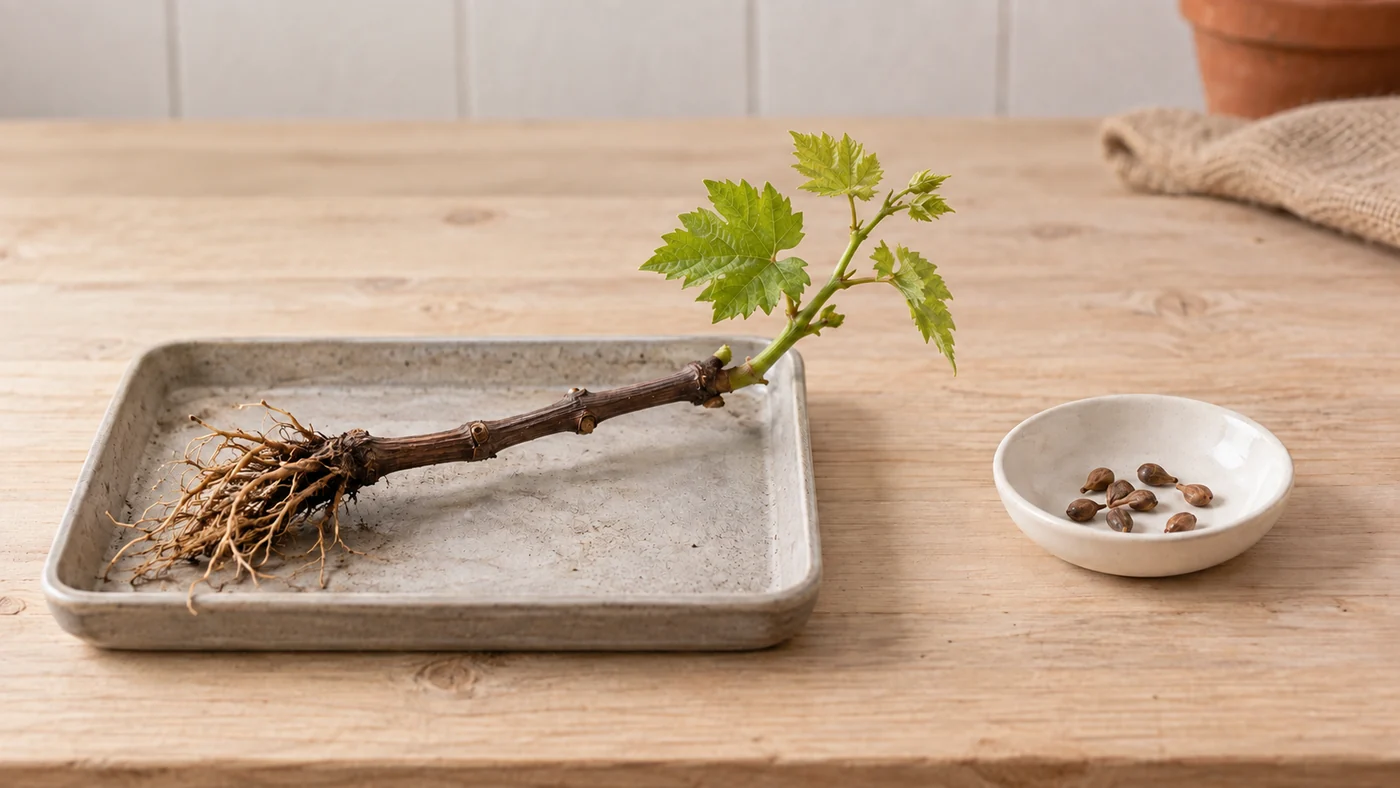
A clone is continuity, not a stopped clock
Preserving a genetic background does not freeze every detail forever.
A genomic study of 15 Zinfandel clones found extensive shared variation alongside differences accumulated within their clonal histories. Somatic mutations—changes arising in the growing plant rather than through a new sexual cross—can contribute to that diversification. A detected difference is not automatically a demonstrated flavor difference. Vondras and colleagues, 2019
This helps separate three claims that often become tangled in wine storytelling: the age of a cultivar’s lineage, the age of a particular living vine and the qualities of this year’s fruit.
A young plant can continue an old cultivar. An old vine is not necessarily the original plant from which that cultivar began. Neither statement is a tasting score.
There is another useful caution: the Danube study also documented clones in wild populations. Vegetative continuity is not, by itself, exclusive evidence of human intervention. Its historical meaning depends on context. Arnold and colleagues
The vine can retain a relationship to the past without becoming a perfectly preserved copy of everything the past produced.
Where did domestication begin?
This is where a tidy origin story encounters competing reconstructions.
Researchers compare genetic variation to investigate how populations split, mixed and changed. The conclusions are not simply read off a map; they depend on samples, reference populations and the historical models being tested.
A 2021 study of 204 genomes supported a single domestication origin in Western Asia, followed by substantial contributions from European wild populations to cultivated wine grapes. Magris and colleagues
A 2023 analysis of 3,525 cultivated and wild accessions instead inferred two domestication events, in Western Asia and the Caucasus, approximately 11,000 years ago. Its reconstruction linked them with lineages associated with table and wine grapes. Dong and colleagues
An accession is a particular plant-material sample or maintained entry. It is not another word for an excavated vineyard.
The two studies should not be silently merged into one unanimous account. Nor should the larger number of samples become a substitute for understanding their methods. They offer different reconstructions of population history.
Most importantly, the estimated date in the 2023 model is not a dated jar of wine, a named farmer or the inaugural harvest of a modern variety.
A genetic chronology is an argument about ancestry, not a diary of the first vineyard.
Ancient seeds add a different kind of evidence
Archaeological remains let researchers examine plant material from particular past contexts rather than infer the entire past from living collections.
Shape is one route. A 2024 investigation analyzed 19,377 archaeological grape pips from France, comparing them with modern reference material and accounting for distortions associated with preservation. It identified a regional expansion of domestic forms around 600–500 BCE. That is a result about the studied French record, not the beginning of domestication worldwide. Bouby and colleagues, 2024
Genomes provide another route. Published in March 2026, a study analyzed 54 ancient grape-pip genomes, including 49 newly sequenced samples, primarily from France. Domestic-related ancestry appeared in its sampled sequence by approximately 625–500 BCE. The authors explicitly challenged an earlier Neolithic spread into western Europe proposed in the 2023 reconstruction. Noraz and colleagues, 2026
That is a meaningful disagreement about western dispersal. It does not, on its own, refute every part of an eastern domestication model or establish that every unsampled earlier site lacked cultivated vines.
Morphology, ancient DNA and modern population models can question one another. Agreement matters; so does the precise point of disagreement.
| Evidence | The question it helps address | What it cannot establish alone |
|---|---|---|
| An ancient seed’s measured shape | Does it resemble reference groups, after accounting for preservation? | An exact modern cultivar or the maker’s intended drink |
| DNA from archaeological material | Which genetic relationships appear in the dated or contextually dated sample? | Every event before that sample, or a complete taste profile |
| Genomes of living accessions | Which historical population model fits the observed variation? | A directly witnessed first farm or first wine |
These are complementary lines of inquiry, not three interchangeable clocks.
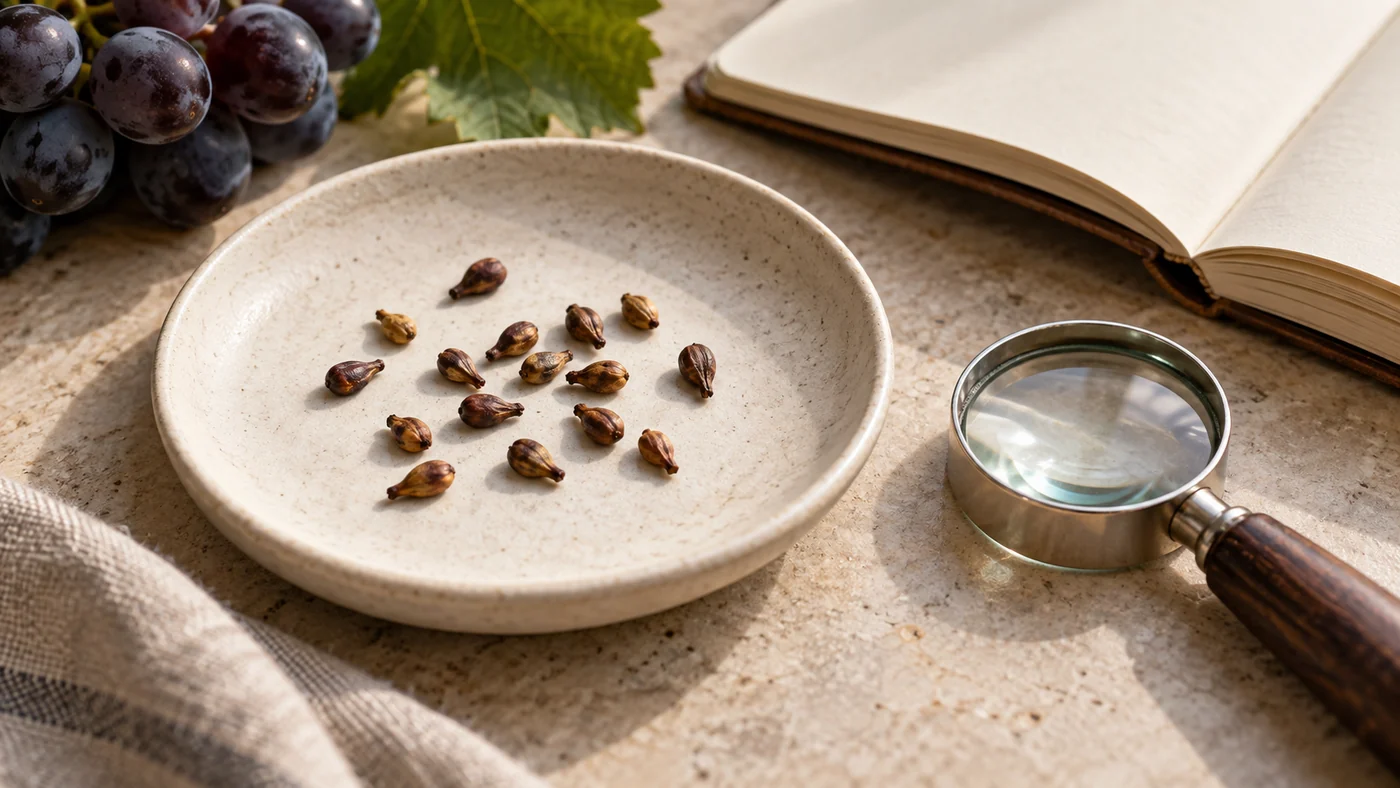
The wild vine did not disappear when cultivation began
Domestication is sometimes drawn as a door closing behind the crop.
Grapevine history does not fit that image particularly well.
Crossing between cultivated and wild populations can introduce genetic variants that persist in later descendants. That continuing incorporation is called introgression. It is not proof that every region independently invented grape cultivation, and it does not mean a grower deliberately made every historical cross.
A 2024 study compared cultivated varieties with wild vines, mainly from northern Italy. Several Lambruscos associated with the Po and Adige plains showed mixed wild–cultivated ancestry; other varieties also called Lambrusco did not show the same pattern. The authors discussed a post-domestication contribution, not an identical origin for everything sharing the name. Schneider and colleagues
This is a better kind of regional story: specific plants, specific comparisons and a conclusion with boundaries.
The name Lambrusco cannot do the genetic analysis for us. And genetic mixture does not make the resulting wine less legitimate. It tells us that cultivation could continue drawing on variation beyond the planted vineyard.
The wild relative is not only a chapter in a history book
Conservation becomes part of the story precisely because these plants are not simply vanished ancestors.
A European collaborative project developed guidance for identifying, evaluating and conserving wild grapevine resources, including both conservation in natural habitats and collections outside them. The work makes identification part of conservation rather than assuming every untrained vine represents the same resource. Zdunić and colleagues, 2017
The Julius Kühn Institute likewise maintains and characterizes wild vines, cultivated varieties and breeding material. Its work links living collections with identity records and genetic information. JKI’s genetic-resources program
Those activities answer different needs. A collection preserves documented material for study and use; a habitat also contains ecological relationships. We should not ask one to stand in for everything the other provides.
For a reader, the practical consequence is modest but important. An interesting vine at a woodland edge is not an invitation to take cuttings or declare that an ancient variety has been rediscovered. Observation and an appropriate botanical identification come before collection or a dramatic story.
Protecting the history of the vine also means protecting possibilities that do not yet have a famous label.
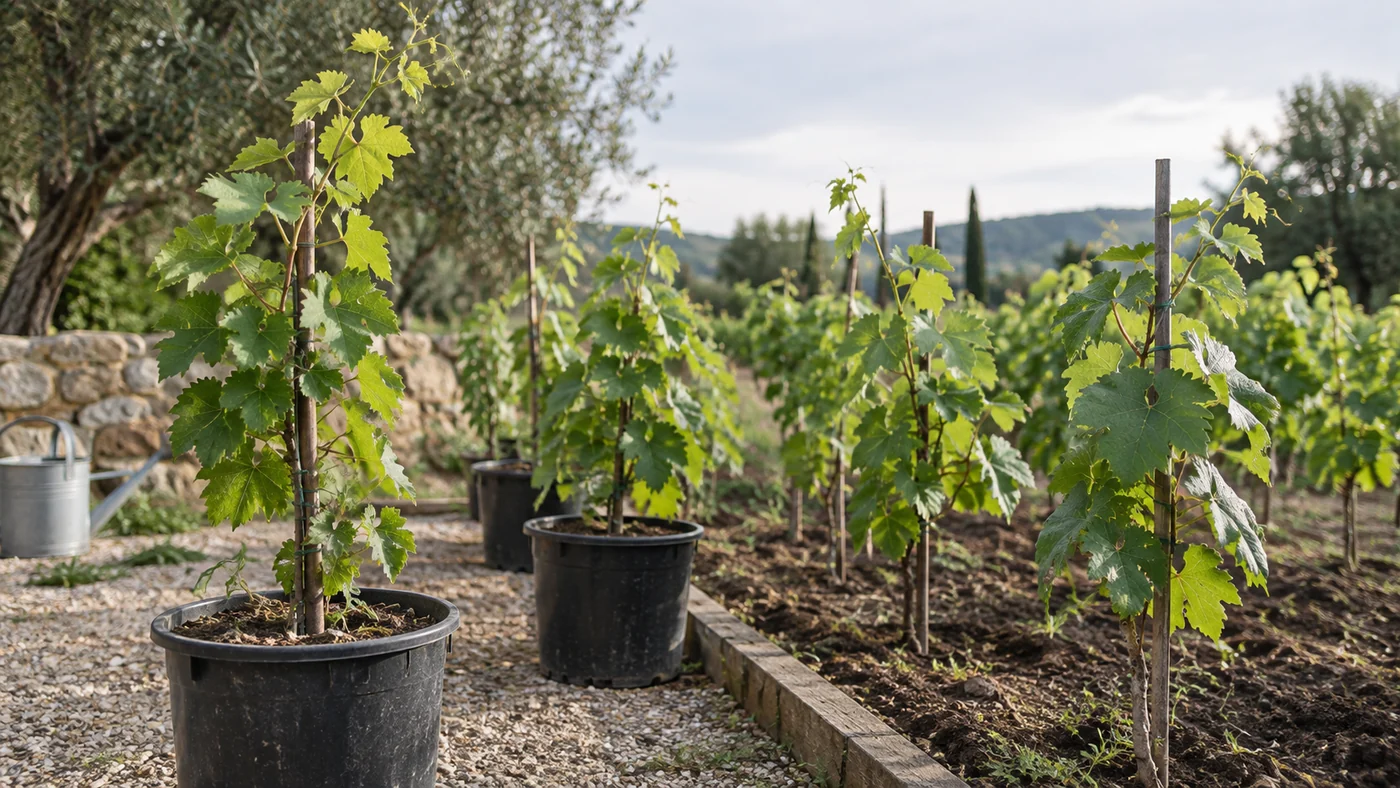
Five questions for reading a vine’s history
A bottle, nursery description or vineyard visit may offer a compelling origin story. This original Ask Sommelier AI reading aid keeps the questions manageable; it is not a genetic test or an archaeological protocol.
1. Which plant?
Are we discussing the Eurasian grapevine, a cultivar, a clone, a wild population or an individual vine? “Ancient grape” is too broad to answer those questions by itself.
2. Which change?
Does the evidence concern flowers, fruit, seed shape, genetic ancestry or a cultivation practice? One trait should not carry the explanation for the whole plant.
3. Which kind of reproduction?
Was the lineage generated through sexual crossing or maintained through vegetative propagation? A seedling and a cutting offer different kinds of continuity.
4. Which evidence?
Is the claim based on modern genomes, an ancient sample, measured morphology, historical documentation or an inherited local account? Respecting a tradition does not require calling it a laboratory result.
5. Which place and time?
Does a date describe a modeled population event, archaeological context, first written mention or planting year? A regional observation should not silently become a global beginning.
These questions do not make a vineyard visit less enjoyable. They let a good story become more specific without demanding that every gap be filled.
What this changes in the way we talk about wine
The history of a vine deserves better than two shortcuts: old means better and genetics explains the whole glass.
For Ask Sommelier AI, the editorial standard is to keep cultivar identity, lineage history, documented vine age and production information separate. Historical context can enrich a recommendation; it cannot certify the condition or quality of a particular bottle. This is a standard for responsible explanation, not a claim that the app has authenticated a plant or archaeological sample.
Return to the seed and the dormant cutting.
One suggests a new combination. The other offers a way to carry forward something already chosen. Neither contains the whole history of the vineyard. Together, they make its central tension easier to understand: creating variation, recognizing something useful and finding ways to keep it.
We do not need to invent the first person who made those choices to appreciate the knowledge they required.
The vineyard is not nature erased. It is a long relationship between inherited possibilities and human choices.
Next, that relationship begins to move: Wine Learns to Travel: Amphorae, Ports and Mediterranean Routes. Transporting a drink, transporting a vine and transmitting the knowledge to cultivate it are three journeys we should learn to distinguish.
Frequently asked questions
When were grapes domesticated?
There is no single excavated date that settles the full process. The 2023 genomic reconstruction inferred two eastern domestication events about 11,000 years ago; a 2021 study supported a single-origin model. State which study and which kind of date you mean. Dong · Magris
Are wild grapes and cultivated grapes different species?
In this article, the Eurasian wild and cultivated forms are treated as subspecies of Vitis vinifera. Naming conventions vary between publications. This does not mean that every grape species worldwide belongs to that one domestication story. Magris and colleagues
Does a cultivated vine need a separate male plant?
Most cultivated Vitis vinifera varieties have functional male and female flower parts and can self-pollinate. The usual separate-sex arrangement of the wild relative is different. “Most” matters; a general description does not replace information about a particular plant. Badouin and colleagues
Can a seed reproduce the same wine-grape variety?
Not reliably. Sexual reproduction can produce a new genetic combination. Vegetative propagation is used to maintain a selected cultivar’s background; this does not make every descendant permanently free of mutations. Myles · Vondras
Does wild ancestry mean a grape was domesticated locally?
Not necessarily. Wild ancestry can enter an already cultivated lineage through later crossing and introgression. That is different from independently establishing a crop from a local wild population. Schneider and colleagues
Is domestication the date wine was invented?
No. A model of plant ancestry and evidence for making a beverage answer different questions. A domestication estimate should not be relabeled as the first vintage, and a seed’s presence alone does not establish how its fruit was consumed. Dong · Bouby and colleagues
References
Source titles retain their original language. Some links lead to abstracts or access-controlled publisher pages; the separate research dossier records the access used.
- Bouby, L., et al. (2013). Bioarchaeological Insights into the Process of Domestication of Grapevine (Vitis vinifera L.) during Roman Times in Southern France. PLOS ONE 8(5), e63195. DOI / source. Additional access.
- Arnold, C., Bachmann, O., & Schnitzler, A. (2017). Insights into the Vitis complex in the Danube floodplain (Austria). Ecology and Evolution 7(19), 7796–7806. DOI / source. Additional access.
- Badouin, H., et al. (2020). The wild grape genome sequence provides insights into the transition from dioecy to hermaphroditism during grape domestication. Genome Biology 21, 223. DOI / source. Additional access.
- Massonnet, M., et al. (2020). The genetic basis of sex determination in grapes. Nature Communications 11, 2902. DOI / source. Additional access.
- Terral, J.-F., et al. (2010). Evolution and history of grapevine (Vitis vinifera) under domestication: new morphometric perspectives to understand seed domestication syndrome and reveal origins of ancient European cultivars. Annals of Botany 105(3), 443–455; published online 23 December 2009. DOI / source. Additional access.
- Myles, S., et al. (2011). Genetic structure and domestication history of the grape. Proceedings of the National Academy of Sciences 108(9), 3530–3535. DOI / source. Additional access.
- Vondras, A. M., et al. (2019). The genomic diversification of grapevine clones. BMC Genomics 20, 972. DOI / source. Additional access.
- Magris, G., et al. (2021). The genomes of 204 Vitis vinifera accessions reveal the origin of European wine grapes. Nature Communications 12, 7240. DOI / source. Additional access.
- Dong, Y., et al. (2023). Dual domestications and origin of traits in grapevine evolution. Science 379(6635), 892–901. DOI / source. Additional access.
- Bouby, L., et al. (2024). Seed morphometrics unravels the evolutionary history of grapevine in France. Scientific Reports 14, 22207. DOI / source. Additional access.
- Noraz, R., et al. (2026). Ancient DNA reveals 4000 years of grapevine diversity, viticulture and clonal propagation in France. Nature Communications 17, 2494; published 24 March 2026. DOI / source. Additional access.
- Schneider, A., Ruffa, P., Tumino, G., Fontana, M., Boccacci, P., & Raimondi, S. (2024). Genetic relationships and introgression events between wild and cultivated grapevines (Vitis vinifera L.): focus on Italian Lambruscos. Scientific Reports 14, 12392. DOI / source. Additional access.
- Zdunić, G., et al. (2017). Guiding principles for identification, evaluation and conservation of Vitis vinifera L. subsp. sylvestris. Vitis 56(3), 127–131. DOI / source. Additional access.
- Julius Kühn Institute (accessed 21 September 2026). Conservation and characterisation of genetic resources. Official institutional program page. DOI / source.