The nursery is quiet in winter.
Rows of dormant vines wait in bundles: pale canes, sealed grafts, trimmed roots, and small tags tied carefully to wood that has not yet produced a leaf.
At this stage, the tag does almost all the talking.
It may say Merlot. Albariño. Zinfandel. Carménère. One word can determine where the vine is planted, how growers manage its season, what a future bottle may be called, which legal rules apply, and what a drinker expects before the cork moves.
Then the cutting is copied.
Grapevines are commonly multiplied vegetatively—through cuttings, grafting, and clonal propagation—so a chosen vine can persist through generations with much of its genetic identity intact. The same process that preserves a valued cultivar can also preserve an old naming error. A misplaced tag, a visually similar vine, a local synonym, or an accession entered incorrectly into a collection may travel farther than the person who first attached the name.
In our previous Cellar Journal article, we asked how a changing climate may alter which varieties fit a place.
Before asking which grape belongs in the vineyard of the future, another question comes first:
Are we certain the vine is the grape its history says it is?
The central idea: a grape name is a claim. DNA can test the biological match. History, law, place, and wine still have work to do.
That last sentence matters.
DNA has resolved extraordinary mysteries in wine. It has joined grapes once believed separate, corrected vines carried for decades under the wrong name, reconstructed parentage, and even connected archaeological material with cultivars still grown today.
But DNA is not a magic label reader.
It does not decide which cultural name is the most meaningful. It does not, by itself, prove the route a vine followed across countries. It cannot look at a tasting note and convict a bottle of being the wrong grape. It does not turn a genetic relationship into a sensory recipe. And it cannot predict the complete wine from the cultivar alone.
To use grape genetics well, we need to know exactly which question the evidence answered.
The vine had a face before it had a fingerprint
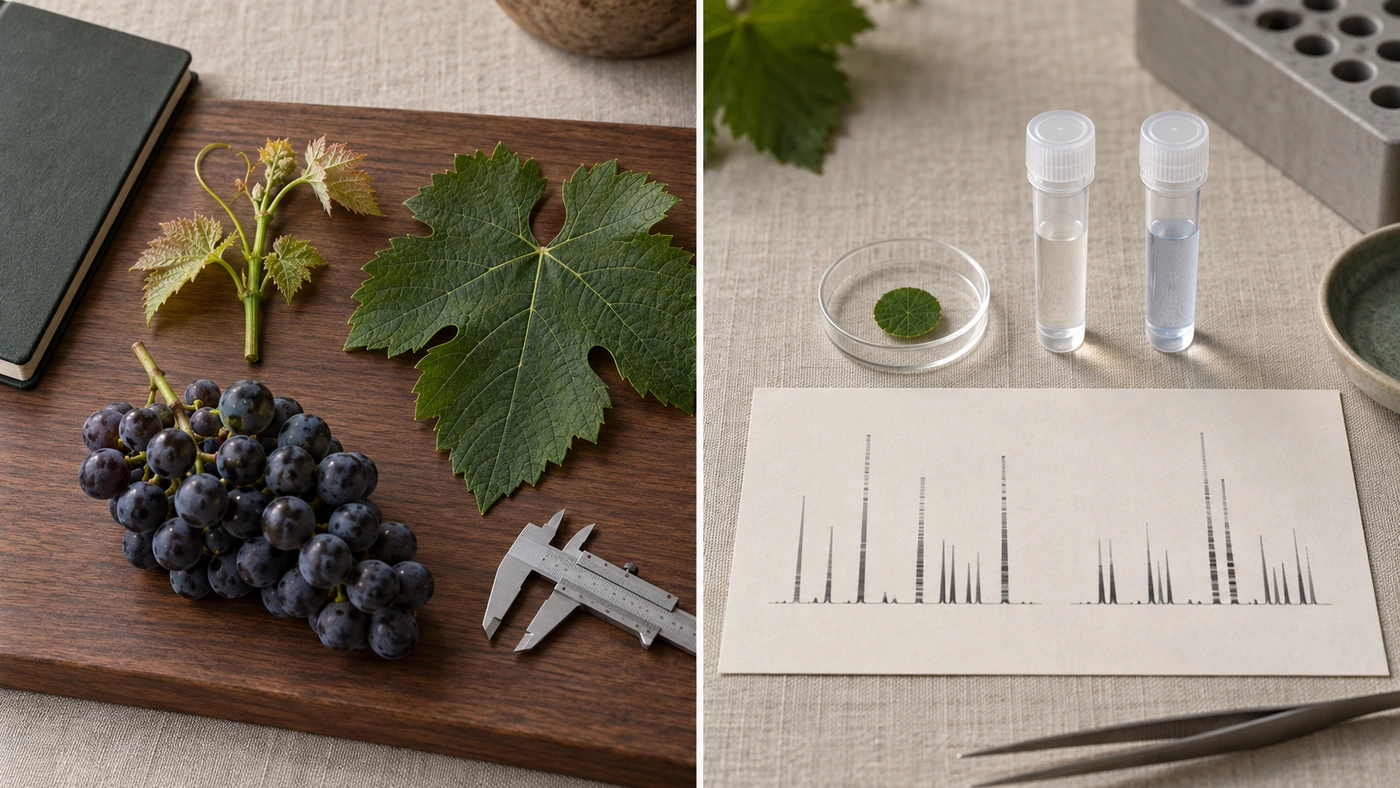
Long before laboratories could profile DNA, grape varieties were identified by ampelography: the disciplined observation and comparison of the vine itself.
An ampelographer studies features such as:
- the opening, color, and hair density of the young shoot tip;
- the shape, lobes, teeth, surface, and petiole sinus of the mature leaf;
- bunch length, density, wings, and form;
- berry shape, skin color, flesh, seeds, and particular flavors;
- the timing of budbreak and veraison.
This is not casual leaf recognition. It is a specialized visual language built through collections, illustrations, measured descriptors, and years of field experience.
The current OIV descriptor system retains detailed morphological characters, while the OIV’s variety-identification protocol recommends combining ampelographic description with nuclear DNA analysis rather than treating one as a universal replacement for the other (OIV Descriptor List; OIV-VITI 609-2019).
That combination makes sense.
Morphology shows the vine as a living plant. DNA provides environmentally independent markers that can separate look-alikes and connect material held in different collections. Ampelography can alert an expert that something in the row does not fit the name. Genetics can then test that suspicion against authenticated references.
The vine had a face before it had a fingerprint. Modern identification is strongest when it can read both.
The history of Carménère in Chile illustrates this partnership especially well. The first decisive correction did not begin with a machine announcing a result. Ampelographers noticed that some vines called Merlot did not behave or look like Merlot. Molecular work later confirmed the distinction.
DNA did not make expert observation obsolete.
It gave the observation another level of proof.
A DNA profile does not arrive with a grape name attached
When people hear “DNA test,” they often imagine a complete genome entering a computer and returning one definitive word.
Most cultivar identification has historically worked more selectively.
SSR markers, also called microsatellites, examine chosen regions where short DNA sequences repeat. The pattern across several markers can be highly discriminating. The OIV minimum protocol calls for a profile using at least nine reference SSR markers so results can be compared using a harmonized system (OIV-VITI 609-2019).
SNP panels examine selected single-nucleotide positions—places where one DNA “letter” may differ. A widely studied 48-SNP panel was designed for reproducible grapevine cultivar identification across laboratories and had discrimination comparable to a much smaller number of highly polymorphic SSR markers within the evaluated material (Cabezas et al., 2011).
Whole-genome sequencing reads at far greater resolution and can reveal differences that smaller panels miss, including candidate variation among clones of the same cultivar.
These methods do not answer exactly the same question.
A panel designed to distinguish cultivars may correctly identify Carménère while lacking the resolution to distinguish one Carménère clone from another. A whole-genome study may separate clones but still require additional work to determine whether the observed variants change vine behavior, fruit composition, or wine style.
The word DNA therefore covers several levels of resolution.
And every result needs a reference.
The profile does not contain the word Carménère inside it. It becomes an identification when the laboratory compares the sample with trusted reference material or a validated database. The Vitis International Variety Catalogue, or VIVC, was built in part to connect cultivar names, morphology, origins, synonyms, and genetic profiles across collections (Maul & Töpfer, 2015).
The Julius Kühn Institute currently reports more than 6,000 validated grapevine and wild-species fingerprints published through VIVC. It also states that about 10% of the varieties it has checked worldwide proved to involve synonyms, homonyms, or misnomers—an institutional estimate about the material examined, not a universal percentage of every vineyard on Earth (JKI).
DNA without a reference is a pattern, not a name.
A professional identity claim should therefore tell us:
- what material was sampled;
- which method and markers were used;
- which authenticated reference or database supplied the comparison;
- whether the result supports identity, close relationship, parentage, or clone-level distinction;
- what uncertainty or unresolved alternatives remain.
The technology may be sophisticated.
The logic is still comparison.
Five terms that should never be collapsed into one
Wine conversations often use same grape, related grape, clone, and wrong name as though they described the same situation.
They do not.
| Term | What it means in this article | What it does not mean |
|---|---|---|
| Synonym | Different names attached to the same cultivar genotype or recognized cultivar identity | The wines must taste the same or the local names are culturally meaningless |
| Homonym | The same name has been used for genetically different cultivars | One of the wines is automatically fraudulent |
| Misnomer | A vine or accession carries a name that does not match its verified identity | The error was intentional or every wine made from the material was unlawfully labeled |
| Parentage | A cultivar is genetically consistent with being the offspring of identified parents | The child is the same cultivar as either parent, or tastes like a 50:50 blend of them |
| Clone or sport | A vegetatively propagated lineage within a cultivar has accumulated somatic variation, sometimes producing a visible trait | Every clone is a new variety, or a cultivar is genetically frozen forever |
A sixth word is useful: accession.
An accession is a particular plant sample maintained in a collection, vineyard, nursery, or database record. The accession has a physical identity and an assigned name. Those two may later be confirmed, revised, or left unresolved.
Databases may also use a Prime name as the principal catalog name for a genotype. That choice makes records searchable. It does not make a historic regional synonym illegitimate or erase the culture built around it.
Names do more than classify biology.
They carry language, law, trade, memory, and belonging.
A misnamed vine is not automatically a fraudulent wine
When a genetic correction becomes public, the story is often told like a scandal.
Sometimes fraud exists. But misidentification can also arise through centuries of vegetative propagation, similar-looking vines, inconsistent spelling, translated names, incomplete collections, nursery mix-ups, and methods that did not yet have sufficient resolution.
The Australian Albariño/Savagnin case is a useful lesson because the official response focused on systems, not theatre.
Wine Australia says a 2008 Albariño/Savagnin blanc misidentification exposed the need to validate material held in major national germplasm collections. A subsequent project DNA-typed 1,514 accessions using international references. It confirmed 363 unique varieties represented by 875 accessions, found cases of misnaming, and created the basis for a more reliable national collection and typing service (Wine Australia).
The result was not perfect certainty.
Eighty-eight percent of the accessions received a VIVC variety-name assignment under the project’s stated categories; 12% could not be assigned. The 48-SNP panel used in the first stage was also unable to distinguish clones and lacked sufficient resolution for reliable identification of many accessions with non-vinifera ancestry, including commercial rootstocks. Additional SSR work resolved some—but not all—of the remaining questions.
That is what responsible science looks like.
It does not force every sample into a name because the audience prefers closure.
An inconclusive result is not failed science. It is a correctly stated boundary.
The case also protects us from a dangerous shortcut:
A naming correction documents an identity problem. It does not, by itself, establish intent.
That distinction matters for laboratories, nurseries, collections, producers, journalists—and any AI system describing a disputed bottle.
Zinfandel, Primitivo, and the names a grape acquires
Few grape stories reveal the difference between biological identity and cultural identity as elegantly as Zinfandel.
California knew the vine as Zinfandel.
Puglia knew it as Primitivo.
Croatia preserved related names including Crljenak Kaštelanski and, through historical evidence, Tribidrag.
Visual similarity raised questions, but genetics separated the relationships. A 2000 microsatellite study showed that Zinfandel and Primitivo shared the same genotype, while Plavac Mali was a distinct cultivar—closely related, but not the same grape (Pejić et al., 2000). Continued fieldwork later located Crljenak Kaštelanski material in Croatia that matched Zinfandel and Primitivo, a result announced by the UC Davis team in 2002 (UC Davis).
The investigation did not stop with living vines.
In 2011, researchers amplified DNA from a 90-year-old herbarium specimen labeled Tribidrag. Across the nine microsatellite markers analyzed, it matched the profile of Zinfandel. Historical documents then helped connect the Tribidrag name with Croatian cultivation reaching back to the early fifteenth century (Malenica et al., 2011).
Notice the division of labor.
DNA linked biological material.
Ampelography and field collection helped locate candidates.
Herbarium evidence connected an older physical specimen.
Documents supplied names and dates.
None of those sources alone tells the entire migration story.
A genetic match is not a passport stamp.
It can establish that two samples match at the tested level. It does not automatically reveal who moved the vine, along which route, in which year, or under what name.
And biological identity does not collapse three wine cultures into one.
A California Zinfandel, a Puglian Primitivo, and a Dalmatian wine from the same cultivar can differ through climate, soil, clone, vine age, yield, harvest decisions, fermentation, extraction, maturation, and producer intention.
DNA joined the names. It did not collapse the cultures.
The synonym is scientifically useful.
The local name is historically real.
The wine still belongs to a place and a way of making it.
Carménère: a correction that became part of the identity
Chile offers a different kind of story.
For years, vines now recognized as Carménère grew among plantings identified as Merlot. The varieties can resemble one another in the field, but ampelographic differences eventually drew attention. Jean-Michel Boursiquot recognized Carménère among the Chilean material, and molecular analysis later confirmed the distinction, according to Chile’s Instituto de Investigaciones Agropecuarias (INIA).
The 2001 peer-reviewed study analyzed 93 vines from five Chilean vineyards originally planted as Merlot, along with collection and California material. The vineyard samples matched the DNA profiles of either Merlot or Carménère, consistent with prior visual identification. Four collection vines originally planted as Merlot matched Carménère; one California vine imported as Cabernet Franc also proved to be Carménère (Hinrichsen et al., 2001).
The result corrected the name of the plant material.
It did not erase the decades during which Chilean growers had already adapted those vines to Chilean conditions.
The correction did not make the vineyards less Chilean. It made their biological story more precise.
The story has continued to gain resolution.
A 2026 genome-wide study sequenced 36 biological replicates representing 12 Carménère clones maintained in Chile. It identified more than 9,000 candidate clone-private single-nucleotide variants and small insertions or deletions per clone after its filtering approach, showing a level of clonal diversity that earlier low-resolution marker systems could not fully capture. The authors describe the variants as a resource for clone discrimination and future research—not as proof that one clone is better, more authentic, or sensorially superior (Garcia et al., 2026).
This is the deeper lesson.
First, science asks whether the vines are Carménère rather than Merlot.
Then it can ask how Carménère lineages differ within the cultivar.
Identity becomes more precise without becoming simple.
Parentage is not identity
DNA can also reconstruct families.
In 1997, microsatellite evidence showed with a very high degree of probability that Cabernet Sauvignon is the offspring of Cabernet Franc and Sauvignon Blanc (Bowers & Meredith, 1997).
It is one of wine genetics’ most memorable discoveries, partly because the parents seem to meet inside the name.
But the finding is often explained badly.
Cabernet Sauvignon is not Cabernet Franc plus Sauvignon Blanc poured together. It is not a sensory average in which black fruit comes from one parent and green aroma from the other in neat proportions. It is a distinct cultivar produced by sexual reproduction, carrying one inherited set of genetic material from each parent and its own biological combination.
Parentage is a family relationship, not a blend recipe.
The same caution applies when DNA identifies siblings, offspring, or likely ancestors.
Relationship helps reconstruct history and breeding. It does not make the cultivars interchangeable.
Nor does a pedigree prove the exact place or date of the cross. Genetic evidence can support parentage with high statistical confidence; historical context must address where and when the event plausibly occurred.
A variety is not genetically frozen
Wine grapes are propagated clonally because growers want continuity.
Continuity is not perfect stasis.
As a vine is copied over many generations, somatic mutations can arise in cells and persist in vegetatively propagated lineages. Most may have no obvious consequence. Some can affect visible or agronomic traits. Occasionally, the difference becomes important enough to receive a distinct name or commercial identity.
The Pinot family makes this visible.
Pinot Noir, Pinot Gris, and Pinot Blanc are not simply unrelated grapes that share a convenient word. Research on the berry-color locus found that Pinot Gris and Pinot Blanc arose through independent somatic mutation paths from ancestral Pinot Noir material, including large structural changes affecting anthocyanin production (Vezzulli et al., 2012; Pelsy et al., 2015).
This creates an important methodological limit.
A cultivar-identification panel can be excellent at separating unrelated varieties and still fail to distinguish certain color sports or clones. In the 48-SNP study, Pinot Blanc and Pinot Meunier could share the same panel profile as Pinot Noir, while other higher-resolution or targeted analyses could reveal meaningful differences (Cabezas et al., 2011).
Neither result is necessarily wrong.
They answer questions at different resolution.
A test designed to identify the family may not identify every member of the household.
That is why a report should never say merely, “DNA proved it,” without explaining which DNA method, which comparison, and which level of identity.
DNA can reach into history—but it cannot write history alone
The persistence of grapevines through clonal propagation gives genetics an unusual archive.
In 2026, researchers reported genome-wide ancient DNA from archaeological grape pips spanning roughly 4,000 years. The study found evidence of vegetative propagation and long-distance exchange across ancient sites. Most strikingly, one medieval sample from Valenciennes, dated to 1400–1500 CE, was genetically identical to modern Pinot Noir at the study’s genomic resolution (Noraz et al., 2026).
That finding is extraordinary.
It is also narrower than the headline temptation.
It supports clonal continuity of biological material across nearly six centuries. It does not tell us whether the medieval fruit was eaten, made into wine, or used in another way. It does not reconstruct the flavor of the beverage, the vineyard management, the clone’s complete modern path, or every historical name attached to it.
DNA can connect bodies across time.
History still requires archaeology, texts, trade records, language, and place.
Genetics can correct the cast list. It cannot write every scene.
This is why “DNA is rewriting wine history” should not mean that genetics replaces history.
It means the archive now includes biological evidence that earlier historians did not possess.
Can DNA identify the grape inside a finished bottle?
Sometimes—but not as easily as television makes it sound.
The cleanest material for varietal identification is usually living plant tissue: a young leaf, shoot, or other source with abundant, intact grapevine DNA.
Winemaking changes the sample.
Fermentation, pressing, clarification, stabilization, filtration, aging, and time can reduce the quantity and quality of recoverable grape DNA. Microbial DNA, inhibitors, degradation, and blending make the analytical problem harder.
Targeted methods can still work under defined conditions. A 2020 study developed Nebbiolo-specific SNP assays and detected the cultivar through experimental winemaking stages. In that experiment, the assays detected Nebbiolo in must mixtures at 1% and in wine mixtures at 10–20%; commercial-wine performance was constrained by low grapevine DNA and PCR inhibitors (Boccacci et al., 2020).
This supports a precise conclusion:
Finished-wine DNA authentication is possible in some systems, but performance depends on the cultivar, marker, matrix, processing, sample quality, mixture, and laboratory method.
It does not support a universal claim that any bottle can be scanned and its complete varietal recipe recovered.
DNA in a bottle is not a QR code.
A negative or inconclusive result may reflect insufficient recoverable DNA rather than proof that the named cultivar is absent. A positive result may demonstrate that a target genotype is detectable without quantifying every component or proving the label’s full legal composition.
The sample and method still define the claim.
The label is a legal promise—not always a complete recipe
Even when every vine is identified correctly, the grape name on a bottle does not necessarily mean the wine is 100% that variety.
Labeling rules vary by country, product category, appellation, and date.
For American wine, the U.S. Alcohol and Tobacco Tax and Trade Bureau currently states that a single grape-variety designation generally requires at least 75% of the named variety, together with an appellation of origin and additional conditions; specified exceptions exist (TTB).
For covered grapevine products made in the European Union, the currently consolidated rules generally require at least 85% of the product to come from the named variety when one variety or synonym appears, subject to the regulation’s exclusions and additional conditions (Commission Delegated Regulation (EU) 2019/33, Article 50).
Those percentages are examples, not a global decoding key.
Appellations may impose stricter rules. Imported wines may follow the law of origin. Multiple-variety labels have separate requirements. Rules can change.
This creates three distinct questions:
- Biological identity: what cultivar did the sampled vine or grape material match?
- Composition: what proportion of each grape entered the wine?
- Legal designation: what is the producer permitted to state on this label in this jurisdiction?
DNA identification addresses the first question most directly.
It may contribute evidence to the second under suitable methods.
It does not interpret the third without the relevant law.
The grape name on the front label is meaningful. It is not always the complete cellar ledger.
What DNA cannot predict about the wine
A cultivar’s genome matters.
It influences berry color, ripening behavior, aroma precursors, acidity patterns, disease response, bunch architecture, and many other biological possibilities.
But genetic identity does not arrive in the glass untouched.
The final wine also reflects:
- clone and rootstock;
- site, soil, exposure, and water;
- climate and vintage sequence;
- vine age, crop load, and canopy;
- harvest timing and berry condition;
- yeast, bacteria, extraction, vessel, oxygen, and temperature;
- blending, maturation, bottle age, and storage;
- serving conditions and the person tasting.
This is why a DNA match between Zinfandel and Primitivo does not make their wines sensorially identical. It is why knowing Cabernet Sauvignon’s parents cannot predict the exact aroma of one Cabernet. It is why a Carménère clone with a distinctive genomic marker cannot be declared superior without validated phenotypic and wine evidence.
The genome establishes possibilities. The vineyard and cellar select among them.
Even that sentence requires humility. Gene expression, environment, development, and management interact. A grape variety is neither an empty name nor a complete sensory destiny.
The cultivar is the beginning of the explanation.
Not the end.
The Ask Sommelier AI Seven-Layer Grape Identity Read
When a headline says that DNA “proved” a grape’s identity, read the claim through seven layers.
1. Name
What exactly is being evaluated?
Is the claim about a label name, local synonym, database Prime name, nursery tag, accession, historical word, or legally permitted designation?
Do not assume those categories are interchangeable.
2. Material
What was sampled?
A leaf, shoot, dormant cane, berry, seed, must, experimental wine, commercial wine, herbarium specimen, or archaeological pip?
The material affects DNA quantity, quality, contamination risk, and what can be concluded.
3. Method
Was the identity assessed through ampelography, SSR markers, a SNP panel, targeted assays, whole-genome sequencing, or a combination?
The word DNA is not enough. Resolution matters.
4. Reference
Against what was the sample compared?
An authenticated reference vine, a recognized germplasm collection, VIVC-linked profile, laboratory database, historical specimen, or only another sample whose own identity is uncertain?
A result can be no stronger than the reference that gives it a name.
5. Relationship
What did the analysis actually support?
Identity, synonymy, parent–offspring relationship, close kinship, clone-level distinction, color sport, or merely the closest available match?
These are different findings.
6. Law
What does the applicable labeling rule require at the place and date of sale?
Biological identity does not, by itself, establish legal compliance or violation.
7. Glass
What can the result explain about the wine—and what remains attributable to site, season, farming, cellar, maturation, and service?
The chain is:
Name → material → method → reference → relationship → law → glass.
This is an original Ask Sommelier AI editorial framework. It is not a laboratory protocol, legal opinion, or certification standard. Its purpose is to stop one dramatic word—DNA—from carrying conclusions the evidence never tested.
How Ask Sommelier AI should use grape identity
For a wine intelligence system, grape names are not merely strings.
They are a network of biological identity, recognized synonyms, local usage, historical names, legal permissions, parentage, clone information, and evidence quality.
Ask Sommelier AI should therefore be able to recognize that Syrah and Shiraz refer to the same cultivar identity while preserving the name actually printed on the bottle. It should connect Zinfandel, Primitivo, and relevant Croatian synonyms without pretending that the wines share one universal style. It should distinguish Cabernet Sauvignon from its parents. It should avoid flattening Pinot Noir, Pinot Gris, and Pinot Blanc into one sensory profile simply because their histories are genetically close.
It should also preserve provenance:
- source of the identity claim;
- method used;
- reference database or collection;
- date verified;
- jurisdiction for label rules;
- whether the evidence concerns cultivar, clone, parentage, or finished-wine authentication;
- confidence and unresolved alternatives.
And it must never infer mislabeling from taste alone.
A Cabernet that lacks cassis is not genetically suspicious. A pale Pinot is not automatically another variety. A herbaceous Carménère does not prove a nursery error. Style mismatch is a reason to investigate context—not an identity verdict.
The app can normalize a name. It must not normalize away history, law, or uncertainty.
The app helps with the choice.
The Journal protects the chain of reasoning.
How to read an extraordinary grape-DNA claim
You do not need to become a molecular geneticist.
Ask five simple questions:
- Was the test performed on the vine, the grape, the must, or the finished wine?
- Did the report identify a cultivar, a relationship, or a clone?
- Which reference material or database supplied the name?
- Does the historical conclusion require documents beyond the DNA result?
- Is someone using the genetic finding to make an unsupported claim about taste, quality, authenticity, or fraud?
A strong report will welcome those questions.
A weak one will repeat the word DNA until uncertainty disappears from the story.
Frequently asked questions
Are Zinfandel and Primitivo the same grape?
They are recognized as the same cultivar genotype under different regional names, with Croatian material also connecting the identity to Crljenak Kaštelanski and the historical name Tribidrag. That does not make wines from California, Puglia, and Croatia identical in style.
Why was Carménère confused with Merlot in Chile?
The vines can appear similar, and Carménère material was historically interplanted or carried under Merlot names. Ampelographic observation raised the distinction; SSR DNA profiling later confirmed which sampled vines matched Merlot and which matched Carménère.
What is ampelography?
Ampelography is the identification and description of grapevines through standardized observation of shoots, leaves, bunches, berries, phenology, and other plant characteristics. Modern official protocols use it alongside genetic analysis.
What is the difference between a grape variety and a clone?
A variety or cultivar is the broader cultivated genetic identity. A clone is a vegetatively propagated lineage within that cultivar. Clones can accumulate somatic mutations and differ in traits without necessarily becoming separate cultivars.
Can the same grape have several names?
Yes. Those names are synonyms when they refer to the same cultivar identity. Some are local, historical, legal, or commercial names and may remain culturally important even when databases use one Prime name.
Can the same name refer to different grapes?
Yes. That is homonymy. It is one reason a name alone may be insufficient and why morphology, provenance, and genetic profiles are compared.
Can DNA prove where a grape originated?
DNA can identify matches, parentage, kinship, and population relationships. Establishing geographic and historical origin usually also requires field distribution, diversity, archaeological material, herbarium specimens, documents, and careful historical interpretation.
Can DNA identify the varieties in a finished wine?
Sometimes, with targeted methods and suitable DNA quality. Finished wine is a difficult matrix because winemaking can reduce or damage grape DNA and introduce inhibitors. A result must be interpreted within the validated method and sample conditions.
Does a varietal label mean the wine is 100% that grape?
Not necessarily. Current U.S. rules generally use a 75% minimum for a single named variety in American wine, while covered EU products generally use 85%, subject to conditions and exceptions. The governing jurisdiction and appellation must be checked.
Does knowing the grape’s DNA tell us how the wine will taste?
No. Genetic identity defines biological potential, not a complete sensory outcome. Clone, rootstock, site, climate, vintage, farming, harvest, winemaking, aging, storage, and service all shape the finished wine.
The tag, the fingerprint, and the glass
Return to the winter nursery.
The vine still has no leaves. The tag is still doing most of the talking.
That small word may be inherited from a local language, copied from an old collection, protected by law, corrected by a laboratory, or preserved because generations of growers built a culture around it.
DNA can test whether the vine matches a trusted biological reference.
It can join synonyms, separate homonyms, reveal parentage, and discover variation inside a cultivar. It can bring a medieval seed into conversation with a modern vineyard.
But it cannot taste the season.
It cannot manage the canopy, choose the harvest date, conduct a fermentation, write the applicable label law, or decide which regional name carries the deepest human meaning.
The tag tells us what we call the vine. The fingerprint tells us what it matches. The glass tells us what it became.
Once the biological identity is clearer, another question waits.
What happens when the grapes are known—but the wine no longer fits the rules written for them?
That is where Tignanello enters the story.
References — English
- International Organisation of Vine and Wine. OIV Protocol for Identification of Varieties — Resolution OIV-VITI 609-2019. Status: in force; accessed September 2026.
- International Organisation of Vine and Wine. Third Edition of the OIV Descriptor List of Grape Vine Varieties and Vitis Species. Accessed September 2026.
- Maul, E. & Töpfer, R. Vitis International Variety Catalogue (VIVC): A cultivar database referenced by genetic profiles and morphology. BIO Web of Conferences 5, 01009 (2015).
- Julius Kühn Institute. Conservation and Characterisation of Genetic Resources. Official VIVC and grapevine-collection overview; accessed September 2026.
- Cipriani, G., Spadotto, A., Jurman, I., et al. The SSR-based molecular profile of 1005 grapevine accessions uncovers new synonymy and parentages, and reveals a large admixture among varieties of different geographic origin. Theoretical and Applied Genetics 121, 1569–1585 (2010).
- Cabezas, J. A., Ibáñez, J., Lijavetzky, D., et al. A 48 SNP set for grapevine cultivar identification. BMC Plant Biology 11, 153 (2011).
- Wine Australia. Grapevine Germplasm Variety Identification. Official completed-project summary and report links; accessed September 2026.
- Pejić, I., Mirošević, N., Maletić, E., Piljac, J. & Meredith, C. P. Relatedness of Cultivars Plavac Mali, Zinfandel and Primitivo (Vitis vinifera L.). Agriculturae Conspectus Scientificus 65(1), 21–25 (2000).
- University of California, Davis. Researchers Discover Zinfandel’s Hidden Roots. Institutional research account, September 3, 2002.
- Malenica, N., Šimon, S., Besendorfer, V., Maletić, E., Karoglan Kontić, J. & Pejić, I. Whole genome amplification and microsatellite genotyping of herbarium DNA revealed the identity of an ancient grapevine cultivar. Naturwissenschaften 98, 763–772 (2011).
- Hinrichsen, P., Narváez, C., Bowers, J. E., et al. Distinguishing Carménère from Similar Cultivars by DNA Typing. American Journal of Enology and Viticulture 52(4), 396–399 (2001).
- Instituto de Investigaciones Agropecuarias, Chile. Científicos de INIA La Platina recuerdan cómo identificaron genéticamente a Carménère. Official institutional account, August 1, 2024.
- Garcia, J., Cochetel, N., Balic, J., et al. Genome-wide characterisation of extant clonal diversity in Chilean Carménère. OENO One 60(3) (2026).
- Bowers, J. E. & Meredith, C. P. The parentage of a classic wine grape, Cabernet Sauvignon. Nature Genetics 16, 84–87 (1997).
- Vezzulli, S., Leonardelli, L., Malossini, U., Stefanini, M., Velasco, R. & Moser, C. Pinot blanc and Pinot gris arose as independent somatic mutations of Pinot noir. Journal of Experimental Botany 63, 6359–6369 (2012).
- Pelsy, F., Dumas, V., Bévilacqua, L., Hocquigny, S. & Merdinoglu, D. Chromosome Replacement and Deletion Lead to Clonal Polymorphism of Berry Color in Grapevine. PLOS Genetics 11(4), e1005081 (2015).
- Noraz, R., Chauvey, L., Wagner, S., et al. Ancient DNA reveals 4000 years of grapevine diversity, viticulture and clonal propagation in France. Nature Communications 17, 2494 (2026).
- Boccacci, P., Chitarra, W., Schneider, A., Rolle, L. & Gambino, G. Single-nucleotide polymorphism genotyping assays for the varietal authentication of Nebbiolo musts and wines. Food Chemistry 312, 126100 (2020).
- U.S. Alcohol and Tobacco Tax and Trade Bureau. Grape Variety Designations on American Wine Labels. Current official guidance; accessed September 2026.
- European Commission. Commission Delegated Regulation (EU) 2019/33, consolidated text — Article 50, Name of Wine Grape Variety. Current consolidated text accessed September 2026.