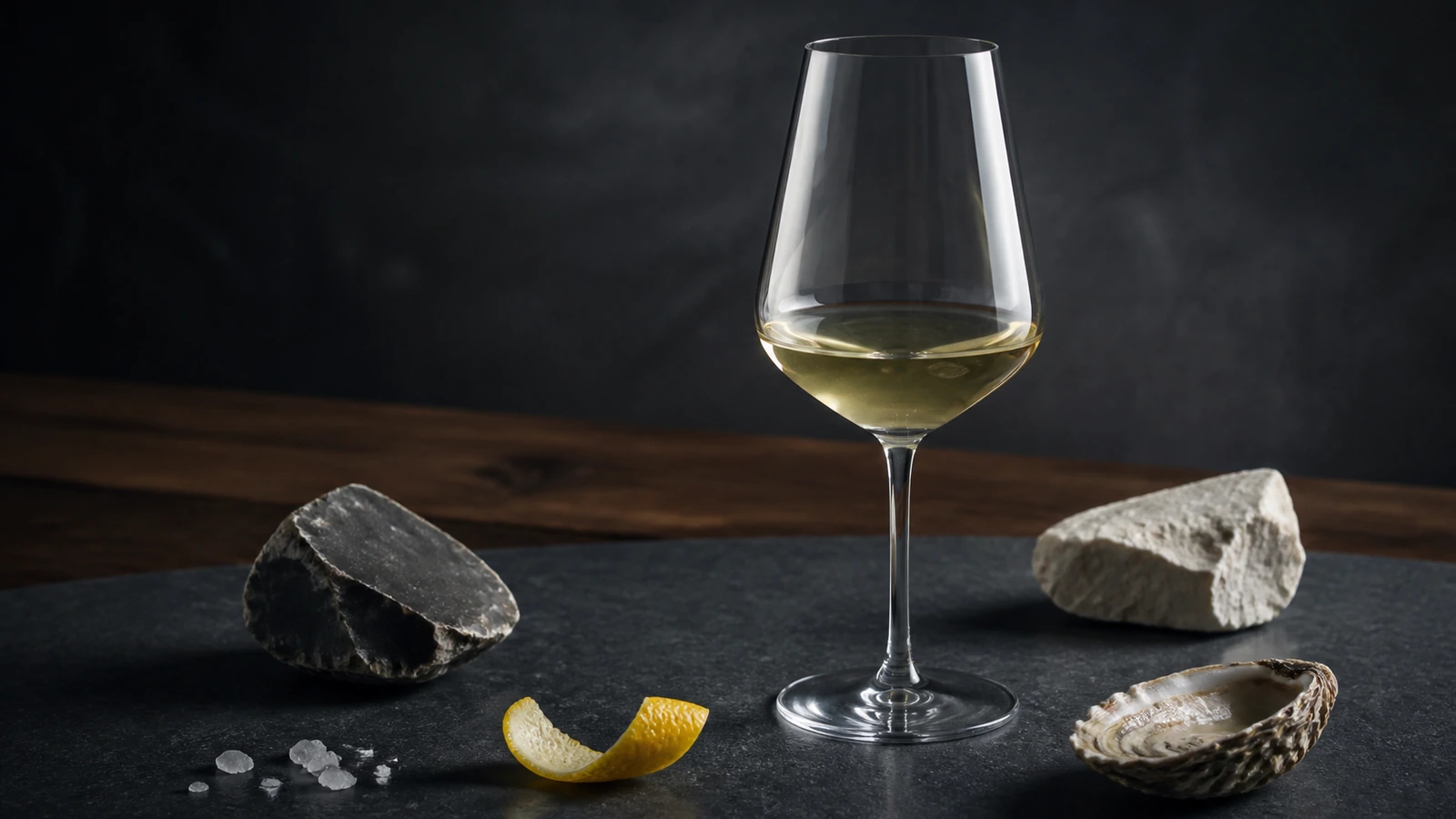
A chilled white wine reaches the table.
At first it is almost quiet: pale color, restrained fruit, a line of citrus. Then another impression appears. Something like flint after a spark. A trace of sea air. The dry memory of chalk. Perhaps a cool, stony sensation that seems to remain after the fruit has gone.
Someone calls it mineral.
The word feels immediately right—and scientifically unfinished.
In our previous Cellar Journal article, we followed wine aroma from grape to fermentation, maturation, and bottle. This time, we take one of wine’s most evocative descriptors and ask a more difficult question:
When a wine reminds us of stone, salt, chalk, or the sea, what are we actually perceiving—and what are we merely inferring?
The central idea: minerality is not one substance in wine, and it is not a sip of bedrock. It is a sensory pattern that may be assembled from aroma, acidity, salt, bitterness, texture, contrast, and expectation. The description can be useful even when the geological story attached to it is too simple.
One word carrying two different claims
Most wine descriptors make one modest claim.
If you describe a wine as lemony, you are saying that its aroma or flavor reminds you of lemon. You are not claiming that the vineyard contained lemon trees, or that lemon molecules traveled through the vine.
Mineral often does more.
It can describe a sensory impression—flinty, chalky, saline, steely, stony, taut. At the same time, it can suggest a cause: limestone, slate, granite, volcanic rock, marine sediment, or another feature of the vineyard.
Those two claims should be separated.
The first asks:
What does the wine feel or smell like?
The second asks:
Why does it feel or smell that way?
A taster can make a useful sensory observation and still overreach on causation.
That distinction is the key to understanding minerality without either romanticizing it or dismissing it.
A real word with a blurry sensory object
Minerality is not imaginary merely because people disagree about it.
But the disagreement is substantial.
In a study of 16 Burgundy Chardonnay wines, 34 wine experts rated minerality by nose and on the palate while a separate trained panel described the wines. The experts showed strong disagreement about which wines were most mineral, even though their written definitions repeatedly returned to three broad families: stone-related terms, acidity or freshness, and seashore-related terms (Ballester et al., 2013).
That result is revealing.
Experts may share a vocabulary without applying it to the same wine in the same way.
Another study comparing industry professionals with a trained descriptive panel found minerality associated with several different signals: acid taste; citrus, fresh, wet-stone, chemical, reduced, chalky, and grassy aromas; bitterness; and lower expression of some buttery, oaky, caramel-like, or overtly fruity attributes (Heymann, Hopfer & Bershaw, 2014).
Even culture can change the pattern. French and New Zealand wine professionals evaluating the same Sauvignon Blanc wines did not always use the same sensory and chemical information when judging mineral character (Parr et al., 2015; Parr et al., 2016).
A careful conclusion follows:
Minerality is not one universally calibrated sensation. It is a family resemblance.
Different wines may enter that family through different doors.
The rock does not travel intact into the glass
The most literal explanation of minerality sounds beautifully direct:
The vine grows in limestone, slate, granite, basalt, or chalk. The roots absorb the rock. The wine tastes of the place.
The problem is not that soil and geology are irrelevant.
The problem is the proposed route.
Geological minerals are structured crystalline compounds. Vine roots do not absorb miniature pieces of limestone or slate and carry their intact flavor into grapes. Roots take up water and dissolved ions in biologically regulated forms. Those ions may be essential to vine function, but they are not the same thing as the parent rock, nor do they preserve a rock’s sensory identity on the journey to wine.
Geologist Alex Maltman made this distinction explicit: the mineral elements measured in wine are nutrient elements and ions, only distantly related to the complex geological minerals in vineyard rocks. The concentrations and sensory relevance of those elements do not support the simple idea that the taste of bedrock has been transported into the glass (Maltman, 2013).
That does not justify the opposite slogan—minerals never matter.
Sodium, potassium, magnesium, calcium, iron, copper, chloride, and sulfur-containing compounds can exist in wine. Some may influence taste directly, catalyze reactions, or contribute to volatile aroma pathways under particular conditions. A recent interdisciplinary review argues that certain mineral ions and sulfur-related compounds can overlap with sensory-relevant concentration ranges, while also acknowledging that most studies have not found a simple positive relationship between perceived minerality and the concentration of minerals in wine, or a clear transfer from soil mineral profile to wine (Tai & Kostaki, 2025).
The debate therefore deserves precision rather than a new absolute.
A more careful conclusion: some inorganic ions and sulfur-related compounds may participate in specific salty, bitter, metallic, reductive, or flinty sensations. That is not the same as tasting limestone, slate, or granite from the vineyard.
Soil matters—just not like seasoning
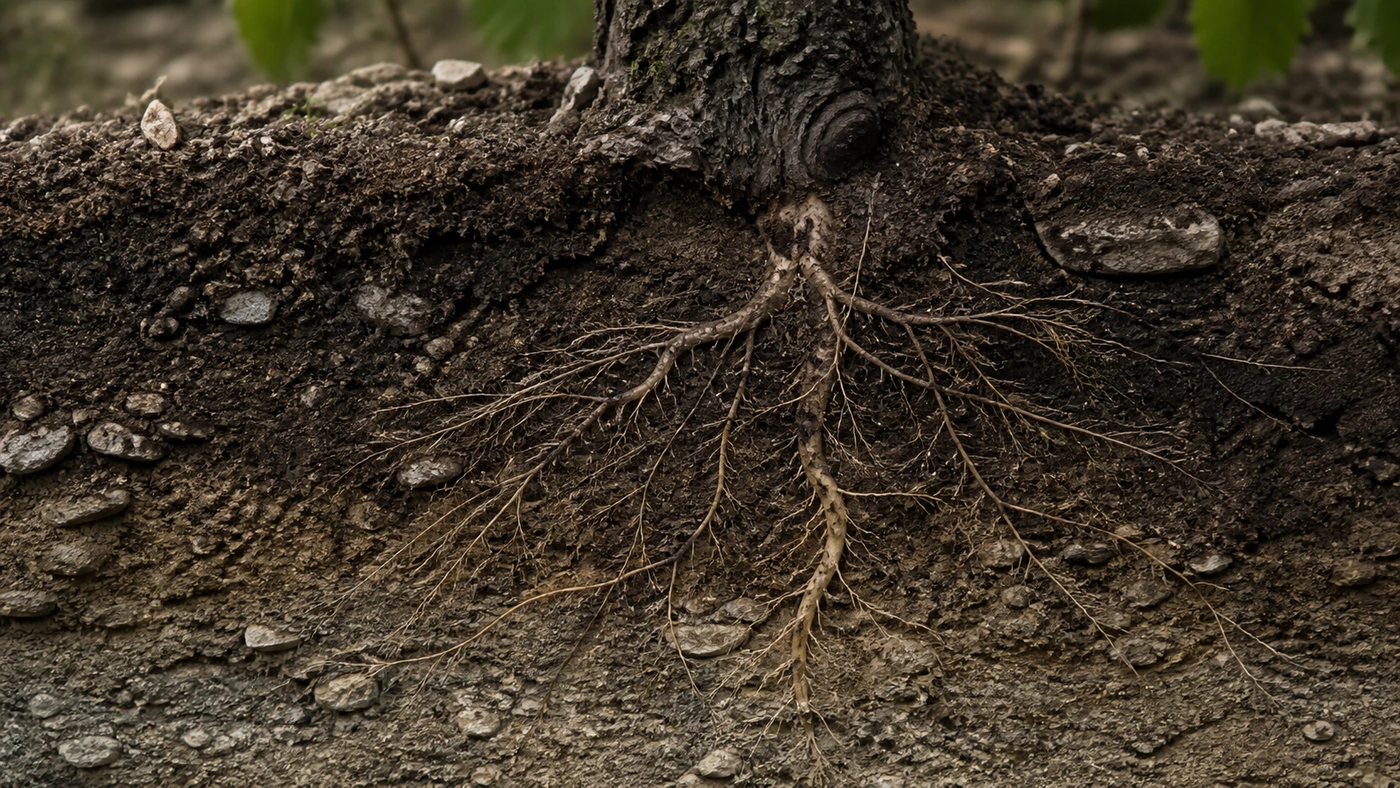
Rejecting a literal rock-to-wine flavor pipeline does not make terroir meaningless.
Soil can shape wine profoundly, but it usually does so through the living vine.
A major review of soil-related terroir factors identifies three especially important pathways: temperature in the root zone, water supply, and mineral or nutrient supply. These affect phenology, vine growth, berry development, acidity, phenolics, and aroma compounds or their precursors (van Leeuwen, Roby & de Rességuier, 2018).
Field research in Swiss vineyards showed that soil fertility and rooting depth altered vine nitrogen status, which in turn related to grape composition and sensory differences in standardized wines (Reynard et al., 2011). Separate experimental work found that manipulating phosphorus status in vines produced detectable differences in wine appearance, aroma, flavor, and taste across several varieties and sites (Skinner et al., 2019).
These studies do not prove that a person can taste a named soil or rock.
They show something more plausible and more interesting:
soil changes the conditions under which the vine lives; the vine changes the fruit; the fruit changes the fermentation; and the resulting wine may carry sensory consequences.
Soil acts less like seasoning sprinkled into a glass and more like part of the architecture in which the wine became possible.
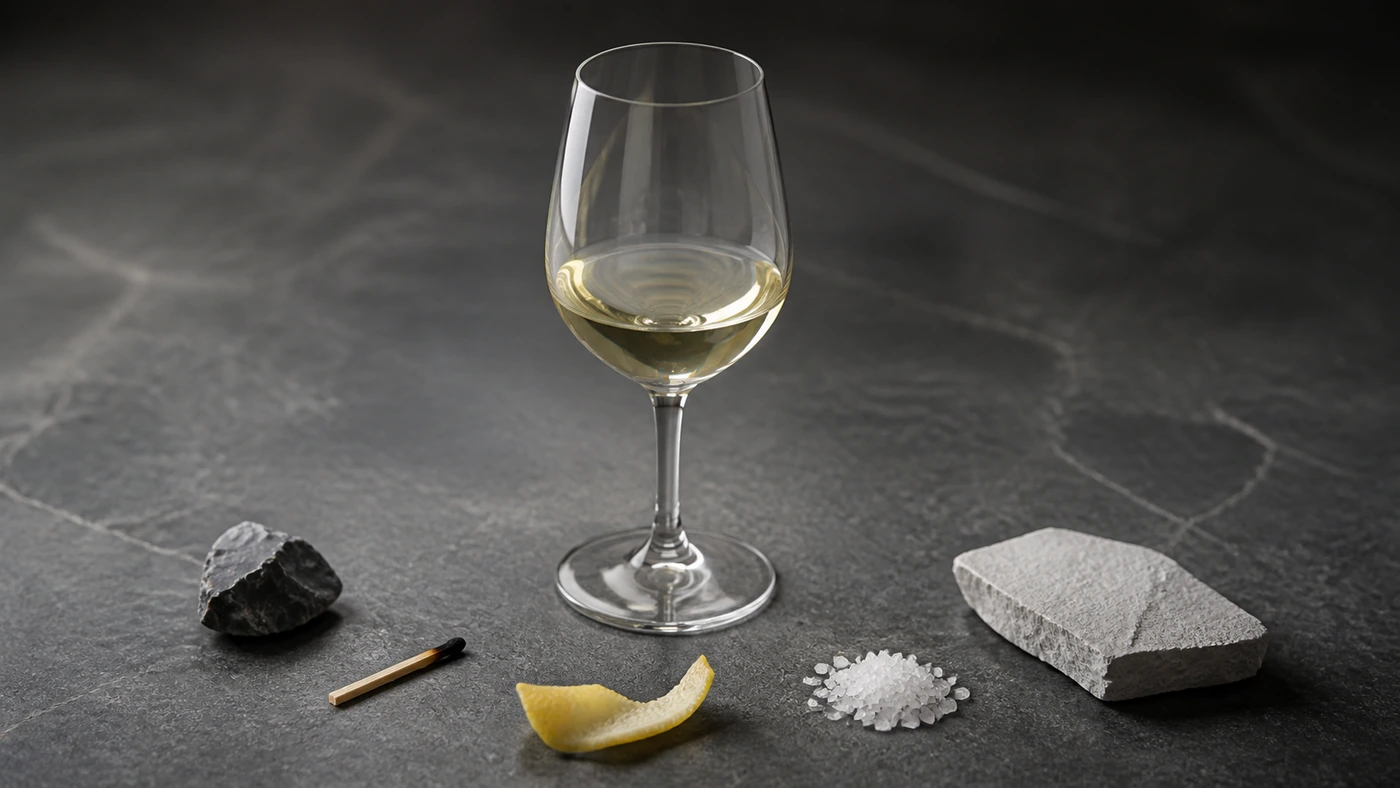
Minerality is a chord, not a single note
If minerality is not one compound or one geological flavor, what can create the impression?
The evidence points toward several overlapping sensory channels.
No single channel is required in every wine. No combination functions as a universal formula.
But together they explain why the word persists.
1. Flint, struck match, smoke, and other sulfur-related aromas
Some wines described as mineral carry an aromatic edge reminiscent of flint, a struck match, gun smoke, shellfish, or a faint reductive note.
These impressions can involve highly potent sulfur compounds rather than vineyard stone.
In Chablis, researchers found that wines rated as more mineral by nose under one experimental condition had higher methanethiol, a volatile sulfur compound associated in that work with a shellfish-like aroma and reduced expression of fruit and floral notes. The relationship appeared in orthonasal assessment, not consistently in full tasting, which is an important limitation (Rodrigues et al., 2017).
More recent research on Australian and New Zealand Chardonnay combined chemical analysis, trained sensory evaluation, consumer testing, and an odorant-addition experiment. The thiol 2-furylmethanethiol strongly directed flint, struck-match, and mineral aromas in that Chardonnay context; phenylmethanethiol played a smaller role at the concentrations studied (Espinase Nandorfy et al., 2023).
This does not mean every flinty wine contains the same causal profile.
Nor does it mean every sulfur note is desirable.
Concentration, wine matrix, oxygen exposure, time, and individual preference all matter. The same family can read as elegant restraint to one drinker and distracting reduction to another.
The disciplined tasting note is not:
“I taste flint, therefore the vines grew on flint.”
It is:
“The wine has a flinty or struck-match aromatic impression; sulfur-related compounds are one plausible contributor.”
2. Acidity, freshness, and the impression of tension
Mineral wines are often described as bright, linear, tense, electric, or mouthwatering.
Those words frequently travel with acidity.
Several sensory studies have found positive relationships between minerality judgments and acid taste, titratable acidity, malic acid, or tartaric acid in particular wine sets (Heymann, Hopfer & Bershaw, 2014). In the Burgundy study, one group of experts linked palate minerality with sourness, while another linked it more closely with bitterness (Ballester et al., 2013).
But the relationship is not universal. In the cross-cultural Sauvignon Blanc study, perceived sourness did not consistently predict minerality across all conditions and participant groups (Parr et al., 2015).
Acidity can support a mineral impression.
It cannot define minerality by itself.
Otherwise, every highly acidic wine would be mineral—and it is not.
3. Genuine saltiness
Sometimes saline may be more literal than stony.
The International Organisation of Vine and Wine notes that sodium and chloride levels are generally low, but can be higher in wines from vineyards near a coast, above brackish subsoil, or in arid ground irrigated with saline water (OIV, OIV-MA-D1-03).
Controlled sensory work has shown that sodium chloride can be detected in grape juice and wine at concentrations that may fall within regulatory limits. In Chardonnay samples, higher sodium and chloride were associated with salty and soapy attributes and with lower fruit expression (de Loryn et al., 2014).
So yes, real salt-related taste can exist in wine.
But three boundaries matter:
- A salty impression does not automatically identify its chemical cause.
- Elevated sodium or chloride does not mean the wine will be described as mineral by every taster.
- A coastal vineyard does not guarantee a saline wine, and a saline wine does not prove a coastal vineyard.
Saline is often more precise than mineral when the primary sensation is truly salty.
Precision does not reduce the poetry.
It makes the poetry trustworthy.
4. Chalkiness, dryness, bitterness, and texture
Not every mineral impression begins in aroma or taste.
Some wines feel chalky, powdery, dry, firm, fine-grained, or almost electrically taut across the palate. Tasters may use mineral to compress that tactile experience into one word.
The Burgundy and white-wine studies both linked minerality with combinations of chalky character, bitterness, acidity, freshness, and other mouthfeel cues rather than one discrete flavor (Ballester et al., 2013; Heymann, Hopfer & Bershaw, 2014).
Here, language becomes especially metaphorical.
A wine can feel chalky without containing perceptible chalk. It can feel steely without providing evidence of steel. It can show tension even though tension is not a taste receptor.
These words are not useless.
They are attempts to communicate structure.
The mistake occurs when a tactile metaphor is converted into a geological measurement.
5. Expectation, contrast, and what the wine is not showing
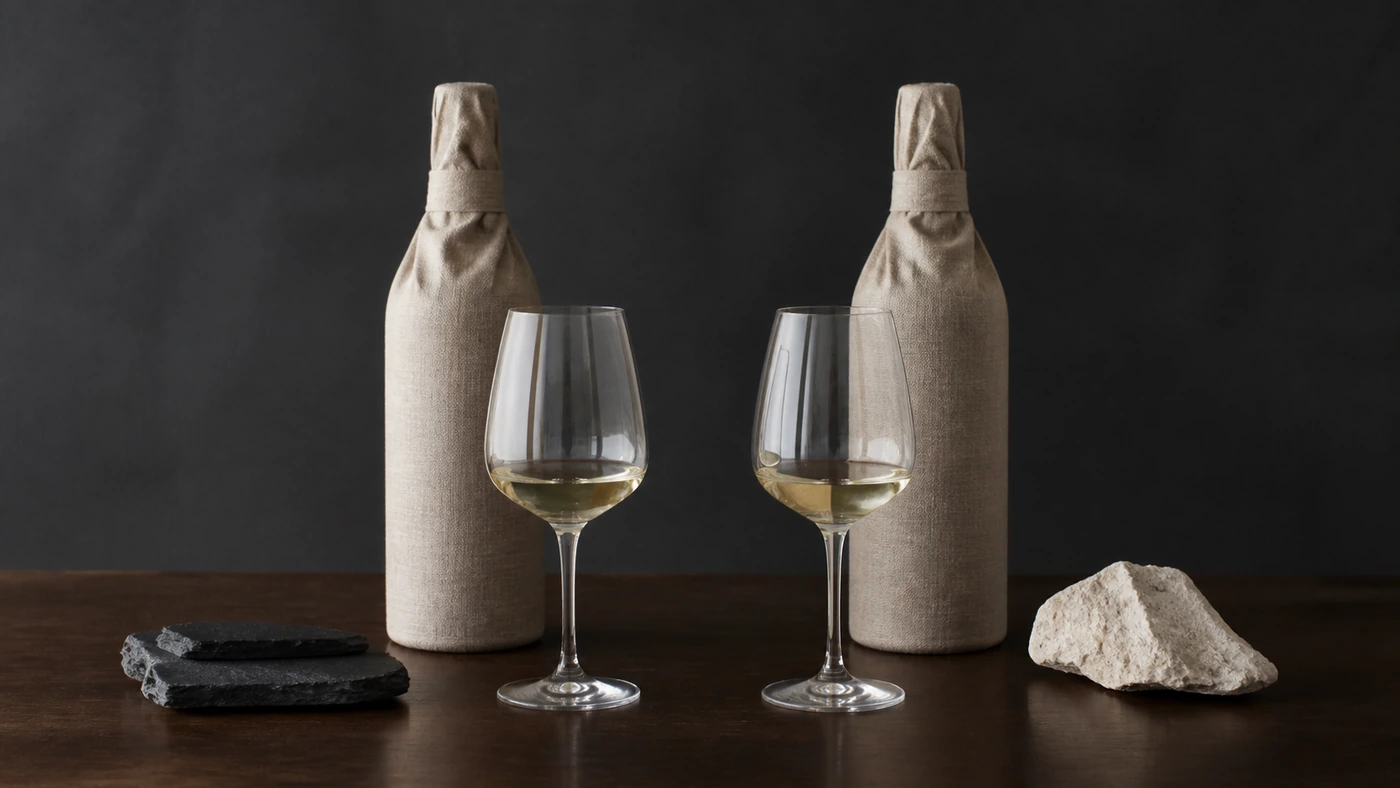
Perception never arrives without context.
A wine with restrained fruit, high freshness, a subtle sulfur edge, and a dry finish may be called mineral partly because no single fruit aroma dominates the frame.
The label can also influence what tasters notice.
In a 2024 study, 20 wine experts evaluated 20 German Rieslings first without information and then with soil type supplied as an external cue. Providing the soil information changed sensory ratings, including minerality-related terms such as earthy, chalky, marine, flinty, and salty. Even a composite control wine was perceived differently when presented with different soil labels (Nguyen et al., 2024).
This does not prove that every mention of slate or limestone is imagined.
It proves that expectation can become part of the tasting system.
Culture matters too. French and New Zealand professionals assessing the same wines drew on partially different sensory and compositional information when assigning mineral character (Parr et al., 2016).
What we perceive is shaped by the wine.
What we call it is also shaped by what we have learned to expect.
A living scientific debate—not a solved slogan
Wine discussions often force minerality into one of two camps:
- You are tasting the soil.
- Minerality does not exist.
The evidence supports neither slogan in that form.
The literal transport of vineyard rock flavor is not a defensible explanation. At the same time, tasters repeatedly use mineral language for patterns involving sulfur-derived aromas, acidity, saltiness, bitterness, texture, muted fruit, and contextual expectation. Some ions may contribute directly or indirectly in specific cases; other impressions arise from organic volatile compounds, structure, or cognition.
Researchers have also tried to model minerality statistically from sensory and chemical variables, but such models remain dependent on the wines, panels, and definitions used. They should not be mistaken for one universal chemical formula (Zaldívar Santamaría, Molina Dagá & Palacios García, 2019).
Among Chablis producers, beliefs about how to create or preserve a mineral style vary with production philosophy. Interviews did not reveal one proven recipe; they revealed different professional models of how vineyard and cellar choices might enhance or mask the style (Rodrigues et al., 2022).
Minerality is therefore best treated as a disciplined sensory category, not a chemical fingerprint.
Replace the umbrella with the weather beneath it
The word mineral is most useful when it begins the description rather than ending it.
Ask what sits underneath it.
| If you notice… | More precise sensory language | Plausible contributors | What it does not prove |
|---|---|---|---|
| Flint, struck match, gun smoke | Sulfidic, smoky, flinty, reductive | Potent sulfur compounds; redox and winemaking context | Flint, slate, or volcanic soil |
| Wet stone or cool stone | Stony, restrained, low-fruit, fresh | Aroma contrast; sulfur notes; acidity; learned metaphor | Dissolved vineyard rock flavor |
| Saline or sea-spray impression | Salty, briny, shellfish-like, marine | Sodium/chloride in some wines; volatile sulfur compounds; taste-aroma interaction | Coastal origin by itself |
| Chalky finish | Dry, powdery, fine-grained, bitter, tactile | Acidity, phenolics, bitterness, mouthfeel interactions | Limestone soil by itself |
| Steely or electric | High-acid, linear, firm, cool-toned | Acidity, low sweetness, restrained fruit, structural contrast | High iron or steel content |
| Mineral “tension” | Persistent acidity, dry finish, narrow flavor line | Structure and temporal sequence across the palate | One compound or one vineyard cause |
The goal is not to ban the word.
It is to make the word earn its place.
The five-question mineral note
When a wine feels mineral, use this sequence.
1. Where do you perceive it?
Is it primarily:
- in the aroma before tasting?
- as a taste on the tongue?
- as texture or dryness?
- in the finish?
- or as a global impression after all of them combine?
Location matters because flint aroma, salt taste, and chalky texture are not the same signal.
2. What direct descriptor can replace “mineral”?
Try one or two specific words:
- flinty
- struck match
- wet stone
- saline
- briny
- chalky
- steely
- bitter
- dry
- taut
You may still keep mineral as the umbrella, but the direct descriptor gives it content.
3. What structural cues support the impression?
Notice:
- acidity
- sweetness or dryness
- bitterness
- fruit intensity
- alcohol warmth
- phenolic grip
- persistence
A mineral impression often emerges from relationships among these features.
4. How confident are you in the perception?
Say whether the impression is:
- faint
- moderate
- pronounced
- stable with air
- disappearing as the wine warms
- stronger on the nose than the palate
That makes the note repeatable.
5. What does the observation not allow you to conclude?
Resist using the descriptor to infer, without other evidence:
- the exact soil type
- a specific rock formation
- coastal proximity
- one winemaking technique
- superior quality
- authenticity or terroir purity
A complete note might read:
Flinty and faintly marine on the nose, with high acidity, a light saline impression, and a chalky-dry finish. The sensory pattern is clear; no specific geological cause is inferred.
That note says more than mineral.
It also claims less than I can taste the limestone.
That is not caution for its own sake.
It is better tasting.
How to test minerality without letting the label answer first
Try a small comparative tasting.
Choose two or three dry white wines frequently described as mineral—perhaps Chablis, Muscadet, dry Riesling, Assyrtiko, Etna Bianco, Sancerre, or a restrained cool-climate Chardonnay. These are examples of styles commonly discussed with mineral language, not guarantees that every bottle will show the same pattern.
Serve them at the same temperature, in the same glass, and without revealing the labels.
For each wine, record five lines:
- Aroma: flint, smoke, shell, stone, citrus, fruit, herbs—or none?
- Taste: sour, salty, bitter, sweet, neutral?
- Texture: chalky, smooth, oily, dry, fine-grained?
- Finish: short, saline, citrus-led, smoky, persistent?
- Minerality: only after the first four lines, would you use the word?
Then reveal the bottles and read the producer descriptions.
Notice whether slate, limestone, volcanic rock, coast, or altitude changes the way you reinterpret the glass.
The exercise is not designed to embarrass you for being influenced.
Influence is part of perception.
The point is to learn when it enters.
Why this distinction matters to Ask Sommelier AI
A useful recommendation should not tell someone that they “taste limestone” simply because a database or label associates a wine with limestone soil.
It should separate:
- the sensory evidence in the wine;
- plausible chemical and structural contributors;
- verified facts about the vineyard;
- and the confidence of any connection among them.
For someone who loves high-acid, restrained whites with flinty aromas and a dry finish, mineral can be an efficient preference signal.
But the recommendation becomes more personal and more accurate when that signal is decomposed:
Do you enjoy the sulfur edge? The acidity? The saltiness? The chalky texture? The absence of overt fruit? Or the way those features arrive together?
Ask Sommelier AI is built around that distinction: preserve the drinker’s language, then make it more precise without erasing the palate behind it.
Frequently asked questions
Is minerality in wine real?
The sensory experiences grouped under minerality are real, but the term does not refer to one universally agreed sensation or one chemical compound. Different tasters may use it for flinty aroma, acidity, salinity, bitterness, chalky texture, restraint, or a combination.
Can you taste limestone, slate, or granite in wine?
Current evidence does not support the literal idea that the flavor of an intact vineyard rock travels through roots into grapes and wine. Soil can influence vine physiology, grape composition, and wine style through water, temperature, nutrients, rooting, and other interactions. That is different from tasting the rock itself.
Does a salty wine come from a coastal vineyard?
Not necessarily. Sodium and chloride can be higher in some coastal, brackish, or saline-irrigated environments, and salt can be sensorially relevant in some wines. But a salty impression alone cannot identify vineyard location, and coastal proximity does not guarantee perceptible salinity.
Is a flinty or struck-match aroma a fault?
It depends on intensity, context, and preference. Low to moderate expression may contribute complexity in some Chardonnay and other white-wine styles. At higher intensity, sulfur-related aromas can mask fruit or become distracting. The descriptor is not an automatic quality verdict.
Are mineral wines better wines?
No descriptor guarantees quality. Minerality is often used in positive or premium contexts, but balance, clarity, complexity, length, typicity, condition, and personal preference still matter. A wine can be excellent without being called mineral, and a mineral descriptor cannot rescue an unbalanced wine.
The stone is in the memory—not necessarily in the wine
Return to the chilled glass.
The flint impression may be carried by a sulfur compound. The freshness may be sharpened by acidity. The saline note may be a genuine taste or part of a broader aroma-taste pattern. The chalkiness may be tactile. The word mineral may also have been waiting in your mind since you saw the vineyard’s soil on the label.
None of that makes the experience false.
It makes the experience layered.
A wine can remind you of stone without containing the taste of a stone. It can carry the vineyard without serving the vineyard as an ingredient. It can be shaped by soil without functioning as a geological sample.
The glass may still feel like flint, salt, chalk, or the cool air above wet rock.
That is worth recording.
The error begins only when the metaphor is forced to become a mineral analysis.
References & further reading
- Maltman, A. (2013). Minerality in wine: a geological perspective. Journal of Wine Research, 24(3), 169–181. https://doi.org/10.1080/09571264.2013.793176
- Ballester, J., Mihnea, M., Peyron, D., & Valentin, D. (2013). Exploring minerality of Burgundy Chardonnay wines: a sensory approach with wine experts and trained panellists. Australian Journal of Grape and Wine Research, 19(2), 140–152. https://doi.org/10.1111/ajgw.12024
- Heymann, H., Hopfer, H., & Bershaw, D. (2014). An Exploration of the Perception of Minerality in White Wines by Projective Mapping and Descriptive Analysis. Journal of Sensory Studies, 29(1), 1–13. https://doi.org/10.1111/joss.12076
- Parr, W. V., Ballester, J., Peyron, D., Grose, C., & Valentin, D. (2015). Perceived minerality in Sauvignon wines: Influence of culture and perception mode. Food Quality and Preference, 41, 121–132. https://doi.org/10.1016/j.foodqual.2014.12.001
- Parr, W. V. et al. (2016). Perceived minerality in Sauvignon Blanc wine: Chemical reality or cultural construct? Food Research International, 87, 168–179. https://doi.org/10.1016/j.foodres.2016.06.026
- Rodrigues, H. et al. (2017). Sensory and chemical drivers of wine minerality aroma: An application to Chablis wines. Food Chemistry, 230, 553–562. https://doi.org/10.1016/j.foodchem.2017.03.036
- Espinase Nandorfy, D. et al. (2023). The Role of Potent Thiols in “Empyreumatic” Flint/Struck-Match/Mineral Odours in Chardonnay Wine. Australian Journal of Grape and Wine Research. https://doi.org/10.1155/2023/8847476
- de Loryn, L. C. et al. (2014). Evaluation of Sensory Thresholds and Perception of Sodium Chloride in Grape Juice and Wine. American Journal of Enology and Viticulture, 65(1), 124–133. https://doi.org/10.5344/ajev.2013.13088
- International Organisation of Vine and Wine. OIV-MA-D1-03: The level of sodium and chloride ions in wine. https://oiv.int/index.php/standards/compendium-of-international-methods-of-wine-and-must-analysis/annex-d/annex-d-advices/level-of-sodium-and-chlorides-ions-in-wines
- van Leeuwen, C., Roby, J.-P., & de Rességuier, L. (2018). Soil-related terroir factors: a review. OENO One, 52(2), 173–188. https://doi.org/10.20870/oeno-one.2018.52.2.2208
- Reynard, J.-S., Zufferey, V., Nicol, G.-C., & Murisier, F. (2011). Soil parameters impact the vine-fruit-wine continuum by altering vine nitrogen status. OENO One, 45(4). https://doi.org/10.20870/oeno-one.2011.45.4.1502
- Skinner, P. W., Ishii, R., O’Mahony, M., & Matthews, M. (2019). Sensory attributes of wines made from vines of differing phosphorus status. OENO One, 53(2). https://doi.org/10.20870/oeno-one.2019.53.2.2421
- Nguyen, T. H., Zimmermann, D., Müller, J., & Durner, D. (2024). Soil types as extrinsic cues differentially shape sensory perception of German Riesling wine. OENO One, 58(4). https://doi.org/10.20870/oeno-one.2024.58.3.7918
- Rodrigues, H., Valentin, D., Otheguy, M., & Ballester, J. (2022). How to make a mineral wine? Relationship between production type in the Chablis vineyard and the search for a mineral wine style. OENO One, 56(2). https://doi.org/10.20870/oeno-one.2022.56.2.4856
- Zaldívar Santamaría, E., Molina Dagá, D., & Palacios García, A. T. (2019). Statistical Modelization of the Descriptor “Minerality” Based on the Sensory Properties and Chemical Composition of Wine. Beverages, 5(4), 66. https://doi.org/10.3390/beverages5040066
- Tai, H.-C., & Kostaki, E. (2025). The science of minerality. RSC Advances, 15, 40245–40251. https://doi.org/10.1039/D5RA06531C
- Biss, A. J., & Ellis, R. H. (2024). Minerality in Wine: Textual Analysis of Chablis Premier Cru Tasting Notes. Australian Journal of Grape and Wine Research. https://doi.org/10.1155/2024/4299446