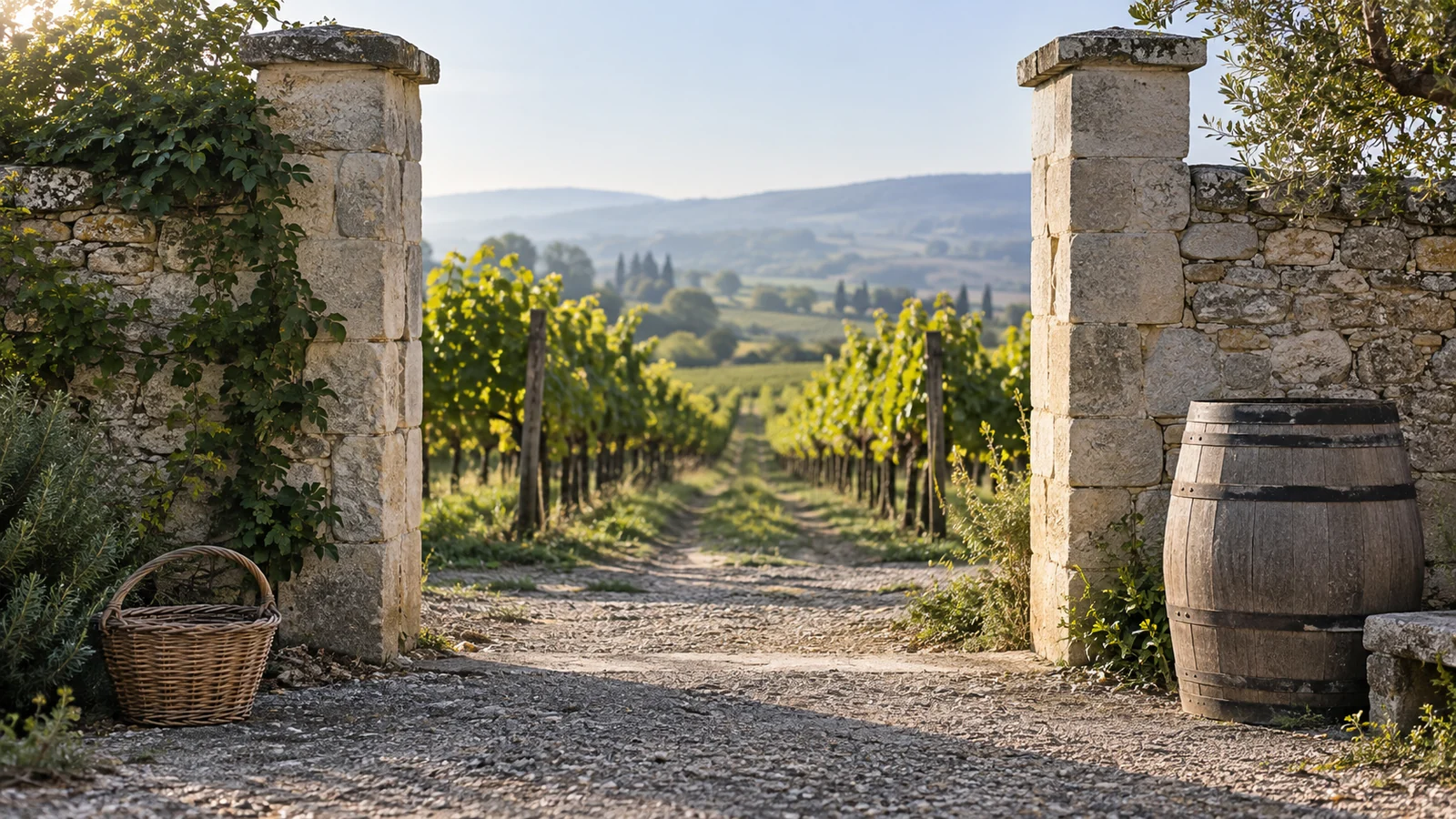
Imagine stopping beside a vineyard wall. A plaque at the entrance recalls an abbey and an old date. The stone seems to offer a simple answer: this is where the monks made wine.
Then look at the path leading away from the gate. Who looked after the land? Who carried the harvest? Who arranged for the wine to reach someone willing to buy it?
After walking through a Roman winery in the previous Cellar Journal article, we need to widen the frame. This time, the interesting object is not a press or a jar. It is the relationship between people whose names do not always appear together.
The medieval vineyard was built through land and rights, repeated work, and connections to a market.
That is the thread of this journey—not a contest to award the whole history of wine to one group.
A landscape needs more than one name
“Medieval” covers too much time and territory for a single vineyard story. Here we follow selected examples from western Europe, principally lands in present-day France and a commercial connection with England, from the early ninth century into the fifteenth.
The examples are deliberately different. An estate inventory, a land transaction, a cellar account and a trade privilege answer different questions. Read together, they help us distinguish owning a vineyard, working it and earning money from its wine. The same person or institution could occupy more than one of those positions. Saint-Germain estate inventory Côte-d’Or departmental archives Leturcq on the Blois account, 2023 Vintners’ Company, institutional history
That distinction changes the question on the imagined plaque. Instead of asking only who founded a property, we can ask how it continued to function.
What the abbey brought—and what its name leaves out
Begin with the Rule of Benedict. Chapter 40 discusses wine as part of the community’s allowance, makes room for abstinence and warns against excess. It is concerned with daily communal provision, not only with religious ceremony. Rule of Benedict, chapter 40
This is a rule, not a record of what every monk drank. Nor is an old allowance advice for drinking today. Its usefulness here is simpler: it shows why reducing monastic wine to one ceremonial purpose would leave part of the picture out.
The land records surrounding Cîteaux offer a second contribution. They document an institution receiving, acquiring and reorganizing vineyard holdings over generations. Côte-d’Or departmental archives
That is substantial historical work. Recognizing it does not require picturing a monk performing every task. The name of a proprietor tells us where certain rights were held; it does not automatically identify every pair of hands behind a harvest.
A monastery belongs in the story. It need not occupy the entire frame.
An inventory gives us two names
At Villeneuve-Saint-Georges, an early ninth-century inventory associated with Saint-Germain-des-Prés identifies Arctardus and his wife, Eligildis, within a tenant household. Their holding includes vineyard land alongside other agricultural land. The record also lists obligations in money, produce—including wine—and labor. Saint-Germain estate inventory
The change in scale is immediate. “The abbey’s vineyards” becomes a household, a holding and a set of demands.
We should not invent their conversation at harvest, assign Eligildis an undocumented pruning task, or imagine that their obligations resembled a freely negotiated modern employment contract. We can nevertheless keep their names in the story instead of allowing the institution’s name to replace them.
An inventory was not written to celebrate the people it counted. It organized information useful to an estate. Reading it with attention to households therefore asks something different of the document: not only what the owner possessed, but whose lives were connected to those possessions.
The surviving entry does not tell us whether Arctardus liked the wine. It tells us that the wine belonged to a wider economy of land, work and dues.
That is already more human than a vineyard with no one in it.
A famous clos was assembled, not simply discovered
Move forward to Burgundy and a clos: an enclosed vineyard. The Côte-d’Or archives present the formation of the Clos de Vougeot through gifts, purchases and exchanges. One transaction from 1287 names Marie, widow of Jean Lathomi, and her sons Perrenet and Huguenin in the sale of a vineyard parcel to Cîteaux. An exchange with Pierre Pontot follows in 1291. Côte-d’Or departmental archives
These are not decorative names beside a finished monument. They reveal transactions through which holdings changed.
A vineyard boundary can look inevitable when we encounter it centuries later. A sale makes us see a decision; an exchange makes us see negotiation. The landscape becomes something people assembled, rather than a perfect map waiting for someone to discover it.
Marie’s presence also deserves precision. Here she appears as a participant in a property transaction. That is evidence of a specific role, not permission to reconstruct every aspect of her work or status.
The useful lesson is neither that monasteries did everything nor that their contribution was imaginary. It is that their histories intersected with the histories of other landholders and families.
A wall can survive while the negotiations behind it become almost invisible.
Not every vineyard worker lived in a village
The title includes farmers, but even that word needs room to breathe.
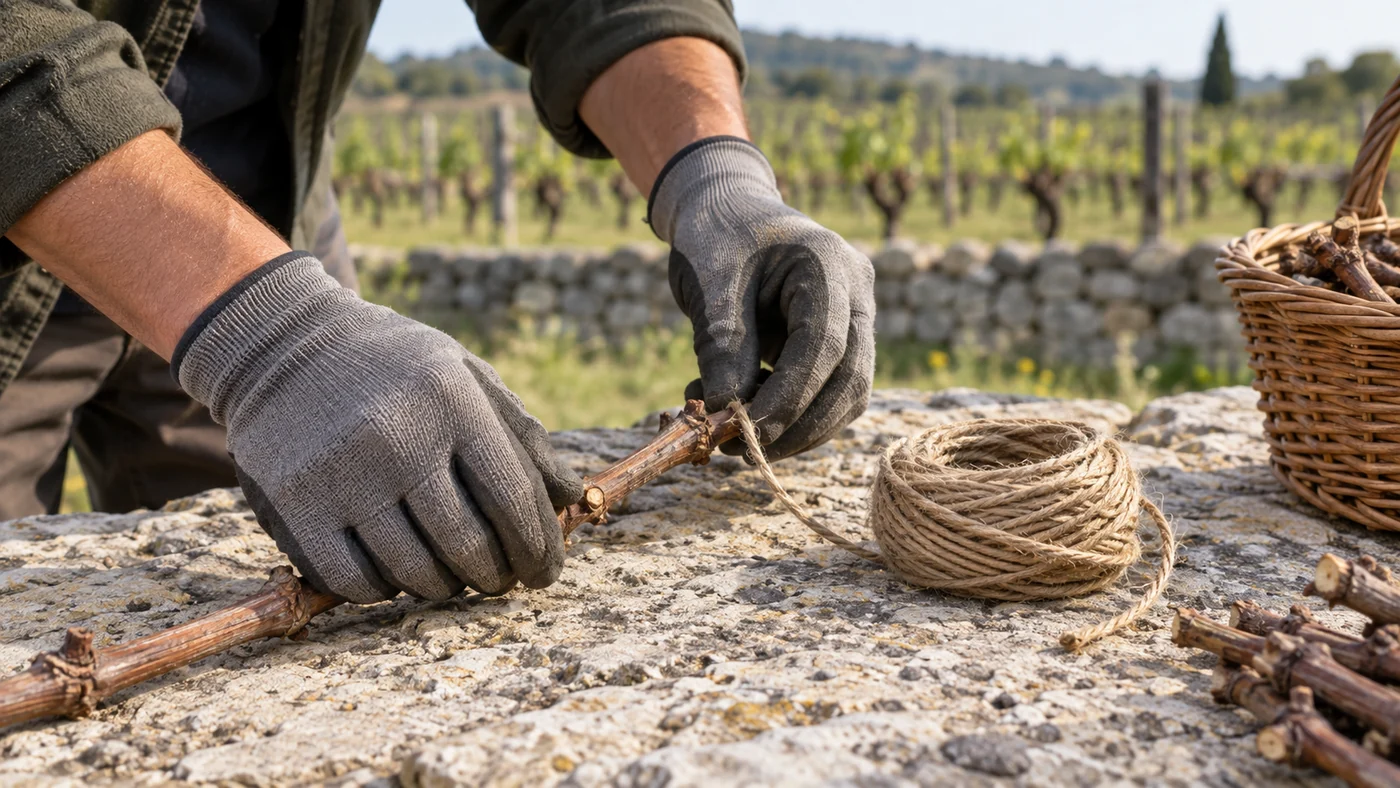
Historian Mickaël Wilmart’s study of late medieval French sources brings vineyard work into the city. Urban residents invested in vineyards without necessarily cultivating them; specialists could be paid by the day or for an agreed set of tasks. At Auxerre, a dispute documented in 1393 connected working hours with the earlier closing of city gates during wartime. Wilmart, 2024
This is a useful surprise for anyone who instinctively places winegrowers outside the city and merchants inside it. The boundary between those worlds was more complicated.
It also helps explain why “who owned the vines?” is not enough. Ownership can identify an investment. A payment for work identifies a different relationship. Neither description should silently stand in for the other.
Rather than treating a worker as an anonymous figure added to a landscape, we can ask what knowledge the owner needed from that person. We can also ask whose version of a dispute survives. A complaint about working hours is not a neutral portrait of the worker’s character.
Recognizing skill and recognizing unequal power are compatible. We do not have to choose between a romantic peasant and a faceless labor force.
In a secular cellar, someone kept the account
At Blois in 1385, the count’s wine officer, Caisin de Bonduiz, recorded stock and expenditure. Samuel Leturcq’s study shows a role spanning cellar supplies, vineyard administration and wine dues. The account also records equipment repairs and transport by land and water. Leturcq on the Blois account, 2023
Here the organizing institution is an aristocratic household, not an abbey.
The account brings unglamorous necessities into view. Wine had to be kept somewhere; equipment had to remain usable; movement had a cost. A barrel in a picturesque cellar becomes part of a working system when someone has to account for its upkeep.
This is a different kind of expertise from growing a vine, but it belongs to the wine’s history just as surely. Organizing what enters a cellar, what leaves it and what needs attention connects agricultural production with a household’s expectations.
A cellar can tell a story through an expense as well as through an impressive object.
The cooper belongs in the picture
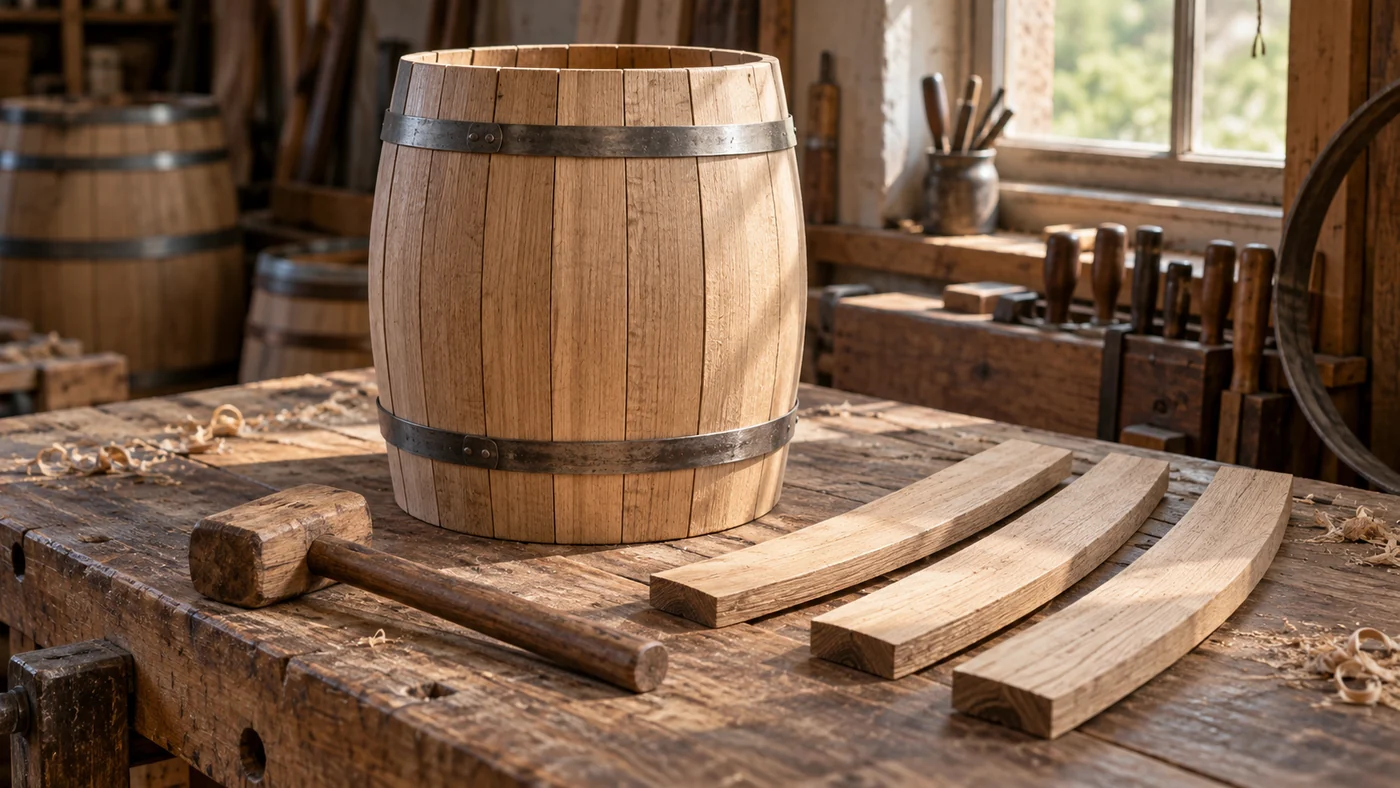
Rudi Beaulant’s research on fifteenth-century Dijon examines rules for coopers, the craftspeople who made barrels. The 1445 ordinance and related records show occupational regulation, inspection and named participants in the trade. Beaulant, 2024
The barrel, then, was not simply rustic scenery behind the wine. Its manufacture involved people whose work could be assessed and disputed.
There is a distinction worth keeping here: a requirement for sound workmanship is not evidence that everyone complied. Equally, the existence of regulation is not evidence that medieval wine had a single standardized taste.
What it does change is our sense of the production chain. The winegrower’s labor depended on work beyond the vine. Looking at a barrel can lead us toward a workshop, an inspection and a relationship between craftspeople and urban authorities.
When telling the story of a wine, it is easy to stop at the person who grew the grapes. The container asks us to continue.
The market was part of the vineyard’s world
Wine also connected people who never stood in the same field.
The Gascon Rolls Project’s introduction to medieval trade describes English demand for wine shipped through Bordeaux alongside Aquitaine’s need for grain from England. Wine belonged to a movement of goods in more than one direction. Gascon Rolls Project, trade introduction
We do not need a grand fleet scene to see the significance. A purchaser elsewhere gives the harvest a destination beyond the producing household. A trading connection adds further decisions between making wine and receiving income from it.
Access was not simply a matter of having something to sell. The Vintners’ Company identifies its first charter, dated 15 July 1363, as a grant of monopoly for trade with Gascony, with associated commercial and inspection powers. That is the institution’s account of its charter, not a claim that every sale followed the same pattern. Vintners’ Company, institutional history
This introduces power into the route. Who could participate mattered as well as where a ship could go.
The vineyard’s reputation should therefore prompt questions about both production and opportunity. A story centered only on natural conditions can miss the arrangements that helped particular wines reach buyers.
What survives is not necessarily what stayed unchanged
Burgundy’s climats are delimited, named vineyard plots. The UNESCO account recognizes a landscape shaped through contributions from monastic orders, ducal power and other actors, including the commercial role of Beaune. Its history is not the achievement of one isolated institution. UNESCO, Burgundy’s climats
That does not make place less interesting. It makes the relationship between wine and place more human.
Names need similar care. Leturcq’s research on medieval vine terminology shows that a word could identify a kind of vine, a type or quality of wine, or an ambiguous mixture of those meanings. A familiar-looking name is not, by itself, a modern identification of the plant. Leturcq on medieval vine names, 2023
The distinction matters at today’s table. An old property name can lead us to a real historical connection. It cannot, without additional evidence, establish an unchanged grape population, an unchanged recipe or an identical flavor across centuries.
We can admire continuity without asking it to mean that nothing happened in between.
Five questions to take to your next bottle
A historical claim becomes more useful when it gives us something specific to ask.
Where and when? Replace “since medieval times” with a named place and a period where the evidence allows it.
Whose role is being described? A founder, a proprietor, a tenant, a vineyard worker and a merchant are not interchangeable identities.
What does the document actually record? Ownership, an obligation, an expense, a rule and a sale offer different kinds of knowledge.
What continuity is being claimed? A surviving name or boundary should not quietly become a claim about an unchanged vine or wine.
What is true of this bottle? Ask about the present producer’s choices and notice the wine actually in your glass. Let the history enrich your attention rather than predetermine your response.
This is the kind of curiosity we cultivate in the Ask Sommelier AI Cellar Journal: knowing more without pretending that a good story can taste a wine for us.
History can bring another dimension to the table without becoming an instruction about what you must enjoy.
Return to the gate
Return to the imagined vineyard wall.
The abbey’s name has not disappeared. It now sits beside other kinds of names: a tenant household, a seller, a wine officer, a craftsperson, a trading institution.
They do not all belong to the same place or century. Their value is not that they can be assembled into one invented harvest. They teach us to look for the people and relationships that a single celebrated name can leave outside the frame.
The next time a vineyard offers you its history, listen for the work as well as the founding date.
The past becomes richer when we remember more of the people who made the wine possible.
Next in this series: The Vine Crosses the Atlantic: Routes, Missions and Labor Behind American Wine.
Questions worth asking
Did monks build the medieval vineyard on their own?
No. The cases here include a monastic estate, tenant households, other landholders, a secular court and urban trades. The point is to distinguish their contributions, not replace one exclusive origin story with another. Saint-Germain estate inventory Côte-d’Or departmental archives Leturcq on the Blois account, 2023 Beaulant, 2024
Was monastic wine only for religious ceremonies?
No. The Rule of Benedict’s discussion of a communal wine allowance already shows a context beyond ceremony. It is a prescription, however, not a measurement of consumption in every monastery. Rule of Benedict, chapter 40
Does owning a vineyard mean someone worked it personally?
Not necessarily. Wilmart distinguishes urban investors from the people engaged to cultivate their vineyards. A property document and a record of paid work may describe different participants. Wilmart, 2024
Why include merchants in a history of vineyards?
Because sales depended on connections and access as well as production. The Bordeaux–England trade and the Vintners’ charter illustrate commercial relationships beyond the growing site. Gascon Rolls Project, trade introduction Vintners’ Company, institutional history
Did monks invent today’s Burgundy climats in one step?
The evidence used here does not support that story. UNESCO presents a landscape shaped by multiple actors over time; the Vougeot documents reveal transactions, not one instant of creation. UNESCO, Burgundy’s climats Côte-d’Or departmental archives
Can a medieval wine name tell us exactly what it tasted like?
No. Historical terminology can be ambiguous even about the vine or type of wine it describes. A name alone cannot recover a particular wine’s sensory profile. Leturcq on medieval vine names, 2023
Sources and further reading
The historical documents are accessed through the editions or institutional explanations identified below. R07 is the introduction visible on the project’s blog index, not a claim to have consulted its full linked post.
R01. Benedict of Nursia / Saint Meinrad Archabbey. The Rule of Benedict, chapter 40: The Measure of Drink. Historical rule; modern online translation, undated chapter page.
R02. Abbé Irminon / Internet Medieval Sourcebook, Fordham University. Polyptyque de Villeneuve-St. Georges, c. 800. Early ninth-century record; later edition and modernized English excerpt.
R03. Archives départementales de la Côte-d’Or. Dégustation de vin et d’archives du Clos de Vougeot. Exhibition, 16 December 2022; medieval charters discussed individually.
R04. Mickaël Wilmart. Le vigneron médiéval, un personnage urbain ?. Crescentis 7, 20 December 2024. DOI: 10.58335/crescentis.1639.
R05. Samuel Leturcq. Des variétés de vignes dans le compte de la bouteillerie du comte de Blois en 1385. Crescentis 6, 15 December 2023. DOI: 10.58335/crescentis.1451.
R06. Rudi Beaulant. Les ordonnances relatives à la tonnellerie de Dijon à la fin du Moyen Âge. Crescentis 7, 20 December 2024. DOI: 10.58335/crescentis.1503.
R07. Simon Harris / The Gascon Rolls Project. The Regulation of trade: The Grant of Licences to the Mercantile Community — introduction displayed on the project blog index. 24 August 2016.
R08. The Vintners’ Company. Introduction & Origins. Undated institutional history; medieval charter dated 15 July 1363.
R09. UNESCO World Heritage Centre. The Climats, terroirs of Burgundy. World Heritage property 1425; institutional statement.
R10. Samuel Leturcq. De la théorie à la pratique. Penser et nommer la vigne dans les sources médiévales. Crescentis 6, 15 December 2023. DOI: 10.58335/crescentis.1484.