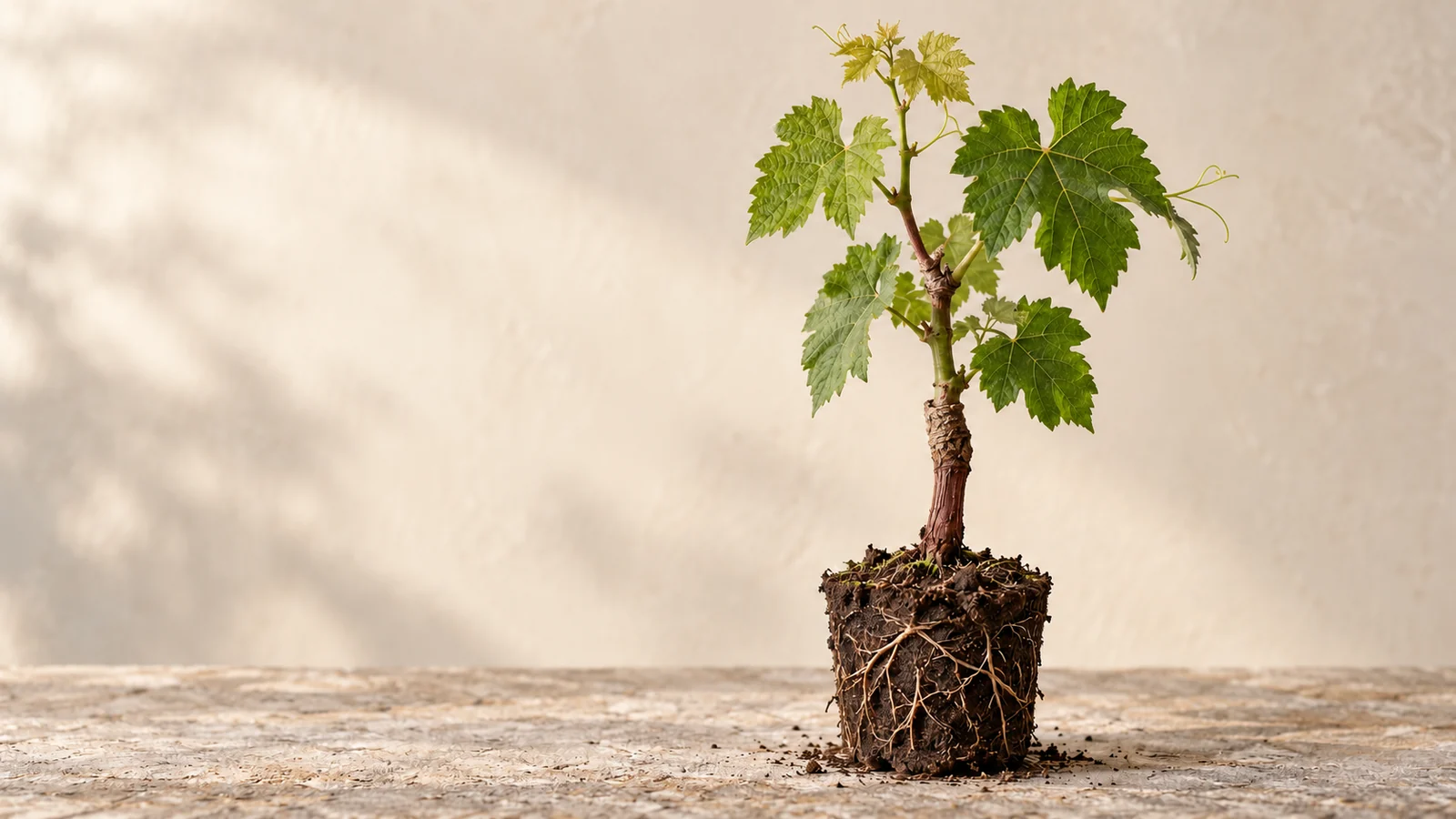
Imagine standing beside a young vine at a nursery. Its small leaves are catching the light. A little lower, the stem thickens around a healed join. You were about to ask which grapes it would produce. Now you have another question: why does it have a seam?
That imagined encounter is our starting point. Before we discuss what is in the glass, we need to look at what holds the vine in the ground.
In the previous Cellar Journal article, living plants crossed the Atlantic and became part of new wine cultures. This time, the relationship between the two sides of the ocean takes an unexpected turn.
The decisive response to phylloxera was to keep the grape variety on different roots—not to make the insect disappear.
Understanding that distinction changes the way we read both vineyard history and the words on a modern wine label.
The trouble began below the leaves
Phylloxera is an insect, not a fungus. Its scientific name is Daktulosphaira vitifoliae. Native to North America, it became central to the European vineyard crisis of the nineteenth century; INRAE places the beginning of that crisis in the 1860s. INRAE, phylloxera
Root-feeding forms can injure susceptible roots and cause swellings. Secondary fungal infections contribute to decay, weakening the vine and its production. The insect and those infections are different parts of the explanation. UC IPM, root injury
For a reader, the important shift is one of attention. A vineyard can look like a story about leaves and fruit while the decisive problem lies out of sight.
But this is not an invitation to diagnose a sick vine from a photograph. Knowing the historical cause of one crisis is not the same as identifying the cause of every yellow leaf today.
An Atlantic connection, not one proven passenger list
How did an insect associated with American vines become a European catastrophe?
A 2020 genomic study traced much of the ancestry of the sampled European populations to the upper Mississippi region, associated with wild Vitis riparia. It also found evidence consistent with additional ancestry in France from the New York region. The authors distinguish those population relationships from a fully reconstructed sequence of historical introductions. Rispe and colleagues, 2020
That is a richer answer than an arrow drawn across an ocean. It is also a more careful one: ancestry is not the name of a ship, a passenger or a nursery shipment.
The earlier article separated the journey of a plant from the journey of a drink. Here we need another distinction: reconstructing where an insect population came from is not the same as documenting every movement that carried it.
The historical irony is worth noticing without turning it into blame. American vine material would become part of the response to a crisis involving an American-origin insect. Geography supplied both a challenge and resources for adaptation.
Living through a crisis without knowing its ending
Looking backward, it is tempting to compress the story into two sentences: the vines died; growers grafted them and recovered. Contemporary voices restore the uncertainty between those sentences.
In December 1880, botanist Maxime Cornu’s article in Nature described serious losses alongside sustained investigation. The accessible contemporary introduction is not a victory speech. It shows a problem still demanding experiments and interpretation. Cornu, 1880 — publisher preview
The Duchesse de Fitz-James supplies a different viewpoint. Writing in 1881 about her estate at Saint-Benezet, she described repeated treatments, their demands on labor and experiments with American vines. It is one owner’s account, not the experience of every household, but it makes the work behind a proposed solution visible. Fitz-James, 1881
An idea in a paper still has to become a living plant. Someone has to select the material, make the join, tend it and decide whether the result is worth repeating. A failed attempt is not just an untidy step in a timeline when someone’s next harvest depends on it.
The useful historical question is therefore not only “Who found the answer?” It is also “What did turning that answer into a vineyard require?”
Two plant parts, one working vine
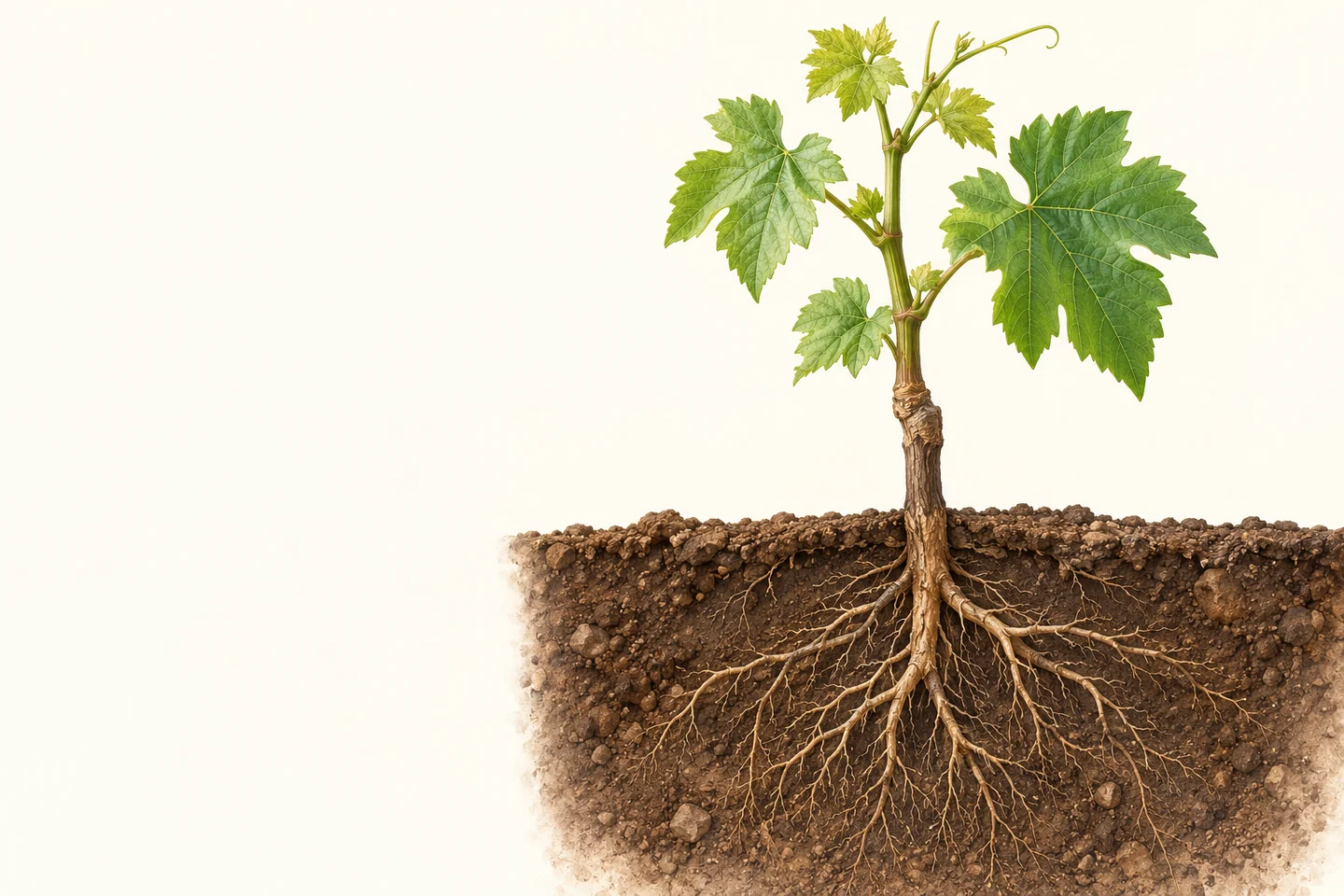
Grafting joins a rootstock—the rooting part—to a scion, the selected upper material that will form the desired growth. It is a form of asexual propagation: the tissues join and grow together. It is not the sexual crossing that produces a new seedling variety. Mississippi State University, grafting basics
In the response to phylloxera, the important move was to place familiar Vitis vinifera varieties on roots selected for resistance. The choice did not require replacing the fruiting variety with the variety providing the roots. INRAE, historical response
Think of the nursery vine from the opening. Calling the upper part Pinot noir does not tell us the name of the rootstock below it. Conversely, a rootstock name does not name the grapes destined for the wine.
This distinction also helps with the word hybrid. A rootstock may itself have been bred by crossing vine species. Attaching a scion to it is a different operation. Keeping those two operations separate prevents a great deal of unnecessary confusion.
The seam is a connection, not a new grape variety.
There was never just one suitable root
Finding resistance was essential. Finding roots that worked in particular soils made the task more demanding.
INRAE’s account of Pierre-Marie-Alexis Millardet describes research on American vines and collaboration with grower Charles de Grasset. Their work included hybrid rootstocks adapted to conditions such as calcareous soils. The history connects observation, breeding and cultivation rather than assigning the rebuilding of vineyards to one inspired gesture. INRAE, Millardet and de Grasset
Two catalogue entries make the continuing problem easy to understand.
Plantgrape describes 101-14 Millardet et de Grasset as highly tolerant of root phylloxera but sensitive to drought. It is not a universal answer simply because it addresses the insect. Plantgrape, 101-14 MGt
The same catalogue describes 110 Richter as highly tolerant of root phylloxera and well adapted to drought, but very sensitive to excess water. A useful characteristic in one setting can come with a limitation in another. Plantgrape, 110 R
These are examples, not planting recommendations. They explain why a grower asks more than whether a rootstock can withstand one pest.
For the wine reader, the lesson is accessible: a technical choice can be thoughtful without being the same everywhere. “Different” does not automatically mean an earlier grower was mistaken or a neighboring estate has discovered a superior formula.
A rootstock belongs to a site, not to a league table.
Resistance did not erase the insect
Here is the qualification that keeps the story from becoming a myth of complete conquest.
University of California extension guidance explicitly distinguishes resistance from immunity. Grafted vines can carry phylloxera on their roots. A plant that tolerates an insect better is not necessarily a plant on which no insect can live. UC ANR, resistance and movement
Nor does every rootstock have the same record. UC Davis documents the widespread removal of poorly resistant AXR#1 from California vineyards in the 1990s. That is a specific historical failure, not evidence that grafting as a whole stopped working. UC Davis, AXR#1 context
The practical idea is durable: successful protection does not remove the need to understand the organism or evaluate the plant material.
This also changes the language of the history. “Rebuilding” is often a better word than “eradicating.” The first describes what people could accomplish in the vineyard; the second makes a much stronger claim about the pest.
A story can have an important solution without having an ending in which the original threat vanishes.
Own-rooted, old and pre-phylloxera ask different questions
Now return to a bottle described as own-rooted, or pie franco in Spanish.
An own-rooted vine grows on its own roots rather than on a different rootstock. It can be propagated from a cutting and planted as a new vine. The description therefore does not, by itself, establish great age. Oklahoma State University, own-rooted vines
“Old vines” is an age claim. “Pre-phylloxera” is a historical claim whose meaning needs clarification: does the producer mean surviving plants, the ancestry of planting material, or a vineyard’s regional history? Those are questions to investigate, not interchangeable proofs.
Ask for the planting date and what, exactly, has remained continuous. A long-lived site, a longstanding variety and a particular living vine are not the same object.
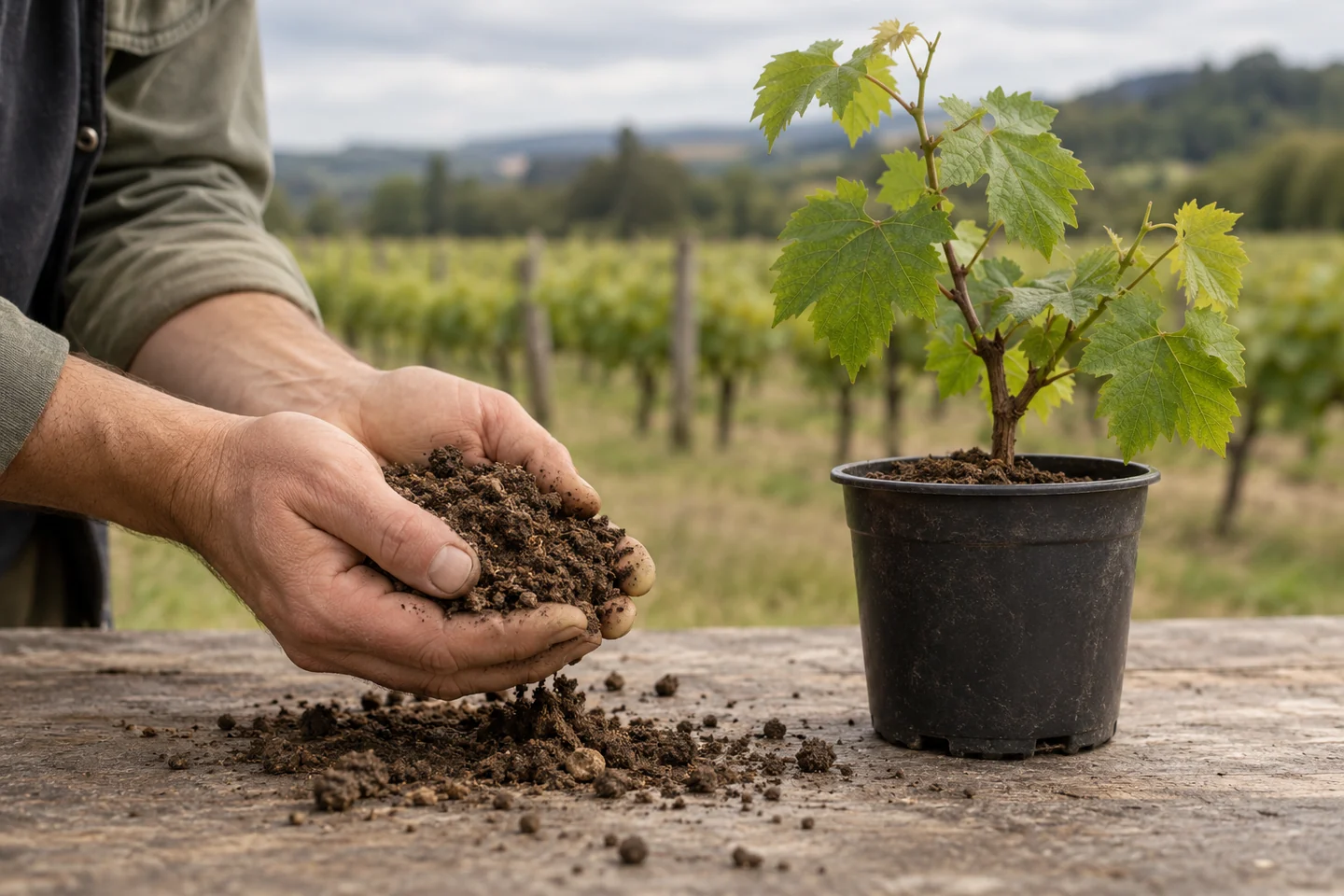
Soil enters this conversation too. UC IPM identifies sandy soils as unfavorable to damaging phylloxera problems in its California guidance. That regional observation should not be turned into a worldwide guarantee that every sandy parcel is insect-proof. UC IPM, soil context
There is no need to drain the romance from a remarkable vineyard. Specificity can make its history more interesting. A documented survivor deserves a better explanation than a word being asked to mean age, immunity and quality at once.
Can the roots change what reaches the glass?
It would be just as misleading to say that roots never matter as to promise that one root system always makes finer wine.
A 2022 Pinot noir study reported rootstock-related differences in the phenolic composition of grapes and wines across three vintages. Its measurements concern composition; they do not establish that consumers preferred one rootstock or that every difference could be identified in a blind tasting. Blank, Samer and Stoll, 2022
A Cabernet-Sauvignon study published in July 2026 reports vintage-dependent effects of rootstocks on aromatic expression in wines from 2020 and 2021. Its sensory findings do not rank universal quality. Farris and colleagues, 2026 — abstract
The distinction is useful at the table. A chemical measurement, a sensory difference and a preference are three different answers. None should quietly substitute for the others.
An own-rooted wine can be fascinating. So can a grafted one. Let the history direct your questions rather than dictate the pleasure you are supposed to feel.
We do not need to choose between respecting research and respecting our own palate. We need to avoid making either answer a question it was not asked.
A historical chapter with present-day consequences
Absence from an old account is not permanent protection.
The Canary Islands’ official gazette records a focus detected in Acentejo, Tenerife, on 30 July 2025, with laboratory confirmation on 12 August. Those dates concern a particular event, not the infestation status of every island or parcel today. Gobierno de Canarias, BOC of 22 August 2025
For visitors, the connection is practical rather than dramatic. Australian government guidance identifies risks from plant material, footwear and equipment, and asks visitors to respect vineyard access precautions. Follow the host’s designated routes and current local instructions; do not treat a cutting or soil as an innocent souvenir. Australian Government, visitor biosecurity
You do not have to become a pest specialist to recognize the courtesy involved. The vineyard is someone’s working landscape, not merely the background of a photograph.
Curiosity becomes more valuable when it comes with care.
Four questions to bring back to the bottle
The purpose of this Cellar Journal story is not to turn dinner into a rootstock examination. It is to make a few words more useful.
Which plant is being named? Separate the fruiting variety from the rootstock. Ask whether a technical sheet actually identifies both before filling the gap yourself.
What continuity is being claimed? Look for a planting date or a precise explanation of “pre-phylloxera.” Do not quietly exchange the age of a place for the age of a plant.
Why was this choice made here? A producer’s explanation about the site is more informative than a claim that one type of root is inherently more authentic.
What does this particular wine offer? Attend to its actual aroma, texture and balance. Your enjoyment need not agree with a hierarchy suggested by a romantic description.
These are reading questions, not a certification method or a blind-tasting test. A missing detail is a reason to ask, not a reason to invent it.

Back to the small seam
Look again at that imagined nursery vine. The join no longer seems like an awkward interruption. It has become a question worth noticing.
The point is not that every vine must tell the same story. It is that continuity sometimes depends on changing a part we rarely see.
You can admire the surviving vineyard and the work of rebuilding one. Neither admiration requires claiming that the past tasted purer than the present.
The seam does not diminish the story. It helps us see how the story continued.
Next, we leave the roots for another question: what happens when grape juice begins to ferment? CJ-028 turns to Pasteur, experiments and the moment fermentation became something winegrowers could investigate differently.
Questions worth asking
Is phylloxera a fungus or an insect?
An insect. It has forms associated with roots and leaves; its visible effects depend on the host and conditions. Secondary fungal damage is a different part of the problem. Embrapa, phylloxera
What does a rootstock do in a grafted vine?
It supplies the roots beneath the selected upper variety, or scion. Mississippi State University
Does grafting create a new hybrid grape variety?
No. Joining existing tissues is not a sexual cross. The rootstock may already be a hybrid. Mississippi State University
Has phylloxera been eradicated?
No. Agriculture Victoria describes resistant or tolerant rootstocks and containment, not a known treatment that eradicates the insect. Regional status must be checked locally. Agriculture Victoria
Does own-rooted mean old or pre-phylloxera?
No. Own-rooted describes the roots, not the planting date. A newly rooted cutting can also be an own-rooted vine. Oklahoma State University
Does the rootstock name prove that a wine is better?
No. Ask what “better” means, which wines were studied, and whether preference was actually measured. Farris and colleagues, 2026
Sources and further reading
Sources consulted on 14 October 2026. They support the claims indicated in the text; inclusion does not imply endorsement of Ask Sommelier AI. Historical documents, institutional guidance and experiments serve different purposes.
R01. Delbac, L.; Deluche, C. — INRAE, Ephytia. Daktulosphaira vitifoliae — Phylloxera. Updated 9 December 2020.
R02. University of California Statewide IPM Program. Grape Phylloxera — UC IPM Pest Management Guidelines: Grape. Updated July 2015.
R03. Rispe, C.; Legeai, F.; Nabity, P. D.; et al.. The genome sequence of the grape phylloxera provides insights into the evolution, adaptation, and invasion routes of an iconic pest. 23 July 2020. BMC Biology 18, 90. Read with the correction below.
R04. Rispe, C.; Legeai, F.; Nabity, P. D.; et al.. Correction to: The genome sequence of the grape phylloxera provides insights into the evolution, adaptation, and invasion routes of an iconic pest. 11 September 2020. BMC Biology 18, 123; Figure 4 axis-label correction.
R05. Cornu, Maxime. The Phylloxera in France. 9 December 1880. Nature 23, 127–130. Publisher preview only was consulted.
R06. Duchesse de Fitz-James. La Vigne américaine en France. 1881. Revue des Deux Mondes, tome 45. Contemporary account via Wikisource transcription.
R07. INRAE — Santé et Agroécologie du Vignoble. PMA Millardet. Undated institutional historical page.
R08. Wilson, Jeff; Porter, Wayne; Barickman, Casey — Mississippi State University Extension. Basic Grafting Techniques. Publication 3402; displayed imprint POD-02-26.
R09. Carroll, Becky — Oklahoma State University Extension. Rootstocks for Grape Production. February 2017; HLA-6253.
R10. Plantgrape — INRAE / IFV / Institut Agro Montpellier. 101-14 Millardet et de Grasset. Live catalogue entry, consulted 14 October 2026.
R11. Plantgrape — INRAE / IFV / Institut Agro Montpellier. 110 Richter. Live catalogue entry, consulted 14 October 2026.
R12. University of California Agriculture and Natural Resources — Foothill Fodder. Phylloxera: a foothill pest whose time has come. 17 June 2018.
R13. Bailey, Pat — University of California, Davis. Soil Fungi Linked to Insect-Associated Decline of Resistant Rootstocks. 10 January 2005.
R14. Botton, Marcos — Embrapa Uva e Vinho. Filoxera (Daktulosphaira vitifoliae). Undated technical page.
R15. Blank, Magali; Samer, Sabrina; Stoll, Manfred. Grapevine rootstock genotypes influences berry and wine phenolic composition (Vitis vinifera L. cv. Pinot noir). 7 February 2022. OENO One 56(1), 133–144. Publisher-indexed abstract and relevant text; underlying data not reanalyzed.
R16. Farris, Laura; Marguerit, Elisa; Pelonnier-Magimel, Edouard; Morel, Marine; Tempére, Sophie; Lytra, Georgia; Barbe, Jean-Christophe. Exploring the Effect of Rootstocks on Cabernet-Sauvignon Wine Aromatic Expression Using Two Sensory Analysis Methods. Published online 1 July 2026. ACS Food Science & Technology 6(7), 2129–2136. Publisher abstract only; full paper not consulted.
R17. Gobierno de Canarias — Boletín Oficial de Canarias. Orden de 20 de agosto de 2025 relativa al foco de filoxera de la vid en Tenerife. BOC no. 166, announcement 3039, 22 August 2025. Descriptive shortened title; the link leads to the full official instrument.
R18. Australian Government — Department of Agriculture, Fisheries and Forestry. Grape phylloxera. Official biosecurity page, consulted 14 October 2026.
R19. Agriculture Victoria. Grapevine phylloxera. Official biosecurity page, consulted 14 October 2026.