The champagne reached the glass almost without bubbles.
It came from a Baltic shipwreck discovered in 2010. When the analyses were published in 2015, researchers described roughly 170-year-old samples: no bubbling was observed on pouring, although tasters felt a slight tingle. The closure had preserved liquid, but not all the gas. 1
The easy headline would have been that a wine had defeated time. The interesting question was different: what had it kept, what had it lost, and what had it become?
Preservation can mean keeping a drink recognizable. It can also mean protecting what we liked about it. Aging well makes a further demand: that the transformation offer something worth waiting for. These are three different expectations, although we often place them behind the same cork.
After Pasteur and fermentation, our story continues where a winery’s visible work often ends. A bottle is filled, a closure is fitted, and the product appears finished. For its buyer, a decision begins that may last one evening or many years.
The bottle is where those two histories meet: the wine someone intended to make and the wine we eventually get to drink.
Glass has a memory too
Before considering a cellar, pause over the shape of the container.
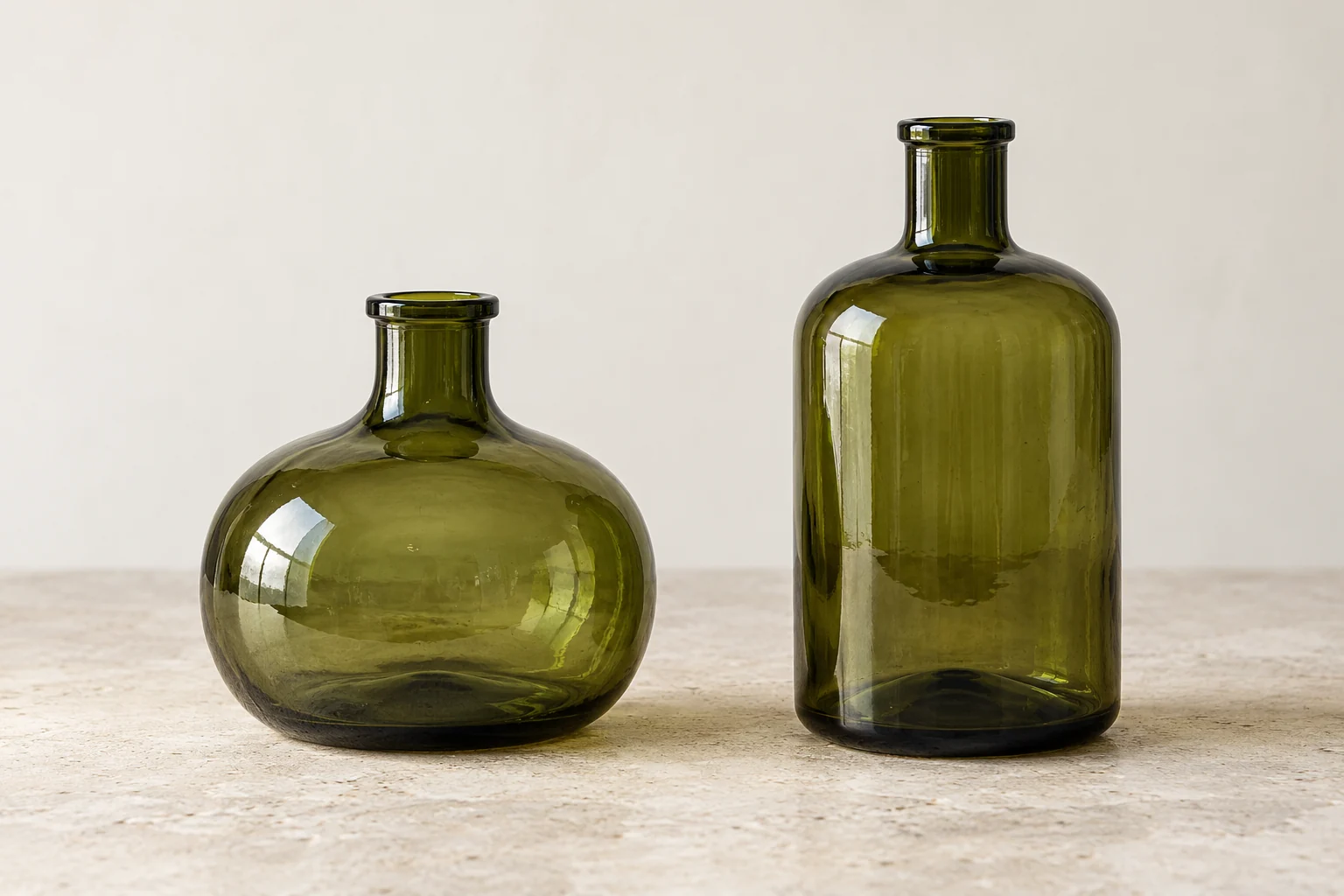
London Museum holds a wine bottle dated approximately 1686–1715, with a flattened globular body, a short neck and dark green glass. It looks unlike the tall, regular silhouette we now associate with a row of wines. 2
Another object in its collection, catalogued within 1700–1799, has a cylindrical body and retains a tool mark from its manufacture on the base. The two objects reveal different solutions. Their date ranges overlap: they are not two frames sufficient to date a worldwide replacement. 3
The comparison changes how we look. Before it became packaging that seems inevitable, each bottle was something someone had to make: a mouth that needed to accept a closure, a base that needed to support it, a body that needed handling.
A fragment from the Hollandia, held by the Rijksmuseum, adds another detail. It is a bottle neck with its cork still level with the mouth, dated between 1700 and, at the latest, August 13, 1743. Here, glass and bark are not separate concepts. They have survived together. 4
None of these objects independently identifies the inventor of the modern wine bottle or establishes when people began valuing mature wine. Their interest is more concrete. They return us to a material problem that remains relevant: storing something requires container and closure to work together.
They also bring workers back into a history too easily told through famous vintages alone. The hand that shaped the glass did not determine every aroma in the wine. It nevertheless made part of the object on which that wine’s future depended.
What gets enclosed when we close it
Once bottling is finished, wine is not necessarily isolated from all oxygen. Some may be dissolved in the liquid; some may occupy the space between liquid and closure. Later, certain closures can release oxygen already held within them and allow additional oxygen to enter. The AWRI distinguishes these contributions because they do not all happen in the same way or at the same time. 5
That requires us to be more precise about a familiar expression: wine needs to breathe.
A bottle has no lungs. It is more useful to consider a changing exposure: what was present at the beginning, what may arrive later, and the reactions occurring in that particular wine. Two apparently equivalent statements—oxygen was present at bottling and oxygen entered during storage—describe different moments.
The cork stops being a talisman. The question is no longer whether it looks sufficiently traditional, but what relationship the packaging system establishes with its contents. Oxygen, meanwhile, stops being an ingredient with a fixed reputation: its effects need to be interpreted alongside the wine and its conditions.
Change that does not need fresh air
In 2026, Zaragoza researchers compared sixteen red wines for one month at 35 °C, with and without oxygen exposure. Both groups changed, and the team identified oxygen-independent processes, including esterification equilibria. This was accelerated research: it did not establish how many cellar years equaled that month. 6
That finding corrects the picture of a wine motionless until air enters. Even when that entry is greatly restricted, chemical relationships remain capable of changing.
Esters offer a way into the subject. Certain connections between acids and alcohols can form and break; the proportions of the substances need not remain constant. Experimental work by Shinohara and Shimizu in 1981 already examined how temperature, pH and ethanol concentration affected the formation of particular esters in wines and model solutions. 7
We do not need to memorize their names to understand the consequence: waiting does not simply add years; it allows substances to shift into different proportions.
Those substances are not alone. Research published in the 2025 volume of Food Chemistry examined how polyphenolic composition participated in ester evolution. Its experiments showed that the wine matrix affected aspects of those reactions. In those experiments, more highly polymerized flavanols favored ester preservation more than monomeric forms or anthocyanins. Knowing one compound and watching the calendar is not enough. 8
Think of a conversation: changing who is present changes what can happen among everyone else. That is an analogy, not a molecular theory. It helps explain why a vintage, a grape or a single acidity figure cannot, by itself, forecast the sensory destination of every bottle.
Softening is not simply removing tannin
The promise of cellaring is often expressed in a single word: softness.
Research into astringency asks us to proceed more carefully. Gambuti and colleagues investigated oxygen exposure and the wine’s reactivity with salivary proteins, alongside sensory evaluation. Effects depended on wine composition. The work received funding from Nomacorc; it provides experimental evidence, not an independent ranking of every closure. 9
For the drinker, what matters is the relationship between composition and sensation. Counting tannins is not the same as describing exactly what a mouth will feel. Nor does a chemical transformation guarantee that someone who loved a young wine’s firmness will prefer the later result.
There is another possible direction. In an experiment involving two Shiraz wines, lower oxygen exposure after bottling favored the accumulation of certain sulfur compounds, including hydrogen sulfide and methanethiol. The effect concerned those wines and conditions, rather than delivering a verdict on every bottle with limited oxygen exchange. 10
This is why the simple contest between more air and less air is unhelpful. Caring for wine requires attention to different responses, rather than pursuing one variable as though all the others must obey it.
One morning, fourteen futures
On May 26, 1999, the AWRI bottled a Semillon with fourteen closure types. Its first results, published in 2001, followed twenty months of evolution. The tested screw cap better retained certain antioxidants and slowed browning, but a rubber-like aroma also appeared. No closure won on every criterion assessed. 11
The experiment’s value lies in its question: by starting with a common wine and comparing closures, researchers can investigate something a solitary bottle cannot reveal. There is no need to compare a prestigious label with a modest one, or let the sound of a cork decide the outcome in advance.
It would be equally mistaken to turn those 1999 products into a ranking of today’s market. The history teaches us how to compare, rather than freezing technology in the year of the trial.
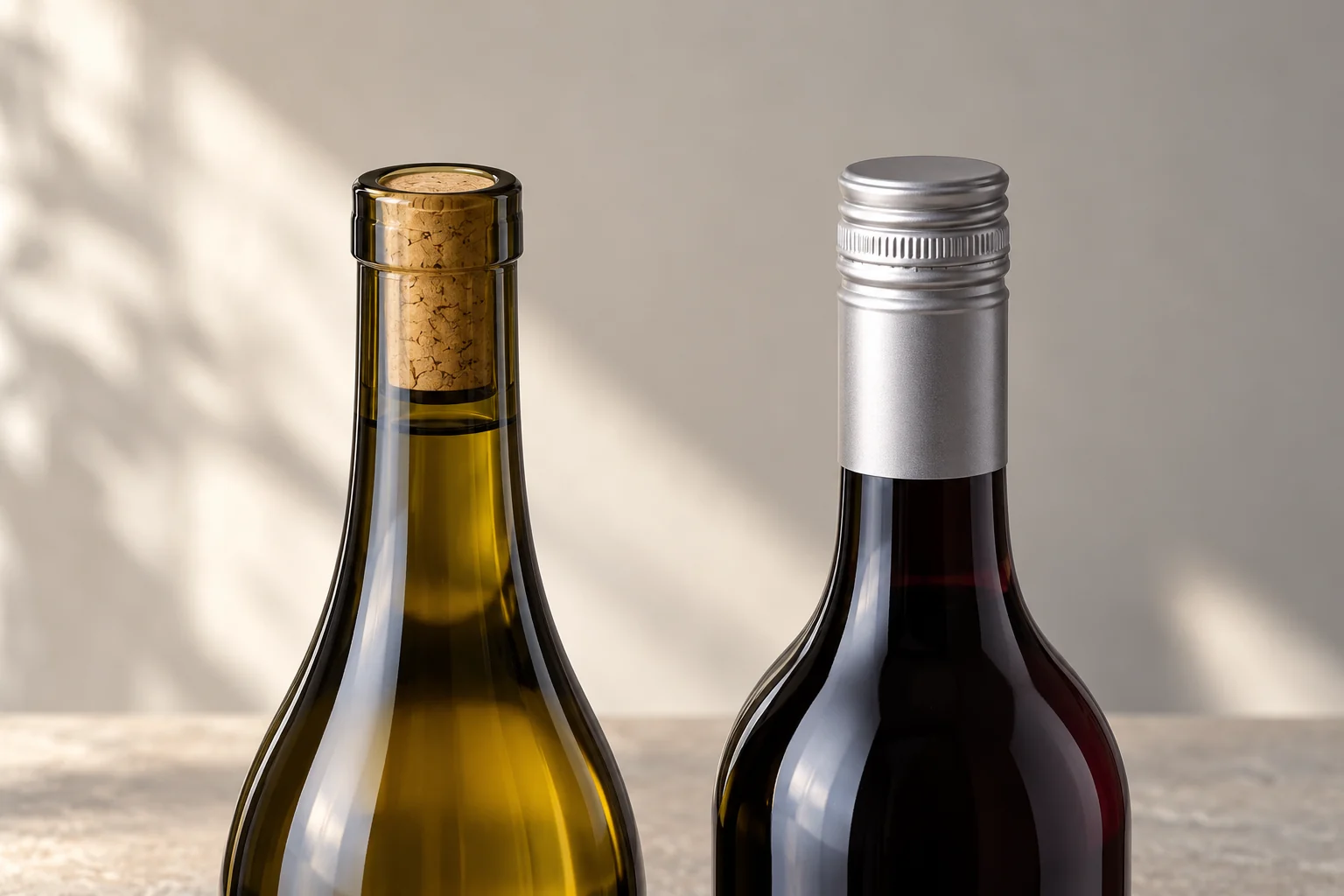
Even screw cap needs more detail. The seal is made through a disc with an internal liner compressed against the glass mouth. The AWRI describes liner materials with different oxygen permeability: outward appearance does not tell the whole story. 12
For the reader, the implication is liberating. There is no obligation to choose a side based on a sound, a gesture or a material. Tradition can carry emotional value without becoming evidence of how a particular bottle behaves.
Age does not record the summer it lived through
The date on a label records one part of time. By itself, it does not record the temperature that accompanied the bottle.
A study of Mendoza Malbec compared natural cork and screw cap at 15 and 25 °C over two years. At twenty-four months, sensory profiles differed; overall, the results pointed to a substantial influence of time and temperature, greater than closure type within that design. Warmer storage was associated with dried-fruit and dried-vegetative notes. 13
Two years had passed for every bottle. They had not passed in the same way.
That exposes an essential limit of vintage language: chronological age is not a condition report. A year can be thoroughly documented while we still know little about the places the wine has passed through.
Light adds a different variable. Carlin and colleagues studied 1,052 bottles of twenty-four white wines under shelf-exposure conditions. They found substantial losses of aroma compounds in clear glass after seven days. Darkness better protected aromatic integrity in the experiment. That period describes the trial, not a universal expiry date for every transparent bottle. 14
Nor is the problem resolved by calling any glass dark. Laposa and colleagues measured light transmitted into actual bottles and found differences according to color, illumination and geometry. Protection is a property that can be investigated, rather than a decorative adjective. 15
All of this makes the discretion of a cellar more interesting. Its purpose is not to display patience, but to provide conditions for the transformation being sought. A bottle may look beautiful under a spotlight; that beauty and the protection of its contents are separate questions.
What, exactly, are we waiting for?
By now, should I keep it deserves a less automatic answer than the older, the better.
The first conversation should concern the particular wine: what development its maker expects, under which conditions and over what horizon. A drinking-window recommendation makes sense as a conditional expectation, not a guaranteed appointment with a superior version of the wine.
The second conversation is personal. Perhaps the energy of fruit matters most to you; perhaps you want to explore a more developed profile. Recognizing that preference does not require passing an examination. Nor does it oblige you to admire a wine because it took a long time to reach the table.
When you encounter a label you have tried before, a simple note may be more useful than a solemn promise: what you noticed, what you enjoyed, how it was served and what you know about its storage. This is not a controlled experiment, but it helps separate your actual experience from the reputation that arrived ahead of it.
That is also the conversation we want to encourage at Ask Sommelier AI: knowledge that accompanies the palate, without asking it to surrender to age or prestige.
There is a legitimate way of waiting in order to discover. There is another, less generous kind of waiting: postponing indefinitely for fear of missing an imagined perfect moment.
The bottle we keep contains a possibility. Opening it lets us discover which one.
Questions worth asking
Does every wine improve with storage?
Age alone cannot decide that. Better requires knowing what you enjoy; storage history also matters. The Malbec study gives a specific example of that latter difference. 13
Can a wine under screw cap evolve?
Yes: restricting oxygen does not stop every change. Different internal liners can also alter a screw cap’s behavior. 6 12
Does wine need fresh oxygen to age?
Not for all its transformations. Nor does it follow that the least oxygen always guarantees the preferred result. 6 10
Does more heat mean better, faster aging?
Faster and better are not synonyms. An accelerated experiment should not become a home recipe or a promise of pleasure.
Does a dark bottle offer complete protection from light?
Do not assume so: transmission depends on the glass and exposure. Dark is not an unlimited guarantee. 15
Does an old wine’s survival show that it became better?
No. Without its initial condition and comparative alternatives, survival and improvement remain different claims. Historical interest does not oblige us to enjoy it, either.
Sources and further reading
Research and institutional records consulted through October 19, 2026. The dossier states the access scope of each entry. Source inclusion does not imply endorsement of Ask Sommelier AI.
1. Jeandet, P., et al. (2015). Chemical messages in 170-year-old champagne bottles from the Baltic Sea: Revealing tastes from the past. Proceedings of the National Academy of Sciences, 112(19), 5893–5898. Historical samples; not a controlled test of underwater cellaring.
2. London Museum (Undated catalogue). Bottle, wine bottle — NN24310. Collection record; object dated c. 1686–1715. Catalogue date range, not the date of an invention.
3. London Museum (Undated catalogue). Bottle, wine bottle — 37.194/38. Collection record; object dated 1700–1799. A second object record, not a universal bottle chronology.
4. Rijksmuseum (Undated catalogue). Hals met kurk van een wijnfles uit het wrak van de Oost-Indiëvaarder Hollandia — NG-1980-27-H-2564. Collection record; dated 1700–in or before 1743-08-13. Bottle-neck fragment with cork; not a surviving sample of wine.
5. Australian Wine Research Institute (Undated; consulted 2026-10-19). Oxygen pick-up during packaging — understanding total package oxygen. AWRI technical resource. Technical explanation of packaging oxygen; not a universal aging target.
6. Aragón-Capone, A. M.; Bueno, M.; Ferreira, V. (2026). Chemical changes in the volatile composition associated to the anoxic and oxidative storages of red wines. Food Chemistry, 506, 148098; online 2026-01-21; issue 2026-03-30. Abstract consulted; accelerated design, not a cellar-time conversion.
7. Shinohara, T.; Shimizu, J. (1981). Formation of Ethyl Ester of Main Organic Acids during Aging of Wine and Indications of Aging. Nippon Nōgeikagaku Kaishi, 55(8), 679–687. Original experimental abstract; wines and model solutions.
**8. Ling, M., et al. (2025 [online 2024]).** The influence of polyphenols on the hydrolysis and formation of volatile esters in wines during aging: An insight of kinetic equilibrium reaction. Food Chemistry, 464, 141593; online 2024-10-09; issue 2025-02-01. Abstract consulted; supports matrix dependence, not a shelf-life rule.
**9. Gambuti, A.; Rinaldi, A.; Ugliano, M.; Moio, L. (2013 [online 2012]).** Evolution of Phenolic Compounds and Astringency during Aging of Red Wine: Effect of Oxygen Exposure before and after Bottling. Journal of Agricultural and Food Chemistry, 61(8), 1618–1627; online 2012-11-12. Abstract consulted; funded by Nomacorc SA, not a closure-market ranking.
10. Ugliano, M., et al. (2012). Oxygen Consumption and Development of Volatile Sulfur Compounds during Bottle Aging of Two Shiraz Wines. Influence of Pre- and Postbottling Controlled Oxygen Exposure. Journal of Agricultural and Food Chemistry, 60(35), 8561–8570. Abstract consulted; two Shiraz wines, not a universal rule.
11. Australian Wine Research Institute (2001). First results of the AWRI wine bottle closure trial published 12 July 2001. Institutional report of the AWRI’s own closure experiment. First 20-month report, not a present-day buying guide.
12. Australian Wine Research Institute (Undated; consulted 2026-10-19). Applying screw cap closures. AWRI technical resource. Technical component description; not a claim of identical performance.
13. Giuffrida de Esteban, M. L., et al. (2019). Impact of closure type and storage temperature on chemical and sensory composition of Malbec wines (Mendoza, Argentina) during aging in bottle. Food Research International, 125, 108553; online 2019-07-11; issue November 2019. Abstract consulted; a particular design, not a universal temperature prescription.
14. Carlin, S.; Mattivi, F.; Durantini, V.; Dalledonne, S.; Arapitsas, P. (2022). Flint glass bottles cause white wine aroma identity degradation. Proceedings of the National Academy of Sciences, 119(29), e2121940119; online 2022-07-05. Indexed original text consulted; trial duration is not universal shelf life.
15. Laposa, Z.; Vesztergom, S.; Kocsis, M.; Keszei, E. (2023). In situ measurement of light transmission into wine bottles and calculation of shelf life. OENO One, 57(1); published 2023-03-07. Indexed abstract/discussion; measurements and models are condition-specific.