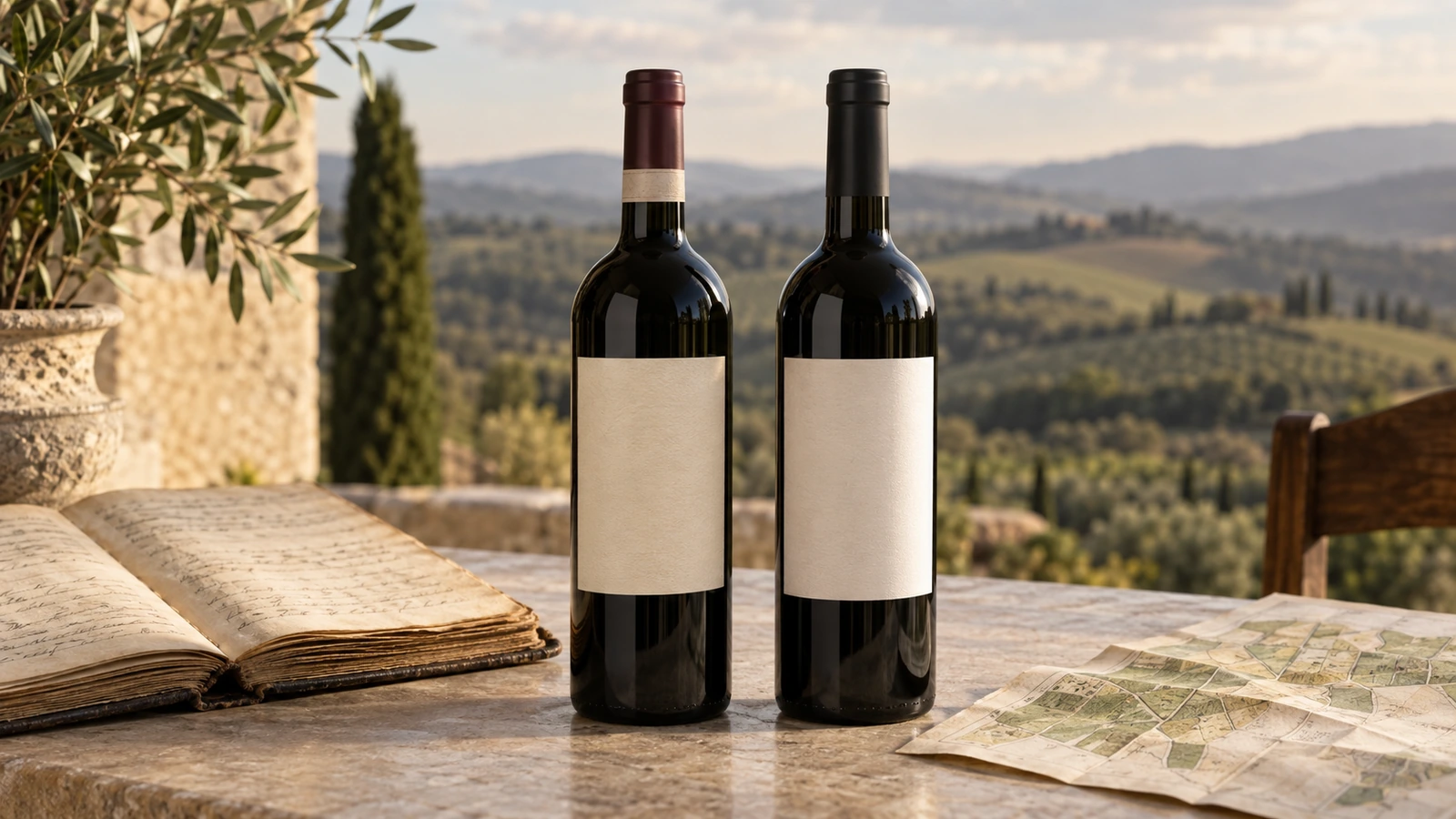
Two Tuscan bottles stand beneath the same restaurant light.
One says Chianti Classico DOCG. The other says Tignanello — Toscana IGT.
The first carries the narrower protected denomination and a place in Italy’s most familiar hierarchy of initials. The second carries a broader geographical indication and a name that became emblematic of modern Tuscan wine.
Before either cork moves, the label seems to have arranged them vertically:
DOCG above IGT. Higher must mean better.
But the categories did not conduct a blind tasting between these two bottles. They answered a different question.
They tell us which geographical name the wine may use, which production specification it followed, and which collective promise its producer chose to make. They can encode origin, permitted grapes, aging requirements, analytical limits, traceability, and reputation. They matter enormously.
They still cannot taste for us.
The central idea: a classification is a contract, not a score.
That sentence is not an argument against appellations. It is an argument for reading them accurately.
A contract can protect a place from imitation. It can preserve a shared identity and establish meaningful standards. What it cannot do is guarantee that every bottle inside the contract will give every drinker more pleasure than every bottle outside it.
Tignanello became famous in the space between those two truths.
What an appellation protects
Long before the modern initials DOCG and IGT existed, Tuscany was already trying to protect the relationship between wine and place.
In 1716, Grand Duke Cosimo III de’ Medici formally delimited the area associated with Chianti wine—what is now the historic Chianti Classico territory—and restricted use of the name to wine from that mapped zone. The modern consortium describes the proclamation as an early form of geographically defined origin protection (Consorzio Vino Chianti Classico, 1716 boundary).
That history matters because an appellation is not merely a recipe.
It is also a boundary.
A protected designation says, in effect:
- this name belongs to a particular place;
- the grapes and wine must meet a defined specification;
- participating producers accept common constraints;
- the collective reputation of the name deserves protection.
Italy now presents its protected wine categories within the European PDO/PGI system. The Italian Ministry of Agriculture identifies DOCG and DOC as traditional terms used within DOP/PDO, and IGT as the traditional Italian term used within IGP/PGI (MASAF, Italian DOP and IGP wines).
Those categories are not empty marketing language. A more specific designation may impose a narrower production area, more detailed grape rules, lower yields, minimum aging, analytical parameters, sensory requirements, or additional controls.
But specificity is not the same as a universal tasting rank.
A legal category tells us which rules a wine followed. It does not, by itself, tell us how much pleasure, precision, or longevity is in the glass.
What classification cannot decide
Imagine two wines that comply perfectly with the same DOCG specification.
They can still differ because of:
- parcel and exposure;
- vintage sequence;
- vine age and yield;
- harvest timing;
- fermentation and extraction;
- vessel and oxygen;
- blending decisions;
- bottle age and storage;
- producer intention;
- the drinker’s palate.
Compliance creates a shared frame. It does not erase variation inside that frame.
The reverse is also true. A wine outside a prestigious designation may be outside because its grapes, percentages, method, aging, location, or labeling choice do not fit the applicable specification. That is not the same as a panel tasting it and declaring the wine inferior.
This distinction is the key to understanding Tignanello.
The wine did not become important because rules are meaningless.
It became important because legal classification and sensory reputation did not always move in parallel.
Tradition was already a moving target
The familiar story of the Super Tuscans is often staged as a simple conflict:
tradition on one side, innovation on the other.
Tuscan history is less tidy.
In 1872, Bettino Ricasoli described what later became known as the “recipe” of Chianti: mostly Sangiovese, a portion of Canaiolo, and some Malvasia Bianca. But the detail usually lost in retelling is that Ricasoli considered the white grape appropriate for lighter, ready-to-drink wine and said it could be omitted from wine intended for aging (Consorzio Vino Chianti Classico, Ricasoli’s 1872 recipe).
Even the famous recipe contained a choice about style and time.
The 1716 act protected geography before there was one immutable modern blend. The 1872 letter reflected experimentation. Later regulations translated selected practices into a collective legal framework. Then the framework changed again.
Tradition is not the absence of editing. It is the record of which edits a community decides to keep.
This does not make tradition arbitrary. It makes it historical.
And history is exactly where Tignanello must be read.
Tignanello was a sequence, not a single act of rebellion
Wine stories become cleaner when one vintage is made to carry an entire revolution.
The producer’s own chronology is more revealing because it unfolds in stages.
According to Marchesi Antinori:
- 1970: the wine was produced from the single Tignanello vineyard under the name Chianti Classico Riserva Vigneto Tignanello. The blend contained 20% Canaiolo and 5% Trebbiano and Malvasia, and the wine was aged in small oak barrels.
- 1971: it became a Tuscan red table wine rather than a Chianti Classico and took the name Tignanello.
- 1975: white grapes were definitively removed from the blend.
- Since 1982: Antinori says the varietal composition has remained the one currently used.
The current producer material describes Tignanello as being made mainly from Sangiovese with smaller proportions of Cabernet Sauvignon and Cabernet Franc. The 2023 technical sheet classifies the wine as Toscana IGT, reports 13 months of aging in predominantly new French oak with a small proportion of Hungarian oak, followed by another 12 months in bottle (Marchesi Antinori, Tignanello history and 2023 wine; Tignanello 2023 technical sheet).
This chronology is more useful than the legend of one dramatic break.
The project changed name, legal category, blend, and cellar language over more than a decade.
Tignanello did not leave its vineyard when it left Chianti Classico. It left a set of rules attached to that name.
More precisely, it moved from one protected claim into a broader legal category available at the time. It was never a lawless wine, and it never stopped being Tuscan.
A careful note about “firsts”
Antinori describes Tignanello as the first Sangiovese aged in barriques, the first contemporary red wine to combine Sangiovese with nontraditional Cabernet, and one of the first red wines from the Chianti Classico area to omit white grapes.
Those statements are valuable producer history. They are also superlative claims made by the producer.
Because establishing an absolute “first” across every estate, experiment, and unpublished cellar record is difficult, this article attributes the claims to Antinori rather than presenting them as independently adjudicated world records.
The dates remain important.
The superlatives remain attributed.
Why Cabernet and small oak barrels mattered
The importance of Tignanello is sometimes reduced to two ingredients in the story:
Cabernet and barriques.
Both mattered. Neither is a complete definition.
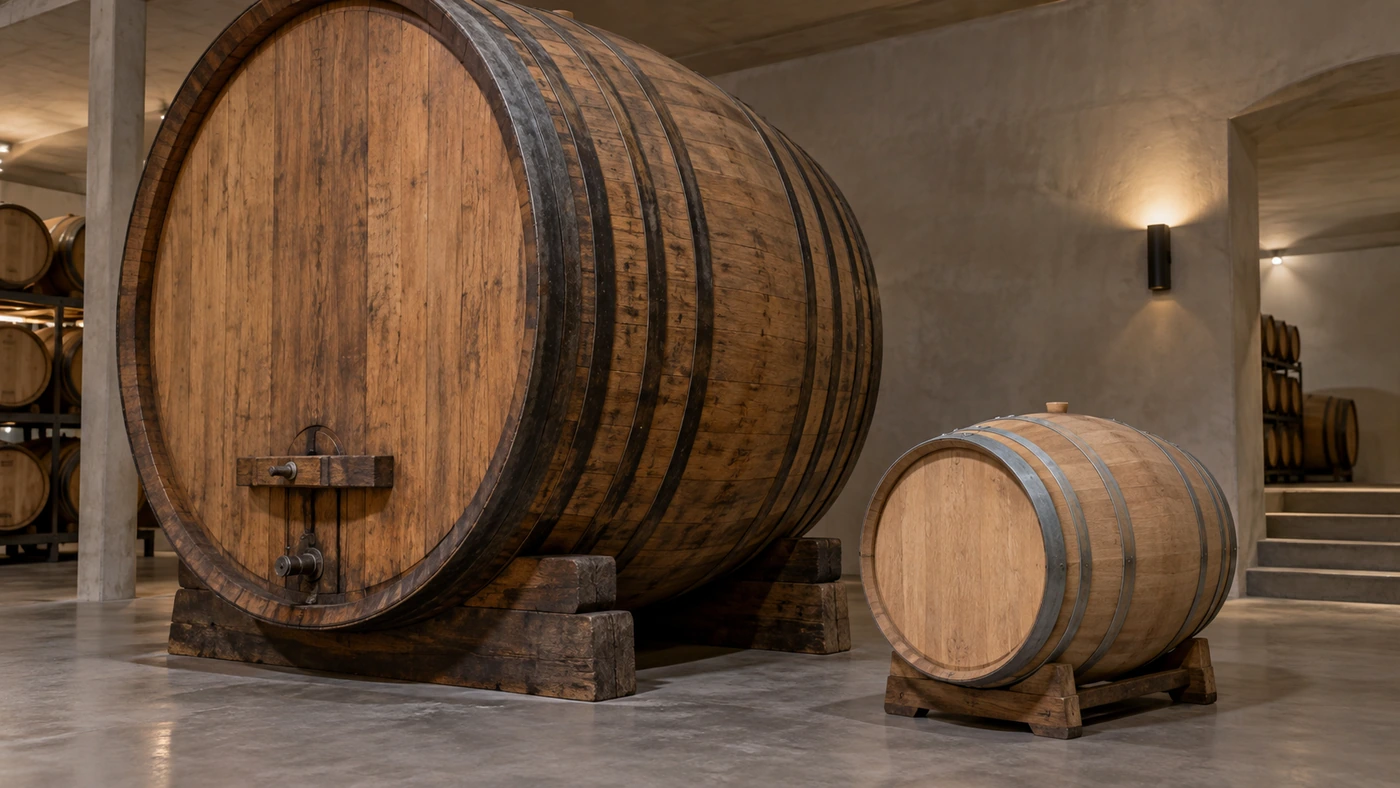
Adding Cabernet Sauvignon and later Cabernet Franc changed the range of structural and aromatic possibilities available to a Sangiovese-centered wine. Using small oak barrels also created a different maturation environment from large, relatively neutral casks.
A smaller barrel generally changes the relationship between wine volume and wood surface. Oak can contribute extractable aroma and phenolic compounds, while barrel construction, wood species, grain, toasting, age, and oxygen transmission influence how the wine develops. Research confirms that barrel maturation involves both transfer of wood-derived compounds and controlled oxygen exposure, but it also shows substantial variation among barrels and wines (Del Alamo-Sanza & Nevares, oxygen transfer in oak barrels; Sánchez-Gómez et al., wood volatiles and barrel oxygenation).
That is why “barrique-aged” is not a sensory guarantee.
It does not tell us:
- the origin or age of the barrel;
- whether it was new or used;
- the toast level;
- how long the wine remained there;
- how the lots were blended;
- whether oak dominates, supports, or disappears into the wine.
Nor does the presence of Cabernet automatically create a Super Tuscan.
Technique is a tool, not a legal category.
The historical importance lies in the combination of ambition, vineyard, blend, vessel, and refusal to let the then-current designation define the only possible serious red wine from that site.
The Vino da Tavola paradox
For modern readers, vino da tavola can sound like a tasting judgment: simple wine, everyday wine, lesser wine.
Historically, that conclusion can be badly misleading.
The category was broad. A wine that did not claim a more specific protected denomination could be placed there even when the reason was noncompliance with a narrower recipe rather than low sensory ambition.
That created a paradox.
Some of Tuscany’s most discussed and expensive wines could occupy a legally less specific category than ordinary wines that complied with an established denomination.
The label hierarchy and the market hierarchy had separated.
Italy’s Law No. 164 of 10 February 1992 created a national framework that included Indicazione Geografica Tipica (IGT) alongside DOC and DOCG. The law entered into force on 12 March 1992 (Gazzetta Ufficiale, Law No. 164/1992). In 1995, the Italian government officially recognized the “Toscano” or “Toscana” IGT and approved its production specification (Gazzetta Ufficiale, Decree of 9 October 1995).
IGT did not turn ambitious Tuscan wine into good wine.
It gave geographically rooted wine a more informative legal home.
Today, the official 2023 Tignanello sheet identifies the wine as Toscana IGT.
That is not an apology printed beneath the brand.
It is the classification the wine uses.
“Super Tuscan” is a nickname, not a denomination
The phrase Super Tuscan sounds official enough to belong on a government pyramid.
It does not.
It has no fixed legal recipe, no protected production zone of its own, no mandatory grape percentage, and no single aging rule. WSET summarizes the central point plainly: the term is not legally defined (WSET, “What is a Super Tuscan wine?”).
Linguistic research has studied Super Tuscan as a pseudo-English wine term that spread through Italian, English, Spanish, French, German, and international wine culture. That history helps explain why the phrase feels like a category even though it is not one (Cristiano Furiassi, “Drink wine, not labels”).
In practice, the nickname has been applied to more than one kind of Tuscan red:
- wines led by Cabernet or other international varieties;
- Sangiovese-led wines blended with Cabernet-family grapes;
- highly regarded 100% Sangiovese wines that historically sat outside the applicable Chianti rules;
- wines from different Tuscan zones and different legal designations.
So the words Super Tuscan do not tell you, by themselves:
- the exact place;
- the exact grapes;
- the percentages;
- the barrel program;
- the legal category;
- the quality;
- the price;
- whether you will enjoy the wine.
They tell you that the market, critics, producers, or drinkers have placed the bottle inside a cultural family.
That can be useful.
It is still not the technical sheet.
A nickname can help you find the shelf. It cannot replace the label’s legal grammar.
Not every Toscana IGT is called a Super Tuscan. Not every wine called a Super Tuscan follows Tignanello’s model. And no bottle becomes legally superior because the nickname appears in a shop description.
The rules changed—but not in one leap
It is tempting to tell the next chapter as a victory scene:
Tignanello broke the rules. The rules admitted they were wrong.
History again resists the clean version.
The Chianti and Chianti Classico framework evolved through collective decisions, research, market pressure, regional identity, and regulatory change.
The official Chianti Classico chronology records several major steps:
- 1984: Chianti became DOCG. For the historic Classico area, the permitted Sangiovese range increased from 50–75% to 75–90%; white grapes were reduced from 10–30% to 2–5%; and authorized red varieties including Cabernet and Merlot could contribute up to 10% (Consorzio Vino Chianti Classico, 1984 DOCG regulations).
- 1996: Chianti Classico became an autonomous DOCG and 100% Sangiovese became possible (Consorzio Vino Chianti Classico, 1996 independent denomination).
- From the 2006 vintage: white grapes were no longer permitted in Chianti Classico (Consorzio Vino Chianti Classico, history of the Black Rooster).
Under the current public rules, Chianti Classico Annata and Riserva use at least 80% Sangiovese and may include up to 20% authorized red varieties. The consortium explicitly lists Cabernet Franc and Cabernet Sauvignon among the permitted international grapes. Gran Selezione is more restrictive: at least 90% Sangiovese and up to 10% authorized indigenous red varieties (Chianti Classico characteristics; Chianti Classico types).
This produces an important correction.
It is no longer accurate to say simply:
“Tignanello cannot be Chianti Classico because it contains Cabernet.”
Cabernet is currently permitted within the stated limits for Annata and Riserva.
But the opposite shortcut is also unsafe:
“Then Tignanello could automatically be Chianti Classico today.”
Eligibility depends on the complete applicable specification—not one grape percentage alone—and classification is also a producer decision. The public sources reviewed confirm Tignanello’s current Toscana IGT status; they do not provide a complete compliance analysis or one definitive reason that the producer retains that classification.
We should not invent one.
A rule can evolve toward a wine without absorbing the wine into the rule.
Was Tignanello traditional or rebellious?
The most interesting answer is: both words are too small.
Tignanello remained tied to a named vineyard in the heart of the Chianti Classico territory. Sangiovese remained its center. The wine was not an attempt to erase Tuscany and replace it with Bordeaux.
At the same time, it challenged the idea that the existing blend rules and maturation conventions described the only serious expression available from that site.
Our editorial reading is this:
Tignanello was not an escape from place. It was an argument about how place could be expressed.
That interpretation should not be confused with a legal finding or a producer quotation. It is a way of understanding why the wine still matters.
Rules protect identity by drawing a boundary.
Innovation tests whether the boundary still describes the wines a place is capable of making.
Sometimes the experiment fails.
Sometimes the market rewards novelty more than substance.
Sometimes a bottle outside the rules becomes a classic—and the denomination continues to evolve along its own path.
A rebel can become a classic without becoming a denomination.
Read the label as a map, not a ladder
When a Tuscan wine list presents DOCG, DOC, IGT, vineyard names, grape names, and the phrase Super Tuscan in the same column, it is easy to treat every term as another rung in one hierarchy.
They are not all answering the same question.
| What you see | What it can support | What it does not prove |
|---|---|---|
| DOCG | Compliance with a protected denomination and its applicable specification; a historically recognized, controlled category | That every DOCG bottle is better than every DOC or IGT bottle |
| IGT / IGP | Protected geographical origin under a broader specification | Low quality, simple wine, or lack of producer ambition |
| Toscana IGT | Use of the protected Tuscan geographical indication under the applicable specification | That the wine is automatically a “Super Tuscan” |
| Chianti Classico DOCG | Origin and production within the protected Chianti Classico system for that vintage and type | That every red wine grown in the historic area may use the name |
| Super Tuscan | An informal cultural and market term used for a diverse family of Tuscan reds | A legal category, exact blend, place, aging method, or quality guarantee |
| Single vineyard | Fruit attributed by the producer or applicable rules to a named parcel, depending on the claim | Automatic superiority, age-worthiness, or legal rank |
| Barrique-aged | Use of a small barrel during some part of maturation | Exact oak impact, barrel age, toast, duration, or quality |
| Cabernet in Tuscany | A grape choice that may shape the blend | “Super Tuscan” status by itself |
The discipline is simple:
Do not ask one word to answer six different questions.
The Ask Sommelier AI Six-Layer Label Read
The following framework is an Ask Sommelier AI editorial tool. It is not a legal certification method or a substitute for the applicable production specification.
1. Place
Where were the grapes grown, and how precise is the claim?
Country, region, protected area, commune, estate, vineyard, or parcel are not interchangeable levels of origin.
2. Legal name
What exact designation appears on the bottle?
Chianti Classico DOCG, Toscana IGT, Bolgheri DOC, or another category should be recorded as written—not translated into a quality score.
3. Rule set
Which specification applied to that vintage and type?
Wine law changes. A blend allowed today may not have been permitted in 1975, and a historical explanation must use the rules of its own period.
4. Producer choice
What did the producer actually do?
Grapes, percentages, vineyard source, extraction, vessel, aging, and release decisions belong here. Use the producer’s technical sheet, but distinguish self-reported information from independent analysis.
5. Market language
Which words come from critics, retailers, collectors, or common usage rather than law?
Super Tuscan, cult wine, icon, and Bordeaux-inspired may help with orientation. They should not overwrite the legal fields.
6. Glass
What does this vintage, this bottle, in this condition, deliver to this drinker?
Classification cannot replace observation, food, budget, maturity, storage, or personal preference.
The chain is:
Place → legal name → rule set → producer choice → market language → glass.
Apply it to Tignanello:
- Place: the named Tignanello vineyard is located within the geographic heart of the Chianti Classico area, according to Antinori.
- Legal name: the current 2023 technical sheet says Toscana IGT.
- Rule set: the Toscana IGT specification, not the Chianti Classico DOCG specification, governs the claim on that bottle.
- Producer choice: mainly Sangiovese with smaller portions of Cabernet Sauvignon and Cabernet Franc, matured through the producer’s stated barrel and bottle program.
- Market language: commonly discussed as a Super Tuscan—an informal term.
- Glass: the actual vintage, bottle history, service, and drinker still decide the experience.
That is more informative than placing one acronym above another.
How Ask Sommelier AI should use classification
A recommendation system can make wine law look deceptively simple.
It is easy to store one field called classification, place DOCG above DOC above IGT, and quietly turn legal specificity into a quality score.
Ask Sommelier AI should not do that.
The product should preserve separate fields for:
- printed legal designation;
- protected geographical category;
- region and subregion;
- applicable vintage-specific rule set;
- producer-reported grape composition;
- vineyard or parcel claim;
- market nickname;
- source and verification date;
- sensory profile;
- confidence and unresolved questions.
For Tignanello, a clear explanation might say:
Legal classification: Toscana IGT.
Common market term: Super Tuscan (informal, not a legal denomination).
Producer-reported composition: mainly Sangiovese with smaller portions of Cabernet Sauvignon and Cabernet Franc.
Important context: the vineyard lies in the Chianti Classico territory, but the wine is not currently released as Chianti Classico DOCG.
The app may use the nickname to help someone find the style they intended.
It must not store the nickname as law.
It may explain that DOCG carries a narrower protected specification.
It must not automatically recommend DOCG over IGT when the user’s palate, dish, budget, vintage, and bottle tell a different story.
The app helps with the choice. The Journal protects the grammar of the label.
Frequently asked questions
Is Tignanello a Chianti Classico?
Not today. Antinori’s 1970 wine carried the name Chianti Classico Riserva Vigneto Tignanello, but from the 1971 vintage it became a Tuscan table wine called Tignanello. The current 2023 producer sheet classifies it as Toscana IGT. Its vineyard is located within the Chianti Classico area, but geographical location and current legal designation are separate facts.
Is “Super Tuscan” an official classification?
No. It is an informal market and cultural term, not a DOCG, DOC, IGT, PDO, or PGI designation. It has no single legally required blend or aging method.
Are all Super Tuscans Cabernet blends?
No. The term has been used for Cabernet-led wines, Sangiovese blended with Cabernet-family grapes, and prestigious 100% Sangiovese wines that historically fell outside applicable Chianti rules.
Does IGT mean lower quality than DOCG?
It means a broader geographical classification with a different specification. DOCG has greater legal specificity and historically recognized status, but the initials do not perform a blind sensory ranking of every individual bottle. An IGT wine can be modest, extraordinary, or anywhere between—just as wines inside a DOCG can vary.
Why did Tignanello become Vino da Tavola?
Antinori records that the wine stopped being Chianti Classico and became a Tuscan red table wine with the 1971 vintage as the project’s blend and identity evolved beyond the applicable framework. The producer’s public chronology does not supply every compliance detail for every early vintage, so the safest explanation is that it no longer claimed the narrower designation—not that a tasting panel declared it inferior.
What grapes are in Tignanello?
Current Antinori material describes it as mainly Sangiovese with smaller portions of Cabernet Sauvignon and Cabernet Franc. Consult the technical sheet for the specific vintage rather than assuming one fixed published percentage for every release.
Does Chianti Classico currently allow Cabernet?
Yes, for the current Annata and Riserva types, up to 20% of the blend may come from authorized red varieties, and the consortium lists Cabernet Franc and Cabernet Sauvignon among them. Gran Selezione has more restrictive current rules. Regulations should be rechecked for the vintage and type in question.
If Cabernet is allowed now, why is Tignanello still Toscana IGT?
The public sources reviewed confirm the current classification but do not establish one definitive reason for the producer’s continuing choice. Compliance depends on the complete production specification, not Cabernet alone, and a producer must also choose to claim a designation. It would be speculation to provide a simpler answer without direct documentation.
Is barrique aging required for a Super Tuscan?
No. Because Super Tuscan is not a legal category, it has no mandatory vessel. Small French oak barrels became historically associated with many influential wines in the group, but the term does not guarantee their use.
Did Tignanello cause Chianti Classico to change its rules?
Tignanello was part of a broader period of experimentation that influenced how Tuscan wine was discussed. But the denomination’s changes resulted from collective regulatory, viticultural, commercial, and cultural processes. One bottle should not be assigned sole causation.
The two bottles, again
Return to the restaurant table.
The Chianti Classico DOCG has not become less meaningful. Its label still carries a precise collective promise about origin and production.
Tignanello’s Toscana IGT has not become a lesser wine because its promise is broader.
The honest questions are no longer:
Which acronym wins?
Which bottle sits higher?
They are:
- What place does the label identify?
- Which rules did the wine follow?
- Which choices did the producer make?
- Which words belong to law, and which belong to the market?
- What does this particular bottle deliver in the glass?
A classification tells us what a wine agreed to be. The glass tells us what that agreement became.
Tignanello matters because it exposed the distance between those two moments without making either one irrelevant.
The law protects belonging.
The producer interprets it.
The drinker completes the sentence.
And that leaves the next question waiting inside the glass:
A rule can tell us what belongs. It cannot settle, by itself, what belonging should taste like.
References — English
- Marchesi Antinori. Tignanello — official wine page, historical data, current composition, and 2023 vinification. https://www.antinori.it/en/vino/tignanello-en/
- Marchesi Antinori. Tignanello 2023 technical sheet — Toscana IGT classification, vinification, and aging. https://www.antinori.it/en/vino/tignanello-en/?gen_pdf=1&wineyear=2023
- Consorzio Vino Chianti Classico. The 1716 proclamation of the boundaries for Chianti wine. https://www.chianticlassico.com/en/century-en/1716/
- Consorzio Vino Chianti Classico. The “recipe” of Chianti Classico — Bettino Ricasoli’s 1872 letter and its aging nuance. https://www.chianticlassico.com/en/century-en/la-ricetta-del-chianti-classico/
- Consorzio Vino Chianti Classico. The 1984 DOCG regulations and changes to the ampelographic base. https://www.chianticlassico.com/en/century-en/il-nuovo-disciplinare-per-la-denominazione-dorigine-controllata-e-garantita-docg/
- Consorzio Vino Chianti Classico. Chianti Classico becomes an independent DOCG in 1996. https://www.chianticlassico.com/en/century-en/la-menzione-chianti-classico-e-riconosciuta-come-denominazione-autonoma/
- Consorzio Vino Chianti Classico. History of the Black Rooster — white grapes banned from the 2006 vintage. https://www.chianticlassico.com/en/trademark/history-of-the-black-rooster/
- Consorzio Vino Chianti Classico. Current Chianti Classico grape and production-area characteristics. https://www.chianticlassico.com/en/wine/characteristics/
- Consorzio Vino Chianti Classico. Current rules for Annata, Riserva, and Gran Selezione. https://www.chianticlassico.com/en/wine/types/
- Ministero dell’agricoltura, della sovranità alimentare e delle foreste (MASAF). Italian DOP/DOCG/DOC and IGP/IGT wine categories. https://www.masaf.gov.it/flex/cm/pages/ServeBLOB.php/L/IT/IDPagina/395
- Gazzetta Ufficiale della Repubblica Italiana. Law No. 164 of 10 February 1992 — new discipline for wine denominations and introduction of the IGT framework. https://www.gazzettaufficiale.it/eli/id/1992/02/26/092G0202/sg
- Gazzetta Ufficiale della Repubblica Italiana. Decree of 9 October 1995 recognizing “Toscano” or “Toscana” IGT. https://www.gazzettaufficiale.it/atto/serie_generale/caricaDettaglioAtto/originario?atto.codiceRedazionale=095A6231&atto.dataPubblicazioneGazzetta=1995-10-25&elenco30giorni=false
- Wine & Spirit Education Trust. What is a Super Tuscan wine? https://www.wsetglobal.com/knowledge-centre/blog/2025/what-is-a-super-tuscan-wine
- Furiassi, C. (2019). “Drink wine, not labels”: A lexicologist’s insight into ‘Super Tuscans’. L’Analisi Linguistica e Letteraria, 29–43. https://hdl.handle.net/2318/1725451
- Del Alamo-Sanza, M., & Nevares, I. (2014). Recent advances in the evaluation of the oxygen transfer rate in oak barrels. Journal of Agricultural and Food Chemistry, 62(35), 8892–8899. https://pubmed.ncbi.nlm.nih.gov/25130973/
- Sánchez-Gómez, R., Del Alamo-Sanza, M., & Nevares, I. (2020). Volatile composition of oak wood from different customised oxygenation wine barrels: Effect on red wine. Food Chemistry, 329, 127181. https://pubmed.ncbi.nlm.nih.gov/32502743/
- MASAF. 2026 procedure concerning the proposed change from “Toscano/Toscana” to “Toscana” IGP/IGT. This is a date-sensitive regulatory process included for editorial review, not used to state that the change is already final. https://www.masaf.gov.it/flex/cm/pages/ServeBLOB.php/L/IT/IDPagina/23951