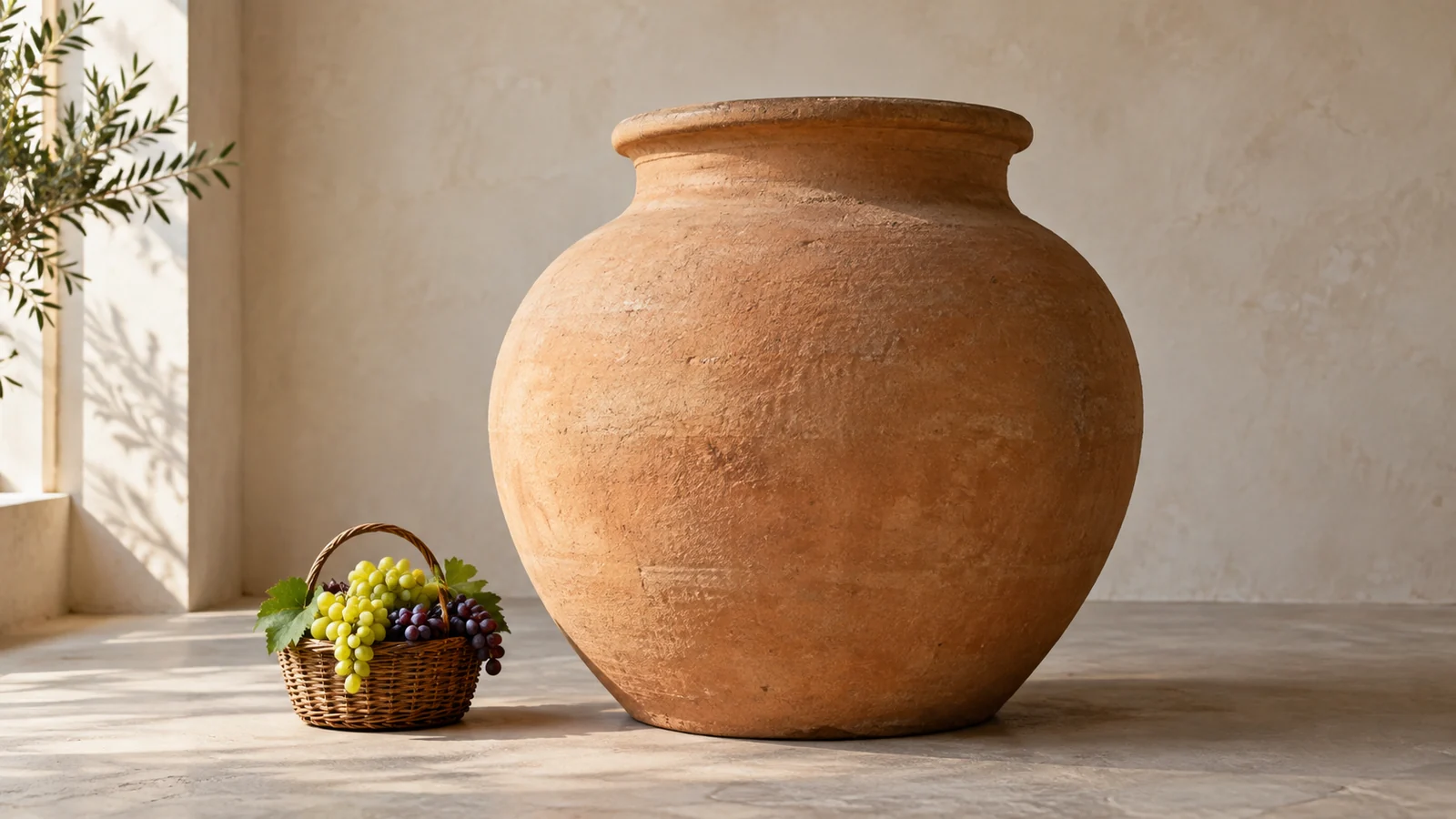
Imagine pressing a grape between your fingers. The skin gives way; a little juice gathers in your palm. You have opened the fruit, but you have not yet made wine.
That small distinction is a useful entrance to a Roman winery.
In the previous Cellar Journal article, we followed wine across the Mediterranean. Now we step back from the cargo to ask what had to happen before a vessel could be filled. Not to overhear an invented conversation between ancient workers, but to follow the tasks that surviving installations and texts allow us to recognize.
A Roman winery was more than a place to tread grapes. It was a system for preparing, transforming and looking after a harvest.
The “day” in this story is a walk through that work. It is not a claim that wine could be finished between sunrise and sunset.
Begin with a place, not with all of Rome
At Villa Regina, near Pompeii, a courtyard contains a wine-storage area with eighteen large jars, or dolia. The site also preserves evidence of a press, a pressing basin and a container for collecting must: grape juice destined for winemaking. The eruption of 79 CE—Common Era—destroyed this farm. Pompeii Archaeological Park
These remains make a sequence of operations tangible. Fruit had to reach a working area; liquid needed somewhere to go; vessels needed attention.
They do not give us the grape variety, the finished wine’s alcohol level or the preferences of everyone who drank it. Nor can one farm represent every period and province of Roman rule.
A place name and a date are not obstacles to a good story. They are what keep the story attached to something real.
The harvest began before the grapes arrived
A harvest scene tends to draw the eye toward overflowing baskets. The written sources ask us to look at the preparations as well.
Cato’s De Agricultura, chapter 23, calls for equipment and containers to be readied for vintage. Columella, in Book XII, chapter 18, pays attention to washing, drying, repairs and the preparation of vessels. The work begins before the dramatic moment of crushing. Cato, chapter 23 · Columella, XII.18
These are instructions, not photographs. A landowner’s recommendation tells us what an author thought should happen, not how faithfully every estate followed it.
Nevertheless, the concerns are revealing. Readiness, cleanliness and organization mattered enough to be discussed. “Ancient” should not become a polite way of saying that nobody paid attention.
Think of the difference between owning a vessel and having a vessel ready when the fruit arrives. The first is an object. The second requires work.
A press releases juice; fermentation makes wine
Treading and pressing concern the extraction of liquid. Fermentation concerns a different transformation.
In today’s scientific description, yeasts convert sugars into ethanol, carbon dioxide and other products. This can begin through microorganisms associated with grapes, must and the cellar, without the addition of a modern commercial yeast culture. That explains a biological possibility; it does not identify the organisms in any particular Roman vessel. OIV, Alcoholic fermentation
Keeping those operations separate prevents a familiar shortcut: the picture of feet in grapes is not a complete explanation of winemaking.
It also changes how we read an excavation. A pressing installation can help us understand extraction and liquid handling. It cannot, on its own, supply the rest of the fermentation record.
Between opening a grape and serving a wine lies a process that a press cannot perform by itself.
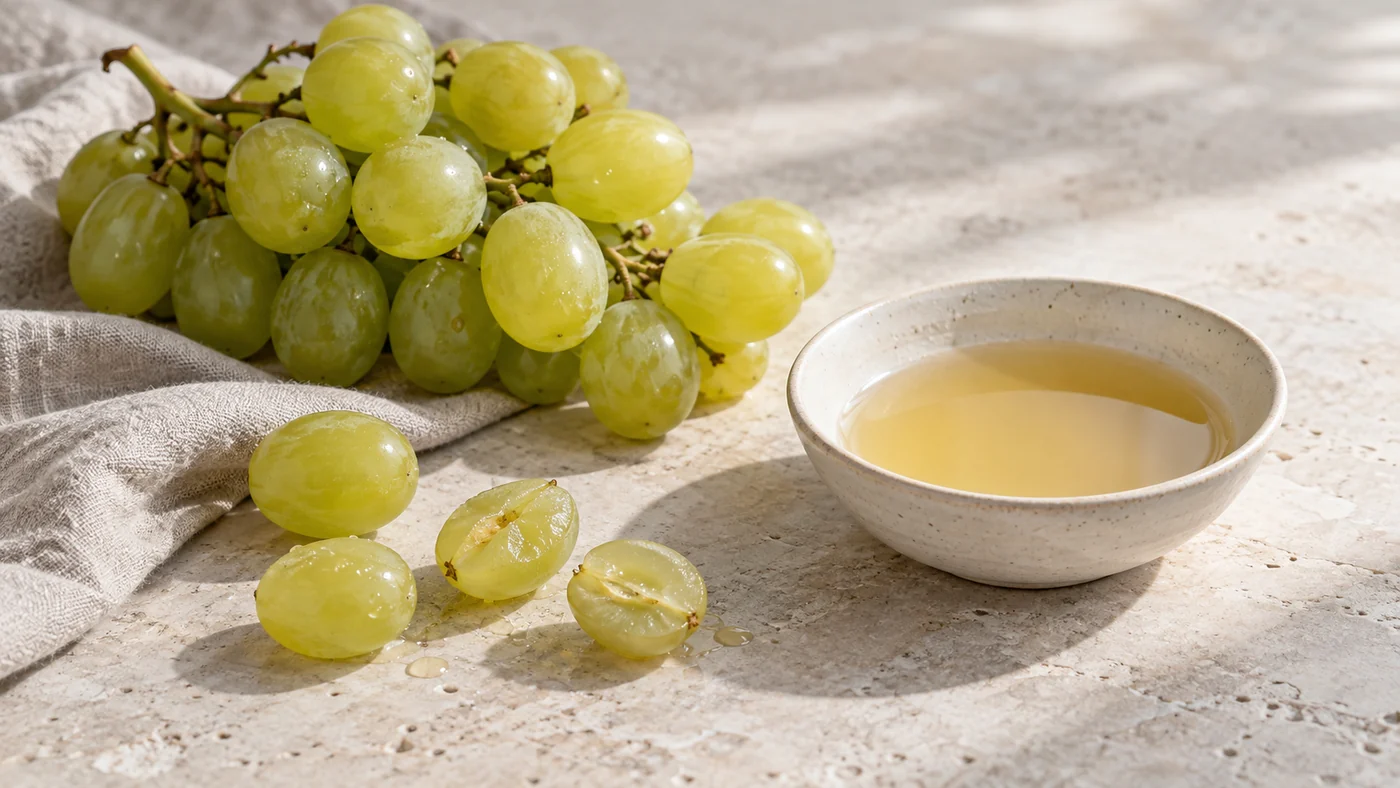
The jar was part of the process
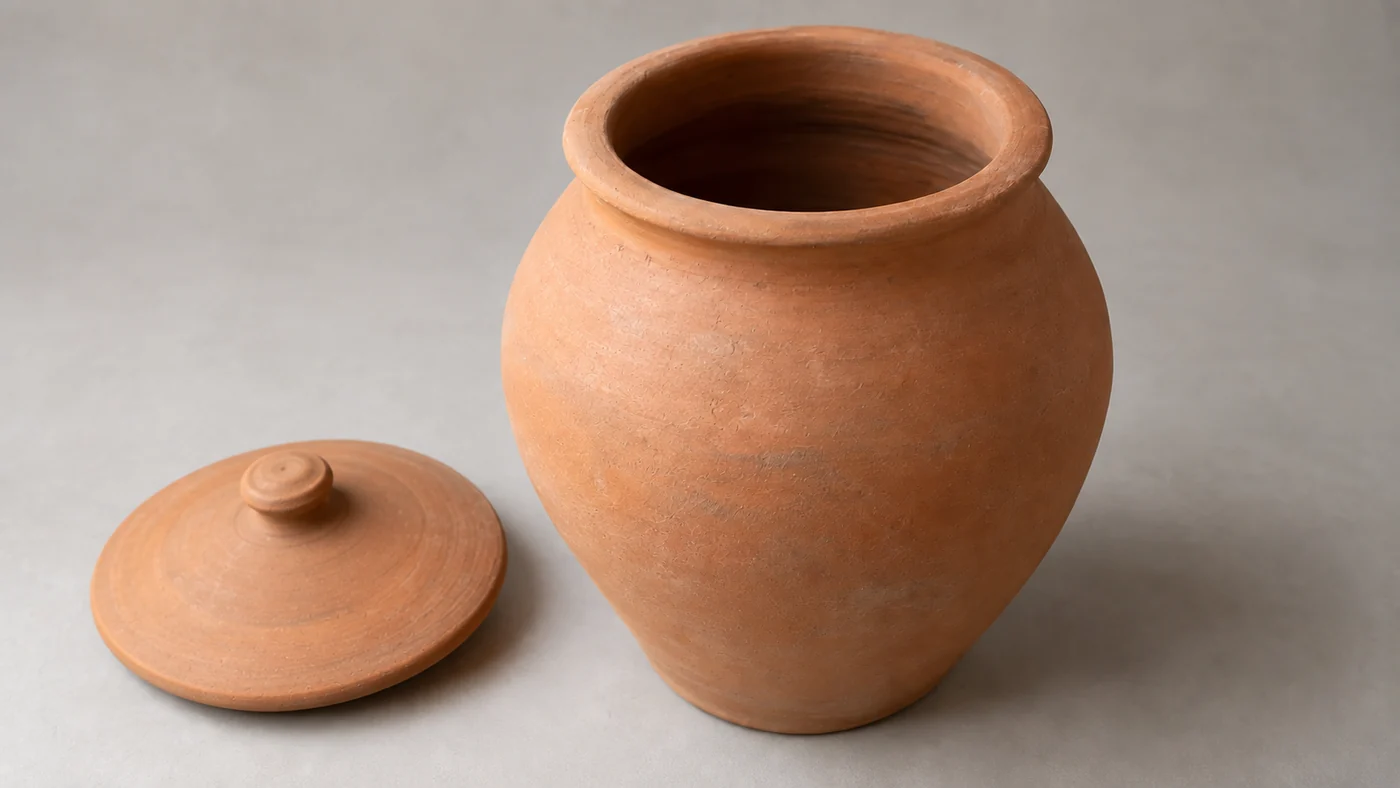
The large dolium belongs to a different practical discussion from the transport amphora we followed in the previous article. Columella distinguishes buried vessels from those standing above ground when discussing their preparation and coating. Placement was a practical matter, not simply a choice of appearance. Columella, XII.18
A 2024 comparative study by Dimitri Van Limbergen and Paulina Komar examines Roman dolia alongside Georgian qvevri and their use in winemaking. It proposes that vessel characteristics are important to understanding the process. The comparison is a research approach, not proof that the two traditions produced identical wines. Van Limbergen and Komar, 2024
Even the apparently simple phrase “wine in clay” leaves important questions unanswered. Modern materials research finds substantial differences in oxygen transmission among tested container materials and treatments. Earthenware is not one uniform membrane. Nevares and Del Alamo-Sanza, 2021
That gives us a better question than “Did clay make it taste ancient?” Ask what the container was actually like and how it was used.
A material name is the beginning of an explanation, not a tasting note.
The work continued after the first day
Columella’s instructions return to the condition of stored wine over subsequent months, including changing attention as warmer weather approaches. His account does not stop at filling the vessels. Columella, XII.30
This is why the title’s “day” needs a door left open. A harvest may produce a memorable scene, but care of the wine belongs to a longer calendar.
There are also choices that a surviving jar cannot settle. How much solid grape material accompanied the liquid? When was it separated? What happened afterward?
Modern enology helps explain why such questions matter: grape skins and seeds can supply tannins, which contribute to astringency and texture. That mechanism does not tell us how much tannin a lost Roman wine contained. Australian Wine Research Institute
The missing details are not decorative. They are among the things we would need before confidently describing the wine in a glass.
Look for the people behind the equipment
It is easy to write a winery’s history as a conversation between a press and a jar. Someone had to coordinate the work between them.
A study published in July 2026 by Tamara Lewit reexamines the vilica, a female estate manager often reduced in modern descriptions to a housekeeper. It argues that her responsibilities included productive work such as overseeing winemaking. Lewit, 2026
The ancient texts discuss such responsibilities within unequal households, including enslavement. Managerial authority should not be mistaken for personal freedom, and the evidence does not assign an identical role to every woman on every estate. Columella, XII.1 and XII.18
Nor does this research identify a particular woman at Villa Regina. Its value here is to widen the question: whose knowledge, supervision and physical labor made the equipment useful?
A history concerned only with the owner’s name risks leaving the actual work outside the frame.
A recipe is not a census of Roman taste
Another shortcut makes all ancient wine sound like one sweet, heavily flavored drink.
Columella gives numerous preparations, yet also expresses a preference for wine that keeps without additions that obscure its natural taste. The presence of recipes and the preference can coexist in the same text. Columella, XII.19.2 and following chapters
Neither passage establishes the proportion of wines made in a particular way. A recipe book does not become a survey of everyone’s daily glass.
The same caution applies in the other direction. We should not turn an ancient preference into a modern claim of “natural wine,” certification or universal quality.
The interesting question is not whether Roman wine fits one contemporary label. It is how many decisions disappear when we force it into one.
What an experiment can—and cannot—bring back
Experimental archaeology offers a more demanding route than imagination alone: make explicit choices, try them and report what happens.
Mario Indelicato’s published project includes a 2017 Sicilian winemaking trial using small replica dolia coated with resinous pitch. When the wine was tasted in 2018, the report described smoky characteristics and discussed the importance of coating relative to the small vessels’ contents. These are observations about that experiment. Indelicato, 2020
They are not a recovered sensory record of every ancient cellar. A result can show that a chosen procedure works—or creates a problem—without establishing how often that procedure occurred historically.
Color language needs care too. An orange-looking wine is not automatically the modern OIV-defined category of white wine with maceration, which specifies white grapes. Appearance alone cannot supply the production history. OIV, White wine with maceration
A useful experiment brings a hypothesis closer to something we can examine. It does not erase the distance between the experiment and the past.
Not every winery looked like a modest farm
At the Villa of the Quintilii, near Rome, an excavated winery with a phase dated to the mid-third century CE presents a striking contrast. Marble finishes, must flowing through fountain-like openings and rooms interpreted as dining spaces led the excavators to discuss production as spectacle. The flowing liquid in this installation was must, not finished wine. Dodd, Galli and Frontoni, 2023
The site expands our picture without becoming a model for every estate. Its luxurious arrangement also does not establish how delicious the resulting wine was.
It is tempting to fill the rooms with a particular emperor and a fully scripted harvest celebration. The interpretation of an architectural setting is not an eyewitness account of such an occasion.
Placed beside Villa Regina, this example makes a more useful point: there was room for very different settings within the history we call Roman winemaking.
A winery could be a workplace and also a setting in which its owner wanted that work to be seen.
Five questions to take into the next cellar
The practical reward of this history is not a list of flavors to memorize. It is a more attentive way of looking.
Where and when? Begin with a particular site and period, rather than asking one vessel to stand for an empire.
What kind of evidence? Separate an excavated installation, an author’s instructions, a modern material test and a reconstruction experiment. Each answers a different kind of question.
Which operation? Identify whether the evidence concerns preparation, extraction, fermentation, storage or transport. Do not let one step silently become the whole process.
Which variables remain unknown? Consider the grape material, vessel treatment, duration and later handling before moving to a sensory description.
What can we actually say about the glass? Preserve the distinction between a plausible explanation and a measured result. Curiosity does not require pretending the missing wine is still available to taste.
The same habit is useful when a present-day bottle emphasizes an amphora or an old technique. Ask what the producer actually did before deciding what you expect to feel. A historical reference can enrich a conversation; it should not decide the tasting in advance.
Back to the grape in your hand
Return to that first drop of juice.
It no longer looks like a complete explanation. Around it, you can imagine questions about ready vessels, organized labor, the movement of liquid and the care that continues when the most photogenic moment is over.
This is the kind of curiosity we want to encourage in Ask Sommelier AI’s Cellar Journal: not the confidence of pretending to have tasted the past, but the pleasure of understanding a little more of the work behind a wine.
We cannot ask a Roman wine to fill our glass again. We can learn to see more of the people and decisions that once filled theirs.
Next: Monks, Farmers and Merchants: Who Built the Medieval Vineyard—a move from the Roman winery to the people and institutions of the medieval vineyard.
Questions worth asking
Did treading grapes turn them into wine?
It helped release juice. Alcoholic fermentation is a separate biological transformation involving yeasts and sugars; extraction alone does not explain it. OIV
Were dolia simply another name for transport amphorae?
No. The winery dolia considered here were large vessels involved in production or storage. The function of a particular container still needs its own archaeological context. Van Limbergen and Komar
Were all Roman wines sweet or heavily flavored?
That conclusion is not supported by the instructions cited here. Columella discusses preparations but also values wine that keeps without additions obscuring its taste. Neither tells us the market share of a style. Columella, XII.19.2
Could fermentation occur without commercial yeast?
Yes. Commercial inoculation is not the only way fermentation can begin. This does not identify the particular microbial population of an ancient wine. OIV
Does a modern wine made in clay reproduce Roman flavor?
The vessel alone cannot establish that. Modern experiments test specified choices; their sensory results belong to the wines actually produced, not to every wine of antiquity. Indelicato
Did women have responsibilities in winemaking?
Lewit’s 2026 study argues that the vilica could oversee productive tasks including winemaking. This is not evidence that all estates had the same arrangements or that managerial responsibility implied freedom. Lewit
References and further reading
The same source base supports both language versions. Access may vary by publisher; the professional dossier distinguishes full HTML passages from abstract-only access.
R01 — Parco Archeologico di Pompei. Villa Regina. Official archaeological site account. 2018-05-30.
R02 — Marcus Porcius Cato. De Agricultura / On Agriculture, chapter 23. English translation by W. D. Hooper and H. B. Ash, reproduced by LacusCurtius. Ancient text; modern edition 1934.
R03 — Lucius Junius Moderatus Columella. De Re Rustica, Book XII. Latin transcription hosted by The Latin Library; especially XII.1, XII.18, XII.19.2 and XII.30. Ancient text; first century CE.
R04 — International Organisation of Vine and Wine (OIV). Alcoholic fermentation. International Code of Oenological Practices, Part II, Musts. Current online entry consulted 2026-10-06.
R05 — Dimitri Van Limbergen and Paulina Komar. Making wine in earthenware vessels: a comparative approach to Roman vinification. Antiquity 98(397), 85–101. 2024-01-23.
R06 — Ignacio Nevares and Maria Del Alamo-Sanza. Characterization of the Oxygen Transmission Rate of New-Ancient Natural Materials for Wine Maturation Containers. Foods 10(1), 140. 2021-01-11.
R07 — Australian Wine Research Institute (AWRI). Winemaking treatment – Oenotannin addition. Institutional winemaking resource. Undated resource; consulted 2026-10-06.
R08 — Tamara Lewit. Not just a housekeeper: a new look at the work of the Roman vilica. Journal of Roman Archaeology, First View, 1–37. 2026-07-13.
R09 — Mario Indelicato. Columella’s Wine: a Roman Enology Experiment. EXARC Journal 2020/1. 2020-02-25.
R10 — International Organisation of Vine and Wine (OIV). White wine with maceration. Resolution OIV-ECO 647-2020; International Code definition I.4.9. 2020; consulted 2026-10-06.
R11 — Emlyn Dodd, Giuliana Galli and Riccardo Frontoni. The spectacle of production: a Roman imperial winery at the Villa of the Quintilii, Rome. Antiquity 97(392), 436–453. 2023-04-17.