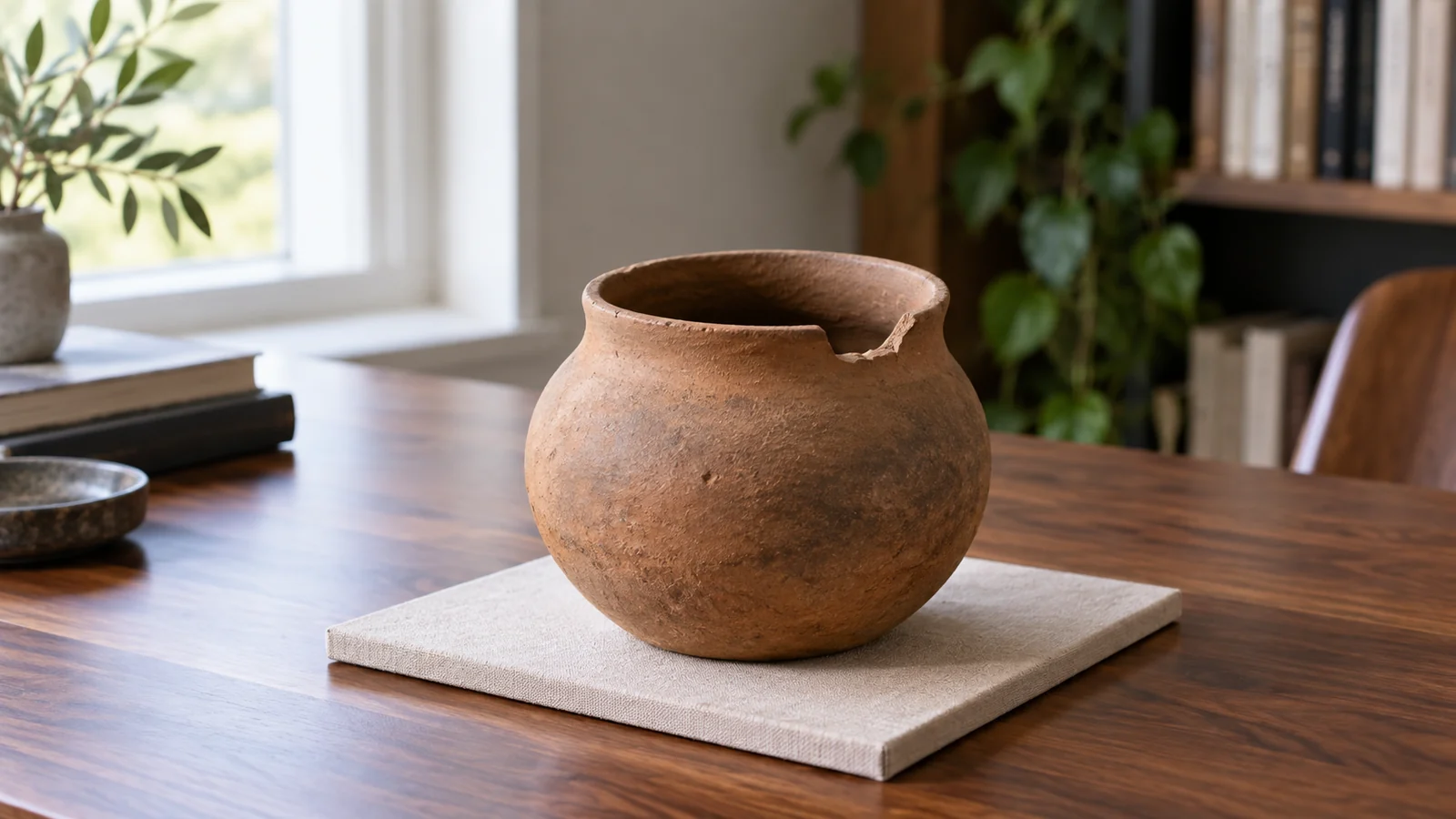
Imagine stopping in front of a museum case.
Inside is a clay vessel. Part of its rim is missing. Its surface is quiet and uneven, with none of the shine that makes a bottle catch your eye across a restaurant. There is no wine to smell, no producer to question and no vintage to uncork.
Yet the label beside it mentions wine.
How can anyone know?
That question opens this new Cellar Journal series: Before the Glass. We have spent time learning how to read a bottle. Now we turn toward the people, plants and objects that made the bottle possible—and the evidence that allows us to tell their stories.
The temptation is to begin with an inventor. One person, one accidental discovery, one first drink. Archaeology gives us something less tidy and more interesting: traces that have survived, contexts that can be dated, and interpretations that must remain open to examination.
The earliest surviving evidence is not a birth certificate.
We can investigate how far back a practice is documented without claiming to have witnessed the moment it began.
When did people begin making wine?
There is no documented inventor or exact first vintage. A major 2017 study interpreted pottery residues and associated evidence from two Neolithic settlements in present-day Georgia as grape wine dating to approximately 6000–5800 BCE. That is an important early claim about grape wine, not the date of its invention. McGovern and colleagues, 2017
Those last words matter. An excavated trace tells us that an activity was present within a particular context. It does not tell us that nobody practised it earlier, somewhere that has not been excavated or where the relevant evidence did not survive.
Nor do all headlines about the “oldest wine” answer the same question. A fermented drink containing several ingredients, residue interpreted as grape wine and an installation used to process grapes are different discoveries.
Before asking which is earliest, we need to ask what was found.
A pot can outlast its contents
The Georgian project’s institutional account explains why pottery is so useful: porous ceramic can retain organic traces long after the original drink has disappeared. Researchers examine those traces rather than taste an intact ancient wine. Penn Museum’s account of the project
Think of the vessel as an imperfect record, not a sealed sample bottle. Its shape is one part of that record. What was absorbed into it is another.
A later study of ancient Cypriot containers makes the distinction tangible. Vessels assumed to hold wine yielded evidence of grapevine products, other fruit products, beeswax and plant oil; seemingly similar containers could have carried different contents. The authors considered both mixing and reuse. Briggs and colleagues, 2022
That does not make a vessel’s shape irrelevant. It prevents the shape from doing the laboratory’s work in advance.
Looking back through centuries of storage and handling, the questions become remarkably practical. Was this a container for liquids? What remains on its inner surface? What else was found beside it? Could the material have entered later? Does the proposed explanation fit all those observations, or only the most photogenic one?
The jar becomes interesting not because it has all the answers, but because different kinds of evidence can be brought to the same object.
Georgia: an early chapter, not a named inventor
The two settlements were Gadachrili Gora and Shulaveris Gora, in the South Caucasus. The investigation connected chemical findings with botanical and environmental evidence. The museum’s report describes tartaric acid together with other organic acids in pottery samples. Penn Museum
The paper’s wine interpretation is a multidisciplinary argument. It is not a claim that an ancient jar was opened and found to contain a drink ready for analysis by a modern tasting panel.
For a reader, the significance is already considerable. Wine history reaches into village settings rather than beginning with a famous estate, a written classification or a recognizable modern bottle. We do not need to supply the villagers with an invented conversation to appreciate the distance between their surviving objects and our own table.
The location also needs careful language. Present-day Georgia locates the finds for us. It does not turn a Neolithic community into a modern nation-state or establish an exclusive cultural ownership of every subsequent development.
A place can matter enormously without being made responsible for the whole history.
A date belongs to something specific
“Six thousand BCE” sounds like a date stamped beneath a pot. Archaeological dating needs a more careful question: what was actually dated, and how is it connected to the object?
The Georgian investigation used radiocarbon-dated material from archaeological contexts and chronological modelling. That is different from directly dating the vanished drink. McGovern and colleagues
The Oxford Radiocarbon Accelerator Unit explains that radiocarbon measurements require calibration to express calendar dates. The conventional reference for radiocarbon years “before present” is 1950, not the year in which you happen to read the result. Oxford’s explanation
This is why a published range deserves to remain a range. Turning it into “the first harvest occurred in this exact year” adds precision the discovery has not supplied.
There are also two calendars in every archaeological news story: the ancient period being investigated and the date of the modern publication. A discovery announced in 2017 may concern material thousands of years older. A new paper may reinterpret an old excavation without discovering a new site.
Keeping those calendars separate makes the story easier to follow—and harder to exaggerate.
Why one molecule cannot carry the whole story
Tartaric acid is useful evidence, but its presence alone is not equivalent to a fermentation record. In a critical review with new analyses, Léa Drieu and colleagues found no proposed chemical wine marker unequivocal on its own. They emphasized contextual support, quantification and controls, including surrounding sediment. Drieu and colleagues, 2020
The discussion did not end there. Patrick E. McGovern and coauthors responded in 2021, disputing parts of that methodological critique while also arguing that chemical findings must be read alongside archaeological and botanical evidence. Their response
Another synthesis, by Oliver Craig, gave greater evidentiary weight to cases with corroborating pressed-grape remains and treated some very early beverage identifications more cautiously. That is an attributed scholarly assessment, not a verdict that earlier winemaking was impossible. Craig, 2021
The useful lesson is neither “chemistry proves everything” nor “we can know nothing.” It is that identifying a compound and interpreting a former activity are related steps, not the same step.
For an unfamiliar reader, a control sample can seem like a technical footnote. Its question is wonderfully ordinary: could we find a similar trace somewhere that never held the proposed drink?
That question is part of the evidence, not an obstacle placed in front of it.
A convincing account lets the vessel, its setting and the analysis question one another.
Hajji Firuz: a residue with more than one question
A reconstructed jar in Penn Museum’s collection comes from Hajji Firuz Tepe, in present-day northwestern Iran, and is dated to 5400–5000 BCE. The record describes jars set into a household floor and a residue interpreted as wine with terebinth resin. Object 69-12-15
Here the story is not just fruit. The resin raises another question: what was the producer trying to achieve?
The researchers’ retrospective account proposes a preservative purpose for the resin. That is an interpretation of function, not access to an ancient maker’s stated intention. McGovern and colleagues, 1997
That distinction changes how we imagine the people behind the jar. We can investigate material choices without assuming that every choice was made for the same reason we would make it today.
Nor does the residue give us a complete recipe. Detecting a component is not the same as recovering its proportion, the condition of the fruit or the experience of drinking the result.
An additional ingredient makes the history richer. It does not make every missing detail available.
Dikili Tash: when processing leaves a second kind of trace
At Dikili Tash in northern Greece, research combines residues in vessels from a house destroyed around 4300 BCE with grape remains associated with pressing. Chemistry and archaeobotany—the study of plant remains from archaeological contexts—contribute different observations to the wine interpretation. Garnier and Valamoti, 2016
A whole fruit, a seed and the remains of processed fruit do not ask exactly the same question. One concerns presence; another may help reconstruct an action. Neither is a complete production diary, but the relationship among them can narrow the possibilities.
This is the point at which the story starts to resemble work rather than a fortunate accident. The reader can begin asking about collecting, separating and containing, without inventing who performed each task or what the drink was called.
Notice how much more informative that is than placing a pin on a map and writing wine beside it.
The evidence begins to describe something people did.
Areni-1: a winery is a different claim
At Areni-1 in Armenia, installations and associated objects dating to around 4000 calibrated BCE support an interpretation of wine production. A 2011 paper added chemical evidence from pottery. Its authors acknowledged that the pigment-related marker under investigation was not exclusive to grapes. Barnard and colleagues, 2011
Here, the spatial relationship among production features and containers matters. Winery is shorthand for an interpreted working arrangement—not a promise of a modern cellar, stainless-steel tanks or an identifiable commercial brand.
The distinction resolves an apparent contradiction. A report about an early winery need not displace older evidence of wine. One concerns a surviving place of production; the other may concern contents once held in a vessel.
A drink can be archaeologically visible without its entire workplace surviving. A workplace can make the interpretation of a drink more persuasive without identifying its first inventor.
Those are different achievements. Neither needs to borrow the other’s headline.
Jiahu: the history of fermentation is larger than grape wine
The map becomes more interesting when we stop expecting every early drink to fit today’s wine categories.
A 2004 study interpreted residues from Jiahu, in China’s Henan province, as a mixed fermented beverage involving rice, honey and fruit—hawthorn and/or grape—as early as the seventh millennium BCE. The alternatives in that description are important. This was not identification of an exclusively grape-based recipe. McGovern and colleagues, 2004
A study published on August 21, 2026 adds another perspective. Liu and colleagues examined microfossils from 16 pottery sherds, finding evidence they interpret as primarily qu-based brewing—using microbial starters—with possible malt-based processing and supplementary honey or fruit. These approaches concern how starch becomes available for fermentation, not simply which fruit might have been present. Liu and colleagues, 2026
This is not a newly discovered grape-wine recipe. It is a newer investigation of brewing practices at an already important site.
For our story, Jiahu supplies a valuable correction: the history of fermented drinks is not a competition in which every community must be made to produce the same beverage.
Different materials and different processes deserve to keep their differences.
A timeline of questions, not a podium
The dates below summarize the publications discussed above. They do not form a ranking of cultures or an exhaustive register of the earliest alcoholic beverages.
| Case | Approximate ancient period | The question it helps investigate |
|---|---|---|
| Jiahu | Seventh millennium BCE | Mixed-beverage ingredients and brewing processes |
| Georgian Neolithic settlements | 6000–5800 BCE | An early interpretation of grape wine from converging evidence |
| Hajji Firuz Tepe | 5400–5000 BCE | Jar contents and resin use |
| Dikili Tash | Around 4300 BCE | Grape processing considered alongside vessel residues |
| Areni-1 | Around 4000 calibrated BCE | A production installation and its associated material |
Read each row with its case’s source and limitations. The table is an editorial orientation, not a harmonized database of measurements made with identical methods.
A living tradition is not an unchanged recipe
Modern practices can help us understand what a vessel might do. They cannot, by resemblance alone, fill every gap in its history.
UNESCO’s 2013 inscription of Georgian qvevri winemaking recognizes a living tradition involving earthenware vessels and knowledge transmitted among families and communities. It does not certify that every detail of a contemporary method was already present in a particular Neolithic village. UNESCO’s decision
Indeed, the 2017 Georgian study reported no evidence that the jars at its investigated Neolithic sites had been buried as modern qvevri commonly are. The study’s discussion
That is not a loss of heritage. Traditions can be meaningful because people keep working with them, not only because we imagine them standing still.
A modern reconstruction belongs in the same careful conversation. It can test what a proposed arrangement allows. It cannot make a freshly produced drink identical to a vanished ancient one simply by using clay.
Continuity deserves respect without requiring us to pretend that nothing changed.
The questions an ancient jar cannot answer alone
Was the wine sweet? Which grape variety was used? What was its alcohol content? Was it made for a household, an exchange or a particular gathering?
Those are worthwhile questions. The cases discussed here do not authorize complete tasting notes or biographies for their makers. A proposed ingredient is not an aroma preserved for us to experience. A production feature is not the transcript of a ceremony.
Cultivation needs its own evidence, too. A genomic study such as Dong and colleagues’ work on grapevine domestication investigates biological relationships and population history. Its inferred domestication chronology is not a direct date for a first drink. Dong and colleagues, 2023
That separation will matter in the next article. Making something from a plant and transforming the plant through cultivation are connected histories, but they need not have the same beginning.
We can leave an answer open without leaving the story empty.
Five questions for reading an ancient-wine claim
This is an Ask Sommelier AI reading guide, not a laboratory protocol. It is meant for the next museum label, documentary or headline that catches your attention.
1. What survived? A vessel, absorbed residue, plant remains and a production installation are different kinds of material. Name the actual find before adopting its most exciting interpretation.
2. What was dated? Look for the dated sample, its connection to the context and the published range. Keep the excavation or publication year separate from the ancient chronology.
3. What was detected? Distinguish an analytical result from the proposed ingredient or activity. Ask whether another source could account for the same signal.
4. What agrees with it? Look for botanical remains, contextual relationships, appropriate controls and other observations. A persuasive argument should show how its parts support—or complicate—one another.
5. How far does the conclusion reach? Evidence of a grape product is not automatically evidence of wine. Evidence of wine does not identify its inventor. Evidence of a tradition does not date every detail of its present form.
A useful headline might become: Researchers interpret these remains as evidence of grape wine in this context and period.
Less dramatic than a universal first. Much more informative.
Return to the vessel
The museum case has not changed. The rim is still incomplete. There is still nothing to uncork.
But the object now holds a different kind of interest. We can distinguish what survived from what was measured, what was measured from what was inferred, and what was inferred from the story we might be tempted to finish ourselves.
For Ask Sommelier AI, that is the standard historical information should meet. A regional history can enrich a recommendation; an ancient association must not become an invented biography or a quality guarantee for a modern bottle.
The pleasure of this history does not depend on awarding one anonymous person the first glass. It lies in following real clues far enough to encounter people whose names we may never recover.
We do not need to invent the first glass to understand how far its history reaches.
Next: From Wild Vine to Vineyard: How We Domesticated a Plant. Before the wine had a name, how did people begin changing the plant that would make it possible?
Frequently asked questions
Who invented wine?
No identified person is established by the evidence discussed here. Archaeological finds can support early production in particular places; the Georgian study itself cautions against assigning an exact priority of invention or diffusion. McGovern and colleagues
Is Georgia where wine began?
It is central to the early evidence presented in the 2017 project. A defensible claim names the sites, approximate period and interpretation; “the proven birthplace of every winemaking tradition” goes further. Penn Museum
Does tartaric acid prove an ancient vessel contained wine?
Not alone. Analytical findings need context and suitable controls. The methodological debate concerns how these lines of evidence work together, not permission to treat a single marker as an exact recipe. Drieu and colleagues · McGovern and colleagues’ response
Is the oldest winery the same as the oldest wine?
No. An installation is evidence about a production setting; residue may document contents without preserving the entire workplace. Areni-1 illustrates the first kind of claim. Barnard and colleagues
Was the Jiahu beverage grape wine?
The original interpretation was mixed, with hawthorn and/or grape among possible fruit ingredients. The 2026 research adds brewing-process evidence. Neither justifies reducing the account to an exclusively grape-based wine. 2004 study · 2026 study
Is the domestication of grapes the date wine was invented?
No. A biological reconstruction of domestication and an archaeological interpretation of beverage production concern different evidence and questions. They should be compared, not substituted for one another. Dong and colleagues
References
Source titles retain their original language. Links may lead to an abstract or an access-controlled publisher page; access details are recorded in the separate dossier.
- McGovern, P., et al. (2017). Early Neolithic wine of Georgia in the South Caucasus. PNAS, 114(48), E10309–E10318. Source. Additional access.
- Penn Museum (2017, November 13). Move Over, Hajji Firuz Tepe in Iran. Institutional account of the Georgian research project. Source.
- Briggs, L., Demesticha, S., Katzev, S., Wylde Swiny, H., Craig, O. E., & Drieu, L. (2022). There’s more to a vessel than meets the eye: Organic residue analysis of ‘wine’ containers… Archaeometry, 64(3), 779–797. Title shortened; the study concerns ancient Cyprus. Source. Additional access.
- Oxford Radiocarbon Accelerator Unit. Radiocarbon Calibration. University of Oxford. Source.
- Drieu, L., et al. (2020). Is it possible to identify ancient wine production using biomolecular approaches? STAR: Science & Technology of Archaeological Research, 6(1), 16–29. Source.
- McGovern, P. E., et al. (2021). A Response to Léa Drieu et al., 2020… STAR: Science & Technology of Archaeological Research, 7(1), 43–48. Title shortened; response to R05. Source.
- Craig, O. E. (2021). Prehistoric Fermentation, Delayed-Return Economies, and the Adoption of Pottery Technology. Current Anthropology, 62(S24), S233–S241. Source.
- Penn Museum. Wine Jar — object 69-12-15. Hajji Firuz, Iran; collection record. Source. Additional access.
- McGovern, P. E., Hartung, U., Badler, V. R., Glusker, D. L., & Exner, L. J. (1997). The Beginnings of Winemaking and Viniculture in the Ancient Near East and Egypt. Expedition, 39(1). Source.
- Garnier, N., & Valamoti, S. M. (2016). Prehistoric wine-making at Dikili Tash (Northern Greece): Integrating residue analysis and archaeobotany. Journal of Archaeological Science, 74, 195–206. Source.
- Barnard, H., Dooley, A. N., Areshian, G., Gasparyan, B., & Faull, K. F. (2011). Chemical evidence for wine production around 4000 BCE in the Late Chalcolithic Near Eastern highlands. Journal of Archaeological Science, 38(5), 977–984. Source. Additional access.
- McGovern, P. E., et al. (2004). Fermented beverages of pre- and proto-historic China. PNAS, 101(51), 17593–17598. Source.
- Liu, L., He, Y., Li, J., Zhang, J., & Luo, W. (2026). Revisiting Jiahu’s 9000-Year-Old Fermented Beverage: New Microfossil Evidence for Early Qu-Based and Malt-Based Brewing Technologies in North China. Heritage, 9(8), 335. Source.
- UNESCO (2013). Decision 8.COM 8.13: Ancient Georgian traditional Qvevri wine-making method. Representative List of the Intangible Cultural Heritage of Humanity. Source.
- Dong, Y., et al. (2023). Dual domestications and origin of traits in grapevine evolution. Science, 379(6635), 892–901. Source. Additional access.