In 1866, a book about wine carried a word in its title that no winery would want on its label: diseases.
Its author was Louis Pasteur. The full title promised studies of wine’s diseases, their causes, and new methods for preserving and aging it. The concern was practical: bringing in a harvest did not guarantee keeping what that harvest had produced. Napoleon III’s government had commissioned Pasteur to investigate the problem in 1863. 1
“Diseases” here meant alterations of the wine, not a diagnosis of the person drinking it. In a cellar, an unwanted transformation could turn months of work into a loss. The scientific question began precisely where the satisfaction of having made wine ended: what was still happening inside it?
Pasteur helped change how that question could be asked. But the story contains a complication that makes it more interesting: he identified participants in fermentation without fully explaining its mechanism. He acknowledged that gap. And an explanation that seemed to require living cells would eventually be revised through a liquid from which those cells had been separated. 2
Between a fermenting grape and a changing theory lies considerably more than one famous man’s discovery. There is craft, experimentation, productive error, and a question that still belongs in the cellar: what are we actually controlling when we make wine?
Before the microscope, the craft
We come here from a story about roots. In the previous installment, phylloxera forced us to look beneath the vine. Now the change of scale is greater still: from an insect that can be observed with help to the agents of a transformation that winemakers had learned to manage long before they could explain it.
It would be unfair to describe those cellars as places where nobody understood anything. Repeatedly producing a drink requires recognizing patterns, keeping practices that work, and responding when something departs from them. Practical knowledge and an experimental explanation of its causes are different achievements. The second does not retrospectively turn the first into superstition.
Nor did Pasteur enter an empty scientific landscape. In the 1830s, Charles Cagniard-Latour, Theodor Schwann, and Friedrich Kützing had connected yeast with living organisms and fermentation. Their investigations were not identical. Describing cells that multiplied, for example, offered something that merely observing a sediment could not. 2
The disagreement ran deeper than a contest between someone who had seen a microbe and someone who had not. A transformation still needed explaining. Was it an activity of living things? A chemical decomposition that communicated itself to sugar? What evidence could distinguish those possibilities?
Wine history becomes more interesting when that uncertainty remains visible. The results did not arrive in the tidy sequence of a textbook.
Seeing a cell did not establish a cause
In Lille, where Pasteur arrived in 1854, the production of alcohol from beet offered problems that a laboratory did not have to invent. Producers encountered differences between successful processes and those that went astray. His subsequent investigations of lactic and alcoholic fermentations put microorganisms at the center of those differences. 3
Yet seeing yeast in a fermenting liquid does not, by itself, establish what it is doing there. It might accompany the process without causing it. Making progress required changing conditions, following what happened, and comparing outcomes.
A later account by Pasteur, published in English translation in 1879, reveals that approach. He describes nutrient media, small inoculations of yeast, variations in access to air, and observations of fermentative activity. He also attends to the amount of yeast formed and the sugar transformed. He does more than look: he tries to connect what he introduces, what changes, and what he obtains. 4
The dates matter. This later text is not the wine book of 1866, and not every experiment it describes belonged to the original commission. It does, however, make the development of a research program visible.
Its power lay in turning a microscopic presence into a testable explanation. Sediment was no longer only something found at the bottom of a vat; it could be part of the explanation for what had happened inside.
Even so, an enormous distance separated establishing that yeast participated from explaining how it broke down sugar. In his 1914 treatise, the fermentation researcher Arthur Harden reproduced Pasteur’s acknowledgment of that limit: he still did not know the chemical act underlying the transformation. 2
The uncertainty does not diminish the discovery. It restores its actual dimensions.
Air was not just one thing
The dispute over spontaneous generation required another separation. Air carried gases, but it also carried particles. Letting one enter did not necessarily mean allowing the others to reach the liquid.
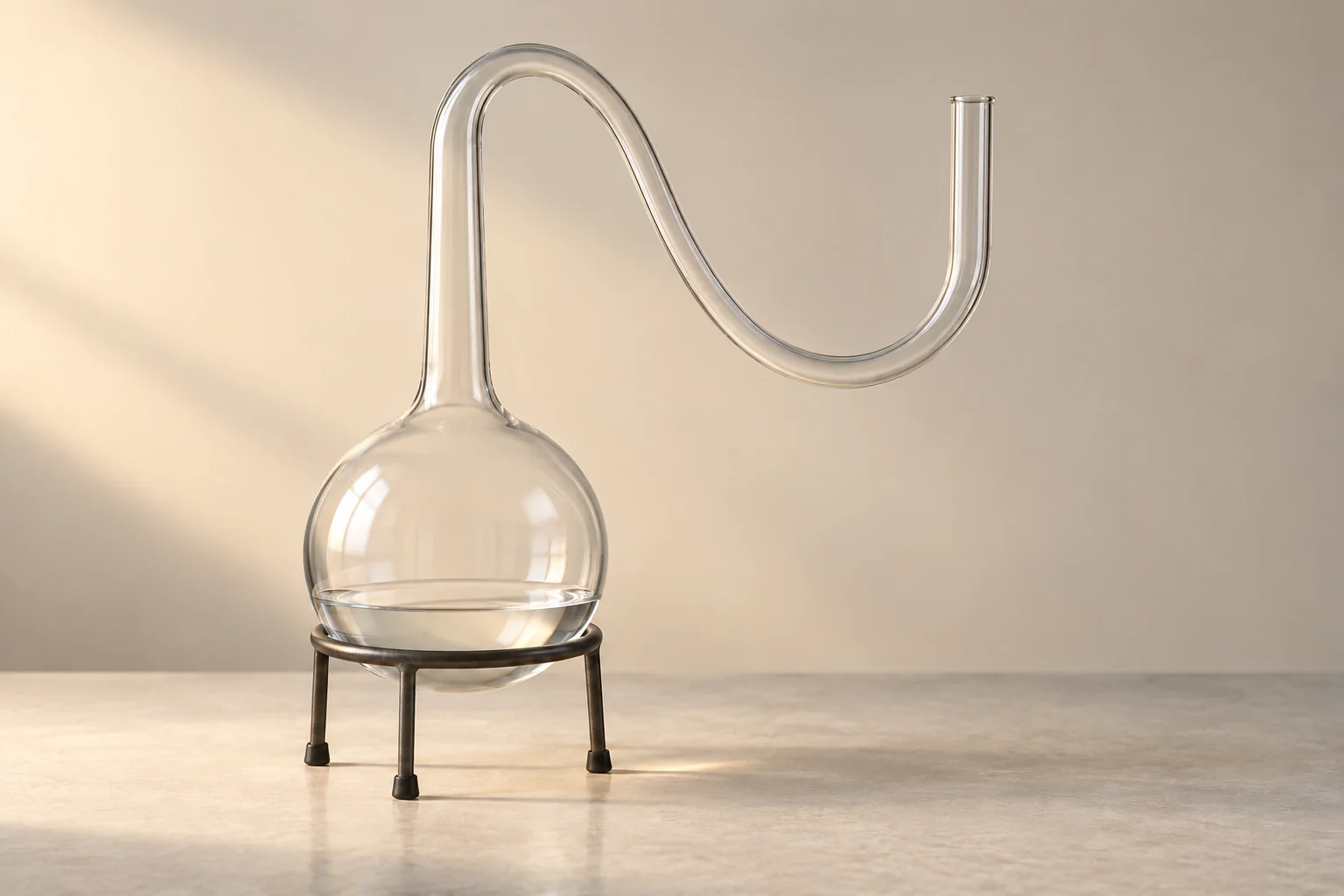
Swan-neck flasks made that experimental distinction visible. Their long, curved necks remained open to outside air while trapping dust and microorganisms before they reached the previously heated liquid. Under the conditions described, the contents could remain free of the changes attributed to life appearing spontaneously. 5
The crucial detail is the connection to the outside. Retelling the experiment as “he sealed a bottle and nothing grew” removes the very comparison that makes it interesting. The design separated contact with air from access by particles carrying microorganisms.
That does not make oxygen irrelevant to wine. Pasteur investigated it as a variable in yeast activity, with effects dependent on conditions. One flask cannot reduce all fermentation to a simple opposition between bad air and good absence of air. 4
Nor did the work establish an explanation for every possible origin of life. It addressed particular claims about microorganisms appearing in particular media.
Today’s wine lists contain another expression that can cause confusion: spontaneous fermentation. This means that a starter culture has not been deliberately added to direct fermentation; participating microorganisms may arrive with the grapes and from the winemaking environment. It does not mean that yeast has created itself from nothing. 10
A shared word does not make two scientific questions equivalent.
Preservation was a different problem
Fermentation transforms must. Preservation seeks to limit the transformations that are no longer wanted. That change of objective matters as much as any famous name.
On April 11, 1865, Pasteur filed a patent for a method of preserving wine through heating. The Institut Pasteur also recalls something often lost in the heroic version: the principle of preserving food with heat was already known. His contribution belongs within an investigation of the causes of spoilage and the conditions for intervening, rather than the invention of applying heat to food. 6
Fermentation and pasteurization are different operations. Heating is not what enables yeast to make alcohol; in this context, it is used to inactivate biological agents. Nor should it be presented as a way to restore aromas that an altered wine has already lost.
The International Organisation of Vine and Wine’s technical code defines pasteurization through a specified temperature and time. That relationship matters more than memorizing an isolated historical number. A number without duration, conditions, and purpose is not a valid procedure. 13
This history does not mean that every present-day bottle is pasteurized. Other tools for microbiological stabilization include filtration designed to remove microorganisms. In turn, “filtered” is too broad a description to establish that a microorganism-removing operation has been applied: filter types and their purposes differ. 15
A winery still has to choose what it wishes to preserve and how to do so. The word “science” does not make that decision for it.
When the explanation had to change
In 1897, Eduard Buchner published a paper whose title proposed a break with an established explanation: alcoholic fermentation without yeast cells. He was not announcing wine made with no connection to yeast. The active material came from yeast itself. 7
The distinction is crucial. An extract obtained from yeast cells retained the ability to ferment sugar even after separation from the intact cells.
Harden later described the extraction work involving Eduard and Hans Buchner, as well as Martin Hahn. In that account, a cellular preparation and an attempt to preserve it with sugar led to the recognition of fermentative activity outside the intact cell. The investigations and preparations preceded the 1897 publication; compressing the episode into a single moment of inspiration would erase that sequence. 2
The finding did not establish that Pasteur had been wrong about everything. Yeast remained a source of the activity. What changed was the requirement that this activity stay enclosed within a whole, living organism.
The extract contained chemical machinery that had come from the cell. Explanation could advance toward enzymes and the reactions they catalyze. The historical term “zymase” should not lead us to picture one pure molecule that, by itself, explained the whole of fermentation. Understanding of the system continued to develop afterward. 2 8
The later work of Harden and William John Young offers a particularly clear way to understand this. Separating an extract into two fractions produced parts that could not, individually, bring about glucose fermentation. Reuniting them restored activity close to that of the original extract. Harden describes these results in the chapter on coenzyme in his treatise. 2
That result required questions about relationships between components, rather than the mere presence of a mysterious substance. Separating, losing activity, and recovering it by recombination made it possible to investigate what the system needed to function. The black box opened in layers: first the organism, then the dependencies of its machinery.
Here lies the most productive tension in the story: an investigation can correctly identify an agent and then attribute to it a necessity that another investigation manages to separate.
There is no need to replace a statue of Pasteur with one of Buchner. We need to notice how a question changes. “Which living organism participates?” and “Which reactions enable the transformation?” open different levels of explanation.
Nor should we simply transport that extract into a modern winery. The experiment clarified a mechanism. It was not a recipe for making wine without managing microorganisms.
Yeast is not working for our palate
In winemaking, Saccharomyces cerevisiae is a central yeast of alcoholic fermentation. It uses sugars and produces ethanol, carbon dioxide, and heat. Its fermentative activity helps explain why a vat changes in composition and temperature. 9
The blackboard version often reduces this to an arrow: sugar → alcohol and carbon dioxide. It provides a useful orientation. It does not account for everything a yeast cell does.
Some material goes into cell growth and other products. The experimental history of fermentation already included the formation of glycerol and acids alongside alcohol. A cellar is not carrying out an operation that produces only two substances and leaves everything else untouched. 2 4
Nor does yeast have the purpose of producing an aroma we will appreciate in a glass. That is our interpretation of its activity. For the winemaker, following fermentation requires attention to its actual progress: the Australian Wine Research Institute recommends recording density and temperature over time to recognize slow or stuck behavior. A series of measurements tells a story that an isolated observation cannot. 14
This is one of the lasting changes in the history. Waiting does not disappear; it becomes informed waiting.
Yet a microbiological explanation should not become the territory of a single species. Uninoculated fermentations can involve different yeasts, including species other than Saccharomyces. Adding a starter culture is intended to steer the process, not to demonstrate that no other microorganisms were present beforehand. 10
Accordingly, “spontaneous” does not guarantee a superior result, and “inoculated” does not adequately describe a uniform flavor. These are facts about how fermentation is initiated and managed. The finished wine deserves a broader assessment.
Bacteria do not all spoil wine
The historical vocabulary of diseases can leave a misleading impression: good yeasts, bad bacteria. The cellar offers a more interesting picture.
During malolactic fermentation, bacteria such as Oenococcus oeni convert malic acid into lactic acid and release carbon dioxide. Winemakers seek this process in many red wines and some whites. It is not a second round of the same work of converting sugar into alcohol. 11 16
The relevant question becomes when it happens and whether it is wanted. A process pursued during production can be troublesome if it begins unexpectedly in the bottle. Context turns a biological activity into a tool or an alteration. 11
Acetic acid bacteria can also transform ethanol into acetic acid in the presence of oxygen. This does not mean all volatile acidity has one cause, or that looking at a wine identifies the organism responsible. 11
A mature view of the cellar is not a territory that must be cleared of every living thing. It is a system in which the identity of organisms, their activity, timing, and conditions all matter.
Can a yeast carry a place?
This question connects the laboratory with a contemporary concern of wine lovers: what it means for a wine to express a place.
A study published in 2015 by Sarah Knight and colleagues compared yeasts from six New Zealand regions in controlled fermentations using the same batch of Sauvignon Blanc juice. It found differences in wine chemical profiles related to the regional origin of the genotypes tested individually. This provided evidence of a possible microbial contribution to differences associated with place. 12
The claim needs boundaries. The work did not establish a ranking of quality or a test for identifying any region blind. Nor did it produce equally persuasive regional differentiation in genotype mixtures: that result was less conclusive. 12
Turning it into “yeast explains terroir” would therefore be excessive. Its interest lies in adding a testable component to a larger phenomenon, not replacing that phenomenon with a single cause.
There is another caution: a fermentation receiving no commercial yeast has not thereby proved that all its microorganisms belong exclusively to the vineyard parcel. Equipment and the winery environment can contribute too. The word “indigenous” needs context before it becomes a geographical passport. 10
An origin story can open curiosity. It should not close the investigation.
What science leaves open
When asking about a bottle, “spontaneous or inoculated fermentation?” can be a good start. The conversation becomes more interesting when it continues: what the winemaker was seeking, which difficulties arose, and how they responded.
These questions do not require a preference for a particular style. Nor do they turn technical complexity into an automatic quality score. They help distinguish a winemaking choice from the commercial promise sometimes built around it.
That is the conversation we value at Ask Sommelier AI: an explanation that helps us look more closely at wine without telling the reader in advance what to enjoy.
Pasteur’s contribution becomes more substantial when we stop requiring him to have known everything. Recognizing agents, designing comparisons, and investigating preservation opened paths. Buchner’s extract showed that one of those paths continued beyond the intact cell. Today’s questions about microorganisms and place move the boundary again. 2 6 12
Wine did not lose its mystery when we began to understand it. The mystery became more precise.
Fermentation stopped being a black box not because someone opened it once and for all, but because we learned to keep opening it.
Questions worth asking
Did Pasteur discover yeast or invent fermentation?
No. Fermentation was practiced before his work, and other researchers had connected yeasts with living organisms in the 1830s. His contribution was decisive in developing experimental explanations of microbial activity and addressing wine spoilage. Saying he “invented fermentation” erases both earlier craft and other scientists’ contributions. 2 3
Are fermentation and pasteurization the same thing?
No. Alcoholic fermentation transforms sugars, producing ethanol and carbon dioxide among other products. Pasteurization applies heat for a specified time to inactivate biological agents. It is not the step that creates alcohol, and it should not be described as a treatment applied to every bottle. 9 13
Does spontaneous fermentation contradict Pasteur’s experiments?
No. In winemaking usage, it means that a starter culture is not deliberately added. Microorganisms may already be present on the grapes and in the production environment. That does not mean they have appeared from nonliving material, which was the question of spontaneous generation. 5 10
Did Buchner show that yeast was unnecessary?
He demonstrated fermentative activity in extracts separated from intact cells. The active material came from yeast: “without cells” does not mean “without substances made by those cells.” The finding made it possible to investigate chemical machinery without requiring it to remain inside a whole organism. 2 7
Are all wine bacteria harmful?
No. Malolactic fermentation can be a deliberate winemaking choice, and Oenococcus oeni has an important role in it. The same activity at an unwanted moment can cause problems. Organism, conditions, and production stage matter more than assigning a role from the word “bacterium” alone. 11 16
Does indigenous yeast guarantee greater quality or expression of place?
No. Experimental evidence supports microbial contributions to chemical profiles, with limits arising from the design and mixtures studied. This does not establish sensory superiority or guarantee a bottle’s outcome. Moreover, a population present in a winery does not necessarily originate only in its vineyard. 10 12
Sources and further reading
Historical sources are distinguished from modern technical guidance. Access notes below identify partial readings; the full research register is in the separate professional dossier.
**[1] Louis Pasteur; catalogue by Science History Institute.** *Études sur le vin: ses maladies, causes qui les provoquent, procédés nouveaux pour le conserver et pour le vieillir*. 1866; digital catalogue undated. Catalogue and bibliographic description consulted; the collection digitizes frontmatter and selected illustrations, not the complete book.
**[2] Arthur Harden.** *Alcoholic Fermentation*. 1914, second edition. HTML text, especially chapters I and IV, consulted. A retrospective source for Pasteur and Buchner, and a researcher account of work involving Harden and Young; not a complete modern biochemistry textbook.
**[3] Institut Pasteur.** *Première époque — 1847–1862*. Institutional historical chronology; undated in this register. Relevant indexed institutional text consulted, including Lille and beet-alcohol production. Its compressed historical narrative is checked against Harden rather than used to claim universal prior ignorance.
**[4] Louis Pasteur; English translation by F. Faulkner and D. C. Robb.** *The Physiological Theory of Fermentation*. English text with preface dated June 1, 1879; later web reproduction. Author text in HTML consulted. This is a later fermentation account, not the 1866 wine book. The biographical introductory note is not used as historical evidence.
**[5] Institut Pasteur.** *Deuxième époque — 1862–1877*. Institutional historical chronology; undated in this register. Relevant indexed account of swan-neck flasks and wine preservation consulted; the discussion concerns the stated experimental conditions, not all possible origins of life.
**[6] Institut Pasteur.** *Louis Pasteur: un héritage universel*. Institutional historical dossier; consulted October 14, 2026. Wine section consulted through the indexed source. It documents the April 11, 1865 patent and acknowledges earlier heat-preservation principles.
**[7] Eduard Buchner.** *Alkoholische Gährung ohne Hefezellen*. 1897. Bibliographic record consulted: Berichte der deutschen chemischen Gesellschaft 30(1), 117–124. The original full paper was not retrieved; experimental description is supported by Harden, not an asserted full-paper reading.
**[8] Nobel Prize / NobelPrize.org.** *The Nobel Prize in Chemistry: The Development of Modern Chemistry*. Undated historical overview. Relevant indexed passage on cell-free fermentation consulted. Direct page and lecture/PDF retrieval were unavailable; no Nobel lecture is represented as read.
**[9] University of California, Davis — Viticulture and Enology.** *Saccharomyces cerevisiae*. Undated technical profile; consulted October 14, 2026. Technical profile consulted through the indexed content for its role in alcoholic fermentation and principal products; not used for universal oxygen requirements or a cellar recipe.
**[10] C. Varela et al..** *Discovering a chemical basis for differentiating wines made by fermentation with “wild” indigenous and inoculated yeasts: role of yeast volatile compounds*. 2009. Indexed introductory passages consulted for microbial sources and uninoculated/inoculated terminology; full results and supplementary data were not reviewed.
**[11] Australian Wine Research Institute.** *Microbiological hazes and deposits*. Undated technical resource; consulted October 14, 2026. Relevant HTML sections on malolactic and acetic acid bacteria consulted. Visual appearance alone is not treated as a microbial identification test.
**[12] Sarah Knight, Steffen Klaere, Bruno Fedrizzi and Matthew R. Goddard.** *Regional microbial signatures positively correlate with differential wine phenotypes: evidence for a microbial aspect to terroir*. September 24, 2015. Publisher text of methods, results and discussion consulted. Same Sauvignon Blanc juice, six regions, single-genotype and mixed-genotype treatments; supplementary files and raw datasets not independently reanalyzed.
**[13] International Organisation of Vine and Wine (OIV).** *International Code of Oenological Practices — Pasteurisation*. Current online technical-code entry consulted October 14, 2026. Indexed definition and objectives consulted. A technical-code entry is not evidence that all wines undergo the treatment or that every jurisdiction authorizes it identically.
**[14] Australian Wine Research Institute.** *Fermentation calculator*. Undated technical resource; consulted October 14, 2026. Indexed explanatory guidance on monitoring density and temperature consulted. No calculator, workbook or user fermentation data were analyzed.
**[15] Australian Wine Research Institute.** *Filtration — physical removal of microorganisms*. Undated technical resource; consulted October 14, 2026. HTML guidance consulted for filtration purposes and distinctions between filter types. No general sensory equivalence or current adoption percentage is inferred.
**[16] University of California, Davis — Viticulture and Enology.** *Oenococcus oeni*. Technical profile; consulted October 14, 2026. Indexed physiological profile consulted specifically for malate-to-lactate conversion and its desired role in malolactic fermentation; not all profile fields are reproduced or generalized.