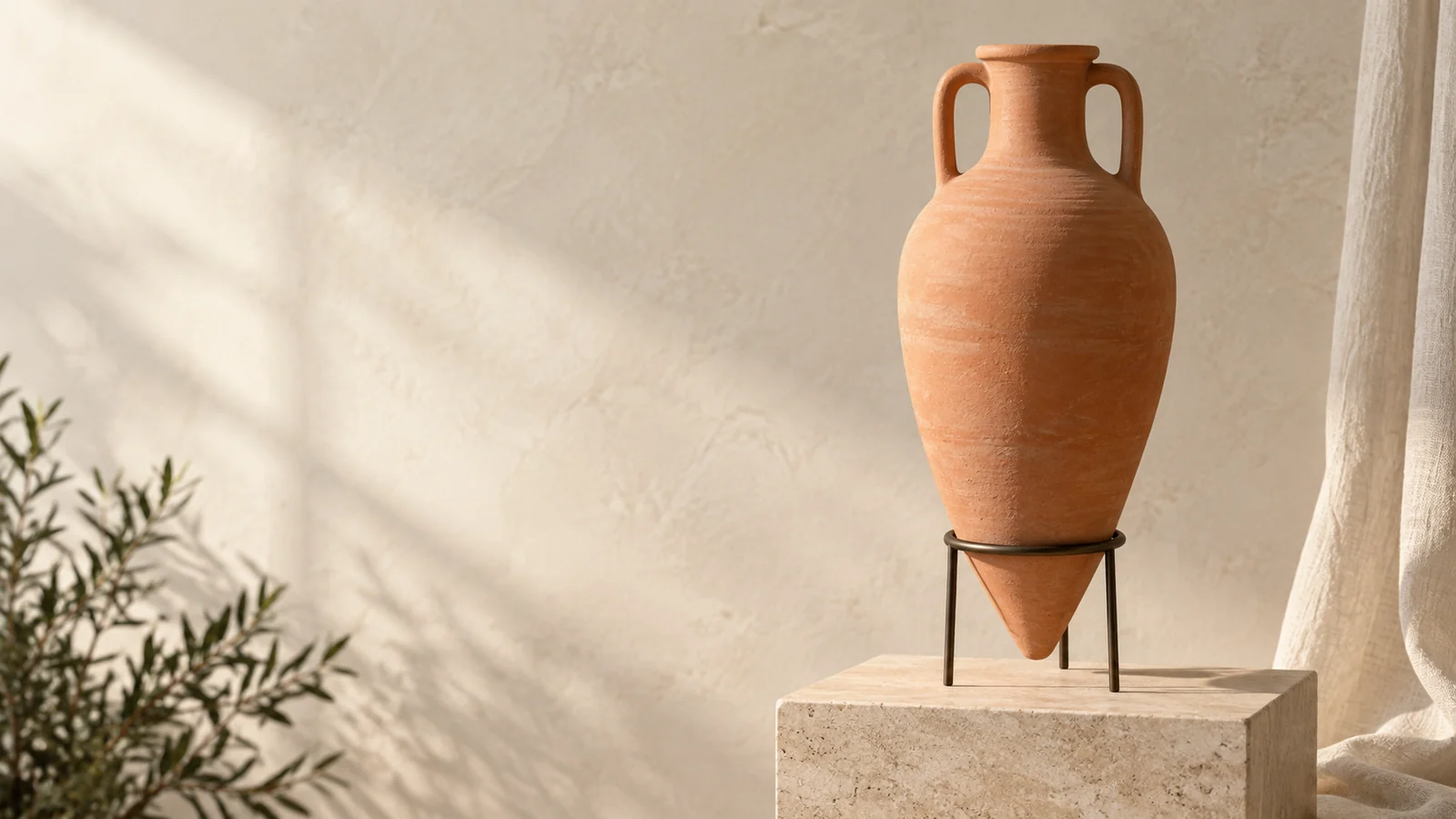
Imagine stopping in front of an amphora in a museum. The label gives you a place, a date and perhaps the name of a shipwreck. Behind the glass, the clay seems quiet.
You start to think about the liquid that might once have filled it. Then the questions multiply. Who made the vessel? Who filled it? How did it reach another coast? Did someone there simply drink the contents—or begin growing grapes themselves?
In the previous Cellar Journal article, a seed and a cutting helped us separate the history of the plant from the history of the drink. Now the question moves beyond the vineyard.
Wine crossed the Mediterranean through the work of growers, potters and sailors, and the ports that connected them. The drink, the vine and the knowledge to cultivate it did not necessarily travel together.
An amphora invites a story. Reading it carefully means asking which parts of that story the evidence can actually carry.
Three journeys that need different evidence
A shipment of wine concerns a beverage. The movement of seeds, cuttings or living vines concerns plant material. The spread of pruning, propagation or winemaking practices concerns knowledge. These journeys may connect, but finding one does not establish all three.
Imagine, as a present-day comparison, ordering a bottle from another country. Receiving the wine would not establish that your neighborhood had acquired its grape variety, planted a vineyard or learned the producer’s methods.
The distinction also changes the questions we ask of ancient evidence. A vessel containing wine concerns that vessel and its contents. Evidence for cultivated grape ancestry concerns plants. A production installation concerns an activity in a particular place. We need an argument for each connection between them.
Nor does this story begin with the familiar Iron Age trading peoples. Research on vessels from Tomb U-j at Abydos, around 3150 BCE, interpreted grape-related residues in Levantine pottery as wine. That earlier case does not, by itself, establish an exclusively maritime itinerary. McGovern and colleagues, 2009
The examples that follow illuminate particular networks, not the first journey of every wine.
The vessel was part of the transport system
Before admiring an amphora’s silhouette, consider the practical question: how do you move a liquid without losing it?
Packaging research treats transport amphorae as parts of a logistical system, connecting container design with handling and movement. The University of Southampton’s amphora resource also makes a basic distinction clear: these vessels carried products including wine, oil and fish products. Shape and archaeological context help interpretation; residues can add evidence about contents. Twede, 2002 · Roman Amphorae, University of Southampton
So “an amphora was found” is the beginning of a question, not a complete wine history.
It helps to separate three identities: where the ceramic was made, where the contents originated, and where the vessel was eventually recovered. Those answers need not be interchangeable. A proposed wine origin deserves its own support rather than inheriting the place printed beside a pottery type.
A Phoenician winepress brings production into view
At Tell el-Burak, about nine kilometres south of Sidon, investigators studied a winepress alongside grape seeds and transport amphorae. They interpreted the evidence as specialized wine production. The installation is placed probably in the seventh century BCE, with a possible late-eighth-century beginning. Orsingher and colleagues, 2020
The press brings agricultural work and ceramic containers into the same picture. Making the liquid and preparing something that could carry it are different practical achievements. Looking at them together, we can ask how a local product became a potential cargo: where would a vessel be filled, and what had to be ready before it could leave?
This makes the expression “Phoenician wine trade” more tangible. There is a place of production to consider, not merely a people’s name on a map. Identifying the route taken by any particular shipment still requires separate evidence.
Two wrecks put a cargo at sea
The eighth-century BCE wrecks Tanit and Elissa carried amphorae interpreted as wine containers. One analyzed vessel, dated typologically to about 725 ± 25 BCE, retained tartaric acid and a pine-resin lining. Egypt and Carthage remain proposed destinations, not demonstrated endpoints. Ballard and colleagues, 2002
A cargo at sea is a powerful piece of evidence. It is still a fragment of a journey.
The place where a ship sank does not automatically tell us where it last loaded, whether it intended another stop, or where its customers lived. A route drawn as one confident arrow can hide all those unanswered questions.
Tell el-Burak and these wrecks therefore belong in the same wider conversation without becoming one documented supply chain. Nothing in the cases presented here proves that wine from that press filled those vessels.
A hold reveals the work of carrying wine
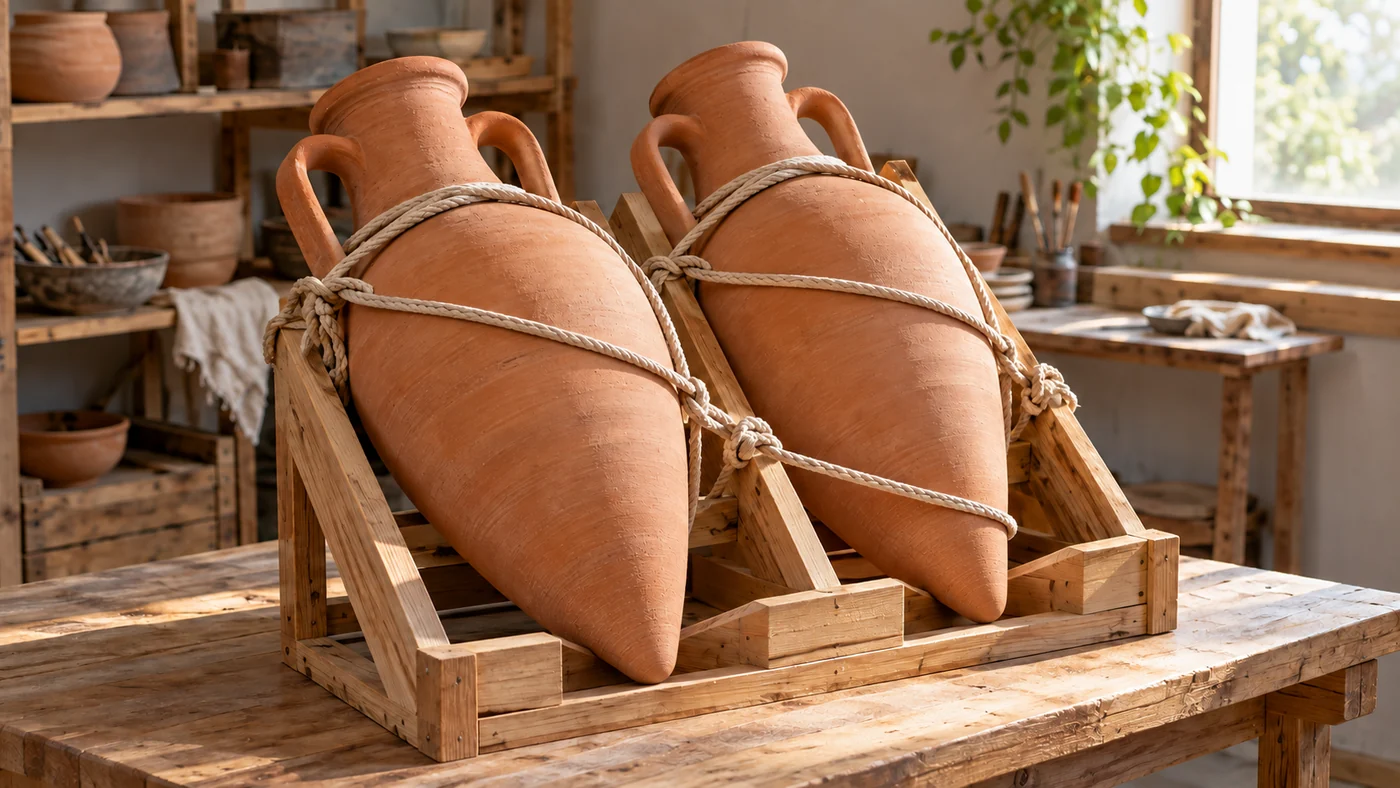
The Grand Ribaud F wreck, off the Giens peninsula in southern France and dated around 500–475 BCE, makes the organization of a load tangible. Investigators described roughly a thousand Etruscan amphorae, tied together in at least five layers. Greek and Massaliote vessels near the stern may have served as provisions. Cargo origin does not establish crew identity. Long, Gantès and Rival, 2006
The important word here is arranged. A container only solves part of the problem; its position among other containers matters too.
Looking at that organized load shifts our attention away from a solitary, beautiful object. We begin asking about loading, securing, access and unloading. These are questions about the labor required to make the shipment possible, even when individual workers remain unnamed.
A cargo can preserve an arrangement without preserving every person’s story.
A stamp speaks, but it does not say everything
A Rhodian amphora in the Metropolitan Museum of Art, dated from the late third to the mid-second century BCE, carries stamps naming the month Panamos, the magistrate Pythogenes and the manufacturer Hephaistion. Such evidence concerns the vessel’s manufacture; it does not give us the wine’s vintage, grape variety or quality. The Metropolitan Museum of Art, collection record
For a moment, the object brings named people into view. Manufacture and its record become more tangible than the broad phrase “Greek trade.” We can ask what each name identifies and why it mattered to mark the container.
The marks may remind us of a modern bottle label. Reading them in their own terms is more revealing than expecting them to answer every question we now ask of wine.
When wine arrives, does a vineyard follow?
At Lattara, present-day Lattes in southern France, investigators identified evidence of wine in imported Etruscan amphorae from around 500–475 BCE, and interpreted a limestone platform from around 425–400 BCE as a winepress. The site brings imported drink and local production into view at different dates. McGovern and colleagues, 2013
The distinction matters more than a tidy “before and after.” Imported wine and a later production installation do not, by themselves, reveal which people transmitted the knowledge, which vines they used or the date of a region’s first harvest.
Evidence of changing grape-seed forms at nearby Port Ariane reaches back to the seventh–sixth centuries BCE in the study’s corrected chronology. This earlier plant evidence belongs in the same regional history. Published correction, 2013
More recent ancient-DNA research found domestic-related grape ancestry by approximately 625–500 BCE in its French sample record. That finding concerns plants and ancestry; it is not a reconstructed shipping itinerary. Noraz and colleagues, 2026
The receiving shore now becomes an active part of our questions. What relationship developed between imported drinks, available plants and local production? Each line of evidence opens a different view of that relationship. Keeping the dates separate lets us ask about change over time, rather than squeezing it into one arrival.
A vessel’s arrival and a vineyard’s beginning are separate questions.
The route does not end at the coast
Amphorae were not the only containers involved. The Roman wreck La Giraglia, north of Corsica, carried at least eight dolia: large ceramic vessels associated with transporting wine in bulk. This case widens the picture beyond a hold composed entirely of smaller transport jars. Marlier and Sibella, 2002
The Rhône offers another change of scale. The French Ministry of Culture describes amphorae of multiple origins in the port deposits at Arles, reflecting Mediterranean distribution toward the north between the second and fifth centuries CE. Ministère de la Culture, Arles port deposits
Arles helps us imagine the port as a connection: an arrival from the sea could become the beginning of another movement inland. The river gives depth to a map that might otherwise stop at a line of coastal settlements. The deposit’s variety also matters; it should not be described as one uniformly wine-filled cargo.
Resin is a trace, not a recovered tasting note
At the Roman anchorage of San Felice Circeo, three amphorae yielded botanical and chemical evidence of grape products and conifer-derived waterproof lining. The combined evidence helps investigate contents without recovering a complete recipe or confirming a particular shipwreck. Chassouant and colleagues, 2022
The lining gives the practical problem of protecting the contents a visible form. Chemistry then asks another question: what remains of the substance once carried? Reconstructing the drinker’s experience would require much more. We can understand something about the vessel’s function while leaving its vanished wine open to further investigation.
The trace can support a question about the contents without restoring the glass.
Five questions for following wine through history
The following is an original reading aid for a museum label, article or documentary. It is not a way to authenticate an artifact or reconstruct an ancient route independently.
1. What traveled?
Was it a beverage, a container, plant material or knowledge? Name the subject before treating different kinds of movement as one event. If a story begins with a shipment and ends with a vineyard, look for the evidence connecting them.
2. What does the vessel contain?
Ask what supports the proposed contents: analysis, markings, associated objects or the investigators’ contextual interpretation. Keep “identified,” “consistent with” and “possible” at their stated levels. A careful description is more useful than replacing every qualification with the word wine.
3. Where does the origin claim come from?
Does “from Rhodes,” “Etruscan” or “Levantine” describe the ceramic, its manufacture, the contents or an interpretation of cultural context? Do not let one answer quietly supply the others. In particular, a container’s attribution is not a passenger list.
4. Which route or destination is supported?
Separate the recovery location from the proposed departure point and the intended destination. If a map adds arrows, ask what connects them. A possible route should stay visibly possible, however persuasive its illustration looks.
5. What changed after arrival?
Is there evidence only for an imported drink, or also for local production, cultivated plants or changed practices? The final question keeps the receiving place in the story. Arrival alone does not explain what people did next.
These questions do not make the past less vivid. They give us a way to keep its human possibilities distinct from the conclusions we can defend.
What returns with us to the glass
The next time a bottle’s story mentions an ancient trading people or a maritime route, we can enjoy the connection while asking what, precisely, has been documented.
For Ask Sommelier AI, that is a useful editorial standard: explain a wine’s historical setting without allowing ancestry or a romantic route to stand in for evidence about the bottle in front of us. History can deepen a conversation; it does not settle whether we will enjoy the wine.
Return to the imagined museum case. The amphora is still quiet, but our questions have changed. We see a container whose surviving traces reveal parts of a journey between people.
Wine history becomes richer when we follow what traveled—and remain curious about what arrived with it.
Next in Before the Labels: A Day in a Roman Winery: What We Can Know About Its Wines. We will move from the journey to the place of production.
Frequently asked questions
Were all ancient amphorae used for wine?
No. Oil and fish products also traveled in amphorae. Contents require evidence beyond shape. University of Southampton
Did the Phoenicians begin the first wine trade?
Earlier evidence discussed at Abydos predates these Phoenician cases. This article does not identify a universal first shipment. McGovern and colleagues, 2009
Does an amphora stamp tell us the wine’s vintage?
The Rhodian stamps discussed here date container manufacture. Identifying a harvest would require additional evidence. The Metropolitan Museum of Art
Did imported wine prove that grapes were grown locally?
Local cultivation requires its own evidence. An imported drink alone cannot establish it. McGovern and colleagues, 2013
What is a dolium?
A large ceramic vessel; the plural is dolia. Some Roman ships, including La Giraglia, carried them for bulk transport. Marlier and Sibella, 2002
Can residues tell us exactly how ancient wine tasted?
They can help identify contents, but they do not recover a complete tasting experience. Chassouant and colleagues, 2022
References
Original source titles are retained. The accompanying dossier records the access used and the limits of each source.
- Twede, D. (2002). The packaging technology and science of ancient transport amphoras. Packaging Technology and Science 15(4), 181–195. Source.
- University of Southampton (2014). Roman Amphorae: a digital resource — Usage. Archaeology Data Service; dataset DOI 10.5284/1028192. Source.
- McGovern, P. E., Mirzoian, A., & Hall, G. R. (2009). Ancient Egyptian herbal wines. PNAS 106(18), 7361–7366. Source.
- Orsingher, A., Amicone, S., Kamlah, J., Sader, H., & Berthold, C. (2020). Phoenician lime for Phoenician wine: Iron Age plaster from a wine press at Tell el-Burak, Lebanon. Antiquity 94(377), 1224–1244. Source.
- Ballard, R. D., et al. (2002). Iron Age Shipwrecks in Deep Water off Ashkelon, Israel. American Journal of Archaeology 106(2), 151–168. Source. Additional access.
- Long, L., Gantès, L.-F., & Rival, M. (2006). L’épave Grand Ribaud F : un chargement de produits étrusques du début du Ve siècle avant J.-C.. Report in the proceedings of the XXIV Convegno di Studi Etruschi ed Italici, pp. 455–495. Source.
- The Metropolitan Museum of Art (collection record, consulted 2026-10-05). Terracotta transport amphora, Greek, Rhodian; object 74.51.357. Greek and Roman Art collection; late 3rd–mid-2nd century BCE. Source.
- McGovern, P. E., et al. (2013). Beginning of viniculture in France. PNAS 110(25), 10147–10152. Source. Additional access.
- McGovern, P. E., et al. (2013), correction. Correction for McGovern et al., Beginning of viniculture in France. PNAS 110(30), 12498. Source. Additional access.
- Noraz, R., et al. (2026). Ancient DNA reveals 4000 years of grapevine diversity, viticulture and clonal propagation in France. Nature Communications 17, 2494; published 24 March 2026. Source. Additional access.
- Marlier, S., & Sibella, P. (2002). La Giraglia, a dolia wreck of the 1st century BC from Corsica, France: study of its hull remains. International Journal of Nautical Archaeology 31(2), 161–171. Source.
- Ministère de la Culture, France (consulted 2026-10-05). Dépotoir portuaire d’Arles. Archéologie sous-marine, Les ports. Source.
- Chassouant, L., et al. (2022). Archaeobotanical and chemical investigations on wine amphorae from San Felice Circeo (Italy) shed light on grape beverages at the Roman time. PLOS ONE 17(6), e0267129. Source.